Study on 3D Face Reconstruction of Sketch
Using Active Shape Modeling
Heba Nomani, Shanta Sondur
M.E. Student, Dept. of IT, VESIT, Mumbai, India
Professor, Dept. of IT, VESIT, Mumbai, India
ABSTRACT: Face recognition of sketch to photo is an active topic of research and has amounts of achievements. Despite of its achievement, the challenge of aging in sketch to photo face recognition has not gained attention. 3D face model is used to overcome many challenges of face recognition such as pose and illumination, since it is invariant to changes of viewpoint, illumination, background clutter, and occlusions; hence has gained so much of attention. However, 3D face reconstruction using sketch has never been done. By keeping in mind the existing problem of aging in face recognition for sketch to photo, we propose reconstructing of 3D face models using only one frontal composite face sketch. The methodologies used for doing so are Active Shape Modeling (ASM) and 3 Dimensional Morphable Model (3DMM). ASM is used for getting the feature points on the face based on the shape while 3DMM is used for reconstructing the face in 3D by using those points. The main challenge that comes for reconstructing 3D face using single sketch is that sketches do not have a defined texture like an image. Since, ASM only deals with the shape of an object, it fits for reconstructing 3 D face using sketch. Also, there does not exist a database for 3D face model using sketches; hence the methodology of 3D morphable model is used, which uses morphable model to reconstruct 3D face.
KEYWORDS: Face recognition, Sketch to photo face recognition, ASM, 3DMM.
I. INTRODUCTION
Over the last few decade ample amount of work has been done in face detection and recognition. The main reason account for this trend is the wide range of commercial and law enforcement applications. Due to this trend many technologies has emerged over years. The new techniques of recognition uses three-dimensional (3D) scans, high resolution still images, multiple still images, multi-modal face recognition, multi-algorithm, and pre-processing algorithms to correct for illumination and pose variations [1]. Even though few recognition systems have reached a certain level of maturity, their success is again depended by many conditions imposed by real environments. In simple words, the existing systems are still far away from the capability of the human perception system. Face recognition encounters many challenges such as aging, lighting, pose, expression, facial mark and many more. To solve the problem of pose variation, lighting variation and aging, concept of 3D face reconstruction was generated. The 3D models give a realistic view of the face which helps in improving the accuracy of face recognition. Due to growing demands in various application areas face recognition has attracted great attention in recent decades. A very important application of face recognition is to assist law enforcement in recognition of a criminal sketch from the existing mug shots of the criminal database. Matching sketches with digital face images is a challenging problem as these two represent the same information in very different forms [3]. Digital images are very rich in texture and detailed information while sketches are representation of soft and prominent edges around the facial features. This makes face recognition between a digital photo and a sketch, a very challenging task. Despite the great need of such an automatic sketch-based photo retrieval system, few effective systems can be found in previous research [4].
from a wide range of pre-defined templates. Composite sketches may not include minute feature details as compared to other type of sketches, therefore, composite sketches often look synthetic and face recognition using them becomes tedious. Due to budgetary reasons many law enforcement agencies use facial composite software. 80% of the officers in law enforcement agencies used computer generated composites [5]. Age variations make face recognition arduous as it changes the structural geometry and face texture. Existing research has not yet addressed this challenging problem; albeit, it represents a very realistic scenario in law enforcement applications.
As the problem of aging in face recognition of sketch to photo has not been given much attention, we propose a methodology where this problem can be solved by 3D face modeling. The construction of 3D model will be from mere single frontal composite sketch of the face. The methodologies that will be used are refined Active Shape Model (ASM) and 3D Morphable Model (3DMM). Active Shape Model detects the feature point based on shape and the profile image. Since, we will be having only single frontal sketch of the face and there is not database available for 3D model of sketches; we will be using 3 D Morphable Models to construct 3D face.
II. LITERATURE SURVEY
In the proposed methodology we will be constructing 3D model from single frontal composite sketch. Construction of 3D model requires detection of feature or landmark points on the face. In our proposed methodology, we will be using Active Shape Model for detecting facial feature points from the composite sketch. Since we have mere single frontal sketch to reconstruct the 3D face and also there is no existing database of 3D face model generated from sketches, we will be using 3 D Morphable Model for face reconstruction. 3 D morphable model reconstruct the face by using the feature points selected by Active Shape Model and the morphable model that is generated by 3D scans of 100 male and female.
Sketch recognition is one of the most challenging applications of face recognition. Due to the incorrectness of features in the witness description, standard face recognition algorithms are generally not applicable to matching sketches with digital face images. In face recognition literature, researchers have generally focused on matching two images captured using digital cameras. However, different law enforcement applications have led to other challenging applications of face recognition such as matching digital face images with surveillance camera images, scanned images, and sketches.
Several law enforcement agencies across the world are now using software to generate the composites according to witness description. Since the composite images are generally drawn based on witness description, it is not very accurate and also lack the detailed texture and minute facial features. Very limited research has been performed for automating this process [12]. Han et al. [5] proposed a component based representation approach for matching composites with digital images. The algorithm extracts facial landmarks using active shape models and then features are extracted for every component using multi-scale local binary patterns. The features extracted from corresponding components of both composite and digital images are matched followed by score fusion and normalization to generate the matching result. The algorithm also uses gender information as an indexing parameter. The component based method was proposed in [5] to match composite sketches to photos using two different facial composite systems.
III. 3 D FACE MODELING
In order to synthesize a specific 3-D face, extraction of two basic sets of data, i.e., the vertex topology of the 3-D wireframe and the texture of the face are required. The vertex topology is useful in structuring a 3-D model, while the face texture enhances the realism of the face model. According to the way of data extraction, the mainstream algorithms of 3-D face synthesis can be classified into four categories as follows [8]: 3D scanner, by using Stereo images, by using multi view images and by using single view image. Since, in our scenario we having only one single sketch the methodology that we will be acquiring to generate 3D face model is by using single view image.
The estimation of 3D geometry from a single image is considerably more difficult since depth cannot be estimated from pixel correspondences. A major challenge is to extract this information directly from the images available to us, and in particular, when possible, from a mere single image. From the paper [9], algorithm for 3 D modeling by using single view image can be classified as: Shape-from-shading (SFS) based algorithm, 3-D morphable model (3DMM)-related algorithm and Learning-based algorithm. Composite sketches do not have shading and there is no existing 3D face model database generated from sketches, hence SFS and learning based algorithm cannot be used in this scenario.
IV. ACTIVE SHAPE MODEL
The most popular Statistical Shape Model is the Active Shape Model (ASM) method, proposed by Cootes et al. [16]. The Active Shape Model represents a parametric deformable model where a statistical model of the global shape variation from a training set is built. One can make measurements whether the target is actually presented after matching the model. In face recognition application, we collect training images; represent all shapes with a set of landmarks, to form a Point Distribution Model (PDM).After landmarks alignment and Principal Component Analysis, gray-level profile is constructed for each landmark in all multi-resolution versions of a training image. To collect information about the shape variations needed to build the model, each shape has to be presented with a set of landmark points or landmarks. The number of landmarks should be adequate to show the overall shape and also show details where it is needed. Each shape will then be represented by a predefined number of landmarks; this number depends on the complexity of the object’s shape and the desired level of detail description.
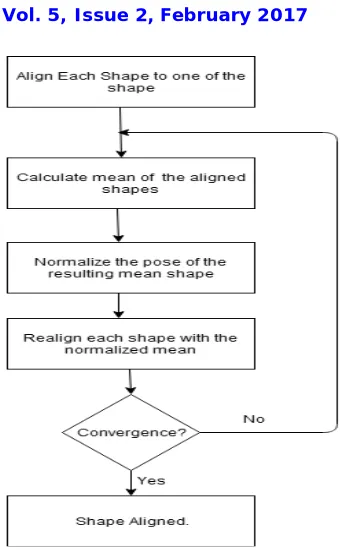
The model that will be used to describe a shape and its typical variations is based on the variations of the position of each landmark point within the training set. A training set of images should contain the object in different forms, and then one has to represent the shape in each image by labeling the set of landmark points. Each landmark point will thus have a certain distribution in the image space. In ASM, one has to model the variation distribution of the landmark points and hence the name Point Distribution Model (PDM). As a result of labeling the training set we have a set of N vectors. In order to study the variations of the position of each landmark throughout the set of training images, all the shapes must be aligned to each other. The aligning is done by changing the pose (scaling, rotating, and translating) of shapes as necessary to obtain the alignment. Figure 1 shows an algorithm for aligning all shapes. From figure 1, normalization of pose means scaling, rotating and translating. Normalization is carried out in order to force the process to converge, otherwise the mean shape may translate or expand (or shrink) indefinitely. Convergence is established if the shapes are not changing more than a pre-defined threshold.
Following is an algorithm for mapping given object with the Point Distribution Model. 1) Initialize with the mean shape.
2) For each landmark, put it at new locations, evaluate with the KNN classifier, move landmark to best new position. 3) Fit the shape model to displaced landmarks.
4) Iterate steps 2 and 3
Fig. 1 Algorithm for aligning all shapes
V. 3D MORPHABLE MODEL
A Morphable Face Model is derived by transforming the shape and texture of the examples into a vector space representation. 3 D scan of diverse set of humans are taken to obtain a better morphable model. From a given set of examples, a larger variety of different faces can be generated if linear combinations of shape and texture are formed separately for different regions of the face. These regions can be the eyes, nose, mouth, and the surrounding area.Once manually defined on the reference face, the segmentation applies to the entire morphable model. For continuous transitions between the segments, a blending technique must be used to non-segment the obtained result.
In 3D morphable models, the model is represented by a mesh of control vertices, combined with an interpolation rule to create a continuous surface from the mesh. For initialization, the system currently requires image coordinates of about seven facial feature points, such as the corners of the eyes or the tip of the nose. Depending on what part of the face is visible in the image, different vertices may be selected for each image. Some salient features in images, such as the contour line of the cheek, cannot be attributed to a single vertex of the model, but depend on the particular viewpoint and shape of the face. The user can define such points in the image and label them as contours. During the fitting procedure, the algorithm determines potential contour points of the 3D model based on the angle between surface normal and viewing direction and selects the closest contour point of the model in each iteration.
VI. PROPOSED METHODOLOGY
Effect of aging becomes one of the major problems in matching sketches to mug shots. Aging has an impact on the shape of the face which can be studied properly through 3D model. 3D model can also be used to study effect of light, illumination and pose. We are proposing a method to generate 3D model from the given sketch. This model can be then used to study impacts of aging, pose, illumination and lighting.
better position for the point. This is commonly done using what is called a profile model, which looks for strong edges or uses the Mahalanobis distance to match a model template for the point. The profile image is used in ASM for mapping feature point on the input sketch. The profile image has the position of each feature point and the distance of those feature point to the other feature point. Once the feature points are obtained from the sketch, it is being fitted to 3D morphable model. Morphable model of 3D faces captures the class-specific properties of faces. These properties are learned automatically from a data set of 3D scans. The morphable model represents shapes and textures of faces as vectors in a high-dimensional face space, and involves a probability density function of natural faces within face space. Since we are dealing with only shapes, the texture vectors will not be maintained. The selected features will be then fitted to the morphable model and a 3D model of the face will be created. The morphable model can be morphed as per the selected feature point on the sketch.
In order to fit the morphable model, the sketches are segmented into eyes, nose, eyebrows, lips and jaw line. This is done to achieve better fitting. Once fitting is done successfully, it is important to merge those segments to achieve a continuous shape. For continuous transitions between the segments, the process of non-segmentation is performed. Non segmentation smoothen the surface and gives a realistic view. The next and the final step is full reconstruction through which a 3 D model of the sketch is generated. The depth of the face is determined by the morphable model and the selected feature point on the sketch; and the 3 D model is constructed. The final 3D model then can be used and rotated to get the all the view of the 3D model. The 3D model generated from the sketches can be further used for aging simulation, different pose or illumination variation for face recognition.
Fig. 2Flow Chart for the proposed methodology of constructing 3D Model from Sketch
VII. CONCLUSION
Modeling and 3D Morphable Model. Active Shape Modeling is used for selecting feature points from sketches and the selected features are used to create 3D model.
REFERENCES
1. P. J. Phillips, P. J. Flynn, T. Scruggs, K. W. Bowyer, Jin Chang, K. Hoffman, J. Marques, Jaesik Min and W. Worek, “Overview Of The Face Recognition Grand Challenge”, IEEE Computer Society Conference on Computer Vision and Pattern Recognition, Vol. 1, Pg No. 947-954, June 2005
2. JinguHeo and MariosSavvides, “3-D Generic Elastic Models for Fast and Texture Preserving 2-D Novel Pose Synthesis”, IEEE Transactions On Information Forensics And Security, Vol. 7, Pg No. 563 - 576, April 2012.
3. TarangChugh, Himanshu S. Bhatt, Richa Singh and MayankVatsa, “Matching Age Separated Composite Sketches And Digital Face Images”, IEEE Sixth International Conference onBiometrics: Theory, Applications and Systems (BTAS), Pg. No. 1 – 6, October 2013.
4. Xiaoou Tang and Xiaogang Wang, “Face Sketch Recognition”, IEEE Transactions On Circuits And Systems For Video Technology, Vol. No. 14, Pg. No. 50 – 57, January 2004.
5. Hu Han, Brendan F. Klare, Kathryn Bonnen and Anil K. Jain, “Matching Composite Sketches to Face Photos: A Component-Based Approach”, IEEE Transactions On Information Forensics And Security, Vol. 8, Pg. No. 191-204, January 2013.
6. Unsang Park, Yiying Tong and Anil K. Jain, Fellow, “Age-Invariant Face Recognition”, IEEE Transactions On Pattern Analysis And Machine Intelligence, Vol. 32, Pg. No. 947-954, May 2010.
7. Brendan F. Klare, Zhifeng Li, and Anil K. Jain, “Matching Forensic Sketches to Mug Shot Photos”, IEEE Transactions On Pattern Analysis And Machine Intelligence, Vol. 33, Pg. No. 639 - 646, March 2011
8. Chung J. Kuo, Ruey-Song Huang, and Tsang-Gang Lin “3-D Facial Model Estimation From Single Front-View Facial Image”, IEEE Transactions On Circuits And Systems For Video Technology, Vol. 12, Pg No. 183 - 192, March 2002
9. Mingli Song, Dacheng Tao, Xiaoqin Huang, Chun Chen, and Jiajun Bu, “Three-Dimensional Face Reconstruction From a Single Image by a Coupled RBF Network”, IEEE Transactions On Image Processing, Vol. 21, Pg. No. 2887 - 2897, May 2012.
10. Bram van Ginneken, Alejandro F. Frangi, Joes J. Staal, Bart M. terHaarRomeny, and Max A. Viergever “Active Shape Model Segmentation With Optimal Features”, IEEE Transactions On Medical Imaging, Vol. 21, Pg. No. 924-933, August 2002.
11. Volker Blanz and Thomas Vetter, “Face Recognition Based on Fitting a 3D Morphable Model”, IEEE Transactions On Pattern Analysis And Machine Intelligence, Vol. 25, Pg. No. 1063-1074, September 2003.
12.Paritosh Mittal, Aishwarya Jain, Richa Singh and MayankVatsa, “Boosting Local Descriptors For Matching Composite And Digital Face Images”, IEEE International Conference On Image Processing, Pg. No. 2797-2801, 2013.
13. Pong C. Yuen and C. H. Man, “Human Face Image Searching System Using Sketches”, IEEE Transactions On Systems, Man, And Cybernetics—Part A: Systems And Humans, Vol. 37, Pg. No. 493-504, July 2007.
14. Xiaogang Wang and Xiaoou Tang, “Face Photo-Sketch Synthesis and Recognition”, IEEE Transactions On Pattern Analysis And Machine Intelligence, Vol. 31, Pg No. 1955-1967, November 2009.
15. Xiaoou Tang and Xiaogang Wang, “Face Sketch Synthesis and Recognition”, Ninth IEEE International Conference on Computer Vision, Vol. 1, Pg. No. 687-694, 2003.
16. T. F. Cootes, C. J. Taylor, D. H. Cooper, and J. Graham, “Active shape models—Their training and application,”Comput. Vis. Image Understand., vol. 61, no. 1, pp. 38–59, Jan. 1995.
17. Carlos Santiago, Jacinto C. Nascimento and Jorge S. Marques, “2D Segmentation Using a Robust Active Shape Model With the EM Algorithm” IEEE Transactions On Image Processing, Vol. 24, Pg No. 2592-2601, August 2015.
18. Jiamin Liu and Jayaram K. Udupa, “Oriented Active Shape Models”, IEEE Transactions On Medical Imaging, Vol. 28, Pg No. 571-584, April 2009.