Robust Night Time Visibility Estimation
Method in the Presence of Dense Fog
Shruthi Kulkarni, Revansiddappa.S.Kinagi
M. Tech, Department of Digital Electronics, Appa Institute of Engineering & Technology, Karnataka, India
ABSTRACT: Now a days most of the road accidents occurs at night time. Presence of fog also changes the visibility condition. In our proposed system, the fog presence around a vehicle is detected using backscattered veil created by the headlamps. In this aim, a correlation index is computed to compare the current image and a reference image whose fog density is known. It works when the vehicle is alone on a highway without external light sources. It works with oncoming traffic and public lighting. Both approaches are illustrated with actual images of fog. Their complementarily makes it possible to envision a complete night-fog detection system. If fog is detected, its characterization is achieved by fitting the different correlation indexes with an empirical model. Experimental results show the efficiency of the proposed method. The main applications for such a system are, for instance, automation or adaptation of vehicle lights, contextual speed computation, and reliability improvement for camera-based systems.
KEYWORDS: Fog Detection, Morphological Detection, Backscattered vein.
I. INTRODUCTION
With 1.27 million deaths yearly in the world, road crashes are of major concern. Road crashes are the main source of deaths and are expected to be the fifth source in the upcoming years in developed countries as in developing regions. Indeed, speed is cited as the first factor; it is considered to be the cause in one third of road crashes, and it also impacts the severity of accidents.[6] Many attempts at reducing road fatalities and injuries have been carried out from the past 50 years. In the past decade, automated control of speeds has proven very efficient in reducing accidents in England, the Netherlands, and France. It is estimated to have helped reduce fatalities in France by 25% between 2003 and 2007.
However, recent trends have shown stagnation, suggesting that it has reached its full potential for safety benefits. The development of advanced driver assistance systems (ADASs) is a very active field of research in the automotive industry. Systems relying on proprioceptive sensors, such as the antilock braking system (ABS) or the electronic stability Program, are widely integrated in today’s cars. Other systems rely on exteroceptive sensors (e.g., light detection and ranging, radars, and cameras), such as lane departure warning, forward collision warning, traffic sign recognition, or advanced front lighting systems.
In this context, ADASs focusing on speed, such as intelligent speed adaptation (ISA) systems, are considered as having high potential for road safety [6], whatever their types (static versus dynamic) and modes (mandatory versus advisory), mainly because of the drop in the number of crashes due to average speed decrease, all other things being equal. This has been formalized first by Nilsson’s power model between speed and accident Probability , which is later reviewed. Other works, such as and , confirm that crash incidence generally declines as a result of speed limit reduction. The second reason for considering ISA as beneficial is the impact of speed on crash severity. Lower speeds mechanically lead to less severe accidents.
ISSN(Online) : 2320-9801
ISSN (Print) : 2320-9798
I
nternational
J
ournal of
I
nnovative
R
esearch in
C
omputer
and
C
ommunication
E
ngineering
(An ISO 3297: 2007 Certified Organization)
Vol. 4, Issue 4, April 2016
adaptation (ISA) system is proposed. The method presents two main novelties. First, the 85th percentile of observed speeds, estimated along a road section, is used as a reference speed, which is practiced and practicable in ideal conditions. Second, this reference speed is modulated in adverse weather conditions to account for reduced friction and reduced visibility distance.
Different researches on this are done. Mario Pavlic et.al [01] proposed an efficient system for distinguishing fog images and fog free images. They made use of image descriptor and a classifier for this kind of classification. They used Gabor filter at different scales, orientations and frequencies for describing entire image globally using descriptors. The algorithm evolution is done on the day time images.
Romain Gallen et.al [01] presented two main novelties in this paper. Initially the percentile of observed speed is estimated which is considered as reference speed. Second is these reference speed is modified in the worst weather conditions. The risk is thus reduced by modulating the crash severity by means of accident scenario. Savneet Kaur et.al [03] proposed a work which involved two camera based methods for identifying night fog captured by multipurpose cameras in vehicle. First approach aimed at finding the fog around the vehicles. Second approach is to estimate halos around light sources. Both these methods are demonstrated taking the actual fog images.
The risk is thus mitigated by modulating the potential severity of crashes by means of a generic scenario of accidents. Within this scenario, the difference in speed that should be applied in adverse conditions is estimated so that the highway risk is the same as in ideal conditions. The system has been tested on actual data collected on a French secondary road and implemented on a test track and a fleet of vehicles. The performed tests and the experiments of acceptability show a great interest for the deployment of such a system.One source of accidents when driving a vehicle is the presence of fog. Fog fades the colors and reduces the contrasts in the scene with respect to their distances from the driver. Various camera-based Advanced Driver Assistance Systems (ADAS) can be improved if efficient algorithms are designed for visibility enhancement in road images. The visibility enhancement algorithm proposed in [1] is not optimized for road images. In this paper, we reformulate the problem as the inference of the local atmospheric veil from constraints.
The algorithm in [1] thus becomes a particular case. From this new derivation, we propose to better handle road images by introducing an extra constraint taking into account that a large part of the image can be assumed to be a planar road. The advantages of the proposed local algorithm are the speed, the possibility to handle both color and gray-level images, and the small number of parameters. A new scheme is proposed for rating visibility enhancement algorithms based on the addition of several types of generated fog on synthetic and camera images. A comparative study and quantitative evaluation with other state-of-the-art algorithms is thus proposed. This evaluation demonstrates that the new algorithm produces better results with homogeneous fog and that it is able to deal better with the presence of heterogeneous fog.Finally, we also propose a model allowing to evaluate the potential safety benefit of an ADAS based on the display of defogged images.
III. PROPOSED SYSTEM
Below figure1 shows the architecture of proposed system. The video frames are generated from the input video and which is applied with image pre-processing steps like color conversion, resizing and noise removal. Morphological operation is applied for fog detection.
The effects of fog on light propagation at night are illustratedin Fig. 1. Two major effects should be accounted for when the only source of illumination is the front-lighting system of the observer’s vehicle, i.e., attenuation and backscattering. We estimate the attenuation of light along its path from the headlamps to the target and back to the driver using classical models of light scattering in disperse media.
Figure 1: Architecture of Proposed System
A. Detection of BackScattered veil
The first system is based on the fact that the light emitted from the headlamps of a vehicle is scattered backward toward the driver in the presence of fog. The idea that is investigated to detect it is to compare different reference images with the input images grabbed by the camera using a correlation index. The reference image represents the front of the vehicle with lighting on, as can be seen in fog on a dark road. It is either a real image taken with the same camera in real or artificial fog, or a synthetic image.
The process allowing to generate such an image can be of any type. In our case, it relies on a Monte Carlo method allowing the synthesis of images in fog in 3-D scenes. When generating a reference image, the photometry and position of the headlamps, the position of the camera inside the car (including its relative angle as compared with the axis of the car), the focal length, and the image resolution of the camera should be all known in order to generate an image as close as possible to a real image acquired with the camera.
The synthetic images are luminance maps. Conversion into 8-bit images is done by normalizing the luminance data between 0 and 255. A γ function is also applied to the synthetic images in order to match the γ of the camera. Six reference images are produced in this way for different meteorological visibility distances. Due to the temporal stability of the backscattered veil with time, the input image is a composition of n successive images grabbed by the in-vehicle camera. The composition is computed by taking the mean of successive pixel values or by applying a rank filter such as the median . As one can see, the backscattered veil remains in the image, whereas other objects such as lane markings mostly disappear.
The input image is then compared with the six reference images using an image correlation index. Since the exposure settings of the camera are unknown, the synthetic and real images have different dynamics. Among available correlation distances, zero-mean normalized cross correlation (ZNCC) has invariant properties regarding the mean and scale of the illumination level. For these reasons the ZNCC has been used.
ISSN(Online) : 2320-9801
ISSN (Print) : 2320-9798
I
nternational
J
ournal of
I
nnovative
R
esearch in
C
omputer
and
C
ommunication
E
ngineering
(An ISO 3297: 2007 Certified Organization)
Vol. 4, Issue 4, April 2016
B. Combination of Both Approaches
When light sources appear in the road environment, the backscattered veil is no longer noticeable because of the limited dynamic range of the camera. However, fog induces the presence of halos around light sources. A halo is the consequence of light scattering produced by water droplets. In the image, it appears as a luminous shape around light sources, the intensity of which slowly decreases away from the source
center. Its expanse and its intensity decrease mainly depend on the fog density and droplet sizes. The algorithm aiming at detecting and characterizing halos is decomposed into the following steps.
1) Light source detection. It is based on an image thresholding
at a high intensity level, which is close to the maximum value of image pixels. Each connected component is extracted, and several geometrical parameters are evaluated, i.e., the position of the center of gravity (CoG), the surface, the compactness, the elongation. Relying on these parameters, connected components that do not correspond to isolated sources are discarded.
IV. RESULT AND DISCUSSION
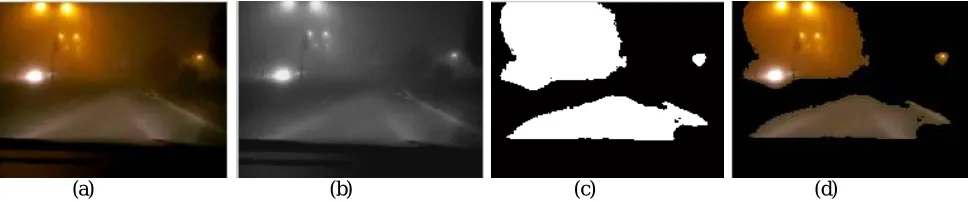
The results obtained at each stage are discussed in this section. Proposed work is evaluated on different videos and results obtained for few frames are discussed are shown here. Input Fog Video is divided into frames and passed into pre-processing block as in Figure 2 and 4 (a). The proposed image is converted into YCbCr plane and only Y luminance plane is picked for further processing as in (b). This Image is then converted into Binary image as in (c) and masked with the original image to get the segmented object as in (d). The Light source present in the frame is segmented as in Figure 3 . The validated Back Scattered Image is as shown in (b) and (c) depicts the Fog present in the image after Validation in the Classification stage in video.
(a) (b) (c) (d)
(a) (b) (C)
Figure 3: (a) Light Source Image; (b) Back scattered Veil Image; (c) Dense Fog
V. CONCLUSION
It can be compiled from the above results that this technique is efficient in detecting and extracting registration plate of the vehicle, not only in clear environment but also in the noisy environment such as foggy and rainy. This can be helpful in areas such as traffic lights, petrol station, border areas and etc. In this technique not only image of registration late is extracted but the characters of the registration plate are also extracted. The future work for this technique is to automatically detect the faulty vehicle by using captured videos.
REFERENCES
[1] Romain Gallen, Aurélien Cord, Nicolas Hautière, Member, IEEE, Éric Dumont, and Didier Aubert,” Night time Visibility Analysis and
Estimation Method in the Presence of Dense Fog”.
[2] Jean-Philippe Tarel, Nicolas Hautière, Laurent Caraffa, Aurélien Cord, Houssam Halmaoui, and Dominique Gruyer” ,“Vision Enhancement in
Homogeneous and Heterogeneous Fog”.
[3] Savneet Kaur, Kamaljit Kaur, Manvi, Rajdeep Singh.” An Automatic System for Detecting the Vehicle Registration Plate from Video in Foggy
and Rainy Environments using Restoration Technique”. International Journal of Computer Applications (0975 – 8887) Volume 97 – No.20, July 2014.K. Elissa, “Title of paper if known,” unpublished.
[4] A.M.raid, W.M.Khedr, M.A.el-Dosuky and Mona Aoud. “image restoration based on morphological operations”, international journal of
computer science, engineering and information technology (ijcseit), vol. 4, no.3, june 2014.
[5] Sahil Dhawan and Jagdish Lal Raheja , “Obstacles detection in foggy environment”. Machine Vision Lab, DSG, Council of Scientific & Industrial Research, CEERI, Pilani, Rajasthan.
[6] Ekta Chauhan, “ A Hybrid Technique for Remove Fog from Image using Edges and Color Enhancement Method, Adjustable Empirical
Function with Wiener Filter”, International Journal of Signal Processing, Image Processing and Pattern Recognition Vol. 9, Issue 2, pp.379-392, 2016.
[7] Nikolajs Agafonov, Andrej, Skageris, Girts Strazdins and Artis Mednis, “IMilePost: Embedded Solution for Dangerous Road Situation