ISSN(Online): 2320-9801
ISSN (Print): 2320-9798
I
nternational
J
ournal of
I
nnovative
R
esearch in
C
omputer
and
C
ommunication
E
ngineering
(An ISO 3297: 2007 Certified Organization)
Vol. 4, Issue 4, April 2016
Smart Android Application for Blind People
Based on Object Detection
Ketaki B. Tharkude, Aishwarya K. Wayase, Pratiksha S. More, Sonali S. Kothey
B. E Students, Dept. of Computer Engineering, RMD Sinhgad School of Engineering, Savitribai Phule Pune University, India.
ABSTRACT: Application for detecting an object using the mobile video camera and giving voice instructions about
the current location of the blind user by using GPS and to give the direction of an object to the blind person. User will need to train the system first regarding the object information. System extracts the features to search objects in the camera view to know the direction of object, where it is placed using angle extraction feature. This Android application gives warning of the obstacles in the way to the user. In this system we are using the updated ORB & BLOB algorithm for object detection and for key matching as these algorithms give the more accuracy than SIRF. Also the proposed system converts the text into audio for giving the instructions about the directions to the blind person and for such conversion the Speech synthesizer technique gets used. The camera of the phone is enough for this purpose and no special hardware is required, ensuring that it requires minimal effort from the user to use the application during everyday life. System gets used in social approach where the object in place or in path everyday life and with the help of this system blind person easily travel or visit common places such as school, college, hospital, shopping mall and travel on roads.
KEYWORDS: Image processing, Object detection, Speech synthesizer, GPS.
I. INTRODUCTION
The Current system in android there is not any mechanism for voice command on android events like phone Call, Message reading, Unlock System. Current users are use the Services for looking the Phones features So the Motivation is that to implement the android system for blind people who cannot handle the android phone effectively. The Blind people wants to allow the android phones services like calling, reading messages using voice commands. Object detection is a wide area of development.
Detecting objects using image processing can be used in multiple industrial as well as social application. This project is proposing to use object detection for blind people and give them audio/ vocal information of object and current location of blind user. We are detecting an object using the mobile camera and giving voice instructions about the direction of an object. User must have to train the system first about the object information. We are then doing feature extraction to search for objects in the camera view. We are taking help of angle where object is placed to give direction about the object.
II. RELATED WORK
ISSN(Online): 2320-9801
ISSN (Print): 2320-9798
I
nternational
J
ournal of
I
nnovative
R
esearch in
C
omputer
and
C
ommunication
E
ngineering
(An ISO 3297: 2007 Certified Organization)
Vol. 4, Issue 4, April 2016
A new object detection algorithm using mean shift (MS) segmentation is introduced, and occluded objects are further separated with the help of depth information derived from stereo vision. The detected objects are then tracked by a new object tracking algorithm using a novel Bayesian Kalman filter with simplified Gaussian mixture (BKF-SGM).
III.PROPOSED ALGORITHM
A. Design Considerations:
Generate the video.
Creating the number of image frames
Conversion of RGB to Gray Scale
Image Enhancement.
Edge detection by using Blob algorithm
Using ORB algorithm for key matching
Converting result text to speech by using speech synthesizer
B. Description of the Proposed Algorithm:
Aim of the proposed algorithm is to detect the object in frames of a video effectively. And match those objects with the database images to confirm the obstacle that comes in way. The proposed algorithm is consists of three main steps. Step 1: FAST Detector:
We start by detecting FAST points in the image. FAST takes one parameter, the intensity threshold between the centre pixel and those in a circular ring about the centre. We use FAST-9 (circular radius of 9), which has good performance.
Step 2: Orientation by Intensity Centroid:
Our approach uses a simple but effective measure of corner orientation, the intensity centroid. The intensity centroid assumes that a corner’s intensity is offset from its center, and this vector may be used to impute an orientation. Rosin defines the moments of a patch as:
and with these moments we may find the centroid:
ISSN(Online): 2320-9801
ISSN (Print): 2320-9798
I
nternational
J
ournal of
I
nnovative
R
esearch in
C
omputer
and
C
ommunication
E
ngineering
(An ISO 3297: 2007 Certified Organization)
Vol. 4, Issue 4, April 2016
Tests leading to the better descriptor rBRIEF, for which we offer comparisons to SIFT and SURF. C. Application Architecture:
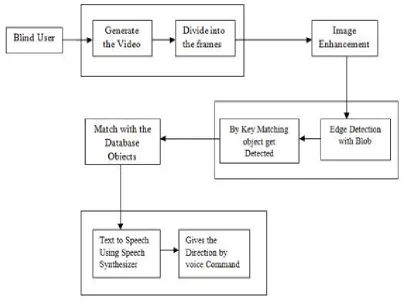
Fig 1. System Architecture
This figure specifies the design that is used to solve the problem of product. We are detecting an object using the mobile camera and giving voice instructions about the direction of an object. We need to train the system first about the object information. We are then doing feature extraction to search for objects in the camera view.
ISSN(Online): 2320-9801
ISSN (Print): 2320-9798
I
nternational
J
ournal of
I
nnovative
R
esearch in
C
omputer
and
C
ommunication
E
ngineering
(An ISO 3297: 2007 Certified Organization)
Vol. 4, Issue 4, April 2016
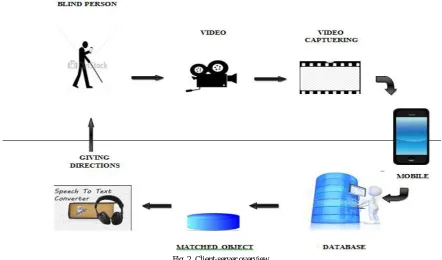
Fig 2. Client-server overview
Client side:
The user that is blind person will use smart android phone to locate the directions and the main component that is after starting the android application it will give current location of blind person and android phone camera will capture the live surroundings and it will get divided into several frames. The exact object captured which is acting as obstacle in blind person path will get send to the server side.
On the other hand that is on server side the object which is sent by the client present in server will match with the object present in database and where as database is collection of already stored object. If object match successful speech to text conversion will take place
.
IV.PSEUDO CODE
Step 1: Generate the video.
Step 2: Number of frames get generated from video. Step 3: Convert Image into RGB to Gray scale.
Step 4: Check the object edges detected by the blob algorithm.
Step 5: By using ORB algorithm Setting we will set the key points for object then matches the object with the database object.
ISSN(Online): 2320-9801
ISSN (Print): 2320-9798
I
nternational
J
ournal of
I
nnovative
R
esearch in
C
omputer
and
C
ommunication
E
ngineering
(An ISO 3297: 2007 Certified Organization)
Vol. 4, Issue 4, April 2016
V. SIMULATION RESULTS
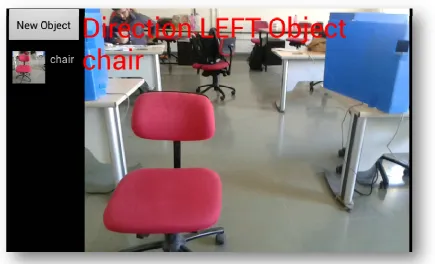
The simulation studies involve the working of android blind people application which contains different modules .In this current location of the blind user will be detected first then camera will be on and it will capture video which will be divided into the frames that the frame will be consider as image .From the image system is going to detect the object using blob detection algorithm. Once the objects are detected, edge detection algorithm is applied to it which will decide the object by bounding box.
Those objects are detected and key points are set by using ORB. Those selected objects are set with the key points and those key points are matched with the database images and if match found that object will be confirmed and system will give notification to the user or blind people. The notification will be given in voice by using voice synthesizer. This is how the application will help user to navigate from one location to another.
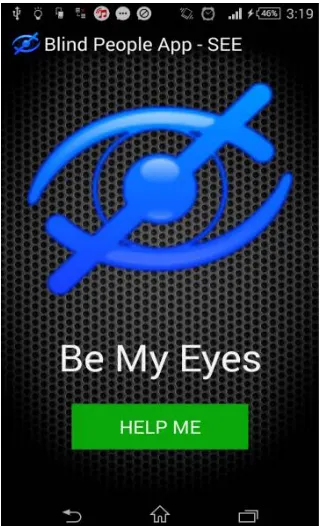
Fig 3. Application window Fig 4. Login page
ISSN(Online): 2320-9801
ISSN (Print): 2320-9798
I
nternational
J
ournal of
I
nnovative
R
esearch in
C
omputer
and
C
ommunication
E
ngineering
(An ISO 3297: 2007 Certified Organization)
Vol. 4, Issue 4, April 2016
ISSN(Online): 2320-9801
ISSN (Print): 2320-9798
I
nternational
J
ournal of
I
nnovative
R
esearch in
C
omputer
and
C
ommunication
E
ngineering
(An ISO 3297: 2007 Certified Organization)
Vol. 4, Issue 4, April 2016
VI.CONCLUSION AND FUTURE WORK
Here we have successfully modeled the Object Detection using ORB algorithm. The tests will went smoothly and had no problems. This report introduced two environmentally-friendly designs for a blind people. We presented information about the Blind people application. This application will be more effective for blind people. It is important to develop this application for the future.The system is used by Blind peoples but the normal people also can use. In future we are going to detect the potholes which are coming across the camera video. System will also detect the depth of potholes and guide blind user to get directed. As well if water on the floor will also be get detected
and inform to users.
VII. ACKNOWLEDGEMENT
There are many people to thank but our special thanks to our guide, Ms. Kanchan M. Varpe. We express our earnest regards and express our gratitude to all the faculty members of RMD Sinhgad of School of Engineering for providing us invaluable support, guidance, help and inspiration all through this paper.
REFERENCES
1. Y. Wu J. Lim, and M.-H. Yang, “Online object tracking: A benchmark,”in Proc. IEEE Conf. Compute. Vis. Pattern Recognit., Jun. 2013. 2. Hersh M., Johnson M. (Eds.) (2008) Assistive technology for visually impaired and blind people, Springer, London.
3. A. Rodriguez, Assisting the Visually Impaired: Obstacle Detection and Warning System by Acoustic Feedback, 17476 – 17496, Sensors 2012.
4. J. A. Hesch, S.I. Roumeliotis, Design and analysis of a portable indoor localization aid for the visually impaired, Journal of Robotics Research, 1400–1415, 2010.
5. J. M. Sáez, F. Escolano, and A. Peñalver, First steps towards stereo based 6DOF SLAM for the visually Impaired, in IEEE CVPR, 2005.
BIOGRAPHY
Ms. Ketaki B. Tharkude is a Student of B.E. Computer Engineering, RMD Sinhgad School of Engineering,
Savitribai Phule Pune University, India.
Ms. Aishwarya K. Wayase is a Student of B.E. Computer Engineering, RMD Sinhgad School of Engineering,
Savitribai Phule Pune University, India.
Ms. Pratiksha S. More is a Student of B.E. Computer Engineering, RMD Sinhgad School of Engineering, Savitribai
Phule Pune University, India.
Ms. Sonali S. Kothey is a Student of B.E. Computer Engineering, RMD Sinhgad School of Engineering, Savitribai