ISSN(Online): 2320-9801
ISSN (Print) : 2320-9798
I
nternational
J
ournal of
I
nnovative
R
esearch in
C
omputer
and
C
ommunication
E
ngineering
(An ISO 3297: 2007 Certified Organization)
Vol. 4, Issue 4, April 2016
Automated Attendance System Using Face
Recognition
Khan Suhel1, Zakariya Hussain2, Khan Shoeb3, Pathan Nazim4, Mubashir Khan5, Apeksha Gopale6
B.E Students, Dept. of Computer Engineering, Kalsekar Technical Campus, New Panvel, India1,2,3,4 Assistant Professor, Dept. of Computer Engineering, Kalsekar Technical Campus, New Panvel, India5,6
ABSTRACT: The objective of this system is to present an automated system for human face recognition for an organization or institute to mark the attendance of their students or employees. This paper introduces face detection method using the Voila and Jones algorithm and recognition using correlation technique. The system will record the attendance of the students in class room environment. The above system is fully automated and easily deployable. User gets an authentication to upload the image containing file and also to view the attendance.
KEYWORDS: Automated, Face Detection, Face Recognition, Voila and Jones Algorithm, Correlation, Attendance.
I.INTRODUCTION
In many Institution and Organization the attendance is a very important factor to maintain the record of lectures, salary and work hours etc. Most of the institutes and organizations follow the manual method using old paper and file method and some of them have shifted to biometric technique. The current method that colleges use is that the professor passes a sheet or make roll calls and mark the attendance of the students and this sheet further goes to the admin department with updates the final excel sheet. This process is quite hectic and time consuming. Also, for professors or employees at institutes or organizations the biometric system serves one at a time. So, why not shift to an automated attendance system which works on face recognition technique? Be it a class room or entry gates it will mark the attendance of the students, professors, employees, etc. This system uses Viola and Jones algorithm for detecting and recognizing the faces.
II.RELATED WORK
First there are different techniques implemented to detect the object of any type. Object detection is the technique or process of perceiving or detecting the specimen of real world objects such as faces, bottles, traffic signs, buildings and many more things in images or videos. These object detection algorithms are basically used to extract the features of the objects and learn from those features to recognize the object. These algorithms are widely used in various applications like video surveillance, automated attendance system and security.
The various object detection algorithms are:
Viola and Jones object detection algorithm It detect object by using its library and classifiers
The Pascal VOC Challenge
It provides the standard image data sets for object detection
Image segmentation
It is the technique of dividing the digital image into multiple segments or set of pixels called super-pixels.
Viola and Jones Algorithm
ISSN(Online): 2320-9801
ISSN (Print) : 2320-9798
I
nternational
J
ournal of
I
nnovative
R
esearch in
C
omputer
and
C
ommunication
E
ngineering
(An ISO 3297: 2007 Certified Organization)
Vol. 4, Issue 4, April 2016
A. Face Detection
Integral image or summed area table is a data structure and algorithm for quickly and efficiently generating the sum of values in a rectangular subset of a grid. In the image processing domain, it is also known as an integral image.
Haar-like features are digital image features used in object recognition. They owe their name to their intuitive similarity with haar wavelets and were used in the first real-time face detector.
Adaboost (adaptive boost) meta-algorithm formulated by yoavfreund and robertschapire which is use to improve the performance of other algorithm. Viola and jones extracts the millions of features (pixels) for comparison so, we adaboost to enhance the overall performance and calculation speed of the algorithm.
Cascade classifier is a particular case of ensemble learning based on the concatenation of several classifiers, using all information collected from the output from a given classifier as additional information for the next classifier in the cascade. Unlike voting or stacking ensembles, which are multi-expert systems, cascading is a multistage one.
B. Face Recognition
Initially the ROI is extracted from the source face image, ROI is the sub image and is smaller than the original image.
Normalized Cross-Correlation is performed on ROI and target image to find the peak coordinates.
The total offset or translation is carried out based on the position of the peak in the cross correlation matrix.
Check for the successful extraction of face from target image and figure out where the face exactly matches inside of target image.
III. SYSTEM OVERVIEW
The System Architecture Consists of basically three layers that is, the Application Layer, the System Layer and the Databases layer.
A. Application layer
There is the capturing phase in this the user captures the frames and using a web app that runs on almost all platforms upload the file to the server. Authentication is provided to the users. This web app is used to upload captured frames as well as to view the attendance.
B. System layer
This is the layer where the processing is done that is the detection and recognition part at the server side. Viola and Jones algorithm is used to detect images from the frames. Initially an integral image is generated from the frame which simply assigns numbers to the pixels generated by summing up the values. Further to detect the objects from the frames the haar-like feature is generated and as millions of features being generated adaboost(boosting algorithm) is used to enhance the performance. The extracted features are passed through a trained classifier which detects the faces from the objects. These detected faces are cropped and passed through the recognition module which by applying correlation to the cropped images and the images in the databases recognizes the faces.
C. Database layer
ISSN(Online): 2320-9801
ISSN (Print) : 2320-9798
I
nternational
J
ournal of
I
nnovative
R
esearch in
C
omputer
and
C
ommunication
E
ngineering
(An ISO 3297: 2007 Certified Organization)
Vol. 4, Issue 4, April 2016
Figure 1: System Architecture
IV.METHODOLOGY
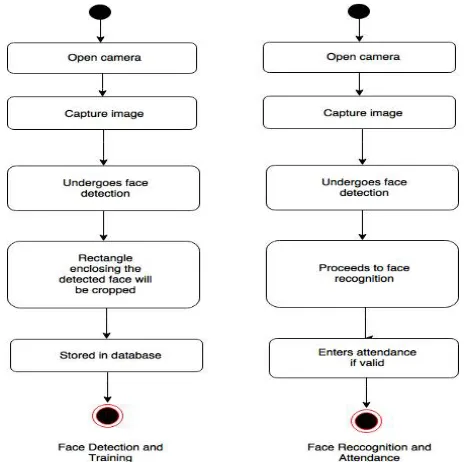
The proposed system introduces an automated attendance system which integrates a web app and face recognition algorithms. Any device with a camera can capture an image or a video and upload to the server using web app. The received file undergoes face detection and face recognition so the detected faces are extracted from the image. The extracted faces are then compared with the saved faces of the database and on the successful recognition the database is updated with the attendance and a sheet is generated and displayed on the web app.
This work is being carried out in five stages:
Step 1: Generating Data for Training
Initially the system is trained that is the cropped images are saved to the database and they undergo detection and recognition. Further this data will be used to compare the detected images in all the uploaded files and mark the attendance.
Step 2: Capturing
In this the capturing of the video or image will be done using a device and the captured file is uploaded to the server using web app.
Step 3: Face Detection
ISSN(Online): 2320-9801
ISSN (Print) : 2320-9798
I
nternational
J
ournal of
I
nnovative
R
esearch in
C
omputer
and
C
ommunication
E
ngineering
(An ISO 3297: 2007 Certified Organization)
Vol. 4, Issue 4, April 2016
Step 4: Face Recognition
The detected images undergo correlation with the trained images of the databases. By this the detected images are now recognized.
Step 5: Attendance Marking
After the recognition process the students recognized are searched in the database and their attendance is marked.
Figure 2: Training and Face Detection & Recognition
V. RESULT
We perform a set of experiments to demonstrate the efficiency of the proposed method. Images of different persons are used in training set. In order to obtain the efficiency of proposed methodology 8 training images are taken.The detected faces from the image are compared with the database. This is called the selection of region of interest. In this way faces of students are verified one by one with the face database using the correlation method and attendance is marked along with the login time and date. Here face recognition rate achieved by proposed methodology is 81.875%.
Table 1: Result Analysis
Sr. No Number of Persons Position Accuracy of
Recognition%
1. 4 Linear 100
2. 4 Random 80
3. 9 Linear 80
4. 9 Linear 90
5. 10 Random 65
6. 10 Random 70
7. 10 Linear 80
8. 10 Linear 90
ISSN(Online): 2320-9801
ISSN (Print) : 2320-9798
I
nternational
J
ournal of
I
nnovative
R
esearch in
C
omputer
and
C
ommunication
E
ngineering
(An ISO 3297: 2007 Certified Organization)
Vol. 4, Issue 4, April 2016
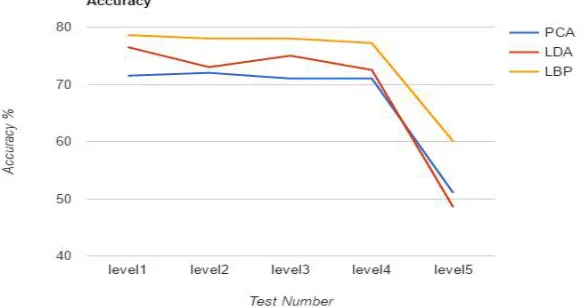
Also we tried giving images of different resolutions to check the recognition accuracy of LBP with other methods. Level 1 contains images of 100x100 pixels, Level 2 contains images of 60x60 pixels, Level 3 contains images of 30x30 pixels, Level 4 contains images of 12x12 pixels and Level 5 contains images of 8x8 pixels. The LBP gave the most promising results.
Figure 3: Testing based on image resolution
V.CONCLUSION AND FUTURE WORK
In order to maintain the attendance this system has been proposed. It replaces the manual system with an automated system which is fast, efficient, cost and time saving as replaces the stationary material and the paper work. Hence, this system is expected to give desired results and in future could be implemented for logout. Also the efficiency could be improved by integrating other techniques with it in near future.
REFERENCES
1. RekhaA, Dr. Chethan H, Automated Attendance System Using Face Recognition Through Video Surveillance, International Journal For Technological Research In Engineering, Volume 1, Issue 11, and July-2014.
2. NirmalyaKar, MrinalKantiDebbarma, AshimSaha, and DwijenRudra Pal, Study Of Implementing Automated Attendance System Using
Face Recognition Technique, International Journal Of Computer And Communication Engineering, Vol. 1, No. 2, July 2012.
3. Naveed Khan Balcoh, M. HaroonYousaf, Waqar Ahmad and M. IramBaig, Algorithm for Efficient Attendance Management: Face Recognition Based Approach, International Journal of Computer Science Issues, Vol. 9, Issue 4, No 1, July 2012.
4. Kwok-Wai Wong, Kin-Man Lam, Wan-Chi Siu, An efficient algorithm for human face detection and facial feature extraction under different conditions, The Journal Of the Pattern Recognition Society, 25 Aug-2000.