Electronic Theses and Dissertations Theses, Dissertations, and Major Papers
2019
Impacts of climate change on hydropower generation and
Impacts of climate change on hydropower generation and
developing adaptation measures through hydrologic modeling
developing adaptation measures through hydrologic modeling
and multi-objective optimization
and multi-objective optimization
Vinod Chilkoti University of Windsor
Follow this and additional works at: https://scholar.uwindsor.ca/etd
Recommended Citation Recommended Citation
Chilkoti, Vinod, "Impacts of climate change on hydropower generation and developing adaptation measures through hydrologic modeling and multi-objective optimization" (2019). Electronic Theses and Dissertations. 7691.
https://scholar.uwindsor.ca/etd/7691
This online database contains the full-text of PhD dissertations and Masters’ theses of University of Windsor students from 1954 forward. These documents are made available for personal study and research purposes only, in accordance with the Canadian Copyright Act and the Creative Commons license—CC BY-NC-ND (Attribution, Non-Commercial, No Derivative Works). Under this license, works must always be attributed to the copyright holder (original author), cannot be used for any commercial purposes, and may not be altered. Any other use would require the permission of the copyright holder. Students may inquire about withdrawing their dissertation and/or thesis from this database. For additional inquiries, please contact the repository administrator via email
developing adaptation measures through hydrologic modeling
and multi-objective optimization
By
Vinod Chilkoti
A Dissertation
Submitted to the Faculty of Graduate Studies
through the Department of Civil and Environmental Engineering
in Partial Fulfillment of the Requirements for
the Degree of Doctor of Philosophy
at the University of Windsor
Windsor, Ontario, Canada
Impacts of climate change on hydropower generation and developing adaptation
measures through hydrologic modeling and multi-objective optimization
by
Vinod Chilkoti
APPROVED BY:
___________________________________________
K.Ponnambalam
External Examiner, University of Waterloo
________________________________________
R.Barron
Department of Mathematics and Statistics
______________________________________________
R.Carriveau
Department of Civil and Environmental Engineering
______________________________________________
E.Tam
Department of Civil and Environmental Engineering
______________________________________________
R.Balachandar, Co-advisor
Department of Civil and Environmental Engineering
______________________________________________
T.Bolisetti, Advisor
Department of Civil and Environmental Engineering
DECLARATION OF CO-AUTHORSHIP / PREVIOUS PUBLICATION
I.
Co-Authorship
I hereby declare that this thesis incorporates material that is result of joint research, as follows: Chapters 2 through 6 of this thesis were completed under the supervision of my advisor, Dr. Tirupati Bolisetti, and co-advisor, Dr. Ram Balachandar. In all cases the key ideas, primary contributions, data analysis and writing were carried out by the author. The contribution of the co-authors (advisor and co-advisor) was primarily through the provision of the broad research idea, review of results, participation in scientific discussion, literature review and subsequently in editing the presentation material.
I am aware of the University of Windsor Senate Policy on Authorship and I certify that I have properly acknowledged the contribution of other researchers to my thesis and have obtained written permission from each of the co-author(s) to include the above material(s) in my thesis.
I certify that, with the above qualification, this thesis, and the research to which it refers, is the product of my own work.
II.
Previous Publication
This thesis includes five original papers that have been previously published/submitted for publication in peer reviewed journals, as follows:
Thesis Chapter
Title Publication
Status
2 Chilkoti, V., Bolisetti, T., and Balachandar, R. (2017). “Climate change impact assessment on hydropower generation using multi-model climate ensemble.” Renewable Energy, 109, 510–517
Published
3 Chilkoti, V., Bolisetti, T., and Balachandar, R. (2019). “Diagnostic evaluation of hydrologic models employing flow duration curve.”
Journal of Hydrologic Engineering, 24(6), 5019009
Published
4 Chilkoti, V., Bolisetti, T., and Balachandar, R. (2018). “Multi-objective auto calibration of SWAT model for improved low flow performance for a small snowfed catchment.” Hydrological Sciences Journal,
5 Investigating the role of hydrological model parameter uncertainty in streamflow projection
Submitted
6 Assessment of climate change impacts and operational adaptation for a hydroelectric facility in Northern Ontario
Submitted
I certify that I have obtained a written permission from the copyright owner(s) to include the above published material(s) in my thesis. I certify that the above material describes work completed during my registration as a graduate student at the University of Windsor.
III.
General
I declare that, to the best of my knowledge, my thesis does not infringe upon anyone’s copyright nor violate any proprietary rights and that any ideas, techniques, quotations, or any other material from the work of other people included in my thesis, published or otherwise, are fully acknowledged in accordance with the standard referencing practices. Furthermore, to the extent that I have included copyrighted material that surpasses the bounds of fair dealing within the meaning of the Canada Copyright Act, I certify that I have obtained a written permission from the copyright owner(s) to include such material(s) in my thesis.
ABSTRACT
The climate change resulting from anthropogenic factors is driving governments and policy-makers to provide additional thrust on renewable energy. Hydropower, which is the dominant renewable component of the energy-mix, is also under threat due to the changing climate conditions. The present study aims to quantify the impact of climate change on hydropower generation, the associated revenues and subsequently suggest the adaptation measures through adaptive reservoir management. A modeling chain consisting of hydrologic and hydropower simulation models is adopted to evaluate the impacts of projected climate change on hydropower generation.
Calibrated hydrologic models forced with the climate data from various climate models have been widely employed for future streamflow projection. A reliable modelling framework should ensure the simulation of reality with limited uncertainty, thus enhancing its predictive ability. In the literature, the hydrologic model assessment is reported to be inadequate when carried out based on only statistical objectives or limited number of evaluation metrics. In the present research, the thrust is given on improving the hydrologic model simulation through model diagnostic assessment, incorporating hydrologic signatures and multi-objective model calibration. Multi-objective evolutionary algorithm (MOEA) is coupled with the hydrologic model, Soil and Water Assessment Tool (SWAT), to perform model calibration. The methodology was first tested for Saugeen River watershed in Southern Ontario and then applied to the Magpie River watershed model located in Northern Ontario.
parameters was investigated and found to dominate during some periods. The accounting of hydrologic model uncertainty is found to be vital for providing an improved assessment.
Steephill Falls hydroelectric project located on Magpie River in Northern Ontario is considered as a case study for assessing climate change impacts on hydropower. The results show that the annual generation is not considerably affected but there is a significant seasonal redistribution on energy production. The changes in the hydropower revenues compared to the present level for the four seasons viz., winter, spring, summer and autumn are estimated to be 21.1%, 18.4%, -13.4% and -15.9%, respectively, for mid-century and 23.1%, 19.5%, -20.1% and -22.9% for
end-century scenarios.
DEDICATION
उद्धरेदात्मनात्मानं
नात्मानमवसादयेत्
|आत्मैव
ह्यात्मनो
बन्धुरात्मैव
ररपुरात्मन
:
||Let a man elevate himself by his own Self alone, and let him not lower himself; for, this Self alone is the friend of oneself, and this Self is the enemy of oneself.
- Bhagwad Gita, Ch.6, v5
Dedicated to my spiritual guru
Swami Chinmayananda
(1916- 1993)
ACKNOWLEDGEMENTS
First and foremost, I would like to thank the almighty for providing me courage, means and blessings to successfully complete my PhD dissertation.
I thank all my family members who have sincerely encouraged and supported me all through. The caring and spirited support that I always receive from my wife, Chanchal, and son, Kaivalya, is immeasurable. Their wholehearted and sincere commitment for my cause is beyond words. I also thank my parents Smt. Pushpa Chilkoti and IG (Retd.) R.C.Chilkoti and my in-laws Smt. Manjula Joshi and Lt.Col.(Retd.) D.K.Joshi for their unbroken motivation and generous blessings always. All the other members of my family also deserve my heartfelt thanks.
I sincerely acknowledge my advisor, Dr. Tirupati Bolisetti, for his incredibly valuable mentorship and guidance that has enabled me to accomplish this endeavor. I thank him for sharing his knowledge and wisdom along with providing adequate technical and financial resources during this journey.
I also take this opportunity to sincerely thank my co-advisor, Dr. Ram Balachandar. I acknowledge him genuinely for being a constant source of inspiration and supporting my work in every aspect. His immense experience in the academia has taught me the finer details of different technical and non-technical skills especially the communication skills.
Both the supervisors have constantly encouraged me to carry out the research fairly and also to publish the same in conferences and journals. I thank them for sparing time to minutely review each of my manuscripts and provide the strong and valuable feedback. Their down-to-earth nature and inspiring words has enabled me to sail through the difficult stages.
I deeply appreciate the feedback provided and patience shown by my committee members Dr. Ron Barron, Dr. Rupp Carriveau and Dr. Edwin Tam in enhancing the thesis quality. I also acknowledge the comments offered by the external examiner, Dr. Ponnambalam, that assisted in improving the quality of presentation of the thesis.
I must also acknowledge Dr. David Hadka and Dr. Reed who developed and shared the Borg MOEA, which has been utilized in my research work.
I acknowledge the World Climate Research Programme's Working Group on Regional Climate, and the Working Group on Coupled Modelling and also thank various climate modelling groups for producing and making available their model output. These were vital for the present research on impact assessment.
I also take this opportunity to thank my fellow graduate student Masihur Rahman for assisting me during my initial phase of learning SWAT software. His indepth knowledge on Hydrology and this modeling tool has been vital in various stages of my research work.
My other fellow graduate student Umair Durrani has been very helpful through my learning phase of ‘R’ coding. I thank him for sharing his knowledge and time.
Ms. Carina Luo from Leddy Library data center has been a great resource for resolving queries on ArcGIS software. I thank her for always quickly responding and providing effective solutions. Dr. Vimaldoss Jesudhas also deserve many accolades. His resourceful inputs have been very valuable at various stages of establishing myself in Canada. My other fellow graduate students Mohammad Madani, Saranya Jayelakshmi, Afanur Rahman, Monika Saha, Israt Jahan, Zach Mcphee and Kyle Eckart also deserve my thanks for holding several technical discussions. I offer my gratitude to the Ontario Graduate Scholarship and University of Windsor scholarship for providing the financial support to my research work.
TABLE OF CONTENTS
DECLARATION OF CO-AUTHORSHIP / PREVIOUS PUBLICATION ... III ABSTRACT ... V DEDICATION ... VII ACKNOWLEDGEMENTS ... VIII LIST OF FIGURES... XIV
CHAPTER 1 INTRODUCTION ... 1
1.1 Climate Change and Infrastructure ... 1
1.1.1 Climate change and the electricity sector ... 2
1.1.2 Impacts on hydropower generation ... 3
1.2 Hydropower in Canadian Context ... 4
1.3 Hydrologic Simulation for Hydropower Assessment ... 4
1.4 Uncertainty Quantification ... 5
1.5 Adaptation Measures for Climate Change ... 6
1.6 Objectives of the Present Research ... 7
1.7 Research Methodology and Organization of Thesis ... 7
1.8 References ... 10
CHAPTER 2 CLIMATE CHANGE IMPACT ASSESSMENT ON HYDROPOWER GENERATION USING MULTI-MODEL CLIMATE ENSEMBLE ... 16
2.1 Chapter Synopsis ... 16
2.2 Introduction ... 17
2.3 Description of Study Area ... 20
2.4 Methodology ... 21
2.4.1 Hydrological model ... 21
2.4.2 MOPEX dataset ... 21
2.4.3 Power generation computation ... 22
2.4.4 Climate change projections ... 22
2.4.5 Bias correction ... 24
2.5 Results and Discussion ... 25
2.5.1 Hydrologic model calibration ... 25
2.5.2 Projected climate model results ... 26
2.5.3 Hydrologic scenario projection ... 28
2.5.4 Energy generation ... 30
2.6 Conclusions ... 33
2.7 Acknowledgements ... 35
2.8 References ... 36
CHAPTER 3 DIAGNOSTIC EVALUATION OF HYDROLOGIC MODELS EMPLOYING FLOW DURATION CURVE ... 41
3.1 Chapter Synopsis ... 41
3.2 Introduction ... 42
3.3 Model Description, Dataset and Study Area ... 45
3.3.1 Model description ... 45
3.3.2 MOPEX dataset and study area ... 46
3.4.1 Uncertainty estimation ... 48
3.4.2 Phase-wise model simulation ... 49
3.4.3 Model performance evaluation ... 51
3.5 Results and Discussion ... 53
3.5.1 Phase-1 simulation ... 53
3.5.2 Flow duration curves ... 56
3.5.3 Model diagnostic assessment ... 58
3.5.4 Phase-2 simulation ... 60
3.5.5 Modeling correlation with hydro-climatic features ... 62
3.6 Conclusions ... 64
3.7 Acknowledgements ... 66
3.8 References ... 67
CHAPTER 4 MULTI-OBJECTIVE AUTO CALIBRATION OF SWAT MODEL FOR IMPROVED LOW FLOW PERFORMANCE FOR A SMALL SNOWFED CATCHMENT ... 73
4.1 Chapter Synopsis ... 73
4.2 Introduction ... 74
4.3 Study Area ... 77
4.3.1 Physical characteristics ... 77
4.3.2 Climatic characteristics ... 78
4.3.3 Hydrological regime ... 79
4.4 Methodology ... 81
4.4.1 Soil and Water Assessment Tool ... 81
4.4.2 Multi-Objective Evolutionary Algorithm (MOEA) ... 83
4.4.3 Coupling of Borg with SWAT ... 84
4.4.4 Multi-metric evaluation ... 86
4.4.5 Measures used for calibration ... 87
4.4.6 Measures used for evaluation ... 87
4.4.7 Model parameter estimation ... 90
4.5 Results and Discussion ... 90
4.5.1 Model parameters ... 92
4.5.2 Time series simulation ... 94
4.5.3 Aggregated flow statistics ... 94
4.5.4 Disaggregated flow statistics ... 96
4.5.5 Flow duration curves ... 97
4.5.6 Low flow residuals ... 99
4.5.7 Model validation ... 100
4.6 Conclusions ... 101
4.7 Acknowledgements ... 102
4.8 References ... 103
CHAPTER 5 INVESTIGATING THE ROLE OF HYDROLOGICAL MODEL PARAMETER UNCERTAINTY IN STREAMFLOW PROJECTION ... 111
5.1 Chapter Synopsis ... 111
5.2 Introduction ... 112
5.3 Data and Methods ... 115
5.3.1 Study area ... 115
5.3.2 Physical characteristics ... 116
5.4 Methodology ... 118
5.4.1 Hydrologic model ... 118
5.4.2 Climate data ... 119
5.4.3 Calibration scheme ... 121
5.4.4 Climate model and scenario ... 122
5.4.5 Bias correction ... 122
5.5 Results ... 123
5.5.1 Gridded climate data ... 123
5.5.2 SWAT model calibration ... 123
5.5.3 Uncertainty assessment ... 127
5.5.4 Climate model data ... 129
5.5.5 Hydrologic response to climate change ... 131
5.5.6 Grouping of climate model ensemble ... 131
5.5.7 Prediction uncertainty ... 134
5.5.8 Quantifying the streamflow change ... 135
5.6 Conclusions ... 137
5.7 Acknowledgements ... 138
5.8 References ... 139
CHAPTER 6 ASSESSMENT OF CLIMATE CHANGE IMPACTS AND OPERATIONAL ADAPTATION FOR A HYDROELECTRIC FACILITY IN NORTHERN ONTARIO... 149
6.1 Chapter Synopsis ... 149
6.2 Introduction ... 150
6.3 Study Area ... 152
6.3.1 Climatic and streamflow characteristics ... 153
6.3.2 Hydropower potential ... 154
6.4 Methodology ... 154
6.4.1 Hydrological modeling ... 155
6.4.2 Power generation ... 155
6.4.3 Climate change projection ... 157
6.4.4 Reservoir optimization for climate change adaptation ... 158
6.4.5 Multi-objective optimization ... 158
6.4.6 Vulnerability ... 161
6.5 Results ... 162
6.5.1 Historical period model simulation ... 162
6.5.2 Climate change impact ... 166
6.5.3 Climate change adaptation ... 173
6.5.4 Vulnerability ... 176
6.5.5 Reservoir levels ... 176
6.6 Conclusions ... 177
6.7 Acknowledgements ... 179
6.8 References ... 180
CHAPTER 7 SUMMARY, CONCLUSIONS AND FUTURE WORK ... 188
7.1 Summary ... 188
7.2 Conclusions ... 190
7.3 Recommendations for Future Work ... 192
ANNEXURES ... 193
Annexure-2a Gridded Precipitation ... 201
Annexure-2b SWAT Calibration ... 204
Annexure – 3 Code for Hydropower computation (in ‘R’) ... 207
LIST OF FIGURES
Fig. 1-1 (a) Growth in electricity generation over the last 25 years (Enerdata, 2018) ; (b) median life-cycle carbon equivalent intensity (gCO2-eq/kWh) for different electricity generation sources
CHAPTER 1
INTRODUCTION
Climate change has been a phenomenon of growing concern for humanity. Climate change can be defined as “a change in the state of the climate that can be identified (e.g., by using statistical
tests) by changes in the mean and/or the variability of its properties, and that persists for an
extended period, typically decades or longer” (Field et al., 2014). The Intergovernmental Panel on
Climate Change (IPCC), the leading international body for the assessment of climate change, attributes the causes of changing climate to both natural as well as anthropogenic factors (Pachauri and Meyer, 2014a). All these changes are making an irreversible impact on the environment and are adversely affecting both the natural systems as well as the man-made systems.
The impacts of climate change arise out of the interactions of the climate change and the vulnerability of an exposed system (Field et al., 2014). The evidences of climate change impacts are strong and comprehensive for the natural systems (Pachauri and Meyer, 2014b), while the impacts on the man-made systems, such as crop productivity and infrastructure, are also very concerning. These impacts are projected to become worse in the years to come for vulnerable systems.
Governments across the globe are taking various measures in order to tackle the threats expected due to climate change. The United Nations Framework Convention on Climate Change (UNFCCC) acts as the entity tasked with supporting the global response to the threat of climate change (“UNFCCC,” 2019). It sets out a legal framework for stabilizing atmospheric concentrations of greenhouse gases (GHGs) in order to limit the global temperature rise to an acceptable level. GHGs are significant drivers for climate change (Cubasch et al., 2013), therefore reduction of their emissions is the prime focus. The latest legislation of UNFCCC, referred to as Paris Agreement, aims to strengthen the global response to the threat of climate change by keeping a global temperature rise in this century well below 2 degrees Celsius above the pre-industrial levels. The agreement compelling the ambitious efforts to combat climate change was ratified and approved at the 24th meeting of the Conference of the Parties (COP) at Katowice, Poland in December 2018.
1.1 Climate Change and Infrastructure
related to water plays a vital role in human development. There are reliable evidences of significant increase of freshwater-related risks due to climate change (Field et al., 2014). Changes in water quality and quantity are expected to play a key role in driving the impacts of climate change on human settlements and infrastructure (Bates et al., 2008). The extreme weather events (such as storms and hurricanes) are likely to intensify in the changed scenario (Min et al., 2011; Mukherjee et al., 2018) which may lead to flooding. This flooding, accompanied by the sea-level rise, poses threats to transportation networks in some areas and also causes damage to buildings. Infrastructure in low-lying coastal areas is vulnerable to damage from sea-level rise, flooding, hurricanes and other storms (Bates et al., 2008). Energy infrastructure is also likely to be impacted by the global changes and may need suitable adaptation (Edenhofer et al., 2012). Hydrological changes will directly affect the potential output of hydroelectric facilities (Boehlert et al., 2016; Minville, 2010), but there will be regional and seasonal variations. In addition, cooling water availability is projected to decline (van Vliet et al., 2016) that could disrupt energy supplies by adversely affecting energy production in thermal and nuclear power plants.
All these projected changes are a cause of concern among the engineers, planners and the decision-makers. A good infrastructure is among the various elements needed to uphold the standard living. Generally, infrastructure projects are capital-intensive ventures that need a high level of effort in terms of material, planning, financial and human resources. Therefore, it is imperative to assess the impacts and suitably adapt to the changing climate conditions.
1.1.1 Climate change and the electricity sector
more fossil fuel is being burnt to generate the required electricity, thus contributing to the emission of GHGs, leading to global warming.
Fig. 1-1 (a) Growth in electricity generation over the last 25 years (Enerdata, 2018) ; (b) median life-cycle carbon equivalent intensity (gCO2-eq/kWh) for different electricity generation sources
(WNA Report, 2011)
The life-cycle carbon equivalent intensity (gCO2-eq/kWh) provides a measure of the carbon foot print of a given energy source (Amponsah et al., 2014). The median gCO2-eq/kWh for different electricity generation sources, such as coal, gas, solar, hydropower and wind are presented in Fig. 1-1b (WNA Report, 2011). Evidently, the renewable energy sources have very low gCO2-eq/kWh as compared to the conventional sources. Moreover, electricity generation contributes over 25% (Pachauri et al., 2015) of the total GHG emissions. With governments firm on taking action against climate change, the phasing-out of emission causing sources of power generation and replacing them with cleaner options is inevitable as part of the climate change action strategy.
1.1.2 Impacts on hydropower generation
infrastructure – including hydropower (Bates et al., 2008). This makes hydropower facilities vulnerable (de Queiroz et al., 2019) to the future climate scenarios and threaten the energy generation and the associated revenues. As the hydropower installations incur huge capital investments and are designed for service life that run into decades, it is very important to assess the impacts of changing climate scenarios on hydropower generation. This is also relevant for achieving a goal of sustainable electricity generation.
1.2 Hydropower in Canadian Context
Canada has a huge hydropower infrastructure. The total hydropower installed capacity in Canada, by 2017, was 81 GW (Hydropower Status Report - Sector Trends and Highlights, 2018) and it contributes 59% to the country’s total electricity generation (Natural Resources Canada, 2017). The country has one of the cleanest electricity grids in the world and it ranks globally fourth in terms of total hydropower installed capacity. Apart from fulfilling the energy needs, hydropower industry contributes $37 billion annually to the gross domestic product (GDP) and supports 135,000 jobs (PRISM, 2015). All these statistics depict the importance of hydropower to the Canadian economy.
As part of the country’s climate change action plan, Canada has targeted a reduction of 30% GHG emission by the year 2030 from 2005 levels (Environment and Climate Change Canada, 2017). Even though the electricity sector contributes only about 11% in the total greenhouse gas emissions, less than the global average of 25%, the phasing out of fossil fuel based sources of electricity generation is underway.
Considering the importance of hydropower to the Canadian electricity sector and its role in mitigating the climate change (Berga, 2016), it is first important to assess the impacts of changing climate on hydropower generation. This research work applies the current state-of-the-art scientific principles to focus on this issue by undertaking a case study based research of one of the existing hydropower facility.
1.3 Hydrologic Simulation for Hydropower Assessment
a hydropower diversion structure is governed by the local climate and the catchment properties. The precipitation falling over the catchment realises as flow in the stream, subsequent to various abstractions. The other climatic parameters viz., temperature, relative humidity, solar radiation among others, also play a vital role in determining the streamflow.
The changing climatic parameters are linked to the modification in the large scale hydrological cycle (Bates et al., 2008) and thus altering the streamflow availability. Various studies have been conducted that enlighten the community on this concerning issue (Eisner et al., 2017; Li et al., 2016; Mendoza et al., 2015; Arnell, 2011; Chen et al., 2011a; Prudhomme and Davies, 2009). Hydrologic simulation models act as a transfer function between the inputs of climate-and-topography and the streamflow output. Hydrologic models are routinely adopted for assessing the impacts of climate change on hydropower (Chilkoti et al., 2017; Kopytkovskiy et al., 2015; Schaefli et al., 2007; Haguma et al., 2014; Huaringa Alvarez et al., 2014; Christensen and Lettenmaier, 2007; Payne et al., 2004; Mimikou and Baltas, 1997). This makes a good hydrologic simulation vital for accurate hydropower assessment and rendering confidence to decision makers (Schäfli, 2005).
The increasing model complexity calls for intensive evaluation techniques. Better model evaluation approaches rooted in process insights rather than satisfying mere statistical-adequacy, would assist in overcoming the short-comings commonly reported in the conventional model assessments. This will result in reducing the uncertainty and enhancing the credibility of hydrological predictions. Thus, the need for stronger hydrologic model simulation with least uncertainties is mandatory.
1.4 Uncertainty Quantification
Uncertainty in the modeling process sprouts from various reasons, such as randomness, lack of knowledge (of model structure, parameters, forcing data, response data), simplification of process and different belief system (Beven, 2016; Athira and Sudheer, 2015). Uncertainty is inherent in the hydrologic modeling due to the presence of these factors and their quantification is one of the key issues in hydrologic simulation (Beven and Freer, 2001). With uncertain climate inputs for the scenario, there is high uncertainty associated with the assessment of future availability of water resources in a changed climate (Koutsoyiannis et al., 2009).
required to appropriately simulate various hydrologic processes. In order to accurately mimic the watershed hydrology, the knowledge of these parameters play an important role. Many hydrological models have parameters that cannot be estimated from some observed system characteristics and these parameters need to be calibrated (Schäfli, 2005). But the lack of knowledge on these parameters introduces uncertainty in the model outcomes.
Various climate change impact assessment studies have identified different sources of uncertainties in the modeling chain and quantified them suitably (Karlsson et al., 2016; Arnell, 2011; Chen et al., 2011b; Prudhomme and Davies, 2009; Wilby and Harris, 2006). Despite the increasing awareness of the implications of hydrological simulation on the portrayal of climate change impacts, the effect of parameter uncertainty is not very clear. Furthermore, this source of uncertainty has not been dealt with extensively. Some researchers have demonstrated the significance of parameter non-uniqueness in the climate change impacts (Mendoza et al., 2016; Jung et al., 2012; Brigode et al., 2013; Bastola et al., 2011; Wilby, 2005), but this is a promising research area with lot of implications. This is one of the key focus areas of the present research. 1.5 Adaptation Measures for Climate Change
Hydropower operators will need to adapt to changing climate scenarios to preserve optimum productivity (Arsenault et al. 2012). The increased knowledge about future hydrological conditions, improved hydrological simulations and good assessment of modeling uncertainty can assist in focusing on the management of water resources in an altered climate scenario. This will enhance confidence in formulating the adaptation measures. Adaptation measures are imperative to reduce the vulnerability of hydropower system to climate change and consequently mitigate the impacts.
Haguma et al. (2017) categorizes the hydropower adaptation into two groups, structural and non-structural. The former involves modification in the physical system configuration, while the later focusses on operational alteration or adaptive reservoir management without altering of the existing physical system in order to minimize the adverse impacts.
for a hydropower system. The present study focuses on the operational adaptation through multi-objective optimization. The operational adaptation is different from other studies in terms of the objective functions and the algorithm. The objective of optimization is to maximize the hydropower revenue which is more relevant than considering the optimization of only the energy generation.
The effect of the changing trends in climate cannot be generalized for hydropower (Gaudard et al., 2014; Schaefli, 2015) and will vary based on the individual project location, size and configuration. Two projects of different configuration, for example one being a run-of-the-river and other being a storage type, but located in same area, will have different impacts of the changing scenarios. Considering the profound regional disparities in the nature of climate change impacts, it is deemed important to evaluate the impact on an individual project.
1.6 Objectives of the Present Research The major objectives of present research are to:
1. Assess the impact of climate change on streamflow and hydropower generation 2. Develop methodology to improve hydrologic simulation
3. Quantify the uncertainties in the climate change impact modeling chain 4. Formulate an adaptation measures for hydropower against climate change 1.7 Research Methodology and Organization of Thesis
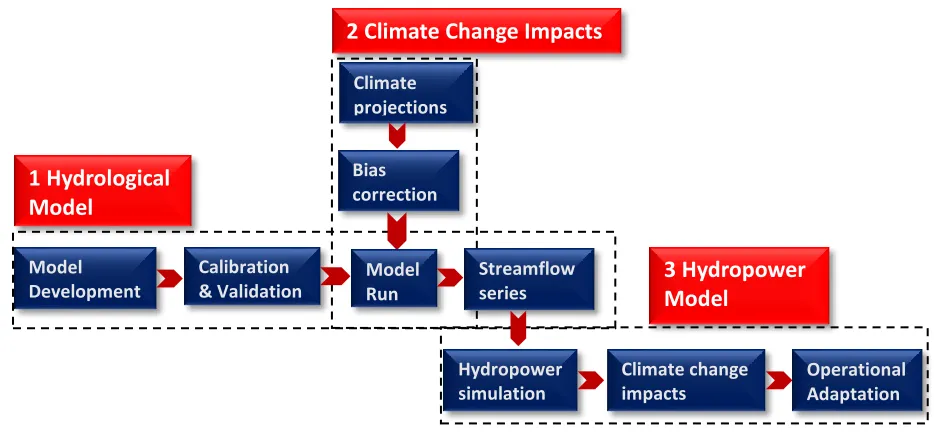
Fig. 1-2 Research methodology
The thesis is organized as a collection of peer-reviewed manuscripts. Three of the research studies are already published in the peer-reviewed journals, while two have been submitted and are under the review process. The dissertation begins with this Introduction chapter and closes with a Conclusions chapter. The references in the individual chapters are listed at the end of the respective chapters.
Chapter 2 presents a case-study of climate change impacts on a small hydropower project located
in Florida, USA, partly following the methodology presented in Fig. 1-2. The analysis adopts a conceptual hydrological model and a routinely followed model assessment strategy. The work has been published in Renewable Energy.
The literature review revealed that strong hydrological simulation is essential for portrayal of reliable climate change impacts (Clark et al., 2016; Bloschl and Montanari, 2009). This renders motivation to undertake a concrete effort towards improved hydrologic simulation in terms of (a) model assessment, (b) use of semi-distributed hydrological model, (c) multi-objective model calibration strategy, and (d) uncertainty quantification. To this end, Chapter 3 focuses on the significance of hydrologic model evaluation. The objective function(s) in any model assessment primarily computes the statistical fit between the simulation and the observation. The mathematical optimum obtained through a calibration scheme may be different from the hydrological optimum (Andréassian et al., 2012). The models, therefore need to be evaluated not
Calibration & Validation Model Development Streamflow series Bias correction Climate projections Climate change impacts Hydropower simulation Operational Adaptation
1 Hydrological
Model
2 Climate Change Impacts
3 Hydropower
Model
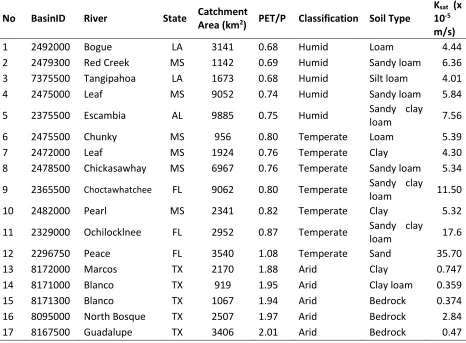
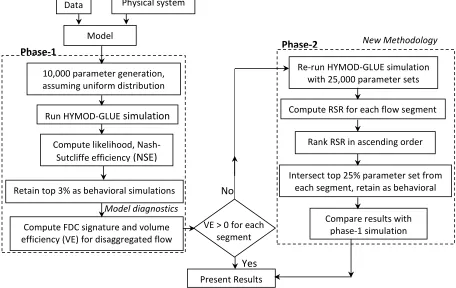
only based on statistical measures but also diagnosed from hydrological perspectives (Gupta et al., 2008). The idea of diagnostic model evaluation was extended further by applying conceptual model in 17 watersheds in southern United States. The work has two components, first the model evaluation and later a methodology for parameter selection. The first part of work was carried forward in the thesis. The research has been published in ASCE Journal of Hydrologic Engineering.
Chapter 4 presents the methodology for model calibration by applying a multi-objective
evolutionary algorithm (MOEA). The Borg MOEA is coupled with Soil and Water Assessment Tool (SWAT), a semi-distributed hydrological model. Role of signature measures, that provide an insight into the hydrologic function of a catchment (Sawicz et al., 2011), was also demonstrated. The research led to the enhancement of model performance, primarily for the low flow simulation. Low-flows play an important role especially in the context of the present work, as hydropower generation is directly affected by it. The research is already published in Hydrological
Science Journal.
Chapter 5 presents the hydrologic simulation for Magpie river watershed located in Northern
Ontario. The methodology developed in previous chapters was extended here. Subsequently, the model was used for streamflow projection for two future scenario periods. Here, the uncertainty assessment in the estimated flows focused on hydrological model parameter uncertainty, which lacks clarity in the available hydrological literature. The research was presented in two international conferences and is currently under the process of peer-review in the Journal of
Hydrologic Engineering.
Chapter 6 uses the future scenario streamflow derived in the previous chapter to make an
assessment of scenario hydropower generation. One of the aspects that most studies in the literature lack is the impact on hydropower revenue and the development of adaptation measures based on revenue generation. The present work proposes operational adaptation of the hydropower facility to mitigate the projected climate change impacts. The proposed adaptive reservoir management includes optimizing the existing reservoir rule curve through multi-objective optimization, in order to maximize the revenue. The research is currently under the process of peer-review in Renewable Energy.
1.8 References
Amponsah, N.Y., Troldborg, M., Kington, B., Aalders, I., Hough, R.L., 2014. Greenhouse gas emissions from renewable energy sources: A review of lifecycle considerations. Renew. Sustain. Energy Rev. 39, 461–475. https://doi.org/10.1016/j.rser.2014.07.087
Andréassian, V., Le Moine, N., Perrin, C., Ramos, M.-H., Oudin, L., Mathevet, T., Lerat, J., Berthet, L., 2012. All that glitters is not gold: The case of calibrating hydrological models: Invited Commentary. Hydrol. Process. 26, 2206–2210. https://doi.org/10.1002/hyp.9264
Arnell, N.W., 2011. Uncertainty in the relationship between climate forcing and hydrological response in UK catchments. Hydrol. Earth Syst. Sci. 15, 897–912. https://doi.org/10.5194/hess-15-897-2011
Arsenault, R., Brissette, F., Malo, J.-S., Minville, M., Leconte, R., 2013. Structural and non-structural climate change adaptation strategies for the Péribonka water resource system. Water Resour. Manag. 27, 2075–2087. https://doi.org/10.1007/s11269-013-0275-6
Athira, P., Sudheer, K.P., 2015. A method to reduce the computational requirement while assessing uncertainty of complex hydrological models. Stoch. Environ. Res. Risk Assess. 29, 847–859. https://doi.org/10.1007/s00477-014-0958-4
Bastola, S., Murphy, C., Sweeney, J., 2011. The role of hydrological modelling uncertainties in climate change impact assessments of Irish river catchments. Adv. Water Resour. 34, 562–576. https://doi.org/10.1016/j.advwatres.2011.01.008
Bates, B., Kundzewicz, Z.W., Wu, S., Palutikof, J. (Eds.), 2008. Climate Change and Water, IPCC Technical Paper-VI. Intergovernmental Panel on Climate Change.
Berga, L., 2016. The role of hydropower in climate change mitigation and adaptation: A review. Engineering 2, 313–318. https://doi.org/10.1016/J.ENG.2016.03.004
Beven, K., 2016. Facets of uncertainty: epistemic uncertainty, non-stationarity, likelihood, hypothesis testing, and communication. Hydrol. Sci. J. 61, 1652–1665. https://doi.org/10.1080/02626667.2015.1031761
Bloschl, G., Montanari, A., 2009. Climate change impacts—throwing the dice? Hydrol. Process. 24, 374–381. https://doi.org/10.1002/hyp.7574
Boehlert, B., Strzepek, K.M., Gebretsadik, Y., Swanson, R., McCluskey, A., Neumann, J.E., McFarland, J., Martinich, J., 2016. Climate change impacts and greenhouse gas mitigation effects on U.S. hydropower generation. Appl. Energy 183, 1511–1519. https://doi.org/10.1016/j.apenergy.2016.09.054
Brigode, P., Oudin, L., Perrin, C., 2013. Hydrological model parameter instability: A source of additional uncertainty in estimating the hydrological impacts of climate change? J. Hydrol. 476, 410–425. https://doi.org/10.1016/j.jhydrol.2012.11.012
Chen, J., Brissette, F.P., Leconte, R., 2011a. Uncertainty of downscaling method in quantifying the impact of climate change on hydrology. J. Hydrol. 401, 190–202. https://doi.org/10.1016/j.jhydrol.2011.02.020
Chen, J., Brissette, F.P., Poulin, A., Leconte, R., 2011b. Overall uncertainty study of the hydrological impacts of climate change for a Canadian watershed. Water Resour. Res. 47, 10.1029/2011WR010602. https://doi.org/10.1029/2011WR010602
Chilkoti, V., Bolisetti, T., Balachandar, R., 2017. Climate change impact assessment on hydropower generation using multi-model climate ensemble. Renew. Energy 109, 510–517. https://doi.org/10.1016/j.renene.2017.02.041
Christensen, N.S., Lettenmaier, D.P., 2007. A multimodel ensemble approach to assessment of climate change impacts on the hydrology and water resources of the Colorado River basin. Hydrol. Earth Syst. Sci. Discuss. 11, 1417–1434.
Clark, M.P., Wilby, R.L., Gutmann, E.D., Vano, J.A., Gangopadhyay, S., Wood, A.W., Fowler, H.J., Prudhomme, C., Arnold, J.R., Brekke, L.D., 2016. Characterizing uncertainty of the hydrologic impacts of climate change. Curr. Clim. Change Rep. 2, 55–64. https://doi.org/10.1007/s40641-016-0034-x
de Queiroz, A.R., Faria, V.A.D., Lima, L.M.M., Lima, J.W.M., 2019. Hydropower revenues under the threat of climate change in Brazil. Renew. Energy 133, 873–882. https://doi.org/10.1016/j.renene.2018.10.050
Edenhofer, O., Pichs Madruga, R., Sokona, Y. (Eds.), 2012. Renewable energy sources and climate change mitigation: Special Report of the Intergovernmental Panel on Climate Change. Cambridge University Press, New York.
Eisner, S., Flörke, M., Chamorro, A., Daggupati, P., Donnelly, C., Huang, J., Hundecha, Y., Koch, H., Kalugin, A., Krylenko, I., Mishra, V., Piniewski, M., Samaniego, L., Seidou, O., Wallner, M., Krysanova, V., 2017. An ensemble analysis of climate change impacts on streamflow seasonality across 11 large river basins. Clim. Change 141, 401–417. https://doi.org/10.1007/s10584-016-1844-5
Enerdata [WWW Document], 2018. Glob. Energy Stat. Yearbook. 2018. URL https://yearbook.enerdata.net/electricity/electricity-domestic-consumption-data.html (accessed 1.15.19).
Environment and Climate Change Canada, 2017. Canada’s National Reports to the United Nations Framework Convention on Climate Change (2017) [WWW Document]. aem. URL
https://www.canada.ca/en/environment-climate-change/services/climate- change/greenhouse-gas-emissions/seventh-national-communication-third-biennial-report.html (accessed 1.15.19).
Field, C.B., Barros, V.R., Intergovernmental Panel on Climate Change (Eds.), 2014. Climate change 2014: Impacts, Adaptation, And Vulnerability: Working Group II Contribution to the Fifth Assessment Report of the Intergovernmental Panel on Climate Change. Cambridge University Press, New York, NY.
Gaudard, L., Romerio, F., Dalla Valle, F., Gorret, R., Maran, S., Ravazzani, G., Stoffel, M., Volonterio, M., 2014. Climate change impacts on hydropower in the Swiss and Italian Alps. Sci. Total Environ. 493, 1211–1221. https://doi.org/10.1016/j.scitotenv.2013.10.012
Haguma, D., Leconte, R., Côté, P., Krau, S., Brissette, F., 2014. Optimal hydropower generation under climate change conditions for a northern water resources system. Water Resour. Manag. 28, 4631–4644. https://doi.org/10.1007/s11269-014-0763-3
Haguma, D., Leconte, R., Krau, S., 2017. Hydropower plant adaptation strategies for climate change impacts on hydrological regime. Can. J. Civ. Eng. 44, 962–970. https://doi.org/10.1139/cjce-2017-0141
Huaringa Alvarez, U.F., Trudel, M., Leconte, R., 2014. Impacts and adaptation to climate change using a reservoir management tool to a northern watershed: Application to Lièvre River watershed, Quebec, Canada. Water Resour. Manag. 28, 3667–3680. https://doi.org/10.1007/s11269-014-0694-z
Hydropower Status Report - Sector Trends and Highlights, 2018. . International Hydropower Association, London, U.K.
Jung, I.-W., Moradkhani, H., Chang, H., 2012. Uncertainty assessment of climate change impacts for hydrologically distinct river basins. J. Hydrol. 466–467, 73–87. https://doi.org/10.1016/j.jhydrol.2012.08.002
Karlsson, I.B., Sonnenborg, T.O., Refsgaard, J.C., Trolle, D., Børgesen, C.D., Olesen, J.E., Jeppesen, E., Jensen, K.H., 2016. Combined effects of climate models, hydrological model structures and land use scenarios on hydrological impacts of climate change. J. Hydrol. 535, 301–317. https://doi.org/10.1016/j.jhydrol.2016.01.069
Kopytkovskiy, M., Geza, M., McCray, J.E., 2015. Climate-change impacts on water resources and hydropower potential in the Upper Colorado River basin. J. Hydrol. Reg. Stud. 3, 473–493. https://doi.org/10.1016/j.ejrh.2015.02.014
Koutsoyiannis, D., Montanari, A., Lins, H.F., Cohn, T.A., 2009. Climate, hydrology and freshwater: towards an interactive incorporation of hydrological experience into climate research. Hydrol. Sci. J. 54, 394–405. https://doi.org/10.1623/hysj.54.2.394
Mendoza, P.A., Clark, M.P., Mizukami, N., Gutmann, E.D., Arnold, J.R., Brekke, L.D., Rajagopalan, B., 2016. How do hydrologic modeling decisions affect the portrayal of climate change impacts?: Subjective hydrologic modelling decisions in climate change impacts. Hydrol. Process. 30, 1071–1095. https://doi.org/10.1002/hyp.10684
Mendoza, P.A., Clark, M.P., Mizukami, N., Newman, A.J., Barlage, M., Gutmann, E.D., Rasmussen, R.M., Rajagopalan, B., Brekke, L.D., Arnold, J.R., 2015. Effects of hydrologic model choice and calibration on the portrayal of climate change impacts. J. Hydrometeorol. 16, 762–780. https://doi.org/10.1175/JHM-D-14-0104.1
Mimikou, M.A., Baltas, E.A., 1997. Climate change impacts on the reliability of hydroelectric energy production. Hydrol. Sci. J. 42, 661–678.
Min, S.-K., Zhang, X., Zwiers, F.W., Hegerl, G.C., 2011. Human contribution to more-intense precipitation extremes. Nature 470, 378–381. https://doi.org/10.1038/nature09763
Minville, M., 2010. Impact and uncertainty of climate change on water resources management of the Peribonka River system (Canada). Water Resour. Plan. Manag. 136, 376–385. https://doi.org/10.1061/(ASCE)WR.1943-5452.0000041
Mukherjee, S., Aadhar, S., Stone, D., Mishra, V., 2018. Increase in extreme precipitation events under anthropogenic warming in India. Weather Clim. Extrem. 20, 45–53. https://doi.org/10.1016/j.wace.2018.03.005
Natural Resources Canada, 2017. Electricity facts [WWW Document]. URL https://www.nrcan.gc.ca/energy/facts/electricity/20068 (accessed 1.16.19).
Pachauri, R.K., Mayer, L., Intergovernmental Panel on Climate Change (Eds.), 2015. Climate change 2014: Synthesis Report. Intergovernmental Panel on Climate Change, Geneva, Switzerland.
Pachauri, R.K., Meyer, L.A., 2014. Climate Change 2014: Synthesis Report. Contribution of Working Groups I, II and III to the Fifth Assessment Report of the Intergovernmental Panel on Climate Change.
PRISM, 2015. Hydropower and the Canadian Economy: Jobs And Investment In Canada’s Largest Electricity Source. Canadian Hydropower Association.
Prudhomme, C., Davies, H., 2009. Assessing uncertainties in climate change impact analyses on the river flow regimes in the UK. Part 2: future climate. Clim. Change 93, 197–222. https://doi.org/10.1007/s10584-008-9461-6
Sawicz, K., Wagener, T., Sivapalan, M., Troch, P.A., Carrillo, G., 2011. Catchment classification: empirical analysis of hydrologic similarity based on catchment function in the eastern USA. Hydrol. Earth Syst. Sci. 15, 2895–2911. https://doi.org/10.5194/hess-15-2895-2011
Schaefli, B., 2015. Projecting hydropower production under future climates: a guide for decision-makers and modelers to interpret and design climate change impact assessments. Wiley Interdiscip. Rev. Water 2, 271–289. https://doi.org/10.1002/wat2.1083
Schaefli, B., Hingray, B., Musy, A., 2007. Climate change and hydropower production in the Swiss Alps: quantification of potential impacts and related modelling uncertainties. Hydrol. Earth Syst. Sci. 11, 1191–1205. https://doi.org/10.5194/hess-11-1191-2007
Schäfli, B., 2005. Quantification of Modelling Uncertainties in Climate Change Impact Studies on Water Resources: Application to a Glacier-Fed Hydropower Production System in the Swiss Alps (PhD Thesis). École Polytechique Federale De Lausanne.
UNFCCC, 2019. URL https://unfccc.int/about-us/about-the-secretariat
van Vliet, M.T.H., van Beek, L.P.H., Eisner, S., Flörke, M., Wada, Y., Bierkens, M.F.P., 2016. Multi-model assessment of global hydropower and cooling water discharge potential under climate change. Glob. Environ. Change 40, 156–170. https://doi.org/10.1016/j.gloenvcha.2016.07.007 Wilby, R.L., 2005. Uncertainty in water resource model parameters used for climate change
impact assessment. Hydrol. Process. 19, 3201–3219. https://doi.org/10.1002/hyp.5819 Wilby, R.L., Harris, I., 2006. A framework for assessing uncertainties in climate change impacts:
Low-flow scenarios for the River Thames, UK. Water Resour. Res. 42, doi:10.1029/2005WR004065. https://doi.org/10.1029/2005WR004065
CHAPTER 2
CLIMATE CHANGE IMPACT ASSESSMENT ON HYDROPOWER GENERATION
USING MULTI-MODEL CLIMATE ENSEMBLE
12.1 Chapter Synopsis
Hydropower is the primary renewable source of energy that harnesses the power of the naturally flowing water streams and its potential is strongly impacted by the hydrological regime. The objective of the present research is to carry out a hydrological model based study to assess the impacts of climate change on hydropower generation by using the regional climate model (RCM) data available through coordinated regional downscaling experiment (CORDEX), and subsequently to analyse the effect of using model ensemble in projecting the future hydrology and energy generation scenario. C.H.Corn hydroelectric project located on River Ochlockonee near Tallahassee in Florida, USA, has been considered as a case study. A hydrologic model of the basin, draining into the dam, is developed using a conceptual model HYMOD with the historical climate and flow data extracted from the model parameter estimation experiment (MOPEX) dataset. The future projected climate scenario (2091-2100) is generated following the Representative Concentrated Pathways (RCP) 4.5 with the ensembles of six climate models. The impact of the future climate on water availability indicates a significant seasonal variability among the model ensemble results with an overall annual increase of statistics for the climate variables, corresponding inflows and a marginal increase in the energy generation.
1 This chapter was published as a journal article: Chilkoti, V., Bolisetti, T., and Balachandar, R. (2017).
“Climate change impact assessment on hydropower generation using multi-model climate ensemble.”
2.2 Introduction
The energy supply acts as a catalyst for an overall development of a society (Intergovernmental Panel on Climate Change and Metz 2007) and the supply of electricity, which is one of the major sources of energy and also the highest-value energy carrier(Intergovernmental Panel on Climate Change and Metz 2007), is imperative for basic humane comfort of living and to uphold an overall social and economic growth. Electricity generation for mass usage primarily comes from two broad sources: renewable and non-renewable. Non-renewable sector relies on burning fossil fuels whereas the renewable sector of electricity consists of hydro, solar, wind, biomass and geothermal. Though most of the nations fulfill the major segment of their energy demands through non-renewable sources (Edenhofer et al. 2012), about twenty-one countries worldwide are able to manage 80% of the electricity consumption through renewable means (“World Bank Data” 2016). Hydropower is a renewable energy source where power is derived from the energy of water moving from higher to lower elevations. The installed capacity of hydro across the globe is 926 GW by the year 2009 (Edenhofer et al. 2012) which constitutes about 19% of the total installed capacity. In the renewable sector alone its contribution is about 85% in terms of annual energy generation (Statham and World Energy Council 2007). Among all the energy sources the hydropower has the best conversion efficiencies of the order of 90% (from water to wire) (Edenhofer et al. 2012) and is termed as one of the cleanest energy resources.
2012). Bates et al. (2008) presents in detail the impacts of climate change on fresh water system and is a much cited technical paper by Intergovernmental Panel on Climate Change (IPCC), which is a leading international body on assessment of climate change. There have been several studies on the streamflow projection under climate change (Chen et al. 2011; Graham et al. 2007a; Graham et al. 2007b; Lenderink et al. 2007; Wi et al. 2015; Wilby and Harris 2006). As the energy production in hydropower is directly dependent on the quantum of water available in a given stream, the changing climate conditions are posing threat to the hydropower resource potential (Edenhofer et al. 2012). The studies related to hydropower are limited in comparison to the climate change effect in other sectors. Schaefli (2015) presents a review of various model-based studies pertaining to climate change and hydropower. In particular the impacts on hydropower have been reported in some of the studies in recent decades (Christensen et al. 2004; Christensen and Lettenmaier 2007; Harrison et al. 1998; Kopytkovskiy et al. 2015; Mimikou and Baltas 1997; Minville 2010; Schaefli 2015). The study on Colorado River basin by Christensen and Lettenmaier (2007) is a much cited work in this field and is an extension to their earlier work (Christensen et al. 2004); the same basin has also been studied later (Kopytkovskiy et al. 2015 and Kopytkovskiy 2010). The operational aspect of hydropower in the climate change scenario was included by some of the researchers (Christensen and Lettenmaier 2007; Larijani 2009; McDonald 2013; Minville 2010; Oni et al. 2012; Schäfli 2005a). A coupled model of hydrology and power market has been reported in Pereira-Cardenal et al. (2014), whereas there are studies including an energy based model without incorporating the streamflow and reservoir-volume generation computations (Larijani 2009). An extensive literature review on the impact of climate change on the electricity sector has been carried out by Chandramowli and Felder (2014).
found to be the major source in quantifying the climate change impacts (Chen et al. 2011; Bloschl and Montanari 2009; Prudhomme et al. 2003). In order to better assess the future impacts and enumerate the uncertainty many researchers suggest conducting an ensemble based study (Schaefli 2015; Minville 2010; Bloschl and Montanari 2009). Some of the hydrologic-model-based studies for assessing the climate change effects on hydropower have also included climate model ensembles (Christensen and Lettenmaier 2007; Minville 2010; Kopytkovskiy et al. 2015).
Climate change studies rely on various climate models that simulate the future climate scenario for different greenhouse gas emission scenarios (GHGES) (Intergovernmental Panel on Climate Change and Metz 2007). The projected data for an array of climate variables can be extracted from the results of the various simulation runs of different category of climate models, most common among them being general circulation model (GCM). A GCM typically represents climate simulation based on coarse grid of approximately 2.50 (~250 km) on map. For CCIA study, the
climate at a local scale, it is vital to utilize the results of climate simulation conducted at an advanced resolution like that in RCM. Hence it is realised that for a meaningful CCIA study for hydropower, the ensembles of such climate model data shall be utilized. CORDEX offers an opportunity to directly exploit the downscaled data for impact assessment studies; and as per the knowledge of the authors none of the studies have implemented the RCM simulation outputs from CORDEX for quantifying the impacts on hydropower system. The objectives of the present research is to carry out a hydrological model based study to assess the impact of climate change on hydropower generation using the RCM data available through CORDEX, and to analyse the effect of using model ensemble in projecting the future hydrology and energy generation scenario.
2.3 Description of Study Area
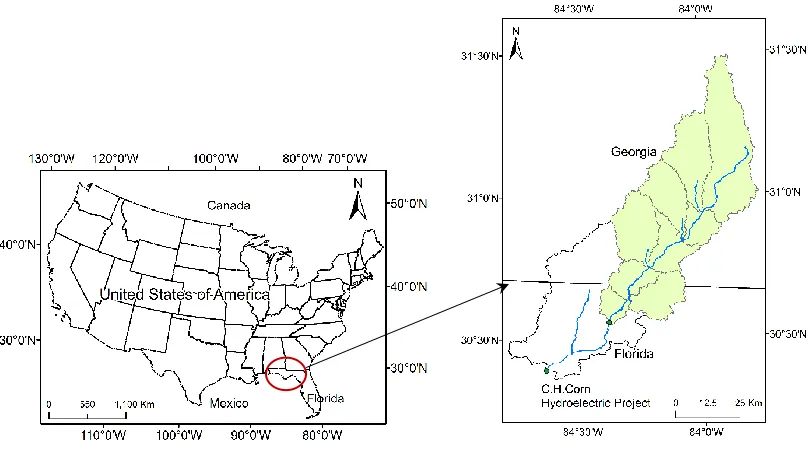
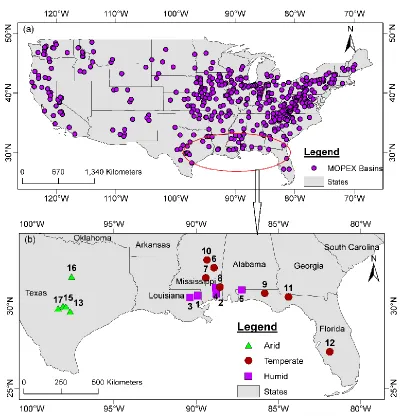
The present study considers C.H. Corn Hydroelectric project (C. H. Corn Hydroelectric Generating Station, 2016) located on Ochlockonee River in United States as a case study (Fig. 2-1). The project which is located 20 miles southwest of Tallahassee is one of the only two hydroelectric facilities in the state of Florida and is a dam toe type of scheme. With an installed capacity of 12 MW, water for power generation is stored in the lake Talqin formed behind the Bluff dam.
Fig. 2-1 Drainage area of Ochlockonee River upstream of C.H. Corn Hydroelectric project
The project was built in 1929 by West Florida Power Company but was abandoned as a power plant in 1970. Refurbished in 1981 by City of Tallahassee as a hydroelectric demonstration project it became fully operational in 1985 under City of Tallahassee Electric Utility Services. Lake Talquin stretches upstream towards Tallahassee and apart from electricity generation is used as recreational lake and also for flood control purpose.
2.4 Methodology
The climate change impact assessment for the C.H.Corn hydroelectric project has been carried out by first developing a conceptual hydrological model which is calibrated and validated based on the observed streamflow. The monthly energy generation computations are then carried out and are validated with the actual generation of the hydropower facility. The hydrological model is subsequently forced with the projected future climate data extracted from the RCMs available under CORDEX regional downscaling project. Energy generation model is again used to compute the future generation and compared with the present energy production. Schaefli (2015) also discusses the relevance of undertaking a hydrological-model based CCIA study for the hydropower system.
2.4.1 Hydrological model
There are various types of hydrologic model either a conceptual/lumped, partially distributed or a distributed model. In a Conceptual rainfall-runoff (CRR) model, the overall hydrologic response of the watershed system is generated at sub-watershed scale on the basis of governing hydrologic phenomena. In the present research a CRR namely HYMOD (Boyle 2001) having an ability of continuous-process simulation has been used for basin hydrologic simulation. The model is considered as a relatively simple but producing robust runoff simulation. The model consists of five parameters viz., storage capacity of watershed C [L], percentage of impervious portions of watershed [ ], recession coefficient for quick flow/surface runoff kq [T ], recession coefficient for
slow/base flow ks[T ], degree of spatial variability of soil moisture capacity within watershed bexp[
]. For further details of the model configuration Boyle (2001) can be referred. 2.4.2 MOPEX dataset
by Global Energy and Water Cycle Experiment (GEWEX) Hydrometeorology Panel (GHP) in 1996 which was then adopted as projects of the International Association of Hydrological Sciences (IAHS)/World Meteorological Organization (WMO) Committee on GEWEX and of the WMO Commission on Hydrology. As part of MOPEX, data from 438 catchments in United States and several others from across the world are already included. The data set for US includes daily time series of mean aerial values for various climate variables namely precipitation, potential evaporation, maximum temperature and minimum temperature among others. For each of the basins daily streamflow record is also available. For the present work, the dataset from one of the MOPEX basins has been utilized to develop and calibrate the hydrological model.
2.4.3 Power generation computation
The energy generation has been computed based on the available streamflow and driving water head behind the dam holding the lake water. The computations are carried out for the daily flow data and then presented on monthly basis. Due to lack reservoir bathymetric information the operational aspects have not been considered in the current study. As our present goal is only to make an assessment of the energy generation at a broad scale, lack of such information would not hamper the analysis.
2.4.4 Climate change projections
For a reliable climate change projection a multi-model ensemble approach (Schaefli 2015) has been adopted in the current study. Data from six RCM’s as part of CORDEX (Giorgi et al. 2009) experiment has been extracted. CORDEX is a regional climate downscaling project that aims to generate an ensemble of high-resolution historical and future climate projections at a regional scale, by downscaling different GCMs participating in the Coupled Model Intercomparison Project Phase 5 (CMIP5)(Asrar 2011). CMIP5 data holds a large potential for assessment of renewable energy viz. solar, wind and hydro in future especially under changing climate scenario. van Vliet et al. (2016) have carried out an extensive study of rivers worldwide, using a CMIP5 multi-model ensemble, to show the potential impacts of climate change on global hydropower and cooling water discharge availability. Data from 21 models of CMIP5 was utilized by Carvalho et al. to assess future changes in the wind energy resource in Europe (Carvalho et al. 2017).
as North America (NAM), and therefore the data pertaining to corresponding domain has been retrieved. The selected models for the present study are listed in Table-1.
Using the climate models, data for two different time horizons were extracted, one for historical duration termed as control period and other for the future period following the Representative Concentrated Pathways (RCP) 4.5 that represents one of the intermediate GHGES as per the latest IPCC guidelines (Pachauri et al. 2014). The control period data from year 1971-2000 is used to bias correct the model data with the available observation data. The future time horizon for assessing the climate change impacts in the present study is considered from the year 2091 to 2100. Henceforth the climate models shall be described by their respective numbers (as in Table 2-1) rather than the name, for simplicity sake.
Table 2-1: CORDEX climate projections used in the present research
Model No
Regional Climate Model (RCM)
Driving Global Climate Model (GCM) RCM Modeling
Agency* GCM
Modeling Agency*
1 CanRCM4 CCCma CanESM2 CCCma
2 RCA4 SMHI CanESM2 CCCma
3 RCA4 SMHI EC-EARTH ICHEC
4 HIRHAM5 DMI EC-EARTH ICHEC
5 CRCM5 UQAM CanESM2 CCCma
6 CRCM5 UQAM MPI-ESM-LR MPI-M
* CCCma- Canadian Center for Climate Modeling and Analysis
SMHI – Swedish Meteorological and Hydrological Institute DMI – Danish Meteorological Institute
ICHEC – Irish Center for High End Computing UQAM-Université du Québec à Montréal MPI –Max Planck Institute of Meteorology
2.4.5 Bias correction
The meteorological parameters derived from the climate models may not possess the statistical characteristics of the observed data of the study area (Schaefli 2015). In such case the climate model data, from however refined simulation grid is obtained, need to be corrected before RCM outputs are transferred into hydrological models (Graham et al. 2007a) and thus to be more representative for a given location. The problem is resolved using the technique called Bias correction (Schaefli 2015); various methods for carrying out bias correction are summarized in Chen et al. (Chen et al. 2011). In the present study we adopt the commonly used Delta change method (Minville 2010; Poulin et al. 2011; Graham et al. 2007a), where the monthly averaged climate model data during the control period is compared with the observed data over the same period. The monthly bias factors thus computed are applied over the daily model data, for the respective months, as per Eq. 2-1 through Eq. 2-4.
iod ControlPer n i RCM i n i Obs i m P P P
1 , 1 , , Eq. 2-1 m el m P m elCorrP
P
mod ,
, mod , Eq. 2-2iod ControlPer n i i RCM n i i Obs m T T n T
n
1 , 1 , , 1 1
Eq. 2-3m el m T m elCorr
T
T
mod ,
,
mod , Eq. 2-4Notations: m P,
- bias in precipitation (P) for month m Obsi
P
, - observed precipitation for ith day of given monthRCM i
P
, - RCM precipitation for ith day of given monthm elCorr
P
mod , - corrected model precipitation of month mm el
P
mod , - model precipitation of month m2.5 Results and Discussion
The results pertaining to hydrological modeling, climate scenario projection, simulation of future hydrological projections and energy generation in future period are detailed in the present section.
2.5.1 Hydrologic model calibration
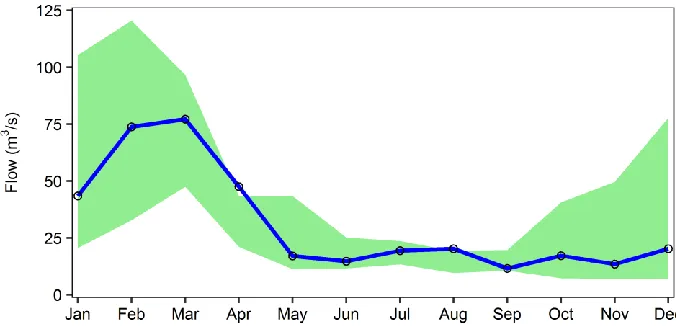
The hydrologic model HYMOD for the present study area has been calibrated based on the data available from MOPEX database for gauge ID 02329000. The climate data for the period 1980-1994 has been used for the model development. Generalized Likelihood Uncertainty Estimation, GLUE (Beven and Binley 1992) method is adopted to generate a range of model parameters which in turn allows to generate a streamflow ensemble that also assist in analysing the modeling uncertainty. All model simulations having a Nash-Sutcliffe efficiency greater than 0.75 are retained. The model is validated with respect to energy generation data which is available from 1996 to 2014, giving an efficiency of 0.84. The detailed results of calibration and validation are not presented here for brevity. Daily precipitation and PET data is used for hydrologic modeling while the daily streamflow data is used for model calibration. A set of model parameters is generated and all the model simulations having an efficiency of more than 0.75 with respect to observed data are retained. Fig. 2-2 presents the summary of simulation of the daily streamflow patterns during the calibration period. The model parameters generated during the calibration are then employed for model run in future climate scenario.
2.5.2 Projected climate model results
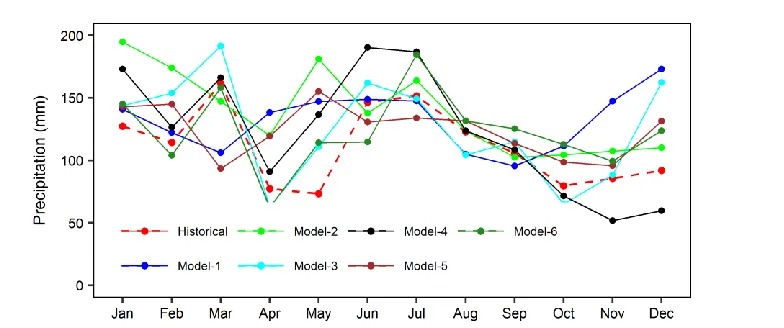
Subsequent to extraction of precipitation and near surface air temperature data from six different climate models, the data were bias corrected based on the method described earlier. The analysis here has been carried out on annual as well as seasonal basis; the whole year is divided into four seasons viz., winter (DJF), spring (MAM), summer (JJA) and autumn (SON). Similar treatment of the results has been reported in the previous studies also (Christensen and Lettenmaier 2007; Minville 2010).
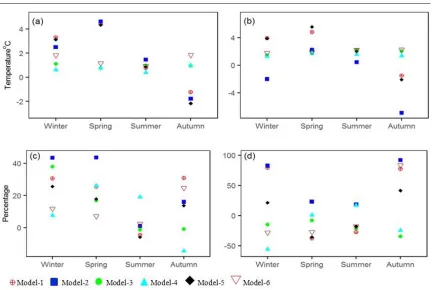
Based on the analysis of control period data, various climate models uniformly depict a bias factor greater than unity for precipitation, which implies that the model projects lesser precipitation than actual during the same period. The average bias among all the models is about 13% but on the seasonal scale the winter period has the highest bias of 20%. The variance of bias among all the models is maximum during autumn and least during summer period. The maximum air temperature presents a positive bias in the range of 0.970C to 4.320C among different models and
seasons whereas the minimum air temperature variable has a larger bias range of -0.210C to
-4.730C. The variance of bias among models is larger during the summer and autumn period for
precipitation whereas for temperature, winter and spring period presents higher variance in bias than other seasons.