University of Windsor University of Windsor
Scholarship at UWindsor
Scholarship at UWindsor
Electronic Theses and Dissertations Theses, Dissertations, and Major Papers
2011
Downloading Deep Web Data from Real Web Services
Downloading Deep Web Data from Real Web Services
Chong FuUniversity of Windsor
Follow this and additional works at: https://scholar.uwindsor.ca/etd
Recommended Citation Recommended Citation
Fu, Chong, "Downloading Deep Web Data from Real Web Services" (2011). Electronic Theses and Dissertations. 322.
https://scholar.uwindsor.ca/etd/322
Downloading Deep Web Data from Real Web Services
by
Chong Fu
A Thesis
Submitted to the Faculty of Graduate Studies through Computer Science
in Partial Fulfillment of the Requirements for the Degree of Master of Science at the
University of Windsor
Windsor, Ontario, Canada
2011
Downloading Deep Web Data from Real Web Services
By Chong Fu
APPROVED BY:
______________________________________________ Dr. Kevin Li
Odette School of Business
______________________________________________ Dr. Jessica Chen
School of Computer Science
______________________________________________ Dr.Jianguo Lu, Advisor
School of Computer Science
______________________________________________ Dr. Alioune Ngom, Chair of Defense
School of Computer Science
DECLARATION OF ORIGINALITY
I hereby certify that I am the sole author of this thesis and that no part of this
thesis has been published or submitted for publication.
I certify that, to the best of my knowledge, my thesis does not infringe upon
anyone’s copyright nor violate any proprietary rights and that any ideas, techniques,
quotations, or any other material from the work of other people included in my thesis,
published or otherwise, are fully acknowledged in accordance with the standard
referencing practices. Furthermore, to the extent that I have included copyrighted
material that surpasses the bounds of fair dealing within the meaning of the Canada
Copyright Act, I certify that I have obtained a written permission from the copyright
owner(s) to include such material(s) in my thesis and have included copies of such
copyright clearances to my appendix.
I declare that this is a true copy of my thesis, including any final revisions, as
approved by my thesis committee and the Graduate Studies office, and that this thesis has
ABSTRACT
Data of deep web in general is stored in a database or a file system that is only
accessible via web query forms or through web service interfaces. One challenge of deep
web crawling is how to select meaningful queries to acquire data. There is substantial
research on the selection of queries, such as the approach based on the set covering
problem where greedy algorithm or its variation is used. These methods are not
extensively studied in the context of real web services, which may impose new
challenges for deep web crawling. This thesis studies several query selection methods on
Microsoft’s Bing web service, especially the impact of the ranking of the returns in real
data sources. Our results show that for unranked data sources, weighted method
performed a little better then un-weighted set covering algorithm. For ranked data
sources, document frequent estimation is necessary to harvest data more efficiently.
DEDICATION
This thesis is dedicated to my families who have supported me all the way since
the beginning of my studies with patience, understanding, and love.
Also, this thesis is dedicated to all those who helped me during my studies. If
each thing in my memory has weight, many things happened in the University of
ACKNOWLEDGEMENTS
I am heartily thankful to my supervisor, Dr. Jianguo Lu, who gave me critical
suggestions, honest criticisms and painstaking comments helping me to finish the
research and writing of this thesis. Without his guidance and support, this thesis would
not have been possible.
I also would like to thank my internal reader, Dr. Jessica Chen, my external
reader, Dr. Kevin Li, and my thesis committee chair, Dr. Alioune Ngom for spending
their time in reviewing this thesis and attending my thesis proposal and defence.
As well as, a special thanks to Frank Luo and Guanghui Luo with whom I built
the framework of WS-Crawler together in a course project.
Finally, I would like to show my gratitude to Yan Wang and Shaohua Wang for
TABLE OF CONTENTS
DECLARATION OF ORIGINALITY ... iii
ABSTRACT ... iv
DEDICATION ...v
ACKNOWLEDGEMENTS ... vi
LIST OF TABLES ... ix
LIST OF FIGURES ...x
I. INTRODUCTION 1 II. RELATED WORK 9 2.1 INCREMENTAL APPROACH ... 9
2.2 SAMPLING BASED APPROACH ... 13
III. SET COVERING PROBLEM 16 IV. SET COVERING ALGORITHMS 21 4.1. GREEDY ALGORITHM ... 21
4.2. WEIGHTED ALGORITHM ... 26
4.3. RANKING PROBLEM ... 31
V. EXPERIMENTS 35 5.1. EXPERIMENTAL ENVIRONMENT ... 35
5.2. EVALUATION CRITERIA ... 39
5.3. EXPERIMENTS ... 41
5.3.1 Sample Databases Creation ...41
5.3.2 Ranking Strength Observation on the Data Sources ...42
5.3.3 Comparison on Query Selection Policies ...43
VI. CONCLUSION AND FUTURE WORK 52
6.1 CONCLUSION ... 52
6.2 FUTURE WORK ... 53
APPENDIX I 55
REFERENCES 60
LIST OF TABLES
TABLE 1:GREEDY ALGORITHM EXAMPLE (1) ... 23
TABLE 2:GREEDY ALGORITHM EXAMPLE (2) ... 24
TABLE 3:GREEDY ALGORITHM EXAMPLE (3) ... 24
TABLE 4:GREEDY ALGORITHM EXAMPLE (4) ... 24
TABLE 5:WIGHTED GREEDY ALGORITHM EXAMPLE (1) ... 29
TABLE 6:WIGHTED GREEDY ALGORITHM EXAMPLE (2) ... 29
TABLE 7:WIGHTED GREEDY ALGORITHM EXAMPLE (3) ... 29
TABLE 8:DESCRIPTION OF DATA SOURCES AND SAMPLE DATABASES ... 41
TABLE 9:PERCENTAGE OF TERMS WITHIN K ... 42
TABLE 10:EXPERIMENT RECORD CHART ... 43
TABLE 11:COMPARISON OF DF-WEIGHTED AND OTHERS ... 48
TABLE 12:COMPARISON OF GREEDY AND WEIGHTED ... 49
LIST OF FIGURES
FIGURE 1:A PART OF ARXIV.COM HOME PAGE ... 1
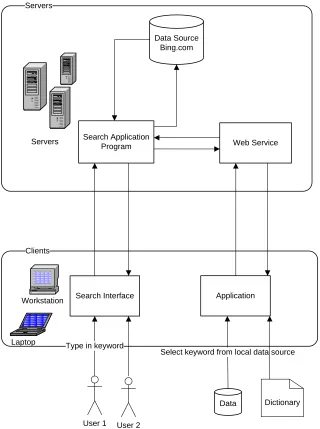
FIGURE 2:ACCESSING BING CONTENT BY TWO WAYS: SEARCH INTERFACE OR WEB SERVICE ... 3
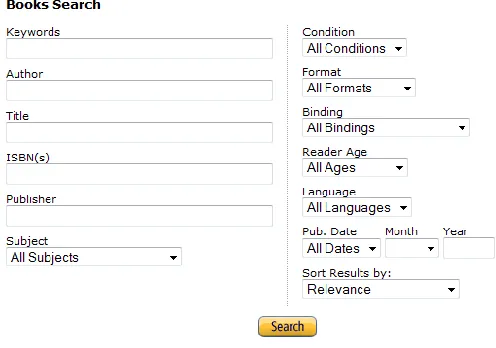
FIGURE 3:HTML SEARCH FORM OF AMAZON BOOK STORE ... 5
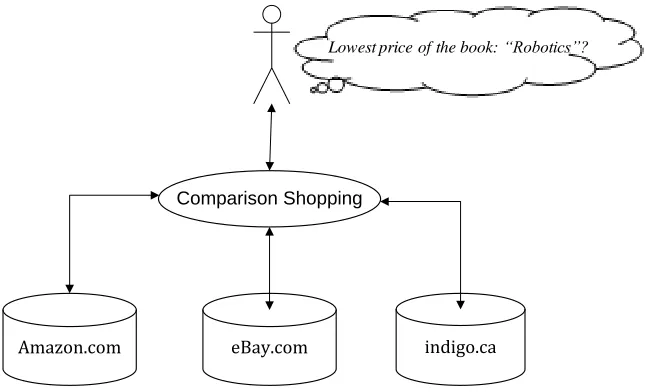
FIGURE 4:VIRTUAL INTEGRATION –COMPARISON SHOPPING ... 6
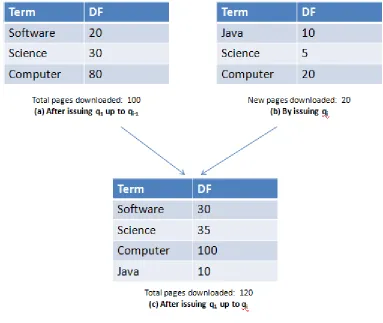
FIGURE 5:STATISTIC TABLE:DOCUMENT FREQUENCY OF TERMS ... 11
FIGURE 6:THE FRAMEWORK OF LU’S SAMPLE-BASED APPROACH ... 15
FIGURE 7:FORMALIZATION OF THE QUERY SELECTION PROBLEM ... 17
FIGURE 8: SET-COVERING FORMALIZATION (EXAMPLE) ... 23
FIGURE 9: THE WHOLE PROCEDURE OF GREEDY ALGORITHM ... 25
FIGURE 10: THE WHOLE PROCEDURE IN SET COVERING VIEW (BY WEIGHTED GREEDY ALGORITHM) ... 30
FIGURE 11:A DEEP WEB SITE USUALLY SET UP A RETURN LIMITATION ... 32
FIGURE 12:THE RESULTS FOR “SITE:CS.BERKELEY.EDU VAZIRANI” ... 35
FIGURE 13:RESPONSE PAGE FROM BING WEB SERVICE ... 36
FIGURE 14:THE USER INTERFACE OF OUR CRAWLER ... 38
FIGURE 15:DATAFLOW DIAGRAM OF OUR CRAWLER ... 39
FIGURE 16:PERFORMANCE DIAGRAMS OF CS.BERKELEY.EDU ... 45
FIGURE 17:PERFORMANCE DIAGRAMS OF UWATERLOO.CA ... 46
FIGURE 18:PERFORMANCE DIAGRAMS OF CTV.CA ... 47
CHAPTER I
INTRODUCTION
The Deep Web [4] data refer to the content that is dynamically generated from
databases or file systems. The information served on the Deep Web is accessible through
query interfaces such as html forms or web services. Many organizations, such as
“Arxiv.org”, “Bing.com” or “Amazon.com”, provide web service interfaces to access
their deep web data. Since data are hidden behind query interfaces, the deep web are also
called as the Hidden Web [7] [10] or invisible web [10]. The figure below is a part of the
home page of “Arxiv.org”. This website provides a large number of academic documents.
In most cases, users look for the document that they want by using the html query form at
the top.
Figure 1: A part of Arxiv.org home page
The deep web often contains a large amount of documents which are often of high
quality and value to users. Since there are no static links to those deep web documents,
deep web content is beyond the reach of traditional search engines [5]. In order to access
the query. According to the research [4], the content of deep web is about 500 times
greater than that visible to conventional search engines. Hence how to utilize the deep
web content becomes a major challenge within the information retrieval community.
The thesis focuses on the task of downloading the deep web data from real web
services. We have developed a web-service crawler named “WS Crawler”, implemented
and experimented with four query selection algorithms for deep web crawling. Our
objective is to evaluate their efficiency for retrieving data from different real data sources
via web service.
In order to share their data to users, some deep web sites provide web service for
client application to access their online databases. Web service is a technology that
enables application-to-application interaction over the network – regardless of platform,
language, or data formats. By exposing web APIs (Application Programming Interfaces)
on the network, functionalities of web service can be activated using HTTP requests.
Through these APIs, client application can access remote content. Advantages of using
web services include: no need to fill html query form and no need to extract relevant data
User 1 User 2 Servers
Servers
Data Source Bing.com
Search Application
Program Web Service
Clients
Search Interface Application
Laptop Workstation
Type in keyword
Data Dictionary Select keyword from local data source
Deep web content in general is stored in a database. By the type of the database,
they can be categorized either as an unstructured (textual) database or as a structured
database [24]. An unstructured database is a site that mainly contains plain-text
documents (e.g., legal documents). In contrast, a structured database is a site that often
contains relational data, such as an online book store that may have multiple fields such
as title, author, and ISBN etc. For a textual database, the search interface usually provides
a simple keyword textbox. Conversely, the interface to a structured database may allow
the users to submit multiple attributes (e.g., searching cars by company name, brand, or
the year of production). The interface may contain a combination of text box, radio
button, dropdown menu etc.
Textual database mainly contains plain-text documents, such as papers, law
documents, and news articles etc. Html query form of a textual database usually only
provides a single textbox to fill in keywords, as shown in Figure 1. It is an html search
form from arXiv.org. The arXiv database is textual. It contains about 500,000 papers.
Structured database mainly contains relational data, such as on line store database. Html
Figure 3: Html Search Form of Amazon Book Store
Here is an example from Amazon on line book store. You can search a book by
author, title, or ISBN etc. Our research is related to textual database.
With millions of databases connected to the internet, we cannot ignore data
hidden behind search interface. To utilize deep web content, virtual integration and
surfacing are the two main applications.
The virtual integration approach [9] [25] is to provide a uniform interface to
access a specific kind of data from different deep web sources. To build such an
application, we need to identify the domain (e.g., book, airline ticket, or real-estate) of
each deep web and analyze the html search interface. Thus, an automatic integration
system often contains an automatic identification system and a semantic system. The
identification system is to analyze the query interface or contents of a deep web site and
to identify the domain that it belongs to. For example, we have known a large amount of
deep web sites. Now, we are only interested in the online book store sites. So a first step,
After that, we already have a set of deep web sites in a domain of interest. Then, we need
to build a unified query interface to search those sites at the same time. To create a
unified query interface, a semantic system is necessary to build and manage semantic
mappings on the search interfaces of those deep web sites. In short, it is to map queries to
difference search interfaces. Then integration system will extract, combine, and rank the
results retrieved form difference data sources. Finally, present regenerative results to the
users. Generally, a virtual integration provides more experience to user besides search.
For instance, we search a book in a virtual integration search engine. The results are
retrieved from the difference online book stores, such as “amazon.com”, “ebay.com”, and
“indigo.ca”. In addition to return those results, the search engine also provides the best
price of the book. For that reason, virtual integration is more suitable for the structure
databases.
Comparison Shopping
Amazon.com eBay.com indigo.ca
Lowest price of the book: “Robotics”?
Figure 4: Virtual Integration – Comparison Shopping
The surfacing approach is also called deep web crawling which downloads hidden
search engine index today. In general, the challenges of deep web crawling include: how
to process html query form [18]; how to extract relevant data from result pages [15] [2];
and how to choose a set of queries [20] [16] [18] [21] [3] [22]. An excellent crawler
should surface the deep web sites automatically. Hence, the crawler needs an approach to
process html query form and extract relevant data from result pages automatically. We
use web service in our experiments, so we do not need to process the html query form,
and the results is XML file format. For that reason, we can focus on query selection
problem.
The real environment usually sets up a return limitation for the maximal number
of results. Most of the earlier methods are designed to download a deep web site without
return limitation. Therefore, they cannot work well when return limitation exists. We
present a DF-Weighted Greedy algorithm to cope with this challenge.
Experiments are carried on three data sources which are “cs.berkeley.edu”,
“uwaterloo.ca”, and “ctv.ca”. The size of the first data source is small, which contains
about 30,000 web pages. This means return limitation problem is not serious in this data
source, because the number of most matches will not surpass the limit. The other two
data sources are larger than the first one. The number of web pages of “uwaterloo.ca” and
“ctv.ca” are approximate 150,000, and 140,000. The experimental results show our
DF-Weighted greedy works well when downloading the data from the last two data sources.
In addition to the introduction section, there are five sections in this thesis.
Section 2 introduces relative work. It includes the difference types of query selection
approaches for deep web crawling. Section 3 introduces set covering problem and how
three sampling based algorithms: Greedy, Weighted Greedy and DF-Weighted Greedy.
Section 5 describes our experiments and gives the results. Finally, the conclusion and
CHAPTER II
RELATED WORK
The key problem of deep web crawling is how to choose a set of queries to submit
to the query form. There are many ways to select keywords.
A primitive solution can be randomly selecting some words from a dictionary.
However this solution is not efficient, due to that a large number of rare queries may not
match any page, or there could be many overlapping returns. Instead of selecting
keywords from dictionary, several algorithms have been developed to select keywords.
Currently, most approaches that had been developed are to analyze and choose the
queries from the documents downloaded from the previous queries submitted to the deep
web database. They can be categorized as: Graph approach [1] [24], Incremental
approach [20] [18], and Sampling based approach [16] [3] [22]. Graph approach is used
to download structured database, so it is not discussed in my thesis.
2.1 Incremental approach
Incremental approach selects queries from the documents that have been
downloaded. The number of documents increases as more queries are sent, thus this kind
of approach are called incremental approach.
Ntoulas et al. [20] propose an adaptive method. Their approach selects the query
returning most new documents per unit iteratively. Since there is no prior knowledge of
document frequencies based on the documents already downloaded. From this estimation
and the occurrences of the queries in the downloaded documents, the number of matched
new documents can be estimated. They propose two ways to estimate. The first method
which is called independence estimator assumes that the occurrence probability of a term
in the subset of documents is equal to that in the entire document set. Based on the
frequency of a term in the subset of documents N(qi | subset collection), the method can
estimate how many times a particular term occurs in the entire document set N(qi). Then
we can estimate the number of new documents by: Nnew(qi) = N(qi) - N(qi | subset
collection).
The method of Zipf estimator [13] is to estimate the frequency of terms inside
document collection by following a power law distribution. That is, the frequency of a
term within the document collection is given by the formula:
N(qi)= α (r +β )-Ƴ, (1)
where r is the rank of the term and α , β , and Ƴ are constants that depend on the
document collection. Based on the subset of documents that we have downloaded, we can
estimate α , β , and Ƴ by the approach which is mentioned in [20]. Given the ranking r
of a term inside the subset of document collection, N(qi) can be calculated by formula
(1). They compare three keyword selection policies: random (Keywords are randomly
selected from dictionary.), generic-frequency (Keywords are selected from
5.5-million-web-page corpus based on their decreasing frequency.), and their adaptive algorithm. The
experimental result shows that adaptive algorithm (Keywords are selected from the
[20], select queries from an incremental document collection. Therefore, we call this kind
of approach as incremental approach. Incremental approach selects queries from an
incremental document collection. That means you need to analyze each document once it
is downloaded and calculate the document frequency again for each term. This step will
be very time-consuming, if we count the document frequency for every query at each
round. In order to calculate document frequency efficiently, Ntoulas’ solution computes
the document frequency by updating the query statistics table after we submit a new
query and download more documents. However maintaining this table still is difficult.
The sampling-based approach [16] [3] firstly creates a sample database and builds
a set of queries from the sample database, rather than iteratively selecting keywords from
an incremental subset of document collection until crawling ends.
Madhavan et al. [18] develop a deep-web crawling system. Because the system is
an industry product, it needs to consider how to select seed queries. Their system detects
the feature of the query interfaces. Since they need to process difference languages, their
approach does not select queries from a dictionary. Instead, they select the seed queries
from the html query form. After that, the iterative probing and keyword selection
approach is similar to that proposed in [20].
Their query selection policy is based on TF-IDF that is the popular measure in the
information retrieval. TF-IDF measures the importance of the word by the formula
below.
(2)
This formula consists of two parts: tf(w, p) is the term
frequency of the term w in page p, and measures the importance of the word w in page
p.
,
where nw,p represents the number of times a word w occurs in web page p;
is the total number of terms in page p.
idf (w) (inverse document frequency) measures the importance of the word
among all web pages, and is calculated by
Madhavan et al’s method adds the top 25 words on every web page sorted by their
TF-IDF values into the query pool. From the query pool, they remove the following two
kinds of terms.
Eliminate the high frequency terms, such as the terms that have appeared in
many web pages (e.g. over 80% ), since these terms could be from menus or
advertisements.
Delete the terms which occur only on one page, since many of these terms
are meaningless words that are not from the contents of web pages, such as
nonsensical or idiosyncratic words that could not be indexed by the search
engine.
The remaining words are issued to deep web as queries and a new set of web
pages are downloaded. Then this is repeated again in the new iteration. Additionally, their
approach emphasizes breadth oriented crawling that is quite different to prior researches.
They observed the statistic data on Google.com and found the results returned to users
were more dependent on the number of deep web sites. They analyzed 10 millions of
deep web sites. They discovered the top 10,000 deep web sites accounted for 50% of
Deep-Web results, while even the top 100,000 deep web sites only accounted for 85%.
This observation causes their focus on crawling as many deep web sites as possible,
rather than surfacing on specific deep web sites.
2.2 Sampling based approach
In [21] [3], Barbosa et al. propose an approach to siphon the deep web by
algorithm selects the highest frequency keyword from the potential keyword list and is
expected to lead a high coverage. It is composed of two phases: phase 1 selects a set of
words from the html search form and randomly issues them until a non-empty result page
is returned. By extracting high-frequency words from the results page, their algorithm
creates an initial keyword list. Then it iteratively updates the frequency of words in the
list and adds new high-frequency words into the list by randomly issuing the word in the
list until the number of submission reaches the threshold. In phase 2, the approach selects
the most frequency keyword from the keyword list to construct a new query in each
round until the number of submission is up to maximum times.
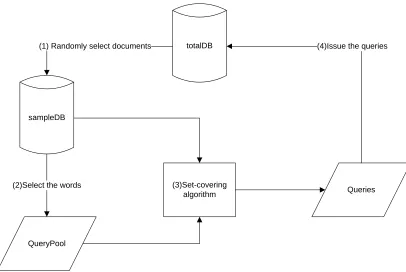
In [16], Lu et al. further improve the sampling based method. Keywords are
selected from a fixed sample database by a set covering algorithm. Those queries which
can cover most documents in the sample database are expected to cover most of data in
the entire database. The framework of this approach is showing in the figure below. For
sampling based approach, queries are selected from the sample set of documents from the
total database. This approach consists of three phases:
1) Create a sample DB: Issue the initial keywords to the total DB, obtain the
matched documents, and then construct a sample database;
2) Construct the query pool: Analyze all the documents in the sample DB, apply
set-covering algorithm to select the keywords and generate a query pool;
3) Send the queries to Total DB to retrieve documents.
The advantage of this method is that only a small part of documents need to be
documents. Our focus is sampling based approach. Hence, more detail about sampling
based approach will be described in Chapter IV.
totalDB
sampleDB
QueryPool
(1) Randomly select documents
(2)Select the words (3)Set-covering
algorithm Queries (4)Issue the queries
CHAPTER III
SET COVERING PROBLEM
One of key problems of deep web crawling is to select a set of meaningful
keywords. Selecting queries from a document collection is a popular method. Ntoulas et
al [20] are the first to use set-covering problem to represent the query selection problem.
Set-covering problem is a typical NP problem [6]. It can be described as the
following: given a finite set U and a family X of subsets of U, the solution is to find a
cover C whose union is U and it is a subfamily of X. The set-covering problem can be
divided into two problems. One is the set covering decision problem, i.e., given a pair
(U,X) and an integer k; the question is to decide whether there is a cover of size k or less.
The set-covering decision problem is NP-Complete. The other is the set covering
optimization problem, i.e., given a pair (U,X) the goal is to find minimum-size subsets
O whose elements cover all of U. The set covering optimization problem is NP-hard [11].
More formally, given U and X as follows:
, and the cost of O is minimum.
The input of the set covering problem is often represented by a query-document
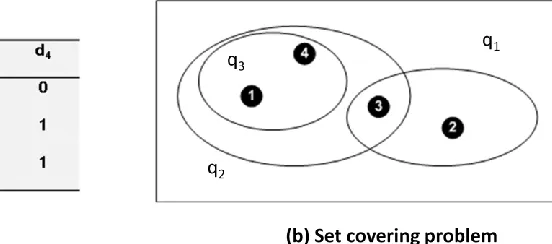
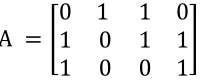
matrix as illustrated in Figure 7. In Figure 7 (a), the matrix represents the relationship
between three queries (q1, q2, q3) and four documents (d1, d2, d3, d4). If the cell (i,j) is
1, query in the ith row (qi) is contained in the document in the jth column (dj). This
matrix representation can be illustrated by Figure 7 (b). The rectangle in Figure 7 (b)
represents the whole document set. Each document is represented as a black point inside
the rectangle. Every oval in the figure (b) represents a set of documents covered by a
query.
Figure 7: Formalization of the query selection problem
The minimum set cover problem can be formulated as the Integer Linear
Program [11]. According to the integer linear program formulation in [11], we formalize
the set covering problem for query selection as the following: Let A is an m*n matrix of
0 and 1 representing a document collection like Figure 7(a). The set covering problem is
to find a solution m-vector S whose Si = 0 or 1 ( i = 1,…,m ) that is representing whether
the query i is either chosen or not. Ci is an m-vector of positive integer that is
of ones that is representing every document in the matrix A is covered. More formally, it
can be formulated as below:
(3)
(4)
where Si = {0,1| i = 1,…,m}; Ei = {1|i=1,…,n}; Ci = { i = 1,…,m}.
For instance, there are two solutions: {q1, q2} and {q1, q3} for the problem in the
Figure 7. From the Figure 7 (a), we can know:
There are three subset q1, q2, and q3 in the matrix A. By the definition of C:
First step, we verify both solutions are satisfied with the condition.
Subject to:
Thus,
LHS=
For the solution {q1, q3}:
Thus,
LHS=
Therefore, both solutions subject to the condition:
In the next step, we calculate the cost for both solutions.
For the solution {q1, q2}:
Total cost =
Total cost =
By the objective function Formula (3), we know the solution 2 is better than the
CHAPTER IV
SET COVERING ALGORITHMS
Set covering problem has been proved to be NP-Complete [6]. Optimal solution is
hard to obtain within polynomial time. Various optimization algorithms are developed,
such as Greedy, Weighted Greedy, Genetic, and Clustering etc. Traditional Greedy and
Weighted Greedy algorithms will be implemented in experiment section.
4.1. Greedy Algorithm
One popular algorithm for set covering problem is the greedy algorithm which
chooses queries according to one rule: at each round, always selects the query that covers
the largest number of new documents per unit cost. A greedy algorithm makes the locally
“best” choice at each stage, but it is not the best choice globally. Assuming we have
constructed a query pool with a set of queries, greedy algorithm is to find the most
effective query from the query pool.
Greedy Algorithm:
Input: m * n Matrix A;
Output: A solution m-vector S;
B = A;
E is an n-vector, and initializes every element to 1;
S and c is an m-vector, and initialize every element to 0;
while {
for( i=1; i<= m; i++){
newi = ;
ci = dfi / newi;
}
Find a k which minimizes ck ;
Sk =1;
Remove the kth row and jth column from B, if cellij =1;
}
for (j = 1; j <=m; j++){
if(Sj = 1 and Aj is redundant) Sj = 0;
}
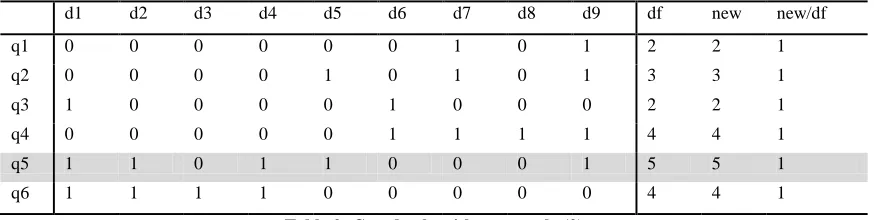
For example, the matrix below represents a sample database which contains nine
documents (d1, d2, d3, …, d9). Suppose our query pool includes six queries (q1, q2, q3,
q4, q5, and q6).
d1 d2 d3 d4 d5 d6 d7 d8 d9
q1 0 0 0 0 0 0 1 0 1
q2 0 0 0 0 1 0 1 0 1
q3 1 0 0 0 0 1 0 0 0
q4 0 0 0 0 0 1 1 1 0
q5 1 1 0 1 1 0 0 0 1
q6 1 1 1 1 0 0 0 0 0
Table 1: Greedy algorithm example (1)
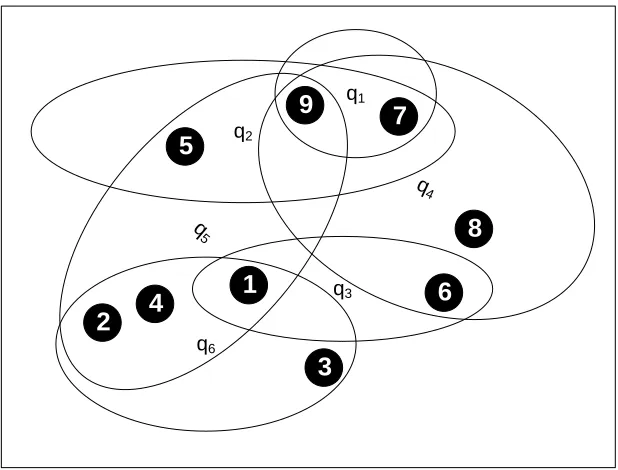
By the rule mentioned above, we can convert the matrix to a set-covering problem
as the figure below. We choose sets (queries) by greedy algorithm to cover all
documents. The whole procedure is listed as following:
1 2 3 4 q6 q2 q1 5 6 7 8 9 q3 q4 q 5
Round 1: Add q5 into query pool, the value of new/df for each query is equal to 1.
As a result, we randomly select the query with largest df.
d1 d2 d3 d4 d5 d6 d7 d8 d9 df new new/df
q1 0 0 0 0 0 0 1 0 1 2 2 1
q2 0 0 0 0 1 0 1 0 1 3 3 1
q3 1 0 0 0 0 1 0 0 0 2 2 1
q4 0 0 0 0 0 1 1 1 1 4 4 1
q5 1 1 0 1 1 0 0 0 1 5 5 1
q6 1 1 1 1 0 0 0 0 0 4 4 1
Table 2: Greedy algorithm example (2)
Round 2: Add q4 into query pool, since new/df(q4) = ¾ is maximum value in the
last column.
d1 d2 d3 d4 d5 d6 d7 d8 d9 df new new/df
q1 0 0 0 0 0 0 1 0 1 2 1 1/2
q2 0 0 0 0 1 0 1 0 1 3 1 1/3
q3 1 0 0 0 0 1 0 0 0 2 1 1/2
q4 0 0 0 0 0 1 1 1 1 4 3 3/4
q5 1 1 0 1 1 0 0 0 1 5 -- --
q6 1 1 1 1 0 0 0 0 0 4 1 1/4
Table 3: Greedy algorithm example (3)
Round 3: Add q6 into query pool, since new/df(q6) = ¼ is maximum value in the
last column.
d1 d2 d3 d4 d5 d6 d7 d8 d9 df new new/df
q1 0 0 0 0 0 0 1 0 1 2 0 0
q2 0 0 0 0 1 0 1 0 1 3 0 0
q3 1 0 0 0 0 1 0 0 0 2 0 0
q4 0 0 0 0 0 1 1 1 1 4 -- --
q5 1 1 0 1 1 0 0 0 1 5 -- --
q6 1 1 1 1 0 0 0 0 0 4 1 1/4
Table 4: Greedy algorithm example (4)
Therefore, the Solution of this example is {q5, q4, q6}.
1 2 3 4 q6 5 6 7 8 9 q4 q 5 1 2 3 4 5 6 7 8 9 q4 q 5 1 2 3 4 5 6 7 8 9 q 5
Figure 9: the whole procedure of Greedy Algorithm
Check whether the solution {q5, q4, q6} covers all the documents by:
Thus, =
Next, calculate the cost of the solution {q5, q4, q6}:
Total cost =
4.2. Weighted Algorithm
Traditional set covering algorithms do not work well when applied to deep web
crawling due to various special features of the application domain. Typically, most set
covering algorithms ignore the distribution of document frequencies. In [34], the authors
developed a new set covering algorithm that targets the deep web crawling. Instead of
straightforward greedy set covering algorithm, it introduces weights into the greedy
strategy. They use Document Frequency df (the number of documents that contain a
specific earlier query.), Document Weight dw (the inverse of the number of terms in QP
that occurs in the document), and Query Weight qw(the sum of the document weights of
all documents containing term q). The weighted greedy algorithm is based on choosing
the query with the smallest df/qw.
To improve simple greedy algorithm and decrease the overlap, the weighted
greedy algorithm instead of a straightforward greedy set covering algorithm. The
definitions are introduced as follows:
Definition 3 (Document Weight): Let D={d1,…,dm} be the SampleDB and
QP={q1,…,qn} be the QueryPool. We consider each document as a set of terms and use
the notation qj di to indicate that a term qj occurs in the document di. The weight of a
document with respect to QP and di (1≤i≤m), denoted by dw(di, QP) (or dw for shot), is
the inverse of the number of terms in QP that occurs in the document di, i.e.
Definition 4 (Query Weight): The weight of a query qj (1≤j≤n) in QP with
respect to D, denoted by qw(qj, QP) (or qw for short), is the sum of the document weights
of all documents containing term qj, i.e.,
Weighted Greedy Algorithm:
Input: m * n Matrix A;
Output: A solution m-vector S;
B = A;
E is an n-vector, and initializes every element to 1;
S and c is an m-vector, and initialize every element to 0;
While {
for( i=1; i<= m; i++){
;
ci = dfi / qwi;
}
Find a k which minimizes ck ;
Sk =1;
Remove the kth row and jth column from B, if cellij =1;
}
for (j = 1; j <=m; j++){
if(Sj = 1 and Aj is redundant) Sj = 0;
}
return S;
The weighted greedy algorithm always selects the next query with the largest
“qw/df". Based on this rule, the weighted greedy algorithm selects keywords from
much better result than the simple greedy method in the SampleDB, so it should be
expected to retrieve a better result in the TotalDB.
By Weighted Greedy Algorithm, we can get the Solution #2(q6, q4, q2) for
example 2.
Round 1:
d1 d2 d3 d4 d5 d6 d7 d8 d9 df qw qw/df
q1 0 0 0 0 0 0 0.333 0 0.25 2 0.583 0.292
q2 0 0 0 0 0.5 0 0.333 0 0.25 3 1.083 0.361
q3 1 0 0 0 0 0.5 0 0 0 2 1.5 0.75
q4 0 0 0 0 0 0.5 0.333 1 0.25 4 2.083 0.521
q5 0.5 0.5 0 0.5 0.5 0 0 0 0.25 5 2.25 0.45
q6 0.5 0.5 1 0.5 0 0 0 0 0 4 2.5 0.625
Table 5: Wighted Greedy algorithm example (1)
Round 2:
d1 d2 d3 d4 d5 d6 d7 d8 d9 df qw qw/df
q1 0 0 0 0 0 0 0.333 0 0.25 2 0.583 0.292
q2 0 0 0 0 0.5 0 0.333 0 0.25 3 1.083 0.361
q3 1 0 0 0 0 0.5 0 0 0 2 0.5 0.25
q4 0 0 0 0 0 0.5 0.333 1 0.25 4 2.083 0.521
q5 0.5 0.5 0 0.5 0.5 0 0 0 0.25 5 0.75 0.15
q6 0.5 0.5 1 0.5 0 0 0 0 0 4 - -
Table 6: Wighted Greedy algorithm example (2)
Round 3:
d1 d2 d3 d4 d5 d6 d7 d8 d9 df qw qw/df
q1 0 0 0 0 0 0 0.333 0 0.25 2 0 0
q2 0 0 0 0 0.5 0 0.333 0 0.25 3 0.5 0.1667
q3 1 0 0 0 0 0.5 0 0 0 2 0 0
q4 0 0 0 0 0 0.5 0.333 1 0.25 4 - -
q5 0.5 0.5 0 0.5 0.5 0 0 0 0.25 5 0.5 0.1
q6 0.5 0.5 1 0.5 0 0 0 0 0 4 - -
We transfer the whole procedure of choosing sets by the weighted greedy
algorithm in set covering view as picture below.
1 2 3 4 q6 q2 5 6 7 8 9 q4 1 2 3 4 q6 5 6 7 8 9 q4 1 2 3 4 q6 5 6 7 8 9
Figure 10 : the whole procedure in set covering view (by Weighted Greedy Algorithm)
Check whether the solution {q6, q4, q2} covers all the documents by:
=
Therefore, all the documents are covered by the solution {q6, q4, q2}.
Next, calculate the cost of the solution {q6, q4, q2}:
Total cost =
By comparing with the cost in the example of section 4.1, we can see the solution
given by weighted greedy algorithm is better than the solution generated by conventional
greedy algorithm.
4.3. Ranking Problem
Return limitation and ranking policy results in the ranking problem. Many hidden
of documents, the deep web sites only return at most k documents. This is called return
limitation. Ranking policy is the rule of sorting results.
Figure 11: A deep web site usually set up a return limitation
Ranking policy generally could be either static or dynamic. A static ranking, say
the web service of “twitter.com”, sorts the results by the order of date and time. A
dynamic ranking could sort the results by the relevance to the query. Those documents
that are highly related to the search query will be listed on the top. The more relevant to
the search query, the position of a document is closer to the top. However for the
commercial search engines, the ranking policy is much more complex. Generally, the
commercial search engines rank the results mainly by the order of relevance and
importance. The relevance of web pages will be evaluated by many factors: such as the
number of occurrence times, the position of appearance, and whether the title contains the
term etc. The importance of web pages will be measured by other criteria, e.g., the
number of links to the web page from the other websites and the reputation of those
websites. Once the search engine has sorted a list of documents with their scores, it will
choose the top k documents as the results for a query.
The return limitation gives us a great challenge to download data from the deep
select the terms with high document frequency as queries. These queries are supposed to
match a large number of documents. However because of the return limitation, only at
maximal k number of documents can be downloaded.
When a deep web site sets up a return limitation, the rule of ranking is also a
critical problem for deep web crawling. By Lu et al. [17]’s previous research, if a search
engine commits static ranking rule, there is the following result:
(5)
where M is the number of documents that can be downloaded; k is the return
limitation; dfq is the lower bound of document frequencies of all queries sent; N is data
source size.
This formula shows that if we select high frequency terms as queries, fewer
documents can be downloaded. For example, suppose we keep submitting queries whose
document frequency is greater than 200 to a deep web search engine whose k equals to
100. By Equation 5, if the search engine lists the result with static ranking policy, the
total number of documents which can be downloaded should be:
No matter how many queries are sent. Despite dynamic ranking policy could
alleviate such a ranking problem, those popular terms are still not a good choice.
Therefore our idea is to select the queries whose document frequencies are less than k.
whose document frequency is less than k. However we do not know the document
frequency of a term until we submit the term as query. Hence, we have to estimate the
document frequency of a term. One straight-forward method is to estimate the document
frequency of a term in the total database by using sample database. Assuming that the
probability of a term in the sample database and the total database is the same, the
document frequency of a term can be estimated by:
(6)
The method that we apply document frequency estimation method on the
weighted greedy algorithm to choose queries from the sample database is called
DF-Weighted algorithm.
DF-Weighted firstly estimates the document frequency of total database for all the
terms in the sample database. The terms whose document frequency is less than k are
selected to generate a matrix with all the documents covered by them. After that, the
matrix is processed as the input of weighted greedy algorithm. Then weighted greedy
CHAPTER V
EXPERIMENTS
5.1. Experimental Environment
The task of our experiments is to evaluate various downloading policies described
in Charter 3 on real deep web sites. We select Bing web service as our test bed and use
slices of the data indexed in Bing as various deep web data sources. Those slices can be
web sites, such as cs.berkeley.edu, which can be accessed using Bing search syntax “site:
cs.berkeley.edu”. Such search interface and the results from Bing are quite similar to the
search box provided by the web site itself. Thus we can simulate the access to almost all
the web sites as searchable deep web data sources.
For example, if we plan to test on “cs.berkeley.ca”, we can repeatedly submit
queries to Bing search engine like “site: cs.berkeley.edu [query]”, as shown in Figure 12.
In this thesis, instead of using html form search interface, we submit the queries to
Bing web service. Therefore we do not need to fill the html query form and extract the
data from html result pages.
Bing API provides HTTP Get to implement the process of submitting requests. A
request to the HTTP endpoint consists of an HTTP GET request to the appropriate URI.
There are two URIs, one for XML results and one for JSON results. The XML format is
used in our experiment. So we submit our requests to the URI: “
http://api.search.live.net/xml.aspx” . If we want to query the site “cs.berkeley.edu” for
the pages matching the term “large”, the complete request sent to Bing web service is:
http://api.search.live.net/xml.aspx?Appid=<AppID>&query=site:cs.berkeley.edu%20larg
e&sources=web.
Figure 13: Response page from Bing web service
The picture above is a portion of response page. Several returned elements are
explained below:
1) The Total element, “<web:Total>”, contains the estimated number of results
inaccurate number, we use our own estimation of the size by exhaustively
sending a very large number of queries.
2) The Offset element, “<web:offset>”, indicates the current position of the
result set you are processing. You can change Offset using the optional
Offset parameter. Each response page at most contains 50 results. This
means, if a query matches 100 results, you need to submit this query twice to
Bing web services. For example, if you wanted to ask for 50 results at a time,
you would pass “web.count=50” as part of the query string. If you wanted to
get the next 50 results after getting the first results, you would pass
“web.offset=51”. The full URI would be as the following:
http://api.search.live.net/xml.aspx?
Appid=<AppID>&query=site:cs.berkeley.edu%20large&sources=web
&web.count=50&web.offset=51
Bing web service imposes some challenges for deep web crawling, such as return
limitation, ranking of the returns, paginated results, and inter-page overlapping.
1) Return limit, only top one thousand of results can be returned per query.
2) Inter-page overlap: Bing web service sometimes even could return same
documents when you issue a query. In our experimental result, we had pruned this
kind of duplicate.
3) Ranking criteria: Comparing local simulation data source, we do not know the
rule of Bing search engine for ranking results. This problem also gives us a new
In order to facilitate the experiment on Bing web service, we build a web service
crawler. The figure below is the GUI and the dataflow diagram of our crawler. To make
the crawler more flexible, the system is independent of algorithms. A query selection
algorithm output the queries to a text file. And our WS-Crawler read the queries from the
text file and creates a query pool.
Figure 15: Dataflow diagram of our crawler
5.2. Evaluation Criteria
When we select queries from documents by different algorithms, the solutions
should be also different. In order to evaluate which solution performance is better, we
select Hit Rate [22] and Overlapping Rate [22] as our evaluation criteria.
Hit rate is to measure how many percentages of documents are harvested by the
crawler. So Hit Rate is equal to the number of unique documents downloaded divide by
the total number of documents in the web database.
Overlapping rate is used to measure the communication cost. In the formula (8),
Overlapping Rate is equal to the number of documents downloaded, including duplicate
documents divide by the number of unique documents downloaded.
(8)
For example, we have a document set which contains 4 documents (d1, d2, d3, and
d4). There are 3 queries (q1, q2, and q3) in our query pool. The relation between the
documents and queries is shown in the Figure 7. We have two solutions that can cover all
of documents. One is {q1, q2}, and the other is {q1, q3}.
Solution 1:
Solution 2:
The hit rate for both solutions is same. However the overlapping rate of solution 2
is lower, this means the solution 2 reaches 100 percent coverage with less documents
5.3. Experiments
5.3.1 Sample Databases Creation
The experiments are carried on three data sources: “cs.berkeley.edu”,
“uwaterloo.ca”, and “ctv.ca”. For each data source, we create three samples whose sizes
are approximately 5%, 10%, and 20% of the original data source. We create three
different sample databases for each data source. The sizes of those sample databases are
approximately 5%, 10%, and 20%. the sample databases are built as follows:
1) Randomly select queries from the Webster dictionary that contains about
59000 terms;
2) Issue some of those queries to Bing web service and download more than 20%
documents;
3) All those documents can be divided into many portions by queries. We
randomly compose those sets of documents into about 5%, 10%, or 20%
document collection;
4) Use Lucene (a tool to index the documents) to create sample databases.
Table 8: Description of Data Sources and Sample Databases
Data Source cs.berkeley.edu uwaterloo.ca ctv.ca
Approximate
(N)
30,000 150,000 140,000
Sample Size
1548 8019 6911
3319 13924 14504
5.3.2 Ranking Strength Observation on the Data Sources
Ranking problem has a great effect on the performance of downloading data from
the deep web sites. Thus to measure the ranking strength of the data sources is necessary.
Ranking strength is measured by calculating the percentage of queries which are within
the return limitation. All the selected terms whose document frequency is bigger than 1
from the three sample databases (20%N). All those terms are submitted to the Bing web
service and k has default value 1000. Then we can get the number of terms whose
document frequencies are less than 100 and 200.
Table 9: Percentage of Terms within k
From Table 9, we can make the following observation:
Because the size of data source “cs.berkeley.edu” is small, the matches of the
most of queries do not exceed the return limit. Therefore ranking strength in this data
source is weak.
Despite the size of “ctv.ca” and “uwaterloo.ca” is very close, words of “ctv.ca”
are very generic. The percentage of popular terms of “ctv.ca” is higher than
“uwaterloo.ca”. Hence ranking strength of “ctv.ca” is stronger than “uwaterloo.ca”.
Data Source
Approximate
(N)
Terms
Num (tn)
df100 df100 /tn df200 df200 / tn
Ranking
Strength
cs.berkeley.edu 30,000 48,522 36,546 75% 39,627 81% weak
uwaterloo.ca 150,000 271,530 173,438 64% 184,403 68% middle
5.3.3 Comparison on Query Selection Policies
We evaluate four query selection policies on 27 combinations of experiment
environments. For each data source, we set up three different return limitations (100, 200
and 1000) and three different sample databases (approximately 5%, 10%, and 20%). We
evaluated the four query selection policies as the following:
Random: Randomly selects queries from the Webster dictionary;
Sampling based policies: Greedy, Weighted Greedy, and DF-Weighted
greedy policies.
As mentioned before, those sampling based algorithms select queries from the
matrixes. However if we generate the matrix by exporting all the terms from a sample
database, this matrix will be so large that the memory of our computer cannot afford it.
By the research of [16], we keep randomly selecting terms from the sample database until
the total document frequencies of terms is 20 times of the size of sample database. We
used those terms to create the matrix as mentioned in the section 3. Finally three
sampling based algorithms are run on the matrix.
Because we evaluate the crawling performance by comparing the value of OR and
HR. In our experiments, we design a chart to record the value of OR, HR and the raw
data as Table 10.
Query est mi mi ui di Mi Ni or OR HR
q1
q2
….
qi
Below is the explanation for the columns in the table 9:
1) est mi: matches estimated by Bing search engine;
2) mi: actual matches;
3) ui : the number of new documents retrieved by a query;
4) di: the number of duplicate documents retrieved by a query;
5) Mi: the number of total matches (includes duplicate docs) retrieved by
{q1 …qi};
6) Ni: the number of total unique documents retrieved by {q1 …qi};
7) or: the overlapping rate of a query;
8) OR: the overlapping rate up to qi;
9) HR: the hit rate up to qi.
After running 108 (4×27) experiments on 27 combinations, we create 27
performance diagrams. The values of OR are plotted on x-axis, and the values of HR are
plotted on y-axis. All performance diagrams are listed in the appendix I. We select some
Figure 16: Performance Diagrams of cs.berkeley.edu
The first three diagrams come from the data source “cs.berkeley.edu”. As said
before, the ranking strength of this data source with respect to the queries is weak. Most
of queries issued do not exceed return limitation k. In other words, the Weighted Greedy
is similar to the DF-Weighted. Thus our proposed method does not show any advantage
Figure 17: Performance Diagrams of uwaterloo.ca
However things change in the performance diagrams of “uwaterloo.ca”. As
ranking strength becomes stronger, DF-Weighted performs better in the data sources:
“uwaterloo.ca”. This can be observed from Figure 17. DF-Weighted performs best in
Figure 18: Performance Diagrams of ctv.ca
Greedy algorithm and weighted algorithm are originally designed to solve
un-ranking data sources. But the un-ranking strength of “ctv.ca” is just strongest in three data
sources. From the Figure 18, diagrams show ranking problem gives a great trouble to
both algorithms. Let’s take an example to explain. “Home” is a word with highest
document frequency and appears in the most of web pages of “ctv.ca”. According to the
rule of the greedy algorithm, the word “home” must be selected by the greedy algorithm.
However, it cannot retrieve as much as expected documents, due to return limitation.
Therefore, it is difficult to achieve a high HR for the greedy and weighted algorithm. But
our DF-Weighted algorithm just could solve this problem perfectly. Performance
“uwaterloo.ca” and “ctv.ca”. To make it clearer, we construct a table (Table 11). We list
their HR at a fix OR value for two data sources: “uwaterloo.ca” and “ctv.ca”. We can
observe DF-Weighted greedy algorithm performs best except the situation in the first
row.
Random Greedy Weighted
DF-Weighted Dictionary
data Sample
size(%) k OR HR(%) HR(%) HR(%) HR(%)
uwaterloo.ca 5
100 1.4 12 19 20 19
200 1.4 16 22 23 25
1000 1.4 15 25 25 30
10
100 1.4 12 15 19 19
200 1.4 16 20 23 23
1000 1.4 15 23 25 25
20
100 1.4 12 18 21 22
200 1.4 16 20 22 22.5
1000 1.4 15 19 22 23
ctv.ca
5 100 1.4 17.5 - - 26.5
200 1.4 18 - - 27
1000 1.4 21.5 - - 26
10 100 1.4 17.5 - - 29
200 1.4 18 - - 30
1000 1.4 21.5 - - 31
20 100 1.4 17.5 - - 29
200 1.4 18 - - 32
1000 1.4 21.5 - - 32
Additionally, from all the performance diagrams, we also found: between greedy
algorithm and weighted greedy algorithm, the latter one outperforms the former a little bit
in the most of cases. To make it clearer, we construct a new table (Table 12). We list their
HR at a fix OR value for two data sources: “cs.berkeley.edu” and “uwaterloo.ca”. We can
observe weighted greedy algorithm always performs better than greedy algorithm.
Greedy Weighted
data Sample size (%) k OR HR(%) HR(%)
cs.berkeley.edu
5
100 1.5 21 24
200 1.5 23 25
1000 1.5 22 23
10
100 1.5 19 22
200 1.5 20 22
1000 1.5 21 23
20
100 1.5 23 23
200 1.5 24 26
1000 1.5 24 26
uwaterloo.ca
5
100 1.4 19 20
200 1.4 22 23
1000 1.4 25 25
10
100 1.4 15 19
200 1.4 20 23
1000 1.4 23 25
20
100 1.4 18 21
200 1.4 20 22
1000 1.4 19 22
Table 12: Comparison of Greedy and Weighted
5.3.4 Effect of Ranking Problem on HDF
Barbosa’s algorithm always selects highest document frequency queries at each
round. In order to clear the effect of ranking problem on the high document frequency
get the actual document frequency for the terms by submitting all terms in the sample
database to the Bing web service. Then we extract all the terms whose document
frequency is at least 200 to generate a new set of queries and store them in a text file.
The text file is called HDF dictionary.
Sample database (20%N) Terms (df > 1) Terms (df ≥200)
cs.berkeley.edu 48,522 5,339
uwaterloo.ca 271,530 25,042
ctv.ca 232,146 20,269
Table 13: The number of terms for three data sources
At the beginning, we set up k to 100 for all the experiments. In the first
experiment, we randomly submit the sample terms. We call this approach Sample
Random. In the second experiment, we select those queries in the HDF dictionary as
queries. Due to this approach always selects high frequency queries, it is denoted by
HDF. In order to generate enough super high document frequency terms, we create a set
of disjunctive queries by randomly combining the terms of HDF dictionary with OR rule,
say “initially OR heidelberg OR social OR theatres OR overall OR include”. In the third
experiment, we issue the disjunctive queries containing five terms. That approach is
called HDF5. In the same way, the approach issuing a set of disjunctive queries with 10
or 15 terms is denoted by HDF10 or HDF15. We donate those four approaches selecting
high document frequency queries to HDF policy. The performance diagrams of five
Figure 19: Comparison on Random Sample Terms and High DF Terms
In Figure 19, we can make the following observation: For HDF policy, the
document frequency of queries are higher, the performance performs worse. In the Figure
19 (a), when ranking strength of the “cs.berkeley.edu” is weak, the performance of HDF
approach beats Random Sample approach. However as ranking strength becomes
stronger in the “uwaterloo.ca” and “ctv.ca”, the performance of HDF approach is even
worse than the Random Sample approach. Those experiments prove HDF policy cannot
CHAPTER VI
CONCLUSION AND FUTURE WORK
6.1 Conclusion
This thesis studies query selection problem so that our crawler efficiently accesses
the content of deep web. To achieve this goal, we select the candidate queries from a
sample database using set covering algorithms.
A conventional method for the set covering problem is the greedy algorithm. And
the weighted greedy is a variation of the greedy by introducing query weight.
Additionally, in order to focus on query selection problem, we access the deep web via
web services. Most of these services set up a return limitation for the results. To increase
the crawling performance, we developed DF-Weighted algorithm by introducing
document frequency estimation based on the sample database.
We carry out our experiments on Bing web service and choose “cs.berkeley.edu”,
“uwaterloo.ca”, and “ctv.ca” as the data sources. We choose HR and OR as the
evaluation criteria. We evaluate four query selection policies: random queries from
dictionary, greedy algorithm, weighted greedy algorithm, and df-weighted algorithm.
Experimental evaluation shows:
Weighted greedy algorithm outperforms the greedy algorithm in most
experiments.
The DF-Weighted algorithm achieves excellent performance in the strong
It is difficult for HDF policy to achieve good performance in the ranking
data sources.
6.2 Future Work
The limit of the number of returns is a big challenge for crawling deep web. The
limitation is stricter, it is more necessary to adopt a good query selection approach for a
deep web crawler. The df-weighted algorithm achieves a surprising result in the
experiments, but document frequency estimation method is indeed very naive. Beside
independent maximum likelihood estimation method (our approach), some other
approaches [14] [23] [19] [13] have been proposed. If we incorporate these estimation
methods into the queries selection technique, we believe this should be helpful to achieve
better performance.
We also discover, when the size of data source is pretty large (e.g. >1 million) and
the return limitation (e.g. 10) is very small, it is very hard to achieve a high HR. To solve
this problem, the multiple keywords combination is a possible method. The main problem
is how to combine a query with several keywords without exceed the return limitation
and with low cost.
In this thesis, we only focus on the textual database. But how to select queries to
download relational database is also interesting topic. For the relational database, html
query form usually also provide multiple attributes interface. We can apply the same idea
frequency based sample database. Predicting the document frequency of the values of
APPENDIX I
All Experimental Results of 27 Combinations:
cs.berkeley.edu Sample size = 10% Limitation = 200 cs.berkeley.edu Sample size = 10% Limitation = 1000
(a) cs.berkeley.edu Sample size = 5% Limitation = 100 (b) cs.berkeley.edu Sample size = 5% Limitation = 200
cs.berkeley.edu Sample size = 20% Limitation = 100 cs.berkeley.edu Sample size = 20% Limitation = 200
cs.berkeley.edu Sample size = 20% Limitation = 1000 uwaterloo.ca Sample size = 5% Limitation = 100
uwaterloo.ca Sample size = 10% Limitation = 100 uwaterloo.ca Sample size = 10% Limitation = 200
uwaterloo.ca Sample size = 10% Limitation = 1000 uwaterloo.ca Sample size = 20% Limitation = 100
ctv.ca Sample size = 5% Limitation = 100 ctv.ca Sample size = 5% Limitation = 200
ctv.ca Sample size = 5% Limitation = 1000 ctv.ca Sample size = 10% Limitation = 100
ctv.ca Sample size = 20% Limitation = 100 ctv.ca Sample size = 20% Limitation = 200
REFERENCES
1 Agichtein.E, Ipeirotis.P, Gravano.L. Modeling Query-Based Access to Text Databases. WEBDB
(2003), 87-92.
2 Alvarez.M, et al. Extracting lists of data records from semistructured web pages. Data & Knowledge Engineering, vol. 64 , no. 2 ( 2008), pp. 491–509.
3 Barbosa.L, Freire.J. Siphoning hidden-web data through keyword-based interfaces. In:Proc.of
SBBD,309-321 (2004), 309-321.
4 Bergman.M.K. The deep web:Surfacing hidden value. the Journal of Electronic Publishing, 7(1)
(2001), 07-01.
5 Chakrabarti.S, Van.B.M, Dom.B. Focused crawling:A new approach for topic specific resource
discovery. Computer Networks, Elsevier, 31 (1999), 1623-1640.
6 Cormen.T.H, Leiserson C.E, and Rivest R.L. Introduction to Algorithms, 2nd Edition. MIT Press/McGraw Hill, 2001.
7 Florescu.D, Levy.A.Y, and Mendelzon.A.O. Database techniques for the world-wide web:A
survey. SIGMOD Record, 27(3) (1998), 59-74.
8 He.B. Accessing the deep web. Communications of the ACM 50(5) (2007), 94-101.
9 He.H, Meng.W, Yu.C.T, and Wu.Z. Automatic Integration of Web Search Interfaces with
WISE-Integrator. VLDB Journal (2004), 13(3):256-273.
10 http://en.wikipedia.org/wiki/Deep_Web(2010).
11 http://en.wikipedia.org/wiki/Set_cover_problem(2010).
12 Ipeirotis.P, Gravano.L. Distributed search over the hidden web: Hierarchical database
sampling and selection. In Proceedings of VLDB (August 2002).
13 Ipeirotis.P.G, Gravano.L. Distributed search over the hidden web: hierarchical database
sampling and selection. Proceedings of the 28th international conference on Very Large Data
Bases, Hong Kong, China:VLDB Endowment (2002), 394-405.
14 Jenlinek.F, Mercer.R. Interpolated estimation of markov sourceparameters from sparse data.
workshop on Pattern Recognition in Practice, 381-397 (1980).