Review on Ant Colony Optimization and
Optimal path in VANET
Harmandeep Kaur1, Rajesh Kumar2
PG Student, Dept. of CSE, Bhai Gurdas Institute of Engineering and Technology, Sangrur, India1
Assistant Professor, Dept. of CSE, Bhai Gurdas Institute of Engineering and Technology, Sangrur, India2
ABSTRACT: Vehicular Ad-hoc Network is a technology used to improve road safety. VANETs are used to
communicate amongst emergency responder’s fire trucks, main data centres and ambulances etc. It increases the effectiveness of communication and lowers the response time to save the lives. The information such as whereabouts, terminus, and speed history have the potential to be intercepted, due to higher mobility security is more challenging. The main challenges in VANET are examining, preserving an actual route for conveying data information. Today some kind of routing protocols used in VANET. Hence, an investigation on routing protocols based on a number of constraints of VANET i.e. a prerequisite issue in communication. This routing protocol is likewise used in VANETs. AODV protocol suffers the nastiest performance when it is openly applied in VANET. In this paper, the approach used is Ant Colony Optimization for evaluate the throughput, overhead and delay of the node in a network.
KEYWORDS: VANET (Vehicular Ad-hoc Network);ACO (Ant Colony Optimization), Path Optimization, metaheuristics, Unicast, Broadcast, Multicast, Hierarchical, ONE Simulator.
I. INTRODUCTION
VANETstands for ‘Vehicular Ad-hoc Network’. It is a particular kind of MANET (Mobile Ad-hoc Network). In VANET means of transportation (Cars, buses etc.) acts as nodes and each vehicle is furnished with communication competencies and are connected to form a network. It forms a dynamic topology and most notably it is a non- uniformly distributed. So to send a message in these linkages MANET are not suitable. These inter-connected automobiles use wireless technology to associate vehicles to each other and to infrastructure. These are intended to increase safety, driving efficiency and make the driving experience comfier. According to studies, about 1.3 million deaths occur from road traffic misfortunes per year but using wireless technologies about 60% of accidents can be avoided with ample warnings. Technically, VANETs use IEEE 802.11 wireless communication protocol and two types of messages sent within VANETs are periodic safety messages and event driven messages, Here in VANETs broadcast range is about 1000 meters and nodes more than an average speed of 120 Kilometers per hour [3][9].
In VANETs mobile nodes are constantly changing network leading movement fashion usually occurs on a lengthy freeways power supply and conservation is not a major concern in VANETs. VANETs provides safety, emergency and convenience services via VANETs are Navigation services, emergency response. VANETs are used to disseminate alerts such as Amber alerts, silver alerts, and emergency weather alerts. The motor vehicle GPS location determines the alert receives. It has likely to save lives. Wireless nature of transmission proposes security and privacy concerns. The information such as whereabouts, terminus, and speed history have the potential to be intercepted, due to higher mobility security is more challenging [3].
Figure1. VANET Architecture
VANETs are used to communicate amongst emergency responder’s fire trucks, main data centers and ambulances etc. It increases the effectiveness of communication and lowers the response time to save the lives [2] [3] [9].
II. ROUTING PROTOCOLS
A. Categories of routing protocols:
Unicast routing protocol.
Broadcast routing protocol.
Multicast/Geo-cast routing protocol.
Figure2. Categories of Routing Protocols
B. Description of routing protocols:
Unicast routing protocol: This protocol transmits packets from only source to a particular destination (One to one). This is a fundamental protocol in Ad-hoc environment and is further classified as given below:
Subcategory 1: Topology Based: These protocols utilize information of the network topology and the communication associations for building routing choices. It uses either proactive or reactive tactics [2].
Subcategory 2: Position based: The routing decision are based on terrestrial position of the vehicles such as GPS, DLS, RLS and SLS [2] [5] [9].
Broadcast routing protocol: In this transmitting protocol packet is sent to all nodes in the network and in turn each node re- broadcast the message to other nodes in the network, and is further classified as given below:
Subcategory 1: Traffic Based: In this algorithm a source node broadcasts a packet to all its neighbors and in turn re-broadcast the packet accurately one time. This process remains until all the nearby nodes have received the packets [2] [9].
Subcategory 2: Area Based: Every vehicle receives multiple packets which may contain over lapping information [2] [9].
Subcategory 3: Cluster Based: This routing protocol for broadcast cluster based protocols broadcast messages to a group of automobiles [2] [9].
Subcategory 4: Probability Based: In the midst of the various broadcast technique to solve the problem of overflowing, probability based approach is becoming eye-catching when there are more competitors to broadcast a pre-set probability is assigned to each node which reduces the chances of collision and re-broadcasting [2] [9].
Multicast/ Geo cast routing protocol: This enables sharing of messages from particular source to a set of destination nodes. Geo cast routing is a location based multicast routing (source node to all nodes) [2] [9].
Subcategory 1: Topology Based: This routing select sending nodes based on the network topology information. A Types of Routing Protocals
Unicast
Topology Based
Position Based Broadcast
Traffic Based
Area Based
Cluster Based
Probabilistic Multicast
Topology Based
Subcategory 2: Location Based: Location based selects accelerating nodes based on location information and the location of nearby nodes and the coordinates of a multicast region. Since forwarding nodes are selected during broad cast of each multicast packet, there is no need to uphold multicast trees end results into less overhead [2] [4].
Cluster Hierarchy: Clustering allows huge networks to be coped efficiently as hierarchical structures. Splitting nodes into clusters forms a single hierarchy whereas, in a multilevel ordered channeling nodes are organized into a tree-like organizations with multiple levels of pools [2] [4].
III.ANT COLONY OPTIMIZATION (ACO)
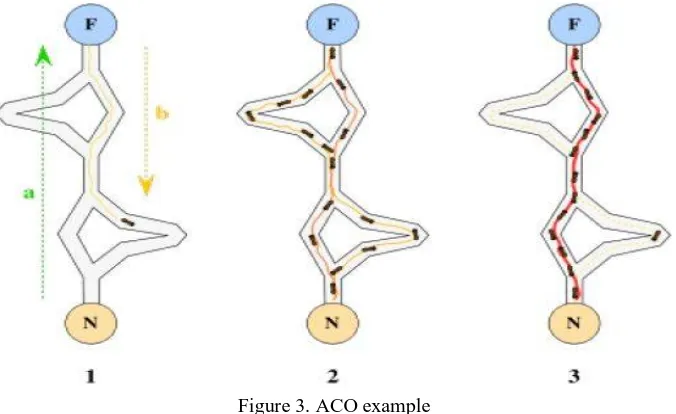
Ant colony optimization (ACO) is a set of rules based on the behavior of the actual ants to find the shortest direction from a supply to the meals. It makes use of the ant’s intelligence whilst trying to find the meals ants deposit a certain amount of pheromone at the path at the same time as visiting and follows the same direction whilst returning returned direction marked by the pheromone. This is a manner ant follow the shorter direction and are expected to return in advance and will increase the pheromone amount on the path at a quicker charge than the ants following the longer direction.
However, the pheromone is subjected to evaporation to a positive quantity at constant rate after a sure c programming language and therefore the paths visited by means of the ants regularly, are most effective stored as marked by using the pheromone deposit, whereas the paths not often visited via the ants are lost due to the lack of pheromone deposit at the course and as an end result the brand new ants are supposed to follow the often used paths handiest.
It's far a probabilistic approach used to search most appropriate course within the graph based on the conduct of ants searching for a path among their colony and supply of meals. It's far a meta-heuristic optimization. The primary concept of ACO is that in this technique shortest path is determined thru pheromone trails, a pheromone is deposited on the direction the extra pheromone on course boom opportunity of path being accompanied [3].
Figure 3. ACO example
Itis a heuristic method for solving a very general class of computational problems by combining user-given heuristics in the hope of obtaining a more efficient procedure, ACO is a metaheuristic. It is a soft computing technique for solving hard discrete optimization problems.
P , = T , , ∑ T , , Where,
T, is the amount of pheromone on edge i, j.
α is a parameter to control the influence of T,
, is desirability of edge i, j (typically 1 / d, )
is a parameter to control the influence of ,
Amount of pheromone is updated according to the equation.
T
, = (1− ) , + T,
Where, T
, is the amount of pheromone on a given edge i, j. p is the rate of pheromone evaporation.
T
, is the amount of pheromone deposited typically given by
T
, =
1
L ( . )
0 ( ℎ )
Where L is the cost of the ACO is metaheuristic have been proposed.
So, artificial intelligence method is used to develop a new approach to clear up issues and it is newly proposed metaheuristic method for solving tough combinational optimization problems, synthetic ants put into effect a randomized construction heuristic which makes probabilistic selections, it indicates superb overall performance with the “ill-declaration” troubles like network routing [3].
IV.ONE SIMULATOR
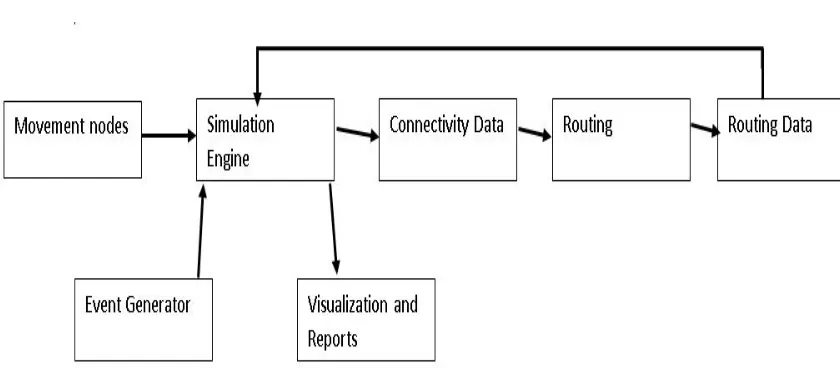
ONE stands for Opportunistic Networking Environment simulator. One is java primarily based tool. It is able to coping with node movement, routing, inter-node contact and message verbal exchange the one is a simulation environment that is proficient of
Producing node movement.
Routing messages among nodes with several DTN routing algorithms.
Visualizing both mobility and communication in real time in its GUI.
ONE can import mobility data from real-world traces. Similarly, it can yield a range of reports on node movement and wide-ranging figures.
Figure 4. Working of ONE Simulator
V. RELATED WORK
In [1] authors have proposed a distributed optimal Community-aware Opportunistic Routing (CAOR) algorithm to show an MSN into a network that handiest includes network houses. That they had shown that in the community of community houses can nevertheless calculate the least expected transport delays of nodes through a reverse Dijkstra set of rules and achieved the surest opportunistic routing overall performance. In the meantime, the range of communities became some distance much less than the variety of nodes in significance, the computational cost and preservation fee of contact data had impressively reduced. They validated how the set of rules expressively accomplishes the earlier ones through massive simulations, based on an actual MSN trace and an artificial MSN hint. [2] In this paper authors have discussed the existing routing protocols for VANETs and categorized them into a taxonomy based totally on key attributes inclusive of community structure, applications supported, routing strategies, forwarding techniques, mobility models and pleasant of carrier metrics. Protocols belonging to unicast, multicast, geo-cast and broadcast classes are mentioned. Strengths and weaknesses of numerous protocols using topology-based totally, role based and cluster-based approaches are analyzed.[3] In this paper, authors have defined routing of facts in distinctly cell network and technique of metaheuristic referred to as ant colony optimization (ACO). ACO has been found to be appropriate for routing and many investigators located it right for VANET. Its feature of pheromone trail makes it extra powerful in terms of routing.In [4] authors have proposed a new hybrid area-primarily based routing protocol that is predominantly designed to address hyperlink failures. This protocol united functions of reactive routing with place-based terrestrial routing in a manner that thoroughly used all of the region facts to be had. The protocol is designed to gracefully go out to reactive routing because the location statistics reduces.In [5] authors have discussed the pros and cons of VANET routing protocols for inter-vehicle communication. In [6] authors have improved the “performance of Ad-hoc on Demand Distance Vector (AODV) routing protocol by using some parameters and compared the proposed AODV protocol performance with Normal AODV in terms of different performance metrics”. In [7] authors have discussed the main processes supposed towards a real and effective answer for video broadcasting over VANET and some of those results were nominated to deliberate their techniques and appropriateness for video broadcasting and compared their performances. In [8] authors have proposed a novel localization protocol for VASNET which gains the benefit of sensor nodes and is totally GPS free. Using GloMoSim simulator the practice has been simulated and detected that by fluctuating the parameters like a number of Road Side Sensors (RSS), communication ranges and rate of well-working sensors, the particular location of a motor vehicle is calculated in 93% cases. In [9] authors offered contemporary VANET and discussed the related problems. Network architecture, sign modelling and propagation mechanism, mobility modelling, routing protocols and network protection are discussed in detail.
VI.PROPOSED WORK
2. In the research work done before there is only connectivity of relay nodes and seen the only shortest path of a relay node.
3. In work done the cluster of nodes is made according to its distance and by some nodes energy is increasinglygradually.
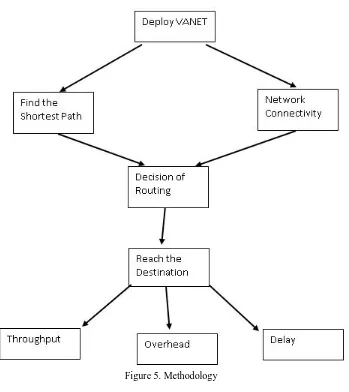
VII. METHODOLOGY
1. Deploy VANET
2. Find the shortest path and Network Connectivity. 3. Take decision of routing.
4. Reach the destiny.
5. Analyse the results of throughput, overhead and delay.
Figure 5. Methodology
VIII. CONCLUSION
REFERENCES
1. Mingjun Xiao, Jie Wu, and Liusheng Huang “Community-Aware Opportunistic Routing in Mobile Social Networks” in IEEE TRANSACTIONS ON COMPUTERS, VOL. 63, NO. 7, pp. 1682-1695, 2014.
2. Venkatesh, Indra, Murali “Routing Protocols for Vehicular Ad hoc Networks (VANETs)” in Journal of Emerging Trends in Computing and Information Sciences, Vol. 5, No. 1, pp. 25-43, 2014.
3. Azmina D. Khanderao and Bhavin I. Shah “Routing Optimization using Ant Colony Optimization in Vehicular Ad-hoc Network: A Survey” in Advances in Computer Science and Information Technology (ACSIT) Volume 2, Number 7, pp 1 – 6, April – June, 2015.
4. Mohammad Al-Rabayah and Robert Malaney “A New Scalable Hybrid Routing Protocol for VANETs” in IEEE TRANSACTIONS ON VEHICULAR TECHNOLOGY, VOL. 61, NO. 6, pp. 2625- 2635, 2012.
5. Bijan Paul, Md. Ibrahim and Md. Abu NaserBikas “VANET Routing Protocols: Pros and Cons” in International Journal of Computer Applications Volume 20– No.3, 2011.
6. Neha Garg and Puneet Rani “An improved AODV routing protocol for VANET (Vehicular Ad-hoc Network)” in International Journal of Science, Engineering and Technology Research (IJSETR), Volume 4, Issue 6, June 2015.
7. FarahnazNaeimipoor, Cristiano Rezende and AzzedineBoukerche “Performance Evaluation of Video Dissemination Protocols over Vehicular Networks” in 8th IEEE International Workshop on Performance and Management of Wireless and Mobile Networks, 2012.
8. Mohammad JalilPiran, G. Rama Murthy, G. Praveen Babu and Ehsan Ahvar “Total GPS-free Localization Protocol for Vehicular Ad Hoc and Sensor Networks (VASNET)” in Third International Conference on Computational Intelligence, Modelling & Simulation, 2011.