A STUDY ON CONDUCTIVE POLYMER NANOCOMPOSITE OF POLYSTYRENE/POLYPYRROLE/MONTMORILLONITE
SOBHAN BAHRAEIAN
A STUDY ON CONDUCTIVE POLYMER NANOCOMPOSITE OF POLYSTYRENE/POLYPYRROLE/MONTMORILLONITE
SOBHAN BAHRAEIAN
A thesis submitted in fulfillment of the requirements for the award of the degree of
Master of Science (Polymer Technology)
Faculty of Chemical Engineering Universiti Teknologi Malaysia
iii
iv
ACKNOWLEDGEMENT
With the Almighty God’s blessing and gracing has led my thesis successfully complete. I would like to take this opportunity to express my gratitude to people who have directly or indirectly contributes towards the success of my research project.
First of all, I would like to express my sincere appreciation to my supervisor, Dr. Rohah. A. Majid for his encouragement and guidance throughout this thesis writing. I am also very thankful to other lecturers from Department of Polymer Engineering especially Assoc. Prof. Dr. Mat Uzir Wahit for their advices and critics, without their continued support and interest, this thesis would not been presented here today.
I am deeply indebted to the technicians and laboratory assistants from Polymer Laboratory for their assistance and cooperation in conducting equipments and testing and sincere thanks to my family for the support, care and love throughout my period of study.
v
ABSTARCT
Conductive nanocomposite of polystyrene/polypyrole/montmorillonite was
prepared by melt-mixing method. Polystyrene properties improved by adding conductive
filler (PPy) and also clay (MMT). This nanocomposite is conductive and the electrical,
thermal and mechanical properties also improved. Firstly, the conductive polypyrrole
(PPy) was synthesized via the chemical polymerization method. Fourier transform
infrared spectrometry (FTIR) and scanning electron microscopy (SEM) were used to
determine the functional group and the particle size of PPy. Later, the PPy at different
weight ratios namely 5, 10, 15 and 20 wt. % were mixed with polystyrene (PS) and
montmorillonite (MMT) to produce conductive nanocomposite. Finally, the
nanocomposite was compression moulded into a thin sheet for further characterizations
and testing. X-ray diffraction (XRD) results showed that the polymer chains were
intercalated between the MMT galleries while the thermal gravimetric analysis (TGA)
had proven that the incorporation of PPy into nanocomposite improved the thermal
stability of sample. The tensile test results revealed that by increasing the amount of PPy
would enhance the strength and the stiffness of the nanocomposite. Meanwhile, by
increasing the weight percentage of PPy, the conductivity values of samples were also
increased. The nanocomposite PS/PPy/MMT which was prepared in this work has wide
vi
ABSTRAK
Nanokomposit berkonduktif polistirena/polipirola/montmorilonite telah disediakan
menggunakan kaedah campuran lebur. Pertamanya, polipirola berkonduktif (PPy) telah
disintesiskan menggunakan kaedah pempolimeran kimia. Spektrometer inframerah (FTIR) dan
mikroskopi imbasan elektron (SEM) telah digunakan untuk menentukan kumpulan berfungsi dan
saiz partikel PPy. Kemudiannya, PPy pada nisbah berat yang berbeza iaitu 5, 10, 15, dan 20 wt%
telah dicampurkan dengan polistirena(PS) dan montmorilonit (MMT) untuk menghasilkan
nanokomposit berkonduktif. Akhirnya, nanokomposit telah diacu mampatkan kapada kepingan
nipis untuk pencirian dan ujian selanjutnya. Keputusan pembelauan sinar-X telah menunjukkan
rantai polimer terinterkalasi diantara galeri MMT, manakala analisis gravimetrik haba (TGA)
telah membuktikan penggabungan PPy ke dalam nanokomposit telah memperbaiki kestabilan
terma sampel. Keputusan ujian tegangan telah mendedahkan dengan meningkat kan amaun PPy
akan menambahkan kekuatan dan kekakuan nanokomposit. Sementara itu, dengan meningkat
kan peratusan berat PPy, nilai kekonduksian sampel juga meningkat. Nanokomposit
PS/PPy/MMT yang telah disediakan dalam kerja ini mempunyai kegunaan yang luas dalam sel
solar, bateri, diod, membran dan superkapasitor.
vii
TABLE OF CONTENTS
CHAPTER TITLE PAGE
TITLE PAGE i
DECLARATION ii
DEDICATION iii
ACKNOWLEDGEMENT iv
ABSTRACT v
ABSTRAK vi
TABLE OF CONTENTS vii
LIST OF TABLES x
LIST OF FIGURES xi
LIST OF ABBREVIATIONS xiii
LIST OF SYMBOLS xiv
1 INTRODUCTION 1
1.1 Background of the study 1
1.2 Problem statement 4
1.3 Objective of the study 5
1.4 Scope of research 5
2 LITERATURE REVIEW 7
2.1 Conductive polymers 7
2.1.1 Background and development 7
2.1.2 Properties 8
2.1.3 Aplication 11
2.2 Polypyrrole 11
2.2.1 Bakhground and development 11
viii
2.2.3 Synthesis of polypyrrole 17
2.2.3.1 Chemical polymerization 17
2.2.3.2 Doping 18
2.3 Polystyrene 20
2.3.1 Background and development 20
2.3.2 General properties 20
2.4 Polypyrrole/Polystyrene 22
2.5 Composite 25
2.5.1 General view 25
2.5.2 Polymer nanocomposites 26
2.5.2.1 Conductive nanocomposite 26
2.5.2.1.1 Host and guest materials for
conducting nanocomposite systems
27
2.6 Organo clay 29
2.6.1 Montmorillonite 30
2.6.2 Montmorillonite and polypyrrole 31
2.7 Polymer/ Clay 33
3 METHODOLOGY 35
3.1 Materials 35
3.1.1 Chemical synthesis of polypyrrole 36
3.1.2 Nanocomposite preparation by melt-mixing 36
3.2 Testing techniques 37
3.2.1 Morphology test and sample characterization 37
3.2.1.1 Scanning electron microscopy (SEM) 37
3.2.1.2 X-ray diffraction (XRD) 38 3.2.1.3 Fourier transform infrared spectroscopy
(FTIR)
38
3.2.2 Thermogravimetric analysis (TGA) 39
3.2.3 Conductivity test 39
ix
4 RESULTS AND DISSCUSSION 42
4.1 Synthesis of PPy 42
4.2 Nanocomposite of PS/PPy/MMT 44
4.2.1 Fourier transforms infrared spectroscopy (FTIR) 44
4.2.2 Conductivity test 46
4.2.3 X-Ray diffraction (XRD) 47
4.2.4 Scanning electron microscope (SEM) 50
4.2.5 Thermal gravimetric analysis (TGA) 51
4.2.6 Tensile test 53
5 CONCLUSION AND RECCOMENDATIONS 56
5.1 Conclusion 56
5.2 Recommendations 57
x
LIST OF TABLES
TABLE NO. TITLE PAGE
2.1 Physical properties of typical metal and conducting polymer 9
2.2 Stability and processing of some conducting polymer 10
2.3 Conductivity of PPy films synthesized from aqueous
electrolytes and from AN
16
3.1 Raw materials for blend and their descriptions 35
3.2 Blend composition 37
4.1 Comparison absorption peaks of PPy from literature and the
laboratory
44
4.2 Absorption peaks of sample blends 46
4.3 Conductivity and resistivity of various PS/PPy/MMT blends 47
4.4 The 2θ angle and d-spacing of MMT for PS/MMT and PS/PPy/MMT nanocomposites
49
xi
LIST OF FIGURES
FIGURE NO. TITLE PAGE
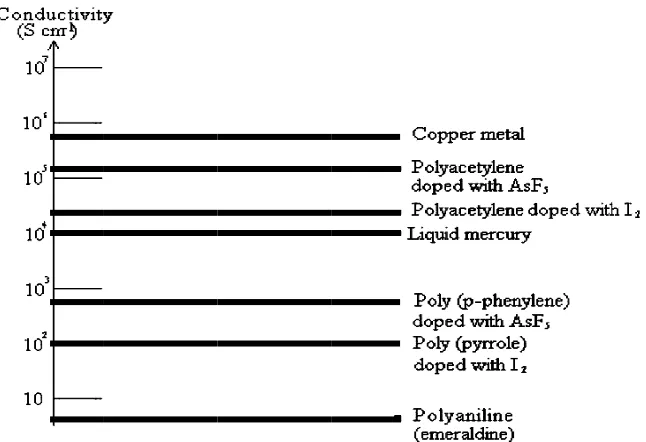
1.1 Logarithmic conductivity ladder of some polymers 2
2.1 Polypyrrole structure 15
2.2 Chemical structure of polypyrrole 15
2.3 Chemical polymerization of PPy 18
2.4 Polystyrene structure 20
2.5 The formation of small dipole moments between the N+
in polypyrrole backbone and Cl−
22
2.6 The changes in conductivity of composite during
temperature variation heating (H) and cooling (C): (PS + 35 wt% PPy)
24
2.7 MMT/PPy-10.8% showing unmodified and galleries
filled by PPy
32
2.8 Schematic representation of PPy intercalation in the
MMT galleries
33
2.9 Intercalation, exfoliation and convectional (unmixed)
categories of polymer clay
33
3.1 The flowchart of research 41
4.1 Pure PPy spectrum 43
4.2 Comparison of IR spectras of different PS/PPy/MMT
blend
45
4.3 XRD pattern of pure polypyrrole 48
xii
4.5 SEM micrograph of pure polypyrrole in range of 5-20
micrometer micrometer
50
4.6 SEM micrograph of PS/0%PPy/MMT 51
4.7 SEM micrograph of PS/20%PPy/MMT 51
4.8 Thermogravimetric analysis of PS/MMT and
PS/PPy/MMT with different PPy contents
52
4.9 Effects of PPy content on the tensile strength of
PS/PPy/MMT blends
54
4.10 Effects of PPy content on elongation of break of
PS/PPy/MMT blends
54
4.11 Effects of PPy content on the Young’s modulus of
PS/PPy/MMT blends
xiii
LIST OF ABBREVIATIONS
PPy - Polypyrrole
PLS - Polymer layered silicate
MMT - Montmorillonite
PS - Polystyrene
SEM - Scanning Electron Microscopy
FTIR - Fourier Transform Infrared Spectroscopy
XRD - X-ray Diffraction
TGA - Thermogravimetric analysis
CP - Conducting Polymer
PANI - Polyaniline
MFI - Melt flow index
MW - Molecular weight
HPLCO2 - High-pressure liquid carbon dioxide
SCCO2 - Supercritical carbon dioxide
Tg - Glass transition temperature
LDPE - Low density polyethylene
PLSN - Polymer/layered silicate nanocomposites
Py - Pyrrole
FeCl3.6H2O - Iron (III) Chloride Hexahydrate
DBSNa - Sodium dodecylbenzene sulfonate
KBr - Potassium bromide
ASTM - American Society for Testing and Materials
wt % - Weight percentage
xiv
LIST OF SYMBOLS
˚C - Centigrade
λ - Wave length
d - The spacing between diffractional lattice planes
θ - The angle of diffraction
ρ - Electrical resistivity
CHAPTER 1
INTRODUCTION
1.1 Background of study
The discovery in 1977 of the high conductivity of doped polyacetylene motivated studies on the synthesis and study of various conjugated polymers. As a result, an entire class of polymeric conductors was developed. Typical representatives of this class are poly(p-phenylene), polypyrrole, polythiophene and its 3-methoxy- derivative, polyaniline. The common feature of the structure of conducting polymers is polyconjugation in the π-system of their backbone.
p c t T S F o u e d h e d s b preserving th conductivity the initial po The resultin S/cm (see Fi
Figure 1.1:
In th obtained by up to 75% b expensive m decades, con have been u electrical pr drawbacks s studies had blending w
he processib y due to inco olyconjugate
g materials h igure 1.1) (V
Logarithmic
he early stag adding high by weight) w manufacturin nducting po used extensi roperties and such as low
been cond with other
bility and me orporation of ed polymers
have conduc Vernitskaya a
c conductivit
ge, the elec h loadings o with the polym
ng and wors olymers like
ively to rep d light weig w processibil
ducted to so polymers
echanical pr f a small con
having cond ctivities typic
and Efimov,
ty ladder of
ctrically con of metal pow
mer medium sening the o polyaniline place the old ght material
ity, low sol olve the pro
such poly
roperties of p ncentration ductivity var
cal of metals , 1997).
some polym
nducting pol wders such a m. Some disa other proper e, polypyrro d method. A
s with respe ubility and oblems by ypropylene,
polymers. T of dopants i rying from 1 s or semicon
mers (Pratt, 2
lymers in th as silver and advantages o rties of poly ole (PPy) an Apart from t ect to metal brittleness.
forming th ultrahigh-m
They acquire into the matr 0-10 to 10-5 S nductors, 1 t
2004).
he industry d gold (some of this metho
ymer. Last nd polythiop their compa ls, there are Therefore, m e composite molecular-w 2 high rix of S/cm. to 105
3
polyethylene, ethylene vinyl alcohol, polyethylene, polymethyl methacrylate, polyurethane and also natural rubber ( Chen et al., 1997; Hosseini and Entezami, 2003; Mavinakuli et al., 2010, Peighambardoust and Pourabbas, 2007).
Among of the conducting polymers, PPy has been the one of the most investigated polymer due to its good electrical conductivity and easiness to synthesis (Ansari, 2006). However, PPy is brittle, infusible and inprocessable (Baytekin, 2009).
Blending of PPy with the commercial polymers such as PS, PP and so on can enhance the properties of composite and can be use to overcome the problems and at the same time polymer blend and conductive polymer nanocomposite. (Alexandre and Dubois, 2000).
The development of nanocomposite materials, i.e. compounds in which an inorganic solid is associated with organic entities interacting at a molecular level, open the way to the preparation of new materials with predetermined characteristics. One of the most promising ways of synthesizing polymer nanocomposites is by intercalating a polymer into a layered inorganic host. Previous efforts have focused on the intercalation of a suitable monomer followed by polymerization or polymer intercalation from solution. The direct melt intercalation has recently been reported as a desired versatile and environmentally benign approach (Chen et al, 2001).
4
the PS fiber surface. MMT was chosen as nanofiller in the nanocomposite for versatile properties.
1.2 Problem Statement
Among the polyolefins, polystyrene has many applications in daily life. It is a thermoplastic with noticeable mechanical properties and reasonable market price. However, its poor conductivity and thermal stability have become major drawbacks. Research showed that the addition of MMT to PS could improve the thermal stability and the mechanical properties but has no avail to the conductivity. PPy as a conducting polymer has become a great choice due to easy synthesis, good environmental and thermal stability and also highly conductivity. However PPy is brittle, infusible and inprocessable which lead to poor mechanical properties. Furthermore, it is expensive if compared with other conductive polymers such as PANi. However, with proper design, these disadvantages can be manipulated this in research.
5
1.3 Objective of the Study
The aim of this research is to produce a nanocomposite with acceptable conductivity and thermal and mechanical properties. Thus the main objective of this study is to use polypyrrole as conductive filler in PS/PPy/MMT nanocomposites. The specific objectives of this study are:
i. To prepare blend of PS/PPy /MMT in different ratios of PPy.
ii. To study the effect of PPy on thermal stability, mechanical and electrical
properties of the blend.
1.4 Scope of Research
The scopes of the study are as follows:
1. Literature review
Literature, search on the development of the conductive polymer blend in the area of PPy and PS blend.
2. Sample preparation
a) Synthesis the PPy using the chemical method. b) Blending the PS/MMT with varies amount of PPy.
3. Sample characterization and morphological study
6
b) Fourier transform infrared spectroscopy (FTIR) was done to confirm the PPy
structure and also evaluate the blend samples.
c) X-ray diffraction (XRD) was carried out to evaluate the intercalation of polymer chains in MMT galleries.
4. Thermal properties analysis
Thermogravimetric analysis (TGA) was done to determine the thermal stability of the blend samples.
5. Conductivity test
Resistivity analysis was carried out to determine the conductivity of the blend samples.
6. Mechanical properties study
REFERENCES
Alexandre, M. and Dubois, P. (2000). Polymer-layered silicate nanocomposites:
preparation, properties and uses of a new class of materials Material. Science.
Engineering, 28. pp. 1-63.
Ansari, R. (2006). Polypyrrole Conducting Electroactive Polymers: Synthesis and
Stability Studies. E-Journal of Chemistry. Vol. 3, No.13, pp. 186-201.
Anuar, K., Murali, S., Fariz, A. and Ekramul, H. N. M. M. (2004). Conducting
Polymer/Clay Composites: Preparation and Characterization. Materials Science,
vol. 10, pp. 255-258.
Aydinli, B., Toppare, L. and Tinçer, T. (1999). A conducting composite of polypyrrole
with ultrahigh molecular weight polyethylene foam. Journal of Applied Polymer
Science 72: 1843-1850.
Bae, W. J., Kim, K. H., Jo, W. H. and Park, Y. H. (2005). Fully exfoliated
nanocomposite from polypyrrole graft copolymer/clay. Polymer 46, 10085–
10091.
Baytekin, S. (2009). Synthesis and characterization of polypyrrole nanoparticles and
their nanocomposite with polypropylene. Master of science. Middle east
technical university, Turkey.
Bhattacharya, A. and De, A. (1996). Conducting Composite of Polypyrrole and
60
Boukerma, K., Piquemal, J. Y., Chehimi, M. M., Mravcakova, M., Omastova, M. and
Beaunier, P. (2005). Synthesis and interfacial properties of
montmorillonite/polypyrrole nanocomposites. Polymer 47, pp 569–576.
Cavallaro, S., Colligiani, A. and Cum, G., (1992). Oxidative chemical polymerization of
pyrrole. Journal of Thermal Analysis and Calorimetry, 38(12), p.2649–2655.
Chen, W., Xu, Q. and Yuan, R. Z. (2001). The influence of polymer state on the
electrical properties of polymer/layered-silicate nanocomposites. Composite Sci.
Tech., 61, 935–939.
Chen, X. B., Issi, J. P., Devaux, J. and Billaud, D. (1997). The stability of polypyrrole
and its composites. Journal of materials science 32: 1515–1518.
Chen, X. B., Issi, J. P., Cassart, M., Devaux, J. and Billaud, D. (1994). Temperature
dependence of the conductivity in conducting polymer composites. Polymer Vol.
35 Number 24. 5256-5258.
Cho, S-H., Kim, W-Y., Jeong, G-K. and Lee, Y-S. (2005). Synthesis of nano-sized
polypyrrole-coated polystyrene latexes. Colloids and Surfaces A:
Physicochemical and Engineering Aspects, vol. 255, pp. 79-83.
Costa, L. C., Henry, F., Valente, M. A., Mendiratta, S. K. and Sombra, A. S. (2002).
Electrical and dielectrical properties of the percolating system
polystyrene/polypyrrole particles. European Polymer Journal 38, pp 1495–1499.
De Jesus, M. C., Weiss, R. A. and Hahn, S. F. (1998). Synthesis of Conductive
Nanocomposites by Selective In Situ Polymerization of Pyrrole within the
Lamellar Microdomains of a Block Copolymer. Macromolecules, vol. 31, pp.
61
Ding, C., Guo, B., He, H., Jia, D. and Hong, H. (2005). Preparation and structure of
highly confined intercalated polystyrene/montmorillonite nanocomposite via a
two-step method. European Polymer Journal, vol. 41, pp. 1781-1786.
Elyashevich, G. K., Rosova, E. Y., Andreeva, D. V., Polotskaya, G. A., Trchová, M. and
Pientka, Z. (2005) New composite systems on the base of polyethylene porous
films covered by polypyrrole and polyacrylic acid. Journal of Applied Polymer
Science, vol. 97, pp. 1410-1417.
Geng, W., Li, N., Li, X., Wang, R., Tu, J. and Zhang, T. (2007). Effect of
polymerization time on the humidity sensing properties of polypyrrole. Sensors
and Actuators B: Chemical vol. 125. pp.114-119.
Han, M., Zhao, K., Zhang, Y., Chen, Z. and Chu, Y. (2007). Dielectric properties of
polystyrene-polypyrrole core-shell conducting spheres suspended in aqueous
solution. Colloids and Surfaces A: Physicochem. Eng. Aspects 302, pp 174–180.
Hosseini, S. H. and Entezami, A. A. (2003). Conducting polymer blends of polypyrrole
with polyvinyl acetate, polystyrene, and polyvinyl chloride based toxic gas
sensors. Journal of Applied Polymer Science, vol. 90, pp. 49-62.
Kaynak, A. (1998). Electrical conductivity of polypyrrole films at a temperature range
of 70 K to 350 K. Materials research bulletin, 33(1), pp.81–88.
Kharat, H. J., Kakde, K. P., Savale, P. A., Datta, K., Ghosh, P. and Shirsat, M. D.
(2007). Synthesis of polypyrrole films for the development of ammonia sensor.
Polymers for Advanced Technologies: 397-402.
Kim, D. Y., Lee, J. Y., Kim, C. Y., Kang, E. T. and Tan, K. L. (1995). Difference in
doping behavior between polypyrrole films and powders. Synthetic Metals. 72,
62
Kim, J. W., Liu, F. Choi, H. J., Hong, S. H. and Joo, J. (2003). Intercalated
polypyrrole/Na+-montmorillonite nanocomposite via an inverted emulsion
pathway method. Polymer 44, 289-293.
Ko, J. M., Rhee, H. W., Park, S. M. and Kim, C. Y. J. (1990). Morphology and
Electrochemical Properties of Polypyrrole Films Prepared in Aqueous and
Nonaqueous Solvents. Electrochem. Soc. 905-909.
Kottarath, S. (2004). Processing &Properties of Clay-ICP/Polyimide Nanocomposite
Coatings on Aluminum Alloy. Master of Science. University of Cincinnati,
Department of Chemical and Materials Engineering, ohio, USA.
Kurosawa, S., Teja, A. S., Kowalik, J. and Tolbert, L. (2006). Supercritical carbon
dioxide processing of conducting composites of polypyrrole and porous
crosslinked polystyrene. Polymer 47, 2997–3004.
Lagashetty, A. and Venkataraman, A. (2005). Polymer nanocomposite. Resonance, John
Wiley & Sons, Inc. pp. 48-60.
MacDiarmid, A. G. (1997). Polyaniline and polypyrrole: where are we headed?.
Synthetic Metals 84, 27-34.
Madani, A., Nessark, B., Brayner, R., Elaissari, H., Jouini, M., Mangeney, C. and
Chehimi, M. M. (2010). Carboxylic acid-functionalized, core–shell
polystyrene@polypyrrole microspheres as platforms for the attachment of CdS
nanoparticles. Polymer, vol. 51, pp. 2825-2835.
Mavinakuli, P., Wei, S., Wang, Q., Karki, A. B., Dhage, S., Wang, Z., Young, D. P. and
Guo, Z. (2010). Polypyrrole/Silicon Carbide Nanocomposites with Tunable
Electrical Conductivity. The Journal of Physical Chemistry C, vol. 114, pp.
63
Mravakova, M., Boukerma, K., Omastova, M. and Chehimi, M. M. (2005).
Montmorillonite/polypyrrole nanocomposites. The effect of organic modification
of clay on the chemical and electrical properties. Materials Science and
Engineering C 26, 306 – 313.
Nair, S., Hsiao, E. and Kim, S. H. (2008). Fabrication of electrically-conducting
nonwoven porous mats of polystyrene–polypyrrole core–shell nanofibers via
electrospinning and vapor phase polymerization. Journal of Materials Chemistry
18, 5155–5161.
Omastova, M., Mravcakova, M. and Chodak, I. (2006). Conductive
polypropylene/clay/polypyrrole nanocomposites. Polymer engineering and
science. pp. 1070-1078.
Omastova, M., Trchova, M., Kova, M. and Jaroslav S. (2003). Synthesis and structural
study of polypyrroles prepared in the presence of surfactants. Synthetic Metals,
138(3), pp.447-455.
Ong, C. K., Ray, S., Cooney, R. P., Edmonds, N. R. and Easteal, A. J. (2008).
Preparation and characterization of composites of polyethylene with
polypyrrole-coated wollastonite. Journal of Applied Polymer Science, vol. 110, no. 1, pp.
632–640.
Peighambardoust, S. J. and Pourabbas, B. (2007). Preparation and Characterization of
Nylon-6/PPy/MMT Composite of Nanocomposite. Journal of Applied Polymer
Science, Vol. 106, 697–705.
Pratt, C. M. (2004). Conducting Polymers. Foot, P. and Kaiser, A. Kirk-Othmer
Encyclopaedia of Chemical Technology Fifth Edition. 22-2-96. John Wiley &
64
Sezer, E. (2007). Conducting nanocomposite systems. Erokhin, V. Ram, M. K. and
Yavuz, O. The New Frontiers of Organic and Composite Nanotechnology. (pp.
144-235) Elsevier Science.
Singh, B. Polymer Clay Nanocomposite [online]. (2010). [Accessed 14 August 2010].
Available at
http://www.scribd.com/doc/518847/Polymner-Clay-Nanocomposite.
Tang, M., Wen, T. Y., Du, T. B. and Chen, Y. P. (2002). Synthesis of electrically
conductive polypyrrole–polystyrene composites using supercritical carbon
dioxide: I. Effects of the blending conditions. European Polymer Journal 39, pp.
143–149.
Uthirakumar, P., Nahm, K., Hahn, Y. and Lee, Y. (2004). Preparation of
polystyrene/montmorillonite nanocomposites using a new radical
initiator-montmorillonite hybrid via in situ intercalative polymerization. European
Polymer Journal, vol. 40, pp. 2437-2444.
Vernitskaya, T. V. and Efimov, O. N. (1997). Polypyrrole: a conducting polymer; its
synthesis, properties and applications. Russian Chemical Reviews. 66 (5) 443
-457.
Wallace, G. G., Moulton, S. E., Misoska, V. J., Kane-Maguire L. A. P. and Innis P. C.
(2002). Nanostructure Based on Inherently Conducting Polymers. Materials
Forum 26, 29-38.
Wallace, G. G., Spinks, G. M., Kane-Maguire, L. A. P. and Teasdale, P. R. (2009).
Conductive Electroactive Polymers. (Third edition). New York, USA. CRC
65
Wilson, J. (1995). Compilation of Air Pollutant Emission Factors, (Fifth edition). Office
of air quality planning and standards. U.S. Public Health Service.
Xanthos, M. (2005). Functional Fillers for Plastics. KGaA, Weinheim,
USA,WILEY-VCH Verlag GmbH & Co.
Xu, C., Agari, Y. and Matsuo M. (1998). Mechanical and electric properties of
ultra-high-molecular weight polyethylene and carbon black particle blends. Polymer
Journal 30, pp.372–80.
Yavuz, O., Ram, M. K. and Aldissi, M. (2007). Electromagnetic applications of
conducting and nanocomposite materials. Erokhin, V. Ram, M. K. and Yavuz,
O. The New Frontiers of Organic and Composite Nanotechnology. (pp. 436-475)
Elsevier Science.
Zhou, Z., Zhai, H. and Xu, W. (2006). Preparation and characterization of
polyethylene-g-maleic anhydride–styrene/montmorillonite nanocomposites. Journal of