Distorted black hole initial data using the puncture method
J. David BrownDepartment of Physics, North Carolina State University, Raleigh, North Carolina 27695 USA
Lisa L. Lowe
Department of Physics, North Carolina State University, Raleigh, North Carolina 27695 USA (Received 30 August 2004; published 10 December 2004)
We solve for single distorted black hole initial data using the puncture method, where the Hamiltonian constraint is written as an elliptic equation inR3 for the nonsingular part of the metric conformal factor. With this approach we can generate isometric and nonisometric black hole data. For the isometric case, our data are directly comparable to those obtained by Bernstein et al., who impose isometry boundary conditions at the black hole throat. Our numerical simulations are performed using a parallel multigrid elliptic equation solver with adaptive mesh refinement. Mesh refinement allows us to use high resolution around the black hole while keeping the grid boundaries far away in the asymptotic region.
DOI: 10.1103/PhysRevD.70.124014 PACS numbers: 04.25.Dm, 04.30.Db, 04.70.Bw
I. INTRODUCTION
Distorted black holes are expected to be produced by astrophysical events such as asymmetrical gravitational collapse, black black hole coalescence, black hole-neutron star coalescence, and possibly hole-neutron star-neutron star coalescence. As ground based gravitational wave detectors such as LIGO, VIRGO, TAMA, and GEO increase their sensitivities, and the planned launch date for the space based detector LISA grows near, the need for researchers to develop a theoretical understanding of these systems becomes increasingly important. In support of that effort, we need to develop the techniques and tools to evolve a dynamic, distorted black hole and extract the emitted gravitational radiation as it settles to a quiescent state.
One of the difficulties encountered in the numerical treatment of single and multiple black hole systems is the presence of nontrivial topologies. In the past, researchers have addressed this problem by using isometry conditions at inner boundaries to represent black hole throats. Another approach to black hole evolution is excision, in which a region inside each apparent horizon is removed from the computational domain. Recently it has been shown that black holes can be treated in terms of fields on R3 by splitting the conformal factor for the spatial metric into singular and nonsingular terms. This so-called ‘‘puncture method’’ was applied to the Bowen-York [1] family of black hole initial data sets by Brandt and Bru¨gmann [2], and used for evolution studies by Bru¨gmann [3] and others (see, for example, Refs. [4,5]). In this paper we make a modest extension of the puncture construction for initial data to include single distorted black holes. We reproduce and extend the results of Bernstein et al. [6 –8], who constructed ‘‘black hole plus Brill wave’’ initial data sets using isometry condi-tions at the black hole throat. Whereas the black holes
obtained by Bernstein et al.are isometric by construc-tion, our distorted puncture black hole data sets are iso-metric only when the free parametersandm, defined in Sec. II, are equal to one another. For m, we obtain nonisometric, distorted black holes.
Another difficulty encountered in the numerical mod-eling of black holes is the wide discrepancy in length scales involved. The computational grid needs to be large enough to capture outgoing gravitational waves and to minimize boundary effects. The grid must also have high resolution in the interior to accurately resolve the strong gravitational fields of black holes. For a finite difference code, adaptive mesh refinement (AMR) is needed to satisfy both of these requirements: high resolution and a large grid. In this paper we introduce our AMR elliptic solver that allows us to solve accurately for puncture black hole data on very large grids. Evolution studies of these data sets are underway [9].
In Sec. II we set up the equations defining the initial value problem for a distorted puncture black hole. We show how the puncture data can be formulated to give isometric data sets, thus enabling a comparison with the results of Bernstein et al. In Sec. III we give a brief description of our AMR elliptic solver. In Sec. IV we present sample results both for isometric and nonisomet-ric black hole data.
II. FORMULATION OF THE PROBLEM
Following Bernstein et al. [6 –8] we write the line element for the physical metricgij as
ds2 4e2qdr2r2d2 r2sin2d2; (1)
qr; ; 2Q0e
2
sinn1ccos2; (2)
where ln2r=. In Eq. (2), Q0, n, c and are adjustable constants that affect the size and type of dis-tortion. We also restrict ourselves to data sets defined at a moment of time symmetry. Thus, the extrinsic curvature vanishes and the momentum constraints are trivially satisfied. The Hamiltonian constraint reduces to
^
r2 1
8R ^ 0; (3)
wherer^2andR^are the Laplacian and scalar curvature of the conformal metric, defined byg^ij 4g
ij.
Solutions of Eq. (3) on the manifoldR3are Brill waves. The distorted black hole data sets of Bernstein et al.were obtained by solving Eq. (3) on the manifoldR S2, with Robin conditions at the outer boundary [@r r=@r
0asr! 1] and isometry conditions at the inner bound-ary [@pr =@r0 at r=2]. We will obtain solu-tions of Eq. (3) on R S2 by following the puncture construction of Ref. [2]. Thus, we write the conformal factor as um=2r and insert this into the Hamiltonian constraint (3) to obtain
^
r2u1 8 ^
Ru m
16r ^
R: (4)
This equation is solved for a continuous solutionuonR3 with Robin boundary conditions@rur=@r0atr! 1 . Note that the ‘‘bare mass’’ m appears as a new parameter in the construction.1
We have had no difficulty in obtaining numerical so-lutions to Eq. (4). However, from an analytical point of view, it is not immediately obvious to us whether or not Eq. (4) always admits solutions, and if so whether those solutions are unique. The problem of existence and uniqueness of solutions of Eq. (4) on R3 is similar to the problem of existence and uniqueness of solutions of Eq. (3) onR3. There are two notable differences. First is the appearance of a ‘‘source’’ termmR=^ 16ron the right-hand side of Eq. (4). Note that with the choice (2) for the function q, the scalar curvature R^ goes to zero rapidly,
^
R lnr2rln=r22 ln2at
r!0, so thatR=r^ does not blow up at the puncture. The second difference between Eq. (4) and the familiar initial value Eq. (3) is that, for (4), we need not require the solutions to be positive. Rather, we would like to know if u is greater than
m=2r so that the combination um=2r is everywhere positive.
By construction the data sets of Bernstein et al.are isometric; that is, they are symmetric under reflections
about the black hole throatr=2. More precisely, each data set is described by a metric tensor whose components gij, as functions of r, and , are unchanged by the coordinate transformation r!r2=4r. We can solve for reflection symmetric data sets using the punc-ture method as well, simply by setting the parameters andmequal to one another:m. To see this, we first note that the Hamiltonian constraint on R S2 can be written as (see, for example, Appendix D of Ref. [10])
~
r21 8
~ R
pr 0; (5)
wherer~2and ~
Rare the Laplacian and scalar curvature for the metric g~ijg^ij=r2. Let 1r denote a solution of Eq. (3), or equivalently Eq. (5), obtained by the puncture method. (For notational simplicity, we display only ther dependence in the solution 1, and in 2below. In general these are functions of and as well.) This solution
1r has boundary behavior 1r !1 as r! 1, and 1r !m=2r as r!0. Now observe that the line element ds2g~
ijdxidxj, with the functionq chosen as in Eq. (2), is invariant under reflectionsr!r2=4r. The scalar operator r~2R=~ 8 is invariant as well. By making the substitution r!r2=4r in Eq. (5) we see that 2r, defined by pr 2r
r
p
1r with r 2=4r, is also a solution of Eqs. (5) and (3). This solution satisfies the boundary conditions 2r !m= as r! 1 and 2r !=2r as r!0. If we choose m, then the solutions 1r and 2r satisfy the same equation and obey the same boundary conditions. If we assume that solutions to the puncture Eq. (4) are unique, then the two solutions 1r and 2r must in fact be identical. From the equality 1r 2rwe find
r
p
1r r
p
1rjr 2=4r: (6)
The line element (1) for this solution can be written as
ds2 pr
1r4e2qdr2=r2d2 sin2d2: (7)
Then the relation (6) is the condition for the physical metric (7) to be invariant under the reflection r!r=4r.
In Sec. IV we present results for the conformal factor for isometric (m) and nonisometric (m) data sets. For isometric data, we can check the reflection symmetry by comparing the ADM mass computed at the two infinities. At the ‘‘outer’’ infinity (r! 1) the ADM mass is given by [11]
M1
1 2
I 1
dS^ir^i : (8)
Numerically, the integral is computed at the outer
bound-1The parametersandmare dimensionful. Thus, our data
sets can be described in terms of the dimensionless parameters
ary of the computational domain. The ADM mass at the ‘‘inner’’ infinity (r0) is found by expressing the metric (1) in coordinatesr,,, whererm2=4r. We find
ds2
1mu
2 r 4
e2qdr2r2d2 r2sin2d2; (9)
where q and u are functions of rm2=4 r, , and . Providedqgoes to zero sufficiently rapidly asr! 1, the metric is asymptotically flat at r0 with ADM mass given by
M0 mujr0: (10)
The choice (2) for qvanishes asr!0likeqrln=r, faster than any power ofr.
III. NUMERICAL CODE
Our numerical code solves Eq. (4) using multigrid techniques with mesh refinement. We use the Paramesh package [12,13] to implement mesh refinement and par-allelization. Paramesh divides the computational grid into blocks, with each block containingNzones. A block of data is refined by bisection — that is, the block is divided into eight ‘‘child’’ blocks (in three spatial dimen-sions) each containingN zones.
Our code carries out multigrid V-cycles using the Full Approximation Storage (FAS) algorithm [14] on nonuni-form grid structures, with zone-centered data. It works with both fixed mesh refinement (FMR) and adaptive mesh refinement (AMR). Working with FMR, we specify a nonuniform grid by hand. Working with AMR, we generally start with a coarse, uniform grid. The code V-cycles until the norm of the residual is less than the norm of the relative truncation error in each block. Any block whose relative truncation error is above a specified toler-ance is flagged for refinement. Paramesh then rebuilds the grid, the data is prolonged from the old grid to the new, and the V-cycle process begins again. Working in this mode takes the place of the Full Multigrid (nested itera-tion) Algorithm [14], where the solution on the final grid structure is reached by a succession of V-cycles of increas-ing peak resolution.
We will provide details of the AMR-multigrid algo-rithm in a later publication, along with numerous code tests [15].
IV. RESULTS
Bernstein et al. [6 –8] produced nonaxisymmetric distorted black holes using isometry conditions at the black hole throat. We have reproduced several of the initial data sets from Ref. [7] using the puncture method, by settingmas described in Sec. II. As a check for
isometry, we have confirmed that the ADM mass at the puncture,M0, agrees with the ADM mass at infinity,M1, to several significant digits.2
Two tests were performed to confirm the consistency of our ADM mass calculations. For the first test we used a sequence of grids with fixed interior resolution but in-creasing outer boundary limits. We started by solving for the initial data on a grid with boundaries (in each dimen-sion) at 13and 13, and having two additional box-in-box refinement levels ranging (in each dimension) from
6:5to 6.5 and from3:25to 3.25. The resolution on the finest of the three levels wasx0:050 78. Other grids in the sequence were created by adding, one at a time, another fixed box-in-box refinement level while doubling the size of the computational domain. This test was intended primarily as a check on the sensitivity of the ADM mass at infinity to the location of the outer bound-ary. We found that the ADM massM1is unaffected to six digits and the ADM massM0is unaffected to seven digits. For the second test we used a sequence of grids consisting of a fixed three-level box-in-box structure but increasing resolution throughout the computational domain. This test was intended primarily to check the convergence properties of the ADM masses M1 and M0. The test showed that the ADM masses converge with second order accuracy.
As a specific example let us consider the data set discussed in Ref. [7] with c 2, Q0 0:5, n4, andm2. The ADM masses for this data at infin-ity and at the puncture are M12:2021 and M0 2:2027. Figure 1 shows a contour plot of the nonsingular part u of the conformal factor in the z0 plane. The contour levels crossing thex-axis between100and zero are, respectively,f1:0015;1:005;1:005;1:0015;0:96g. The contour levels crossing they-axis between100and zero are, respectively,f1:0015;1:005;1:01;1:02;1:1g. The inset in Fig. 1 shows the range inxandyfrom13to 13. In the inset figure, the contours crossing thex-axis between13 to zero aref1:005;1:0015;0:96gand the contours crossing they-axis between13and zero aref1:01;1:02;1:1g. The function uforms two peaks along they-axis with maxi-mum values 2.03, and two valleys along the x-axis with minimum values 0.296. The value ofuat the puncture is 1.10. The profiles ofualong the three axes look similar to those shown in Fig. 2.
With AMR, we are able to push the boundaries out quite far while maintaining high resolution around the puncture. For the data described above, the computational grid extends from 100to 100 and has refined itself to reach a maximum relative truncation error of 0.008. The lowest resolution region is equivalent to a 643 grid with
2A direct numerical comparison of our ADM masses with
those of Bernstein et al. is not possible, since their ADM masses are presented graphically. A visual comparison our ADM mass data with theirs shows good agreement.
x3:125. The highest resolution region is equivalent to a262;1443 grid withx0:000 763.
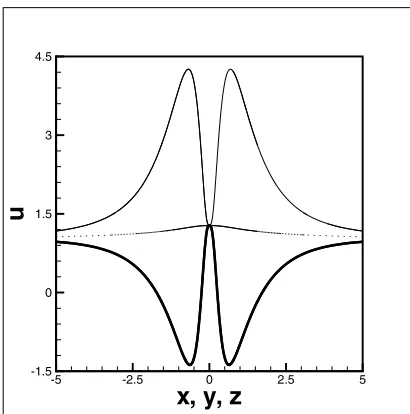
The puncture method allows us to define a new class of initial data: distorted black holes that are not isometric (m). Figure 2 shows such a data set with c 2, Q0 0:5,n4,2, andm10. The results were computed on a grid extending from100to 100 in each dimension. The grid spacing for the lowest resolution region, adjacent to the grid boundaries, is x3:125. The grid spacing for the highest resolution region, sur-rounding the puncture, isx0:012 21. The ADM mass at infinity is M110:7, while the ADM mass at the puncture is M0 12:8. Figure 2 shows the behavior of the nonsingular partuof the conformal factor along the coordinate axes. The thin solid line plots u along the y-axis, the thick solid line plotsu along thex-axis, and the dotted line plotsualong thez-axis. The two peaks in ualong the y-axis have maximum values 4.26, and the two valleys along thex-axis have minimum values1:38. The value ofuat the puncture is 1.28.
Note that for the nonisometric data described above,u takes on negative values in two small regions of radius1 at locations 1 along the x-axis. However, for this data set, the conformal factor um=2ris
every-where positive. We have explored other data sets that contain regions with u <0, and in each case we find that the conformal factor is positive everywhere. For data with c 2, Q0 0:5, andn4, the most ex-treme data sets we have studied have ratios=m1=300 and=m100. For the case=m1=300, the function ureaches a minimum value of 120 but the confor-mal factor remains positive. For the case=m100the function u, and therefore also , is always positive.
ACKNOWLEDGMENTS
We would like to thank the numerical relativity group at NASA Goddard Space Flight Center, and especially Dae-Il Choi, for their help and support. We would also like to thank James Isenberg, Kevin Olson, and Peter MacNeice for helpful discussions. This work was sup-ported by NASA Space Sciences Grant No. ATP02-0043-0056. Computations were carried out on the North Carolina State University IBM Blade Center Linux Cluster. The PARAMESHsoftware used in this work was developed at NASA Goddard Space Flight Center under the HPCC and ESTO/CT projects.
[1] J. M. Bowen and J.W. York, Jr., Phys. Rev. D 21, 2047 (1980).
[2] S. Brandt and B. Brugmann, Phys. Rev. Lett.78, 3606 (1997).
x, y, z
u
-5 -2.5 0 2.5 5
-1.5 0 1.5 3 4.5
FIG. 2. The function u plotted along the three coordinate axes for a non-isometric distorted black hole with c 2,
Q0 0:5, n4,2,m10. The thin solid line (top curve) isualong they-axis, the dotted line (middle curve) isu
along the z-axis, and the thick solid line (bottom curve) isu
along thex-axis. FIG. 1 (color online). Contour plot ofuin thez0plane for
[3] B. Brugmann, Int. J. Mod. Phys. D8, 85 (1999). [4] M. Alcubierreet al., Phys. Rev. D67, 084023 (2003). [5] B. Imbiriba, J. Baker, D.-I. Choi, J. Centrella, D. R. Fiske,
J. D. Brown, J. R. van Meter, and K. Olson, gr-qc/ 0403048.
[6] D. Bernstein, D. Hobill, E. Seidel, and L. Smarr, Phys. Rev. D50, 3760 (1994).
[7] S. Brandt, K. Camarda, E. Seidel, and R. Takahashi, Classical Quantum Gravity20, 1 (2003).
[8] S. R. Brandt and E. Seidel, Phys. Rev. D 54, 1403 (1996).
[9] M. Koppitzet al.(to be published).
[10] R. M. Wald, General Relativity (University of Chicago Press, Chicago, 1984).
[11] N. O´ Murchadha and J.W. York, Phys. Rev. D10, 2345 (1974).
[12] http://ct.gsfc.nasa.gov/paramesh/Users_manual/ amr.html.
[13] P. MacNeice, K. M. Olson, C. Mobarry, R. deFainchtein, and C. Packer, Comput. Phys. Commun.126, 330 (2000). [14] W. H. Press, S. A. Teukolsky, W. T. Vetterling, and B. P. Flannery, Numerical Recipes (Cambridge University Press, Cambridge, 1992).