ABSTRACT
TONEY, STEPHANIE HORNER. Educational Philosophy Interactions in a Middle School Interdisciplinary Team: A Case Study. (Under the direction of Dr. Candy Beal.)
The purpose of this case study was to examine the interactions of middle school teachers each of whom had a unique and personal educational philosophy. The formation and development of the personal educational philosophy and the interactions within the middle school team brought on by the personal educational philosophy of each teacher were also examined. The educational philosophy of the individual participants was identified using Zinn’s Philosophy of Education Inventory. The sample selection for the case study included one team of three middle school teachers during the 2010-2011 academic year with a range of teaching experience from three years to ten years in the classroom and represented the core disciplines of humanities (combined language arts and social studies), science, and mathematics teaching. The teachers were employed at a suburban middle school with an enrollment of approximately 750 students. A triangulation of teacher interviews, classroom and team meeting observations, inventories, surveys, and documents helped to provide accuracy and validity.
school, 3) the understanding of the AMLE middle school philosophy tenets and its relevance to the teacher and his or her educational philosophy, 4) the interaction of personal
educational philosophy on the selection and delivery of curriculum-based assignments, and 5) the interaction of personal educational philosophy in the preference of teaching team members.
Findings of the study concluded that: 1)Educational philosophy is a determining factor for how teachers on a middle school teaching team interact within the team setting; 2) understanding the tenets of the broad educational philosophies allows team teachers to be more tolerant of differences between teachers and to provide a more harmonious work setting; 3) placement of teachers on a team who have complementary philosophies enables more positive interactions among the team members than if team members had competing philosophies; 4) knowledge of generational characteristics and grounding in middle school philosophy are factors in the establishment of educational philosophies.
Educational Philosophy Interactions in a Middle School Interdisciplinary Team: A Case Study
by
Stephanie Horner Toney
A dissertation submitted to the Graduate Faculty of North Carolina State University
in partial fulfillment of the requirements for the Degree of
Doctor of Philosophy
Curriculum and Instruction
Raleigh, North Carolina 2012
APPROVED BY:
_____________________________ _____________________________ Dr. Candy Beal Dr. Carol Pope
Chair of Advisory Committee
ii
DEDICATION
No work this extensive is undertaken alone. I am the grateful recipient of much help along the way from family and mentors. It is to these people that my work here is dedicated.
To my mother, Dr. Sally M. Horner, who raised me to understand that all doors were open to me through education and that education is the most rewarding work of all. To my husband, Glen, who has worked tirelessly my entire adult life to make my dreams come to fruition. To my children who have supported me in all of my endeavors and are a constant joy in my life.
To my mentor, Dr. Gil Hunt, who instilled in me a passion for the middle school model as he ushered me through my teaching credentials and my Master’s degree. I would not have pursued this pathway without him to set down the challenge. To my first principal, Dr. Jeanette Beckwith, who brought me into the field of education through her belief that I was the right person for the job and that I could lead young minds to their best efforts.
iii BIOGRAPHY
Stephanie McKay Horner Toney was born on April 29, 1955, in Chapel Hill, North Carolina. She married Glen Toney in 1974 and they have two sons, Stephen and Carey. She received her B.A. from Meredith College in Biology (1978), an M.B.A. from Meredith College (1987), an M.Ed. in Curriculum and Instruction from Coastal Carolina University (2001). At North Carolina State University, she completed the requirements for the Ph.D. degree in Curriculum and Instruction with a concentration in Middle School Education.
Toney worked in the scientific field at the Environmental Protection Agency, Northrop Services, and Duke University before beginning her career in education. She has spent more than twenty years in the classrooms of middle schools teaching science to early adolescents. She holds National Board Certification in the area of Early Adolescent Science. Toney was selected for the Albert Einstein Distinguished Educators Fellowship in 2001. This national fellowship places educators in the offices of public policy makers and allows fellows to provide practical insight in the establishment and operation of educational programs. Toney spent her fellowship year in the offices of Representative Ruben Hinojosa and views this year as a life-changing event.
iv
ACKNOWLEDGEMENTS
The support of my graduate committee is gratefully acknowledged. Throughout my graduate work at North Carolina State University, Dr. Candy Beal and Dr. Carol Pope have provided guidance and support for my efforts. My interest in middle school and the education of early adolescents was refined and polished through the classes that they taught. Together they have encouraged and inspired me to continue the work throughout the years.
I especially thank Dr. Beal for her patience in the editing process of this dissertation. Without her belief in my work and her unwavering support this would never have been finished. The times that we spent discussing the underpinnings of the middle school education model were invaluable to the entire process. She has been a role model to me through my time at North Carolina State University.
I wish to thank Dr. Lance Fusarelli for his efforts in shepherding me through my pilot study. The pilot study allowed me to hone in on the factors that were most important to this study. I also thank him for the simple words of encouragement, written on an index card, that have sent me back to the table to write on numerous occasions.
My appreciation is extended to Dr. Paul Bitting for the grounding in philosophy that enabled me to focus on this area for my graduate work.
v
TABLE OF CONTENTS
LIST OF TABLES ……… ix
LIST OF FIGURES ……….. x
CHAPTER ONE – Statement of the Problem ……….. 1
Introduction……….….. 1
Generational Attitudes and Educational Philosophies ……….….. 7
Veterans ………..….. 7
Baby Boomers ……….….… 8
Generation X ………..….. 8
Millennials ………..….. 9
How One Builds an Educational Philosophy ……….… 10
Purpose of the Study ……….… 12
Significance of the Study ………. 13
Overview of Existing Literature ………... 13
Research Questions ……….…. 15
Limitations of the Study ……….….. 16
Researcher Subjectivity……… 17
Definition of Terms ………. 19
Conclusion ………... 21
CHAPTER TWO – Literature Review………. 23
Educational Philosophy ………...……… 23
American Educational Philosophy ………... 24
Philosophical Schools that Merged to Form the Comprehensive Educational Philosophy ………. 25
Idealism ……… 25
Perennialism ………. 25
Realism ………. 26
Traditionalism ……….. 27
Comprehensive ………. 27
Philosophical Schools that Merged to Form the Progressive Educational Philosophy ………. 28
Pragmatism ……….. 28
Integrationalism ……….….. 28
Essentialism ………. 29
Progressive ……….. 29
Philosophical Schools that Merged to Form the Behavioral Educational Philosophy ………. 30
Technicians ……….. 30
vi
Philosophical Schools that Merged to Form the Social Change
Educational Philosophy ………. 31
Integrationalism ………... 31
Social Change ………...… 31
Philosophical Schools that Merged to Form the Humanistic Educational Philosophy ……….. 31
Romanticism ……….… 31
Humanistic ……….…... 32
Societal Impact ………. 33
Generations ………... 35
Societal Environment ……… 37
Philosophy as a Function of Teacher Education ………... 39
History of the Development of Middle School Philosophy ………….……. 41
Prior to 1910 ……… 42
1910 to 1960 ………...…. 43
1960 to 1970 ……… 45
1970 to 1980 ……… 47
1980 to 1990 ……… 48
1990 to 2000 ……… 53
2000 to Present ……… 57
Educational Theorists Who Shaped Middle School Philosophy ....………... 62
John Dewey ………. 62
John Lounsbury ………... 64
James Beane ……… 66
Gordon Vars ……… 69
Thomas Erb ………. 70
John Arnold ………. 71
Charity James ……….. 72
Summary ………. 74
Selection of a Survey Instrument ……….. 74
Criteria for Selection of a Suitable Instrument ………... 75
Instruments Considered for Use ……….. 76
Philosophy of Education Inventory ……….. 76
Background of Instrument Selected………. 76
Suitability for Use ………... 77
Summary ………... 79
CHAPTER THREE – Methodology ……….……… 80
Research Questions ………... 80
Rationale for the Selection of a Case Study Method of Research ………… 80
Pilot Study ………. 82
Theoretical Framework ………. 83
Site Selection for the Case Study ……….. 84
vii
Data Collection ………. 85
Selection of Instrument ………... 87
Data Analysis ……… 88
Research Validity and Reliability ………. 89
Ethical Issues ……… 92
Limitations of the Study ……… 93
Summary ………... 94
CHAPTER FOUR – Findings and Analysis ……… 95
The Participants ………...………. 95
Aaron ………..……… 96
Bailey ……….. 96
Cadie ………... 98
Research Question 1: What are the Educational Philosophies of the Participants as Indicated by the Educational Philosophy Inventory? ……... 99
Aaron ……….. 100
Bailey ……….. 102
Cadie ………... 105
Research Question 2: Does the Educational Philosophy as Measured by the Inventory Align with the Teacher’s Perception of His or Her Own Educational Philosophy? ………... 109
Aaron ………... 110
Bailey ……….. 110
Cadie ……… 111
Research Question 3: What Factors Contribute to the Development and Refinement of the General Educational Philosophy for Each Teacher? …... 112
Aaron ………... 112
Influences in the Development of Educational Philosophy ……….. 113
Generational Knowledge ……….. 115
Bailey ……….. 117
Influences in the Development of Educational Philosophy ……….. 117
Generational Knowledge ……….. 120
Cadie ………... 121
Influences in the Development of Educational Philosophy ……….. 121
Generational Knowledge ………...………... 122
Summary ………. 124
viii
Aaron ……….. 126
Educational Philosophy ……… 126
Relationships ………... 127
Association for Middle Level Education ……….…. 130
Selection of Curriculum-Based Assignments ………... 131
Selection of Teaching Team Members ………. 133
Bailey ……….. 134
Educational Philosophy ……… 134
Relationships ………... 135
Association for Middle Level Education ……….…. 139
Selection of Curriculum-Based Assignments ………... 140
Selection of Teaching Team Members ………. 142
Cadie ……….. 142
Educational Philosophy ……… 142
Relationships ………... 144
Association for Middle Level Education ……….…. 146
Selection of Curriculum-Based Assignments ………... 148
Selection of Teaching Team Members ………. 149
Conclusion ……… 151
CHAPTER FIVE – Conclusion ……..……….. 154
Discussion ………. 155
Educational Philosophy is a Determining Factor for How Teachers on a Middle School Teaching Team Interact Within the Team Setting ….. 155
Understanding the Tenets of the Broad Educational Philosophies Allows Team Teachers to be More Tolerant of Differences Among Teachers and to Provide a More Harmonious Work Setting ………... 159
Placement of Teachers on a Team Who Have Complementary Philosophies Enables More Positive Interactions Among the Team Than if Team Members Had Competing Philosophies ………..… 165
Knowledge of Generational Characteristics and Grounding in Middle School Philosophy are Factors in the Establishment of Educational Philosophies ……… 168
Implications for Educators and Administrators ……… 171
Suggestions for Future Research ……….. 174
Epilogue ……… 175
REFERENCES ……….. 176
ix
LIST OF TABLES
TABLE 1: COMPARISON OF EDUCATIONAL PHILOSOPHIES ………. 189
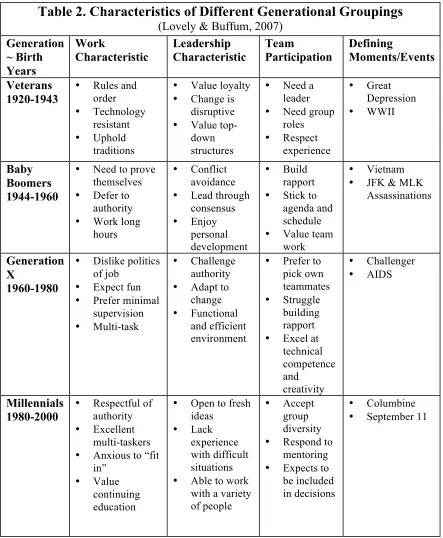
TABLE 2: CHARACTERISTICS OF DIFFERENT GENERATIONAL GROUPINGS ……… 193
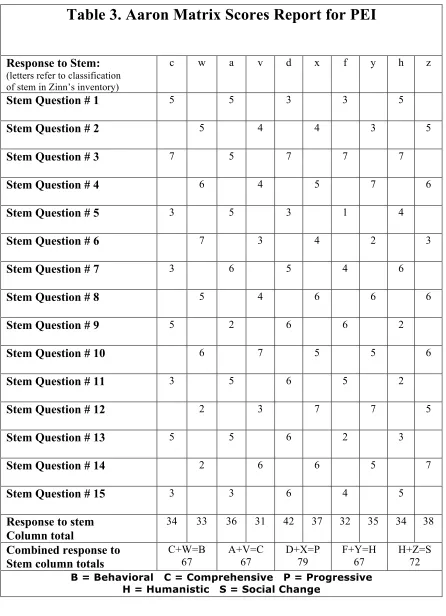
TABLE 3: AARON MATRIX SCORE REPORT FOR PEI ………...…… 194
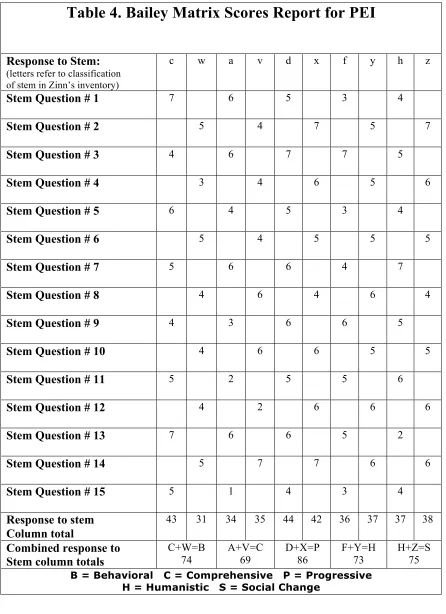
TABLE 4: BAILEY MATRIX SCORE REPORT FOR PEI ………... 195
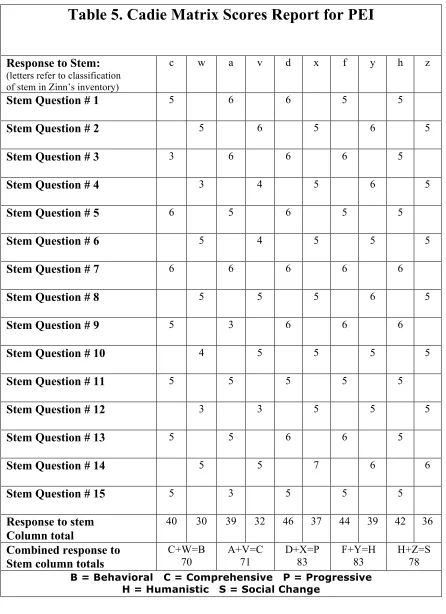
TABLE 5: CADIE MATRIX SCORE REPORT FOR PEI ………. 196
TABLE 6: CHARACTERISTIC KEYS FOR EDUCATING YOUNG ADOLESCENTS AS DEFINED BY THE ASSOCIATION FOR MIDDLE LEVEL EDUCATION ………... 197
TABLE 7: SUMMARY OF PARTICIPANT CHARACTERISTICS ………. 198
TABLE 8: SUMMATIVE MATRIX SCORES FOR THE ZINN PEI ……… 208
x
LIST OF FIGURES
GRAPH 1: VISUAL COMPARISON OF MATRIX SCORES ABOVE
1
CHAPTER ONE Statement of the Problem
Introduction
Youth awakes to a new world and understands neither it nor himself. The whole future of life depends on how the new powers now given suddenly and in profusion are husbanded and directed. Character and personality are taking form, but everything is plastic. Self-feeling and ambition are increased, and every trait and faculty is liable to exaggeration and excess. It is a marvelous new birth, and those who believe that nothing is so worthy of love, reverence, and service as the body and soul of youth and who hold that the best test of every human institution is how much it contributes to bring youth to the ever fullest possible development, may well review themselves and the civilization in which we live to see how far it satisfies this supreme test. (Hall, 1904, p. xv)
For more than a century, the plight of youth has been an ongoing concern for those in the educational community who seek to contribute to the fullest possible development of these youngsters. Changing times have demanded new approaches as teachers seek to review, revise, and rededicate themselves to teaching today’s adolescents. Remaining current means the ongoing re-examination of one’s own beliefs. Do the tenets we hold remain solid and timely?
2
the belief system of a teacher (Katzenmeyer & Moller, 2001). The belief system, in turn, forms a foundation for the teaching and learning approaches that a teacher employs within the classroom and within the middle school team environment (Arnold & Stevenson, 1998; National Middle School Association, 2010b). The philosophical interactions that a teacher has with teammates directly influence practices and methodology utilized within his or her classroom (Arnold, 2004; Erb & Doda, 1989). In the middle school environment, the
practices and methodologies of teachers within a team may be enhanced or stifled depending on the interactions with other team members. Those interactions are a direct result of the educational philosophy of each individual team member.
Middle school teachers are unique in the field of education. These teachers have dedicated themselves to the youth to whom Hall in the 1904 quote refers. Middle school educators have chosen a field that is responsible for teaching and guiding unique individuals, not children, not adults, but those in the middle, early adolescents in need of guidance and advocacy as they seek to educate themselves to become citizens of our world.
3
collaboration. (The one notable exception at the high school level is the use of Paideia seminars that combine literature and history instruction.) For the most part, the level of collaboration at the middle grades level stands unique in the K-12 environment.
Teachers in the middle grades are formed into teaching teams based upon their licensure areas and are expected to begin collaboration immediately. In the formation of the middle school team a major factor to the success of that team, the team members’ educational philosophies, is often overlooked or under-utilized. Middle school principals and teachers would attest that the educational philosophy of individual teachers is rarely considered in the decisions leading to the formation of a teaching team. It is acknowledged that a teacher’s personal educational philosophy will influence curriculum delivery choices, the personal grading practices, and the manner in which district and local policies are interpreted.
However, in most instances, team formation is not based on educational philosophy matching (P. Hamler, personal communication, January 2010; L. Johnson, personal communication, October 2005; F. Lowman, personal communication, May 2006).
4
components of an adult advocate /advisor for each student, a flexible structure for academic instruction, a focus on a curriculum that is integrated and exploratory in nature, and the practice of hiring educators that are dedicated to the unique characteristics of early
adolescents (National Middle School Association, 2001). To be effective teachers of early adolescents, middle school teachers should have an understanding of these philosophical components, and each of the components should be incorporated into their personal
philosophies. Middle school philosophy is based on the understanding of the development of the adolescent and the unique characteristics that are manifested in each student’s academic, social, and emotional needs (Alexander, et. al., 1969).
For students, their family life, kin, network of friends, organizations to which they feel a sense of belonging, and community-based health, recreation, housing, and other services impact their ability to develop and learn just as much, if not more so, as what they learn in the classroom. (Comer, 2004, p. 285)
5
school. The third circle includes interactions with doctors and dentists through health agencies as the individual becomes aware of the workings of the body and also a larger community view that comes from the influence of mass media in the form of television, films, and the Internet. The outermost circle is the broadest level of influence for the individual and includes society as a whole, the culture, and nationality of the individual, as well as the economic and political climate that surrounds the person.
Garbarino, building on Bronfenbrenner’s work, discussed the reliance of youth on the adults within their social map to provide a stabilizing influence. Garbarino defined social maps as “a product of past experience and the cause of future experience” (Garbarino & Bedard, 2001, p. 39). Social maps are a mental chart for the child fashioned by individuals who have created the support structure for the child’s life. Social maps begin at the earliest stages with parents and teachers. The social map “continues to develop in ways that reflect the child’s experience and [his] emerging capabilities” (Garbarino & Bedard, 2001, p. 39). The social map is created through interactions, both positive and negative, with these adult supporters and forms a basis for the future actions of adolescents. For early adolescents, the adults most often included in their social maps are parents and teachers (Garbarino, et. al., 1978). The adolescent who has found positive support from parents and teachers is more likely to be confident and secure within himself. The adolescent who has found negative experiences surrounding his interactions with these supporting adults is likely to feel insignificant and surrounded by hostile situations (Garbarino & Bedard, 2001, p. 40).
6
affect teaching (Katzenmeyer & Moller, 2001). To ignore, or be unaware of the existence of teachers’ philosophies when forming a middle school team may lead to interactions fraught with frustration and conflict rather than team-wide cooperation and accord. Zinn (1999), in her inventory of educational philosophies, presents the role of the teacher as being on a continuum from “Teacher as Expert” to “Teacher as Facilitator.” This continuum spans the domains of instructional planning, student learning, assessment, and educational purpose. Teachers who understand the tenets and constraints of another person’s philosophy, or who share the same educational philosophy as a teammate are more likely to have a harmonious working relationship with that individual.
7 Generational Attitudes and Educational Philosophies
As principals create teams, another factor they consider is the ages of the individuals making up the team. Lovely and Buffum (2007) define four generations and the key
experiences, viewpoints both moral and political, as well as the work ethics that define these cohorts of teachers who are currently teaching within the educational workforce. The
generations within the education environment cover approximately eighty years and include teachers entering the profession as well as those individuals leaving the system through retirement. Each cohort spans about twenty years and is made up of people who have shared broad cultural experiences. The generational cohorts are defined and identified by the “race, gender, socioeconomic status, moral or religious views, music, politics, heroes, headlines, scandals, and world events” that they have in common simply by living within a defined range of time (Lovely & Buffum, 2007, p. 4). These four generational viewpoints are instrumental in determining and refining individual educational philosophies. Generational interactions among team members, as well as among administrators, parents, and students, must be examined as a manifestation of educational philosophies.
Veterans.
8
within educational administration. As educational leaders, they will be responsible for the development and creation of much educational policy.
Baby Boomers.
Baby Boomers, born at the end of World War II through the early years of the space race in the early 1960’s encompass the largest number of individuals in district
administration and educational policy making. As a group, this cohort is “better educated and more confident” of their own abilities and more “me-centered” than the previous generation. Baby Boomers believe that education will provide the best path to fulfilling careers. They see that their task is to prepare students to be “inner-driven idealists” (Lovely & Buffum, 2007, p. 18).
Generation X.
Generation X has a completely different outlook regarding the purpose and need for education. Gen X’ers, 1960-1980, were born as family dynamics were changing. A greater number of women were entering the workforce, while technologies such as microwave ovens, cable television, and video games were emerging to change lives at home.
“Sometimes thought of as detached, morose, and unmotivated, Generation X has had a tough go of things” (Lovely & Buffum, 2007, p. 5). Gen X’ers have had to survive on their own. They see college as the only hope for a career to achieve and support the life style
9
heels, ready with their own ideas of how things should be done. Gen X is also is made up of parents with expectations of their own for their children’s education. These parents bring their own ideas and personal educational philosophies to the table to interact with teachers and administrators, either in harmony or in conflict.
Millennials.
The last group, the Millennials, born after 1980, has entered an educational
environment found to be wanting. Condemned as mediocre, at best, by the Commission on Excellence in Education, “A Nation at Risk set in motion a defining moment for educators” (Lovely & Buffum, 2007, p. 15). It was no longer sufficient to simply graduate; individuals must be educated for the best colleges and the top positions in a global society. This cohort has seen an explosion of technology that has changed every facet of life. Global, immediate, around the clock news has changed the expectations for current events and global cultural understanding for our students. No longer is a computer something that is used in the workplace. Computers are our personal telephones, our method for listening to music, playing games, or watching movies. Students are expected to be facile at utilizing all facets of the technology and at quickly seeing uses for new technology in their own lives.
10
administrative and policy-making roles and are faced with providing educational excellence in a challenging economic climate. The Millennials will change their approach to education as rapidly as the technology. Change is an integral part of their lives. Now four generations must guide and teach the fifth generation, the Net generation, to be prepared for leadership in the 21st century. The Net generation is techno-savvy, creative, and collaborative problem solvers. The many needs of Netters will force teachers and parents to reconfigure their own educational philosophies. The immediacy of society today demands flexibility from
everyone, teachers, parents, and students alike. How One Builds an Educational Philosophy
Teachers interact with a large number of individuals throughout their own education as well as in the preparation for their teaching career. Parents and family members, teachers from elementary, middle, and secondary schooling, college professors, cooperating teachers from student teaching experiences, peers within the student teaching cohort, students he or she will teach, colleagues, administrators, parents of students, and professional development experts, all influence the development and refinement of a teacher’s educational philosophy (Boschee, Prescott & Hein, 1978).
11
experiences as a student in the classroom observing his or her own teachers (Peters, 2009). As Tennyson observes, “We are a part of all that we have met” (1883). Engel (2009) describes as an ideal situation, novice teachers hired in large groups at a single school. As a cohort, these beginning teachers would form their own community of educational
professionals. In this situation, these teachers have “shared experiences” to discuss that may assist them not only in handling routine paperwork, discipline, and curriculum delivery, but also in furthering the development of their personal educational philosophy as they consider together the why’s of what they are doing. In some instances, the establishment of this cohort may provide a bedrock for the building of a philosophy where one did not exist before. Whether beginning teachers are hired in large groups or individually, at some point one’s personal philosophy of education will determine how she or he interacts with fellow faculty members.
The establishment of Professional Learning Communities – PLCs (DuFour & Eaker, 1998) as a regularly scheduled professional interaction within a school, a team, or a
department has become commonplace in education. The PLC has the potential to shape and refine an individual’s personal educational philosophy through sessions, which engage teachers in the discussions of teaching, and learning approaches, grading practices,
12
Teacher education researchers have debated about the “correct” educational
philosophy since 1890 (Null, 2007). It is logical that individuals who view education from different philosophies will have various understandings of what should be taught in a school curriculum (Hirst, 1963). In addition, how it is taught, assessed, and experienced by both teacher and student are important parts of how one regards the teaching process. Therefore, if we expect teachers to collaborate within the teaching teams of middle schools, we must come to an understanding of the educational philosophies of our colleagues. Through the
understanding of the differences that we all bring to a team, we can develop compromises that allow us to teach a mutually satisfactory curriculum that benefits our students.
Purpose of the Study
13
Significance of the Study
The significance of this study comes from the need to understand how an individual’s educational philosophy interacts with the philosophies of other teachers as they work
together. Within the middle school environment, a teacher will develop a general philosophy of education in concert with the middle school philosophy of education. This multi-
dimensional philosophy will provide a lens for that middle school teacher as he or she negotiates the academic year and interacts with students, parents, administrators, and colleagues. This study is based upon the belief that when faculty and administration of a school understand the philosophical makeup of the teachers comprising a middle school team, the teaming experience and outcomes can be improved for all parties.
Overview of Existing Literature
An overview of the existing literature shows a large concentration of work on the middle school team as a critical part of the structure of the middle school organization. A large body of work exists that focuses on various aspects of the middle school team. Beane (1993), Erb and Doda (1989), and Mertz (1994) have all discussed the steps in the creation of interdisciplinary middle school teams.
14
• time for team-based planning and functions versus time for whole-school based planning and functions,
• team autonomy versus whole school decision making,
• staff development focus on teaming activities versus a focus on whole school practices,
• agreement and alignment of goals between grade levels or department versus goals that are team-based only.
Many researchers have studied how to structure the school day to accommodate teams as well as to group students in order to create middle school teams (Alexander & George, 1993; Arhar & Kromrey, 1993; Newmann & Wehlage, 1995; Wiles & Bondi, 1993). Arnold and Stevenson (1998) addressed how to organize team meetings while keeping those meetings productive, how to assign teachers to teams, and how to assign responsibilities among the team members.
Flaherty (2006) delved into the analysis of a teacher’s interpretation of middle school philosophy and the use of that interpretation in the functioning of a middle school team. Flaherty found that when teachers on a team hold common beliefs regarding interdisciplinary teaming, that these common beliefs influence the leadership and direction of the team’s daily practices.
15
• common planning time within a team “allows teachers to better support and understand the educational needs of students” (p. 58),
• teaming structure leads to better job satisfaction and teachers “also show an improvement in their job satisfaction over time” (p. 60),
• teacher teaming improves the overall work climate,
• teaming increases the parental contact not only concerning individual student
achievement but also with regard to general parent involvement with the school itself,
• teacher teaming is associated with higher student achievement as measured by standardized testing.
What has not been studied in the literature is the interaction of individual
philosophies within the structure of a middle school team. This study will provide insights into the role educational philosophies should play in the formation of middle school teams, the significance of a comprehensive understanding of different educational philosophies by teachers on those teams, and finally, the importance played by ones' grounding in middle school philosophy.
Research Questions
The purpose of this study is to examine the interactions of middle school teachers whose educational philosophies may or may not be compatible. The key questions and sub questions that will be examined are:
16
2. Does the educational philosophy as measured by the inventory align with the teacher’s perception of his or her own educational philosophy?
3. What factors contribute to the development and refinement of the general educational philosophy for each teacher?
4. In what ways do the educational philosophies of the middle school team teachers manifest themselves during interactions within the team over a semester of time?
Limitations of the Study
Generalizability will always be a limitation of a qualitative research study. It is not the purpose of this study to attempt to generalize to a larger population, but instead to explore in some depth the factors that contribute to the formation and development of an educational philosophy and the ways in which philosophies interact within a middle school team. This case study is limited to one team of teachers from a single middle school over the course of one academic semester. In order to draw comparisons and conclusions from this data it would be necessary to study multiple teams of teachers in various community settings over multiple years.
17
Researcher Subjectivity
The way that we apply meaning, the lens through which we look, is the subjectivity that we apply to the research. We presume that others experience events in the same manner as we do (Holstein & Gubrium, 1994). It is important that the experiences brought by the researcher not influence the result to the point that the data is skewed to represent what is not there.
I have spent many years through graduate school and through the National Board certification process, studying the middle school educational process and as such, have extensively examined my own philosophy of education. Through my work as an adjunct faculty member in the middle school education department of my previous university, I have spent six years teaching pre-service teachers middle school philosophy. Throughout my higher education teaching experiences, I continued to refine my understanding of my own philosophy and worked on methods for bringing about that understanding in others.
18
teachers, the manner in which I listen in interviews, and the questions that I develop for an interview.
I spent a year as an Albert Einstein Distinguished Educator fellow in Washington, D.C., reviewing and observing educational programs, as well as, developing new programs for special-interest groups within education. My year spent with individuals from vastly different backgrounds who were brought together for a common purpose gave me a new understanding of philosophies of education. As the only Middle Grades Fellow, I spent the year explaining the philosophy of middle grade education and its place in the entire
19
Definition of Terms
Educational Philosophy – An educational philosophy is a belief that each teacher uses to
makes sense for himself or herself regarding the educational decisions that define who should be taught, how they should be taught and why, or for what purpose they should be taught. The educational philosophy further defines the parameters for an individual and dictates the response that he or she will have to questions of educational policies, curriculum theories, human (adolescent) development needs, and pedagogical methods (Gutek, 2004).
Educational Belief System – An educational belief system is a relatively stable set of beliefs
about how students learn and the desirable ways and approaches for teaching. Belief systems are generally influenced by the individual’s own schooling experiences (Hermans, et. al., 2008).
Personal Epistemologies – A personal epistemology is a teacher’s understanding of what
knowledge is and how it is acquired. Epistemologies develop over time with additional experiences and with increased study in the field (i.e. graduate education).
Middle School Team – A middle school team is a grouping of teachers with specialty
licensures in the core curriculum areas (language arts, mathematics, science, and social studies) for middle school. Ideally, these teachers cooperatively plan their lessons with other team members in order to provide an integration of the subject areas relevant and meaningful to the students.
Interactions within the Middle School Team – The normal interactions of a middle school
20
curriculum lessons and activities, team discussions of student achievement, participation in professional development activities as a team.
Factors that influence the development of educational philosophies – A large collection
of experiences and interactions are factors that influence a teacher in the development of an educational philosophy. These factors may include, but are not limited to, the following: the generation to which the person belongs, family attitudes toward education and teachers, individual educational experiences, pre-service teacher coursework, student teacher
experiences, interactions with cooperating teachers, interactions with colleagues, professional development activities, scholarly work and readings.
Development of an educational philosophy – The development of an educational
philosophy is based upon the gross constructions of the attitudes that define the purpose of education, the role of participants in the education process (students, teachers, parents), and the outcomes of the education process.
Refinement of an educational philosophy – The subtle shaping of an educational
21 Conclusion
The primary purpose of this study was to examine, in detail, the interactions of middle school teachers whose educational philosophies may or may not be compatible. The study focused on the identification of the teacher’s philosophies within the context of generally recognized schools of educational thought and the philosophical components of these same schools of thought. The teacher’s perception of his or her own educational philosophy was examined along with the factors that contributed to the development and refinement of the philosophy. Finally, the ways that the individual philosophies manifest themselves through the interactions within the team was examined. The significance of this study comes from the need to understand how an individual teacher’s philosophy interacts with other teachers on a middle school team. This study will provide insight into forming more successful middle school teams when the decisions leading to selecting a team of teachers includes the consideration of matching compatible philosophies. In addition, it will provide insight into creating a more harmonious working environment when faculty
members have a comprehensive understanding of educational philosophies in general and the differences that these philosophies will create in teaching situations.
22
Chapter Three examines in detail the design and methodology of this case study and details the pilot study that preceded this work. The selection of a site and participants as well as the methods for data collection and analysis are addressed within this chapter.
In Chapter Four, the data are analyzed to provide a picture of the individual teachers making up this middle school team. The analysis starts with the initial identification of their individual educational philosophies and how closely that identification matches their self-image of their educational philosophy. The data are analyzed to determine how interactions with the other members of the team and other faculty members are influenced by each teacher’s own educational philosophy.
23
CHAPTER TWO Literature Review
While the literature on the formation and interaction of educational philosophies is limited, there is a plethora of literature that describes different educational philosophies and theories. This review has specifically selected writings that address the formation and interactions of a philosophy in a particular individual.
Educational Philosophy
The focus of this research project is the interaction of teachers in a middle school team who have separate and distinct educational philosophies. Prior to examining the interactions among middle school teachers who are on the same team, one must first study the formation and substance of an individual’s educational philosophy. Why should
24
of educational theory, contribute to the formation of an individual educational philosophy. He states that social and psychological understandings are contributing factors that must be considered in the formation of an educational philosophy (Hirst, 1963).
Many different elements combine to form a person’s educational philosophy. Some of these elements include influences of parents, former teachers (Hirst, 1963), cooperating teachers, and education coursework (Boschee, Prescott, & Hein, 1978), discourse with teaching colleagues (Gutek, 2004), and district professional development workshops and discussions of curriculum (Katzenmeyer & Moller, 2001). Noddings in her statement, “we learn from our teachers about ourselves and others and about life in general” (p. 70) indicates the importance that we place on previous teachers as we develop our own philosophy.
American Educational Philosophy
Gutek (2004) and Noddings (2007) provide an in-depth look at the evolution of educational philosophies and the factors that contribute to the formation of a philosophy in an individual. Educational philosophies define for us the purpose of education. These
philosophies build on the teachings of Socrates, Plato, and Aristotle and help us examine the differences in our concepts regarding who should be educated and how they should be
educated. Educational philosophies envision education differently. They define how a teacher approaches education and what endpoint we may expect for the students.
25
motivations for teaching. It becomes obvious why these groups do not mix well. Throughout history, there are many branches of philosophical thought, or
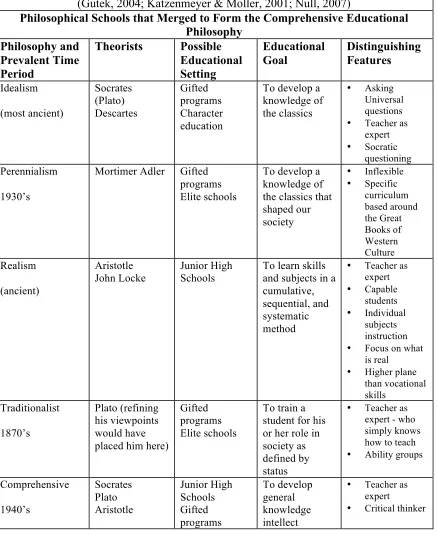
philosophical schools, that have emerged. These many schools can be represented in the five educational philosophies that are a defined in Lorraine Zinn’s Philosophy of Education Inventory. Table 1 (Appendix) shows how the numerous branches of philosophy may be represented in these five philosophical schools (Gutek, 2004; Katzenmeyer & Moller, 2001; Null, 2007).
Philosophical Schools that Merged to Form the Comprehensive Educational Philosophy Idealism.
The most ancient of philosophical schools is Idealism. Socrates belonged to the School of Philosophical Idealism. As he searched for the truth, Socrates used the technique of questioning an individual’s assumptions. By asking universal questions, Socrates’ students used critical thinking skills to examine their own assumptions and their understanding of “truth.” Plato believed that knowledge was absolute and eternal and that ideas were pure and represented the highest level of knowing. In an educational context, this means the teacher is a guide for classical studies working with a set of required core subjects designed to prepare one for adult life (Gutek, 2004). Idealism is evident in character education programs. “The idealist feels that with the growth of a fine moral character as well as personal reflection, wisdom is gained” (Maheshwari & Bansal, 2010).
Perennialism.
26
regarding specifically which classic works to be studied. By requiring the study
of the “Great Books” of western society, no room was left in the curriculum for additional classics or for contemporary works (Boschee, Prescott, & Hein, 1978). Perennialism focuses on the enduring themes and ideas that span history. Perennialism is concerned with “cultural literacy” and the understanding of the ideas that have created our culture. Students in the classroom learn, not from textbooks, but directly from the “Great Books” written by the great minds of western culture. Perennialism is found in many parochial schools because they study the great books of different religions. Unfortunately, this educational philosophy is not designed to bring the love of great classics to all students. “Perennialists see education as a sorting mechanism, a way to identify and prepare the intellectually gifted for leadership, while providing vocational training for the rest of society” (Sadler & Zittleman, 2008, p. 207).
Realism.
Realism is an ancient philosophy. Aristotle, John Locke, and Pestalozzi are
representatives of the School of Realism. Realism focuses on the teacher as an expert, one who teaches an accumulation of learned skills to students deemed capable of learning the subject matter. The purpose of Realism is to produce an educated human being whose theoretical knowledge is on a higher plane than vocational knowledge (Gutek, 2004).
27
world is made of matter and, therefore, is real. The universe operates through laws of nature, and Realism shows the truth of the world discovered through scientific methods.
Traditionalism.
During the 1870’s to 1880’s, Traditionalists defined what eventually became Comprehensive philosophy. This Traditionalist philosophy was based on the teachings of Plato; whose belief was that education should strive toward a higher truth, with an emphasis on the subject discipline, itself (Null, 2007). Traditionalists did not promote equal education, but believed in ability grouping and education for the elite. Lecture and direct instruction by teachers who had a “calling” to teach formed the basis for traditionalism and dominated the American education system for decades. The traditionalist teacher educated students for a role in life based on social and economic status.
Comprehensive.
Bits of Idealism, Perennialism, Realism, and Traditionalism can be seen in the general Comprehensive philosophy. Comprehensive educational philosophy is based on the development of the intellectual properties of the mind and serves to provide a well-rounded education for those students who are capable of grasping the concepts. The teacher is the expert in the classroom, transmitting knowledge to the students in a direct, well-defined instructional manner. Students are challenged to think, seek out the knowledge, and
28
Philosophical Schools that Merged to Form the Progressive Educational Philosophy Pragmatism.
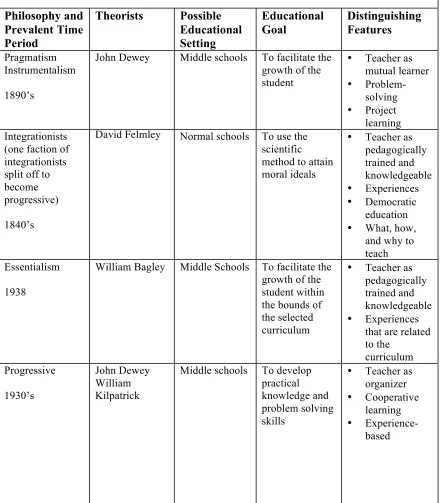
Pragmatism was developed by a group of American philosophers that included John Dewey. Pragmatism supports the vision that education occurs through a series of experiences as the student interacts with his or her environment (Gutek, 2004). Dewey did not indicate that all experiences were equal in quality and saw the teacher as essential to guide the experiences for the students. “The belief that all genuine education comes about through experience does not mean that all experiences are genuinely or equally educative. Experience and education cannot be directly equated to each other” (Dewey, 1938, p. 25). Dewey
strongly held the viewpoint that teachers must guide the students through these experiences but that the students must have a voice in the experiences as well (Noddings, 2007).
Integrationalism.
The School of Integrationist Philosophy was refined and defined during the 1920’s through the 1930’s. This school of philosophy concentrated more on the preparation of the teacher rather than on the instruction of the student. This philosophy was based on the teachings of Kandel and Felmley. By the end of the 1930’s, this group had fractured and is now seen in other, more general, philosophical schools. The splinter faction of the
29
form of the democratic education with pedagogically trained educators. Teaching methods were designed to interest students in the curriculum while maintaining a moral commitment to civic purposes as an end product. The integrationists concentrate on the what, the how, and the why to teach (Null, 2007).
Essentialism.
William Bagley’s dedication to the idea that there must be an approved curriculum, in addition to a pedagogically trained and content-knowledgeable teacher leading the
experiences of the classroom, led to a splintering off of Essentialism from Pragmatism (Bagley, 1938). Bagley did not see the elements of an approved curriculum and content-knowledgeable teachers in his interpretation of the philosophical ideas of his colleague, John Dewey.
Progressive.
30
Philosophical Schools that Merged to Form the Behavioral Educational Philosophy Technicians.
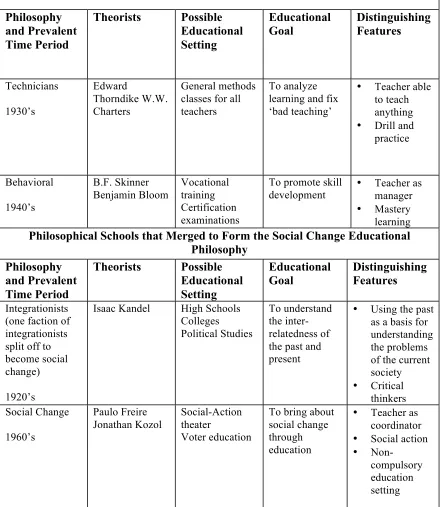
Technicians formed during the 1900’s to 1910’s and based their philosophy on the teachings of Edward Thorndike and W.W. Charters. Technicians believed that actions and behaviors were measurable and that these measures could provide information on how to fix bad teaching. Drill and practice, with teachers as controllers of the learning experience provided the order that was needed in the classroom for learning to take place. The Technicians would later broaden their focus to be called Behaviorists.
Behaviorialism.
The Behaviorists broadened the idea of drill and practice to include skill development, an element necessary for vocational education and learning for mastery. Benjamin Bloom would further develop the “Learning for Mastery” elements of this
31
Philosophical Schools that Merged to Form the Social Change Educational Philosophy Integrationalism.
When the Integrational School of Philosophy fractured, a faction of the Integrationists that most closely followed the teachings of Isaac Kandel was incorporated into the School of Social Change Philosophy. This group was concerned with using the past as a basis for understanding the problems of present day society. This faction was seen in the disciplines of political studies. This school of thought was more closely aligned with students who were older, those who attended high schools and colleges.
Social Change.
The Social Change Philosophy is currently represented by theorists such as Paulo Friere and Jonathan Kozol. Social Change Philosophy is concerned with identifying
injustices and bringing about change needed to correct injustices. The belief that education is the key to fundamental social, cultural, political, and economic change is basic to this
philosophy. The student in the learning process is considered to be equal to the teacher. The teacher serves as a coordinator making suggestions and posing problems for the student to analyze and react to (Katzenmeyer & Moller, 2001, p. 164).
Philosophical Schools that Merged to Form the Humanistic Educational Philosophy Romanticism.
32
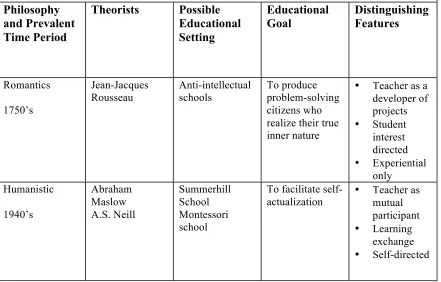
of the individual. Romantics believed that children learned only through experiences that were of interest to the student. They denigrated knowledge from books because they offered only isolated facts, rather than information that supported the child’s development.
Proponents of this philosophy insisted that nothing could be measured precisely and were convinced that by solely following the child’s interests within the classroom the result would be a fully self-actualized, useful citizen (Null, 2007). The Romantics would eventually be absorbed into the Humanistic School of Philosophy in the 1940’s.
Humanistic.
Humanistic philosophy can be seen in the teachings of Abraham Maslow and A.S. Neill. Both men believed that education could not be achieved without having first met the basic needs of the child. Through his school, Summerhill, A.S. Neill demonstrated his belief that children would select educational experiences when left to explore on their own (Neill, 1960). In the Humanistic philosophy, the teacher is a mutual participant in the learning exchange. Students are expected to be highly motivated and self-directed. Students are involved in the learning efforts and provide the big questions that direct their learning. Teachers provide support for the learning process for all students by guiding students to resources and by posing larger questions and ideas for examination (Katzenmeyer & Moller, 2001, p. 164).
33
their diametrically oppositional ideals, cannot co-exist with one another, such as Comprehensive and Social Change or Behavioral and Progressive. To know one’s own philosophy enables grounding in educational thought and practice. To know one another’s philosophy allows colleagues to examine connections and disconnections in teaching and learning approaches that will influence students’ classroom experiences. Katzenmeyer and Moller (2001) discuss the interrelationships of teachers and how these different philosophies define how individuals approach teaching. In their book on teacher leadership, they indicate that the self-knowledge of one’s own philosophy leads to an understanding of areas of inconsistency or disagreements among all members of the education community. They go on to point out that the knowledge of one’s own personal philosophy can lead to better
understandings between colleagues and improve teaming situations. Understanding one’s own philosophy helps a person to know why choices in curriculum delivery methods and assessment practices appear to be the “right” decision. Recognizing the tenets of a colleague’s educational philosophy provides a person with the knowledge of how that
philosophy may differ or even contradict his or her own. Once these differences are known to be philosophical differences, rather than the whims of a contrary person, there can be a foundation of respect between colleagues rather than a foundation of conflict.
Societal Impact
34 instruction following the launch of SPUTNIK.
In this 1957 example that demonstrated society’s impact on education, America expressed its collective embarrassment at having placed second in the space race. Teachers, blamed for the poor science and math performance of the nation’s students, were seen as having failed to prepare youngsters to compete. “American education became an attack point for why the Soviets had won the first leg of the ‘race to space’” (Eichhorn, 1998b, p. 78). This “national shame” created a shift in national educational philosophy. The result increased the emphasis on pure science and mathematics at any cost (Noddings, 2007, p. 48).
In reality, the educational system in our country was not an embarrassment.
Curriculum restructuring was the focus of the 1930’s and 1940’s. In fact, 1932 marked the beginning of what would become the Eight Year Study. Educational reform had stagnated in the high schools because of the domination colleges had in determining curricular
requirements for entering college students. Grant money in the amount of $700,000 from the Carnegie Foundation and the General Education Board was made available to thirty high schools in order to examine how changes in their curriculum would affect the knowledge base for their students. The schools were guaranteed that their students would be accepted into college “without reference to the particular subjects they had taken and without examination in those subjects” (Kliebard, 2004, p. 179). High schools participating in the study developed courses that integrated curriculum. In addition, they implemented
35
discipline-focused standard course of study in high school. This revolutionary study showed that America was actually at the forefront for curriculum integration. We were not an embarrassment; rather our focus was simply elsewhere. Rather than a focus on fact-loading, our teachers taught for the application of ideas in practical situations.
Generations
Significant societal events such as SPUTNIK, the bombing of Pearl Harbor, the assassination of President Kennedy, or September 11, 2001, form part of the collective societal foundations underlying different cohorts or generations of workers. In the field of education, there are four distinct cohorts of educators that are currently guiding students in the classroom (Lovely & Buffum, 2007). Veterans (born 1922-1943) are the smallest group still employed or volunteering in the schools, but the most likely to leave behind a legacy of procedures and policies. The Veteran cohort believes in honor, loyalty, and commitment. The Baby Boomers (born 1944-1960) make up the largest single group of workers in education.
36
group in the classrooms today. This group leads busy lives that are not necessarily centered on a career. Millennials have done more and seen more through constant access to multi-media than any other group. They have been praised throughout their lives and expect to be able to use their creativity to show themselves worthy of continued praise.
37
Societal Environment
Great struggles in society create social movements that influence the lens through which we look. Our own philosophies are linked to these struggles and the societal movements of our times. We are “all, inevitably, immersed in the tasks and values of our historical situation” (Noddings, 2007, p. 72). Noddings (2007) examines the struggles of class within our society as it plays out in small daily struggles within the classroom
environment. These classroom struggles mimic the struggles that we observe in the greater society and are factors in the formation of our philosophies. Noddings postulates that
teachers will either reproduce those greater societal struggles in their own classroom or rebel against the struggles that they themselves battled in order to make the classroom a different environment for their students. Garbarino (1992) supports Bronfenbrenner’s work in
describing the layers and characteristics of society with which an individual interacts. There are four ecological levels that make up the systems that interact to form the environment of the individual. The Microsystem includes 1) the home with parents and siblings, 2) the religious organization, the neighborhood and community, 3) peers and friends, and 4) teachers and classmates in school. The Mesosystem consists of the interactions among the elements of the Microsystem. One’s strength and support is seen in the number of
38
of parents, moving away from the community to a new place, becoming a single-parented household due to divorce or death. The Exosystem encircles all levels of the system and includes connections to the government and an individual’s employment and career choices. The Exosystem defines the values, the guiding principles, and the philosophy of government and society in which an individual resides. “Systems at each level have distinctive
characteristics that are relevant to a child’s development…these effects may be either positive or negative…the overall impact of the environment emerges from the dynamic balance among all influences over time” (Garbarino, 1992, p. 28). These experiences are all part of the person who becomes a teacher and thus contribute important values and beliefs to that teacher’s educational philosophy.
Parents, friends, the community, the religious institutions, the politicians and policies that govern our lives all become factors that must be considered in this philosophy formation (Noddings, 2007). What we value we use as a foundation for the people we become, and the ways that we interact with others, especially within the educational environment. Our theories of equalities, how we view our relationships, and our own racial and gender identities are critical to our own philosophy formation. As society changes the manner in which it values knowledge capital and cultural capital, a shift is made in the philosophy of an individual.
39
to a poor child growing up without the proper schooling to become a teacher, or a young teacher who perceives that she is unable to teach properly due to lack of materials and a poorly written curriculum, these factors contribute to the formation of an educational philosophy. A teacher’s educational heritage matters. The schools that we attended, the teachers that we had as children, the interactions that we had over homework and projects, all contribute to the formation of our educational philosophy.
An educator’s personal philosophy offers a foundation for the manner in which he or she delivers curriculum, designs instruction, and makes evaluation decisions (Katzenmeyer & Moller, 2001). This philosophy should be always “under construction,” an evolutionary process of renewal. For practicing teachers, the current research in education may sway the formation of philosophies. When new ideas are presented by a school district, when topics are studied in Professional Learning Communities, when professional development workshop presentations are authoritative and convincing, philosophies will shift, if the individual can find truth in the research (Noddings, 2007).
Philosophy as a Function of Teacher Education
40
manner that a compass is a tool used for navigation, it is clear that Petress sees an educational philosophy as an important tool for a teacher.
A workable and useful teaching philosophy does need to be broad enough and rich enough to withstand doubt…stable enough to withstand challenge and question by students, colleagues, administrators, and accreditation agencies. (Petress, 2003, p. 133)
41
through a variety of experiences that the teacher conducts within the classroom. Essentialism would promote an understanding of local government and civic responsibilities in addition to a historical perspective of the country through teacher-directed classroom experiences. In the eyes of a student teacher both of these philosophies would create a classroom environment that is very controlled and traditional.
Early research with cooperating teachers and student teachers found that student teachers were likely to shift their educational beliefs to conform more to the beliefs held by the cooperating teacher (Price, 1961). Pope’s work (1983) showed that, contrary to the expected, by the end of the student teaching experience student teachers did not become more like their cooperating teachers in terms of educational beliefs (p. 73). However, Pope did notice a shift of the educational beliefs for the cooperating teachers in her study. She attributes this shifting to the self-reflection on the part of the cooperating teacher, an affirming, or re-evaluation of the educational beliefs of the cooperating teachers,
He may re-examine himself as a teacher so as to renew his philosophy and to provide model directions for the student teacher. He may also sense a great responsibility in helping to mold a future teacher, thereby increasing expectations of himself as well as the student teacher. Participating in the student teaching experience may provide an opportunity for self-renewal and growth as the cooperating teacher comes in contact with an inexperienced, idealistic teacher fresh with new ideas. (Pope, 1983, p. 81)
History of the Development of Middle School Philosophy
42
the development of the philosophy of middle schools. Middle grades education has its own philosophy that has evolved over time. An understanding of the middle school movement, its history, and philosophy is essential for any teacher who intends to fully participate in a true middle school.
Prior to 1910.
Middle schools evolved from the junior high school movement that began in 1888. Charles Eliot, the President of Harvard, concerned that students were not being prepared to enter college, called for a philosophical change in our schools. A bridge needed to be built between the broad general education in the public elementary schools (grades 1-8) and the academic rigor of high schools (grades 9-12), whose students were being prepared for college. Eliot proposed restructuring schools to include seventh and eighth grade in the academically focused high schools. These new schools, grades 7-12, would ensure a more rigorous academic curriculum, and thus better prepared college students (Hunt, Wiseman, & Bowden, 1998). The academic high schools were not the middle school model of today. Their purpose was to cull students who would not be successful in college rather than to raise the academic growth of all students.
A psychologist and an educator, G. Stanley Hall was concerned about the place that high school had in American education. His concerns were that high schools were not preparing students for college; they were too different in their structure and their programs. Hall added critical information to the body of knowledge of educators through his
43
Educational Problems in 1911. Hall contributed to the understanding of human development with the landmark publication of his two-volume book, Adolescence in 1904. Unfortunately, this early work led to the nefarious stereotyping of the young adolescent as an individual controlled by the “storm and stress” of hormones and flights of temper. This misnomer, ingrained in our society, continues to prejudice our views about adolescents. The erroneous image that it paints hampers efforts to see the possibilities and promise of middle schools and negatively influences middle school education efforts.
Beginning the academic year of 1909-1910, the first junior high schools opened simultaneously in Columbus, Ohio, and Berkeley, California. The organization of the school grades was now moving to a 6-3-3 configuration. This new junior high school was intended to decrease the dropouts and failures in high school by providing a bridge between the elementary grades and the secondary grades. The junior high school concept was well received by the education community and it saw rapid growth over the next sixty years. The National Education Association Commission on the Reorganization of Secondary Education officially endorsed the concept of junior high schools in 1918 (Hunt, 1998).
1910 to 1960.
Leonard Koos (1920) provided the first statement of purpose for the junior high school.
44
and in its variables give latitude for the individual choice which is possible and advisable in achieving the vocational and, in some part, the avocational aims. Both constants and
variables should be administered as far as possible to recognize individual differences in ability. Some measure of departmentalization, is desirable, although complete
departmentalization, if provided at any point, should perhaps be deferred to the ninth grade or later. Promotion should be by subject. The work of the classroom should not be restricted to the “examination” method, but should give large recognition to study under supervision and to the project and problem. There should be an advisory system which will, of course, be concerned with the school behavior of the child. It must in addition comprehend his other interests, educational, vocational, social, and recreational. (Koos, 1920, p. 178)
This statement laid the groundwork for Gruhn and Douglass in the mid 1940’s as they identified the basic functions of junior high school (Hunt, Wiseman, & Bowden, 2003). These functions included:
• Integration of subject matter into effective behaviors,
• Exploration in order to make better vocational and academic choices as well as to widen interests in a variety of areas,
• Guidance to help students make better decisions and to make satisfactory social, emotional, and academic adjustments,
45
• Socialization in order to prepare students to be full participants in the general social order,
• Articulation to provide a transition in the communication skills from elementary school to a student ready for high school.
1960 to 1970.
The 1960’s saw the beginning of the Middle School Movement. Junior high schools had grown too rapidly for the original concepts to become a reality. More importantly, these schools did not take into account the developmental needs of early adolescents. Most junior high schools had retained the traditional scheduling seen in high schools, employed
secondary trained teachers, and structured activities around a high school model. All of these factors led to a failure to fulfill the promise of the junior high schools and paved the way for the middle school movement (Hunt, Wiseman, & Bowden, 2003). The dream of a bridge to high school was never achieved as many unsuccessful students simply dropped out of school.
In 1960, James Conant (Harvard University President) published Education in the Junior High School Years. His book called for public school reform with a focus on the “New Math” that focused on mathematical concepts rather than arithmetical calculations and the “New Science” that focused on inquiry and exploration rather than the historical fact building focus that was traditional. Conant also called for the return of grade nine to the high school setting to expand academic study in the secondary school (Hunt, Wiseman, &