Optimizing Analytical Queries on
Probabilistic Databases with Unmerged
Duplicates Using MapReduce
Kavita K. Beldar1, Prof. M.D.Gayakwad2, Prof. M. K. Beldar3
Research Scholar, Dept. of I.T., BVDUCOE, Pune, India1
Assistant Professor, Dept. of I.T., BVDUCOE, Pune, India2
Assistant Professor, Dept. of Mech. Engg., BVDUCOE, Pune, India3
ABSTRACT: In this paper, we present the first known approach for efficiently handling complex analytical queries
over probabilistic databases with unmerged duplicates. Our technical indexing structure is for efficient access to the entity resolution information. The novel techniques are proposed for the efficient evaluation of complex probabilistic queries that can retrieve analytical data. Also used JOIN for summarized information over a large collection of possible resolution worlds. Generally an existent database holds the data whose correctness is unsure. In order to work with such data, there is a need to quantify the reliability of the data. This is achieving by using probabilistic databases. A probabilistic database is an unsure database in which the probable worlds have associated possibilities. Probabilistic Linkage is the process of combining multiple databases into one extensive database for analysis or linking multiple events. We proposed an indexing structure which reduces the complexity of the computations required when processing quires. We are applying map reduce to large probabilities dataset which will mapped over similar data. The proposed MapReduce algorithm gives the better time performance for query evaluation.
KEYWORDS: Probabilistic Databases, Unmerged Duplicates, MapReduce algorithm, indexing.
I. INTRODUCTION
Database system plays an important role every organization. All the organizations or manufacturing companies are totally depending on the correctness of the database. The database may contain the data from various organizations and the records can be duplicate or similar records. This type of database is called uncertain or unsure or probabilistic or dirty database.
Many of the real world databases hold data whose accurateness is unsure. Work on to this type of data there is necessitating computing the veracity of the data. Unsure databases in which the probable worlds have related possibilities are called a probabilistic database. Handling queries efficiently and understanding huge set of unsure data is the most important test in probabilistic databases. This thesis demonstrates that it is possible to effectively manage large, imprecise databases using a generic approach based on probability theory.
II. PROBABILISTIC DATABASES EXAMPLE
Following table shows the example of probabilistic database. Table 2.1 shows the customer details with its different attributes. The database contains the L_name Lorys 10 time’s which are the duplicates records. To perform queries on such type of databases is a complex task. The record r1, r5, r9 contains the same records that is F_name Mats and L_name Lorys.
Table 2.1. Customer table
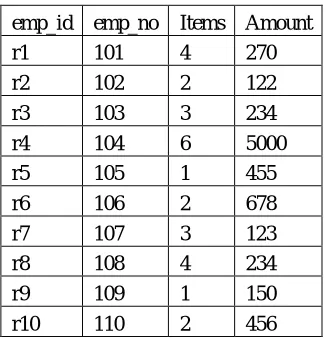
Table 2.2 shows the order table of the Customer persons. It shows that how many items purchased by each customer and with its total amount.
Table 2.2. Order Table
emp_id emp_no Items Amount
r1 101 4 270
r2 102 2 122
r3 103 3 234
r4 104 6 5000
r5 105 1 455
r6 106 2 678
r7 107 3 123
r8 108 4 234
r9 109 1 150
r10 110 2 456
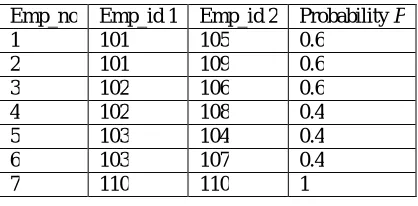
Here, in table 2.3 we calculated the probabilities of table 2.1.Here we compare each row with other rows for checking the similarity between two rows and columns. The record r1 is similar like r5 and r9. Here we calculate the probability using the technique jaccard similarity. Here P and Q are the two different set of records.
P={Mats, Lorys, f, USA, 2006}, Q={Mats, Lorys, f, IND, 2001} JS= (P∩ )/ (P∪ )
JS= (r1∩ 5)/ (r1∪ 5) JS= 3/5
JS=0.6
That is, the records in r1 are similar to the records in r2. The following table 2.3 shows the all probability results. Sr.no Emp_id F_name L_name Gender Location Year
r1 101 Mats Lorys F USA 2006
r2 102 Yakkov Lorys M DUB 2005
r3 103 John Lorys F IND 2009
r4 104 John Lorys M JAP 2001
r5 105 Mats Lorys F DUB 2010
r6 106 Yakkov Lorys F ENG 2005
r7 107 John Lorys F IND 2013
r8 108 Yakkov Lorys M DUB 2005
r9 109 Mats Lorys F PAK 2014
Table 2.3.Probability table
Emp_no Emp_id 1 Emp_id 2 Probability P
1 101 105 0.6
2 101 109 0.6
3 102 106 0.6
4 102 108 0.4
5 103 104 0.4
6 103 107 0.4
7 110 110 1
III.RELATED WORK
In this section, the related works that include the overview of the entity linkages with uncertainty and ranking queries on probabilistic databases, MapReduce techniques, and Top-k ranking queries is introduced.
In 2010 Ekaterini Ioannou, Wolfgang Nejdl proposed solution which supports arbitrarily complex SQL queries with” uncertain” predicates [6]. Main focus is query evaluation on probabilistic databases. This system describes an optimization algorithm that can compute efficiently most queries. As data complexity of some queries is #P complete, this implies that queries do not admit so approximation algorithm and a Monte-Carlo simulation algorithm are used.
In 2011 Ming Hua, Jian Pei authors propose a novel framework for entity linkage with uncertainty [5]. The framework introduces a series of novelties: (i) it performs merges at run time based not only on existing linkages but also on the given query; (ii) it allows results that may contain structures not explicitly represented in the data, but generated as a result of a reasoning on the linkages; and (iii) enables an evaluation of the query conditions that spans across linked structures, offering a functionality not currently supported by any traditional probabilistic databases.
In 2012 Dan Olteanu, Hongkai Wen author proposed solution for leverages data and workload statistics and correlations. [4]. Here the ranking functions can be customized for different applications. Our solution is principled, comprehensive, and efficient. However, investigating unspecified attributes is particularly tricky since we need to determine what the user’s preferences for these unspecified attributes. Proposed solution gives idea that the ranking function of a tuple depends on two factors: (a) a global score which captures the global importance of unspecified attribute values, and (b) a conditional score which captures the strengths of dependencies (or correlations) between specified and unspecified attribute values.
In 2013 authors proposed author investigated the problem of ranking query answers in probabilistic databases [3]. It gives a dichotomy for ranking in case of conjunctive queries without repeating relation symbols: it is either in polynomial time or #P-hard. The key observation is that there are queries for which probability computation is #P-hard, yet ranking can be computed in polynomial time. This is possible whenever probability computation for distinct answers has a common factor that is hard to compute but irrelevant for ranking.
IV.PROPOSED SYSTEM
Modules of architecture are explained below in detail.
A. Probabilistic database
An input or our system is a large probabilistic database, which contains unmerged similar records. The small example probabilistic database is shown in table 2.1. Here the L_name “Lorys” occurs 10 times in the database. It gives the 10 similar results for single query. There is need to find the solution for handling these types of multifunction query.The databases are taken from the online shopping customer’s database which stores the data in sequence from various system resources. Here we are going to consider two databases having different sizes. The main purpose behind taking two databases is the time performance.
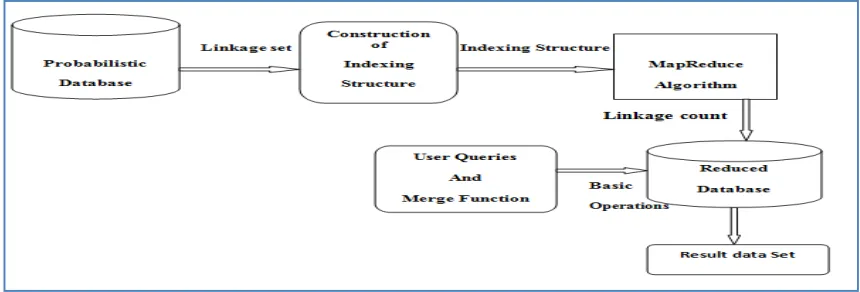
i.e. factor f1 for male and factor f2 for female. The database is grouped into two sizes that are all records by male factor and all records by female factors. It gives fast query processing. Indexing algorithm decreases the complexity of query processing. It provides access to the database which holds unmerged duplicate records. Indexing provides easy creation of possible worlds with fast retrieving the probabilities. It provides random look ups and easy accessed ordered records in large databases. The indexing is done on L_name column, so the L_name is quickly accessed in large probabilistic databases. Following Fig. 4.1 shows the proposed system architecture. The proposed system architecture uses indexing structure and MapReduce technique for executing multifaceted queries on huge a probabilistic database.
Figure 4.1 System architecture using MapReduce algorithm
C. MapReduce
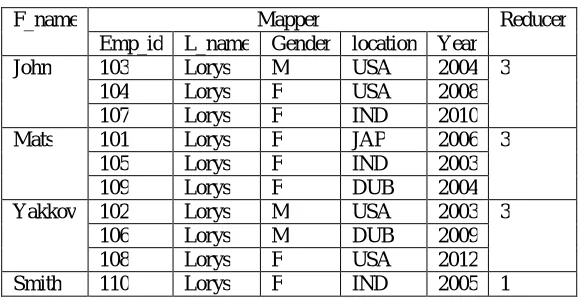
For parallel programs and working on large amount of data in parallel the MapReduce model is widely used. A MapReduce programming is a worldview for performing operations on big databases in distributed situations. The map function divides the documents into single words and for every word in the document it generates<key, value> pairs. For every words in the documents uses the function map (name, document) emit (word, count). The MapReduce algorithm is divided in to all other smaller tasks which are given below that is input phase to final results.
1. Input phase: in the input phase we took a large database and translate this database in to a input file format.
2. Splitting: in splitting phase the database is divide into two different formats. Here the all F_name are splits into smaller subsets.
3. Mapping: in mapping phase the splitted data is converted into a <key, value> pair format. It gives the results zero or one key value pairs. After mapping the f_ name
The results will be in the format <Mats, 3>, <John, 3> <Smith, 1>
4. Shuffling: In this step all the records are sorted by alphabetically and then merged together. The <key value > pairs are grouped together at the merging step. That is for example: <Mats, list<3>>.The sorting step takes input from merging step and sorts all key-value pairs by using keys. The output of this step is sorted key-value pairs.
5. Reducer: The reducer function takes group of key-value paired data as input and run reducer function on every of them. The data is merged, cleaned, aggregated in different ways; it necessitates broad range for processing. After execution is completed it gives the result zero otherwise more than one key value pairs.
6. Final result: The final result combines all the above steps together and generates the results. The total number of F_name are counted and grouped together. How many times a word occurred in a database is calculated at the reducer step.
D. Reduced dataset
Table 4.1 Result of MapReduce Algorithm
F_name Mapper Reducer
Emp_id L_name Gender location Year
John 103 Lorys M USA 2004 3
104 Lorys F USA 2008
107 Lorys F IND 2010
Mats 101 Lorys F JAP 2006 3
105 Lorys F IND 2003
109 Lorys F DUB 2004
Yakkov 102 Lorys M USA 2003 3
106 Lorys M DUB 2009
108 Lorys F USA 2012
Smith 110 Lorys F IND 2005 1
E. Basic operations
Here we perform some basic operations on reduced dataset. That operation means aggregation and top-k queries. We are executing queries database which having the size 50000.
Query 1: select *from Customer where L_name=”Lorys”
It gives all the records whose L_name is Lorys. The result of query 1 is same as shown in above table 2.1.
F. Retrieving by groups
Here we retrieve the queries by using group by clause. The condition is given by on customer’s location and grouped by columns.
Select column1, column2 From Customer
where location =”USA” Group by column1, column2
Query 2:SELECT * FROM Customer Where location =”USA”
Table 4.2. Results of USA locations
101 Mats Lorys F USA 2006 102 Yakkov Lorys M USA 2003 107 John Lorys F USA 2008 109 Mats Lorys F USA 2006
G. Retrieving of Factors
Here we create two different factors that are factor as male and factor as female, which is done by using the indexing structure.
Query 3SELECT *FROM Customer where gender=”male”
Table 4.3. Records as a male
F_name L_name Gender Location year
Yakkov Lorys M USA 2003
John Lorys M IND 2004
Query 4SELECT *FROM Customer where gender=”female”
Table 4.4. Result of all female records
F_name L_name Gender Location year
Mats Lorys F USA 2006
John Lorys F JAP 2008
Mats Lorys F IND 2001
John Lorys F USA 2010
Yakkov Lorys F DUB 2012
Smith Lorys F IND 2005
H. Top-k Query
This query retrieves the top three highest probabilities from the table 2.3 Query 5 SELECT Top 3* FROM Customer
Table 4.5. Results of top-3 records
Sr no Emp_id 2 Emp_id 2 Probability
1 110 110 1
2 101 105 0.6
3 102 108 0.4
The entire above query 1 to query 5 are executed on the second database having size 250000. The execution time performance is compared on both databases which is shown in table 5.1 and table 5.2.
V. PSEUDOCODE
MapReduce Algorithm:
Input: A probabilistic database D, Indexing structure, Views v Output: list (F_name, count)
//It map’s all duplicate F_name together with its all details
1: Class mapper
2: Method map (view v, table t) 3: for all F_name F table t do 4: If (F_name ==F_name) 5:Count++
6: Else
7:Emit (F_name f, count n) // 8: Class reducer
9: Method reducer (F_name f, counts (c1, c2, c3,.…,cn)) do 10: Sum <- 0
11: For all count c counts [c1, c2 …cn] do 12: Sum <- sum+c
VI.RESULTS
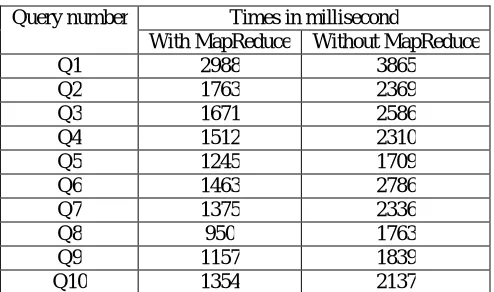
The following table shows the time performance of each query.Here , same queries are perofrmed on two different sizes of data sets that is 50,000 and 250000. Also did the comparision between them with respect to time that is data set size 50,000 merge with MapReduce and without MapReduce and data set size 250000 merge with MapReduce and without MapReduce. With the data set size 250000 the time performance is better than data set size 50,000. Here the time performance is meauserd in milliseconds.
Table 5.1 Time Performance on 50000 dataset
Query number Times in millisecond
With MapReduce Without MapReduce
Q1 2988 3865
Q2 1763 2369
Q3 1671 2586
Q4 1512 2310
Q5 1245 1709
Q6 1463 2786
Q7 1375 2336
Q8 950 1763
Q9 1157 1839
Q10 1354 2137
The following table 5.2 shows the time performance on the second database having 250000 sizes. With MapReduce gives better time performance as compared without MapReduce algorithm.
Table 5.2 Time Performance on 250000 dataset
Query number Times in Milliseconds
With MapReduce Without MapReduce
Q1 2967 4627
Q2 3163 4323
Q3 3229 4358
Q4 3061 4152
Q5 2765 4531
Q6 2378 3687
Q7 2134 3793
Q8 1834 3265
Q9 1957 2846
Q10 1288 2546
Figure 5.1 Query processing time vs. Database size 50000
Figure 5.2 shows the graph of time performance on database size 250000; we execute the same queries on both dataset. The time performance is differing on both datasets. The second dataset gives higher time as compare to the first database.
Figure 5.2 Query processing time vs. Database size 250000
VII. CONCLUSION AND FUTURE WORK
probabilistic database easily and provide efficient way for query processing. Experimental evaluation is done on two different real databases contains 50000 and 250000 duplicate records respectively. The comparison between time performances is done on both with MapReduce and without MapReduce algorithm. Using MapReduce algorithm the time performance is better than without MapReduce algorithm. In this we are able to minimize the time using Map Reduce with indexing that provides efficient access to the possible entity merges and their probabilities.
In future we will try to find the solution for index balancing for huge linkage factor of attributes and how to increase the time performance when the database size will increase more than 250000.
REFERENCES
Journal Article
1. Kavita K. Beldar, M. D. Gayakwad, Debnath Bhattacharyya, Tai-hoon Kim, “A Comparative Analysis on Contingence Structured Data
Methodologies”, Volume 10, No.5 International Journal of Software Engineering and its Application under ISSN 1738-9984.
2. Youzhong Ma, Xiaofeng Meng, “Set similarity join on massive probabilistic data using MapReduce”, Springer Science + Business Media New
York 2013,3 December 2014.
3. Maximilian Dylla, Iris Miliaraki, Martin Theobald, “Top-k Query Processing in Probabilistic Databases with Non-Materialized Views”,
University of Antwerp, 2013.
4. Dan Olteanu Hongkai Wen, “Ranking Query Answers in Probabilistic Databases: Complexity and Efficient Algorithms”, EPSRC
EP/G069557/1 FRESNEL project, 2012.
5. Ming Hua, Jian Pei, Wenjie Zhang, Xuemin Lin, “Ranking Queries on Uncertain Data: A Probabilistic Threshold Approach”, SIGMOD’08,
June 9–12, 2011.
6. Ekaterini Ioannou, Wolfgang Nejdl, Claudia Niederee, “On the Fly Entity Aware Query Processing in the Presence of Linkage” 36th Inter. Conf. on Very Large Data Bases, Sept 1317, 2010.
7. Ekaterini Ioannou, Minos Garofalakis, “Query Analytics over Probabilistic Databases with Unmerged Duplicates”, IEEE Trans. Knowl. Data
Eng., Vol.27 No.8 August 2015.
BIOGRAPHY
Miss. Kavita Kantilal Beldar is a Post Graduate Research Scholar in the Information Technology Department, Bharati