University of Windsor University of Windsor
Scholarship at UWindsor
Scholarship at UWindsor
Electronic Theses and Dissertations Theses, Dissertations, and Major Papers
1-1-1964
Differences in the effectiveness of auditory and visual cues for
Differences in the effectiveness of auditory and visual cues for
autistic children in a two-choice discrimination learning task.
autistic children in a two-choice discrimination learning task.
Sylvia Rowe
University of Windsor
Follow this and additional works at: https://scholar.uwindsor.ca/etd
Recommended Citation Recommended Citation
Rowe, Sylvia, "Differences in the effectiveness of auditory and visual cues for autistic children in a two-choice discrimination learning task." (1964). Electronic Theses and Dissertations. 6367.
https://scholar.uwindsor.ca/etd/6367
DIFPBRENGBS IK THE EFFECTIVENESS OP AUDITORS AND VISUAL
GU&S FOR AUTISTIC CBIIDRBN IN A TWD*0M0ICS
DISCRIMINATION LEARNING TASK
V
SILVIA
.A ., U nlv#r#ity o f Wlndaor, I 962
A Theal*
Submitted to th e Faoulty o f Qradiiate Stodie® through th e Departmemt of Payehology la Partial Polfillment
o f th # RaqalrmaoBt# fo r th # Dogre* o f l a s t a r o f A rts a t th e
U n iv ersity o f Windsor
UMI Number: EC52548
INFORMATION TO USERS
The quality of this reproduction is dependent upon the quality of the copy submitted. Broken or indistinct print, colored or poor quality illustrations and photographs, print bleed-through, substandard margins, and improper alignment can adversely affect reproduction.
In the unlikely event that the author did not send a complete manuscript and there are missing pages, these will be noted. Also, if unauthorized copyright material had to be removed, a note will indicate the deletion.
UMI
UMI Microform EC52548
Copyright 2008 by ProQuest LLC.
All rights reserved. This microform edition is protected against unauthorized copying under Title 17, United States Code.
ProQuest LLC 789 E. Eisenhower Parkway
H * i ' l
APPROVED BY:
j : ' . ' ' ■ ::
^
a / Â j / l y
ABSTRACT
Thle atudy **# *o attem p t to ia v e é tig a te th e d i f f e r e n t i a l
effeo tlv en eee o f vleo& l and a u d ito ry s tim u li as cues In a elmple
t#o»dholoe d ieo rlm ln atlo n te a k o f le a rn in g f o r a u t i s t i c as compared
to n o n â u tls tlc children*
The experim ental group ooneleted o f 18 h o sp ita liz e d a u tl e t i o
c h ild re n , and 13 non&utietlG children* The stim ulus co n d itio n s were
l i g h t a lo n e, bnaaer alone^ and l i g h t and b u ste r combined* The lea rn *
la g ta s k wee to determ ine th a t one o f two doors should he opened to
obtain a reward* The su b je c ts were measured fo r number o f responses,
number o f c o rre c t responses, and re a c tio n tim e to each stim ulus
condition*
The a u d ito ry cue was found to be le s s e ffe c tiv e than th e
v is u a l cue* I t was even le s s e f f e c tiv e fo r a u t i s t i c then f o r non-
PREFACE
T his stu d y began w ith my c u rio s ity aa to th e p o ssib le
v a ria b le * In th e a e tio lo g y o f th e a u t i s t i c ayndrome, Experimental
atudlem in perception le d to i n t e r e s t In th ia f i e l d In r e la tio n to
a u tie a , which was f u r th e r stim u lated by co n ta ct w ith some o f th e s e
c h ild re n . Host o f th e background m a te ria l came from th e writing® o f
1 . Kaoner, 1 . Bender and W» Qoldfarb on th e su b je c t o f childhood
psychoses,
Thanks t o th e cooperation o f th e e ta f f and ch ild ren a t
T histlstow n H o sp ita l, th e Id ea s fo r t h e study se re m odified end
f i n a l l y became a r e a l i t y , My thanks a ls o to th e school in sp e c to r,
p r in c ip a ls and tea ch e rs o f St* A ngela's and S t. Edmond's schools fo r
t h e i r perm ission to t e s t and cooperation in te s tin g fu rth e r su b je c ts
f o r th e c o n tro l group, and to th e c h ild re n them selves fo r ta k in g p a r t.
F in a lly thanks t o my Mentor, Dr, A, 9m ith, fo r h ie e a rly
h elp in th e ferm ulatloo o f th e stu d y , and h is encouragement, c r itic is m
and patle& t guidance through i t s l a t e r sta g es; and to my re a d e rs ,
Mr* M, S t a r r and Dr# F* T, Kingston, f o r t h e i r guidance and suggestions.
Also my thanks to Dr. B. Boddlnott o f T histletow n H o sp ital f o r h is
a s s is ta n c e in th e experim ental d esig n , fo r making th e h o s p ita l children
and f a c u l t i e s a v a ila b le f o r th e experim ent, and f o r t e s ti n g th e s ix
new a u t i s t i c c h ild re n .
T49LS 0* CONTENTS
LIST Of TABLES
Chapter I
IT
I I I
IV
f.r
INTRODUCTION .
D escrip tio n o f A u tis tic Children , Background o f R elated Research • Purpose o f P resen t Research ,
M BTPODOLOCT AND PRO CED URE .
Experim ental Sample « * ,
Equipment
.
.
,
,
.
Experimental Procedure .
PRESENTATION AND ANALYSIS OF RESULTS , Meon Responses f o r Groups and Conditions R e la tiv e E ffectiv en ess o f Sound
Compared to Light * * , D ifferen ces i n R e la tiv e E ffectiv en ess
DISCUSSION OP RESULTS ,
D ifferen ces o f Reward Value . , D ifferences Between H o sp ita lise d and
School Children « . , , Non*soorahle Responses o f A u tis tic S ubjects D ifferenoes between S tim u li . *
SUMMARY AND CONCLUSIONS
BIBUOORAFHY , . ,
VITA AU0T0R13 .
Pag®
i l l
LIS? OF TABLES
T&ble Page
1 Mean Snore* for Experimental and Control
Group# f o r Three C onditions . , . . 12
2 R e la tiv e B ffeetlveoee* o f Bnzaer ve L ight
arlfKO . 13
3 R esu lts o f Menn^Whitney U T est o f Percentage
D ifferen ces o f Buzzer o v er t ig h t Scores . Ik
k D lffereooe* in th e Average Number o f Responses
cHAprm I
INTRODUCTION
The A u tis tic c h ild , from very e&rly age, appears to shut
out h is environment, and does n o t develop s o c ia l r e la tio n ships in th e
normal p a tte r n , He f a l l s to develop adequate vocal o r p h y sical
oOmmunloation w ith th e world, and movement t h a t does occur tends to
be r e p e titio u s . People, o b je c ts , even h im self, he seeks to c o n tro l
through m anipulation, A to y tru c k , e . g . , might be in te r e s tin g to th e
c h ild because he could rep e ate d ly spin i t s wheels o r stro k e i t s ehlny
su rface, but th e r e would be no i n t e r e s t in i t as a tru c k . I f an a d u lt,
e . g , , was b arrin g h is way to a g o al, th e a d u lt would n o t be attack ed
as a person, but th e in te r f e r in g arm o r le g o r body would be pushed
o r p u lled as an o b je c t w ithout any re fe re n c e to the r e s t o f th e in d i
v id u al. Thwarting o f h is wishes i s as l ik e l y to give r i s e to a temper
tantrum a s to an o b je c tiv e a tta c k on th e offending o b je c t; and s e l f -
d e s tru c tiv e a c ts as w ell as tw ir lin g and rocking movements o f h is own
body a re loot uncommon* I t i s a stra n g e s ig h t to see a group o f th ese
ch ild ren , 5, 6, 7 and 8 y e a rs o f age in a playroom to g e th e r, each
occupied w ith h is own thoughts o r movements, and paying l i t t l e o r no
a tte n tio n to each o th er.
The A u tis tic c h ild i s h a p p ie st when alo n e. Although
seemingly u n affected by environm ental stim u li t h a t do not d ir e c tly
i n te r f e r e w ith him, changes in l l r i n g p a tte r n s and ro u tin e s produce
2.
août* a n x ie ty . Hie th in k in g aeeme to he eo concrete end e p eo lflo as
to prevent g e n e ra lis a tio n s , and i n h ib i t grasping cau sal r e la tio n s h ip s .
These c h ild ren a re not feebleminded, and show evidence o f n a tiv e
in te llig e n c e o ften above average, However, because th ey a re a u t i s t i c ,
th ey have no d e s ire to communicate w ith th e e x te rn a l world except fo r
b asic s e l f - g r a t i f i c a t i o n , and a re th u s se v ere ly retard ed s o c ia lly , and
give a g e n eral im pression o f feeblem indedness.
A good example o f t h i s i s t h e i r speech. Because o f t h e i r
d i s i n te r e s t in communicating w ith o th e rs , speech i s u s u a lly delayed
by se v e ra l y e a rs, and may inever develop spontaneously* Those c h ild ren
who a re n o t mute tend to use speech more f o r t h e i r own amusement than
as a means o f communication. Thus e c h o la lla i s a common phenomenon,
and although sentences o r phrase* may be rep eated im m ediately, they
a re o ften sto red fo r hours, days, o r weeks, and then d eliv ered am p-
l a t e l y o u t o f c o n te x t. One o f th e ch ild ren observed by th e author
would remain mute f o r days, then suddenly p a r r o t some p hrase w ithout
any connection to p re se n t e v e n ts, and a l l th e more s t a r t l i n g because
o f i t * m ature co n ten t. Another o f th e c h ild re n r a r e ly spoke w ith o u t
encouragement, y e t would go about singing t o h e rs e lf from a seemingly
l im i tl e s s r e p e r to ir e o f songs and hymns which she had heard on th e
ra d io or from th e s t a f f . In some (ddldreo speech may d e te r io r a te ,
even to mutism, a f t e r having once been acquired.
Another se v ere ly abnormal fe a tu re in th ese c h ild re n , and one
in which th ey resem ble th e a d u lt sch iso p h ren ic, i s t h e i r affe ct* They
do not r e a c t in a normal way to stim u la tio n , "Chen one o f th ese c M l-
3 .
o r & more normal ty p e o f re e e tio n may be delayed fo r hour#, days, o r
lo n g er, Dlgpley* o f emotion, in clu d in g eevere h o s tile ag g ressio n , may
occur w ithout any apparent environm ental stlm ulua proceeding i t .
The c la s s if ic a tio n o f th ese c h ild r œ has been debated, and
th e y a re o ften sa id t o have a%arly Childhood S ohiaophrm ia". However,
ae Robinaon (1961) has pointed o u t, one o f th e mein fe a tu re s o f
echisophrenla 1# d e te r io r a tlA ) , and e lg n lf ie e rég re ssio n from an
e a r l i e r , more normal p erio d o f development. He goes on to say*
In th e m ajo rily o f sev ere H eturbanoe# o f e a rly childhood, th e onset o f th e d ise a s e can, as lan n er s ta te d , be tra c e d to th e e a r l ie e t y e a rs. Withdrawal in th e young (diild o w s ls te o f s e l f - l e o l a t l w and a f a ilu r e o r r e f u s a l to e n te r in to in te rp e rs o n a l r e la tio n s h ip s , r a th e r than an a c tu a l d ep artu re or reg re ssio n or ré g re ssio n from a p rev lo u ely achieved le v e l o f e o d a i p a r tic ip a tio n .
The symptomatology o f childhood psychoeee d i f f e r s frcm th a t o f eohlsophrenla, a# we know i t in th e o ld e r p a tie n t, Frank d e lu s io n a l m a te ria l i s ab sen t, Favoured id e a s a re e;g>re@aed in a r e p e t it i v e stereo ty p ed manner. R ep etetlv e o r compulsive motor a c t i v i t y o ften r ^ r e e e n t s th e most evident fe a tu re s o f th e i l l n e s s . R allu o in atio n i s unusual, e a c o ^ in g i n th e form o f momentary
experieaees which a re a sso c ia te d w ith t e r r o r or a n x i e t y , . The s im ila r ity o f childhood psychoses and achisophrenls in th e a d u lt r e s t s c h ie f ly on th e f a c to r o f e o d a l w ithdrawal ( f a i l u r e to p a rtio ip a te ) mad th e b ia a rre o r unusual q u a li t ie s o f th e behaviour.
Kenner (191*3) termed t h i s " A u tis tic D isturbances o f A ffe ctiv e
Gfmtact", and l a t e r , ( 1 9 W , "Early I n f a n t i l e Autiem", and remained
convinced: th a t i t was a d i s t i n c t syndrome, " d iffe re n tia te d from c h ild -
hood so hlsophreala by v ir tu e o f detachment p resen t no l a t e r than th e
f i r s t y ear o f U f a , and from o lig o p h ren ia ty th e evidence o f good
I n t e l l e c t u a l p o t e n t i a l i t i e s . " However, in follow-up s tu d ie s on Autism,
Sisenberg and Kanner (1956) have included in t h e i r c la s s if ic a tio n a
number o f ch ild ren rep o rted to have developed norm ally fo r th e f i r s t
phenomeno-u.
logy d is tin c t ftroa cases o f childhood echlm ophrw la.
Thus, although a few o f th e 18 c h lld rm in t h i s study have
been diagnosed as "E arly Childhood Soblaophrenia" r a th e r than "Primary
I n f a n t i le A u tim " , th e y a l l f i t th e a u t i s t i c sytdrcme a lre ad y d e sc ri
bed, Since th e researo h ers in t h i s f ie ld l y no means agree on th e
nom enclature, resea rch on ch ild ren c la s s if ie d in c ateg o ries o th er tlwn
t h a t o f E arly o r Primary I n f a n t i le Autism has been u t i l i s e d by t h i s
au th o r i f auoh children f i t t e d K enner's syndrome.
Primary I n f a n t i le Autism i s a condition fo r which th e cause
has never beem adequately dem onstrated, SisAabsrg and Kanner (1956),
in studying 120 o f th e s e ch ild ren oould fin d no c o n siste n t or a p p aren tly
re la te d p h y sio al a b n o rm a litie s. They found a sex d iffe re n c e o f boys
over g i r l s in a r a t i o o f k to 1* They fomid t h a t almoet u n iv e rs a lly
th e p a re n ts were i n t e l l i g e n t , obsessive and m o tlo n s lly f r i g id , but
d id n o t consider t h i s t o be more than a p o ss ib le co n trib u tin g cause.
Bender (1956), Fish (1959) and o th e rs consider one o f th e m ajor c o n tri
buting causes to be a d ev ian t m atu ratio n al p a tte r n , which Bender term s
"a m atu ratio n al lag a t th e embryonic le v e l o h aracteriaed by a p rim itiv e
p l a s t i c i t y in a l l a re a s from Whioh eubsequrnit behaviour develops".
Bender d e f i n ite ly claim s a b lo lo g ie a l b a sis f o r th e behavioural devia
tio n s which th e se c h ild ren e x h ib it.
S erv is and G a rd a (1961) re c e n tly stu d ied 60 such c h ild re n ,
and concluded t h a t th e d i f f i c u l t i e s in v a ria b ly involved th e develop
m ental sta g e when th e mother was th e c h il d 's primary o b je c t, Many
in v e s tig a to r s seem to agree t h a t an e a rly u n s a tis fa c to ry m other-child
5.
a e tlo lo g lo a l f a c to r in t h i s oondltlon* However, th e p aren ts o f mich
o h lld rm u e u a lly claim t h a t th e ch ild ren were " d if f é r e n t" , i . e . ,
unreeponalve, alm ost from b ir th .
I f euch ch ild ren had eomething wrong w ith one o r more o f
t h e i r eenee m odaU tlee, th i# might w ell account fo r th e d lfferen o e in
t h e i r reeponeivw eee from th a t o f o th e r in f a n te . One o f th e moet
common and moat rem arkable symptôme o f t h i e condition l a th e d ie t u r
ban oe o f th e normal speech p a ttern # Not only do th e s e children show
varioua d% rees o f m u tlm , v a rio u s degrees o f delay in th e a c q u is itio n
o f speech, as w e ll a s lim ite d vocabulary, poor sentence s tru c tu re ,
concreteness and l i t e r a l n e s s in word use and e c h o la lia , but many o f
them never acq u ire speech, (Kenner (i960) estim ated o n e -th ird ), and
many o f th o se who do do not speak d i s t i n c t l y . I s t h i s speech d i s t u r -
bance, l ik e th e neologisms o f th e sch iso p h ren ic, a r e s u l t o f th e
a u t i s t i c p e rs o n a lity , or oould i t be due in p a rt to d e fe c tiv e a u d ito ry
in p u t, o r to an i n a b i l i t y to u t i l i s e au d ito ry cues e ffe c tiv e ly ?
I t has o ften been observed t h a t people who a re b lin d seem
to s u f f e r l e s s p e rs o n a lity d istu rb an ce than people who a re d e af, and
S haroff (1959) d isc u sse s th e poseibLe e ff e c t on th e emotional develop
ment o f th e d eaf c h ild when non-verbal c o m m l catio n i s a b ru p tly cut
o f f in favour o f t a l k , which he cannot h ear. Re quoted Reuscb and Kees:
"In th e f i r s t y ear o f l i f e depression n e c e s s a rily must occur through non-verbal means. The c h ild l i t e r a l l y speaks w ith h is whole body. D i f f i c u l ti e s a r is e when p aren ts a re n o t fls a d b le in
communicating n o n -v erb ally end f a i l to respond a t each age le v e l w ith a p p ro p ria te motions* An impoverishment o f ocmaunl catio n
grow In surrounding*, where th e v e rb e l wee m pheelzed too e a rly end when meeeagee expressed in non-verbal terme were l e f t unanswered*" Reueck end Keea here a re r e f e r r in g to th e develop ment o f th e hearing c h ild , How mu<^ g r e a te r i*qx>verlshment o f
cwmmmi c a tio n and d ia r a c te r development may we a n tic ip a te in th e d eaf c h ild , where tW n on-verbal o o n e titu te e h i* only method o f communicating,
Ae Roaenewelg (1959) n o te s , eeneory d e p riv a tio n would r e s t r i c t th e
meaning o f th e environment, and observe#, "As a model psychosis, th e
sensory d ep riv atio n experiment much more c lo s e ly resem bles aohiao-
p h ren ia than do th e eaqpeziments w ith LSD o r m escalin e,"
Qoldfarb (1956 and 1961) re p o rts th a t th e c o n ta ct sense
m o d alities a re p re fe rre d by th e more reg ressed childhood schizophrénies
to th e v is u a l and a u d ito ry f i e l d s , H a rris (1959) noted t h a t scM zo-
p h ren ics were more to le r a n t to co n d itio n s o f a soundproof cu b ic le than
norm als, M e ttle r (1955) claim s an o rg an ic dysfunction as th e b a sie
fo r th e p e rc e p tu a l c«g>acity d ieturbance o f ed hiaophrm ics which makes
i t d i f d o u l t o r Im possible f o r th e c h ild to eetab U sh adequate r e a l i t y
c o n ta c ts, Hal] (1953*) noted th a t a c u te sohlaophrenlcs showed a high
d ^ r e e o f response tim e d e f i c i t to a u d ito ry s tim u li. In an unpublished
study c a rrie d out in Denmark, i t was found t h a t th e hearing o f ch ild ren
o f echlaophrenlc p a r w t s was n o t as good a# th e hearing o f th e ch ild ren
o f non-sehiaophrenlc p a re n ts,*
On th e b a s ie o f a l l t h i s evidence, th en , i t appears th a t
th e re may be a f a c to r o f sensory d ep riv atio n o f some ty p e , and probably
in th e a u d ito iy f i e l d . In th e a e tio lo g y o f frim«ury I n f a n t i l e Autism,
Since any such p o stu la te d sensoiy d e fe c t oould w e ll be d i f f i c u l t to
7 ,
d w o n s tra te ty standard t e s t s , p a r tio n la r ly in view o f th e r e a l
problem in communicating w ith them# a u t i s t i c c h ild ren , i t warn decided
to study th e way th ey handled sensory ones in a simple lea rn in g
problem, w ith a food reward to encourage response. The p a r tio u la r
le a rn in g ta # r chosen was a sim ple tso # ch o iee d isc rim in a tio n . The
p a r tic u la r hypothesis was t h a t a u d lto iy cues would be le s s e f f e c tiv e
CKAPT2R I I
MBTHOIOIDGT AND moCSDURE
Subject*
a l Group, There *w * 18 a u t i s t i c ch ild ren in t h i s group.
Thar* ware 12 c h ild re n , i* g ir l* and 8 hoy*, betwaan th e age* o f 5
year* 6 month* and 10 year* 3 wwith*, who had been o la a e ifla d a*
A u tis tio , and had been under r e s i d e n t ia l treatm en t in th e same
h o s p ita l ward to g e th e r f o r a p w io d o f more than 18 montha* S ix o f
th e s e d iild re n had been ahown to be o o n d itio n ab le in an experiment
c a rrie d out th e previous y e a r, i n which th e m anipulation o f o b je c te
had been rewarded by popcorn. Another group o f a u t i s t i c c h ild re n ,
f iv e boys and one g i r l , between th e age* o f four year* and seven year*
one month, were te s te d by D r.% R oddinott, follow ing «qi^roidmately s ix
month* r e s i d e n t ia l trea tm e n t in th e same h o s p ita l a* th e f i r s t g ro ip .
C ontrol Group. There were o r ig in a lly a t o t a l o f 18 c h lld rm in t h i s
group, matched f o r **%, and ae c lo s e ly a* poaelble f o r age, to th e
experim eotal groiq). Six o f th w e c h ild re n , fiv e boys and one g i r l ,
were from th e e w e h ô p i t a l a* th e experim ental grovqp. They were
c la s s if ie d n e ith e r a* *chisephrenlc o r a u t i e t l c , but a* n e u ro tic or
c h a ra c te r d is o rd e r, and none o f t h e i r p aren ts were known o r suspected
t o be schisophrenie* The o th e r 12 c h ild ren in t h i s group, L g i r l s
and 8 boys, were from two tilndaor grade echoole. They were ra te d a*
9
.
i ll n e s s in t h e i r backgrounds. Of th e se cM ld ren , fo r v ario u s reasons,
( f a i l u r e t o rai^wod t o th e Twsaar, f a i l u r e to respond to th e f i r s t
e e rle a o f t r i a l s , a t t i t u d e s toward th e te s tin g s itu a tio n , e t c . ) , fiv e
had t o be elim inated from th e a n a ly s is . The u sab le c o n tro l group,
th e r e f o re , included 6 oh ild ren fTcm th e h o s p ita l s e ttin g , and 7 from
th e Windsor schools, f o r a t o t a l o f 13 su b je c ts.
Bacperimental Design
Groups. The experim sntal su b je c ts were divided in to two groups o f
n in e ch ild ren each, matched ae w ell ae p o eelb le f o r sex, age, and
o o n d itlo n a b ility , (s in c e t h le i s a conditioning type o f experim ent).
Since th e r e were two boys i n whom some type o f heBiing impair..: ; :
seemed more obvious, one was placed in eadh group. The groiqps were
a ls o matched as w ell a s p o ss ib le f o r degree o f im p a im m t o f th e
c b ild r w ; e * g ., aW .H ty in speech, s e l ^ c a r e , s e lf - p r o te c tio n , e t c ..
T*ie c o n tro l e u b jeo ts were a ls o s p l i t in to two groups, matched as
clo se ly a s p o saib lo fo r age and sex to th e experim ental groups. These
grotg)s a re calle d Experimental Oro^p I , Experimental Group I I , Control
Group I and Control Group H , Groiiyp I was given th e v is u a l stim ulus
f i r s t , and Group 1% was given th e a u d ito ry stim ulus f i r s t .
T r ia ls . There were th r e e blocks o f twenty t r i a l s esoh. In each h a lf
o f t h e tw o n ty t r i a l * th e r e w ere f i v e oues f o r t h e r i g h t ©ide and f i v e
cues f o r th e l e f t s id e , in random o rd er, but never more than th r e e o f
th e same sid e in a row. A d i f f e r e n t random order o f p re s e n ta tio n was
used fo r each block and fo r e&oh c h ild . SVeiy o th er c o rre c t response
10
.
s e rle * o f t r i a l s were In th e o rd e r o f l i g h t , W ezer, l i g h t end buzzer;
end in Grotq)s H , th e o rd e r wee bumzer, l i g h t , l i g h t end bueeer. The
subject® were scored f o r number o f reepeneee, number o f c o rre c t
reeponeee, end re e o tlo n tim e.
Equipment. Tbie ooneieted o f e la rg e cardboard eerto n , w ith th e beck
cut o u t. The fro n t o f th e carton wee th re # f e e t wide, end two f e e t
th re e and o n e -h e lf inehee high. A door, e ig h t inches wide and n in e
inches h ig h , w e cut in each o f th e o u te r loww com era o f th e carton
f ro n t, Above each door a c ir c l e th r e e Inches in di«meter was cut and
backed w ith red silk * The dietaB ce between th e oentree o f th e circleG
was two f e e t , two and o n e -h a lf In ch ea, Looped w hite pipe c le an e rs w # ^
used as handles fo r th e do o rs. A space fiv e and o n e-h alf in ch e s by
e ig h t inches b ^ n d eacdi door was p a rtitio n e d o f f w ith w h ite paper.
This was done to provide a clean w hite eurfaoe f o r th e reward, and to
o b s tru c t th e s u b je c ts ' view fro* th e equipment and experim enter behind
th e carton f r o n t.
A 60 w att l i g h t bulb was suspended behind each c i r c l e , and
a muted darkroom busser was placed on th e back edge o f th e ta b le a t
on# sid e o r th e o th e r to produce.a change in th e d ire c tio n o f th e
etlm ulue. An audible sw itch was used fo r th e l i g h t s and fo r th e buzzer,
t o tu rn them on and o f f , Thie equipmeot, th e popcorn used f o r th e
rew ard, a stop-w atch and th e ecoring sh e e ts , (which a ls o Included th e
schedule o f reinforcem ent and th e stim u lu s d ire c tio n o rd e r), were
p laced on th e ta b le behind th e carto n f r o n t, th e sid e s o f which were
angled out to approxim ately 120 d < ^ e e s . A low child-sim e ta b le was
1 1 .
th e equipment, While th e eubjeot e a t on a sm all c h a ir 80 inches from
th e ta b l e f ro n t, facin g th e c e n tre o f th e equipment. Two etop-watchee
were ueed, one th e examiner, and one by th e a a e ie tfm t.
Procédure, The a e e ie ta n t brought th e c h ild in to the room and i n tr o
duced him to th e experim enter, who gave him popcorn from a cup. The
experim enter than placed th e otq) behind th e equipment and opened th e
rig h t-h a n d d o w , showing th e c h ild th e popcorn which had bew pieced
th e re . The c h ild was encouraged to wme up to th e door, got th e pop
corn, then a l t down again. T his procedure was repeated w ith th e l e f t -
hand door. The experim enter then went behind th e equipment and began
th e t r i a l s . The a e e ie ta n t stood behind th e c h ild . Each twenty-second
t r i a l b ^ a n w ith a three-second presenta'WLon o f th e stim u lu s. For th e
f i r s t t r i a l o f each s e r ie s , th e ch ild was led to th e oorreot door
i f he f a ile d to reepond to th e cue w ltliiu th e f i r s t ten eeconde. The
a s s i s t a n t t r ie d t o prevent th e c h ild from opening th e second door,
(o r from going behind th e t a b l e ) , by going in th e o p p o site door d ire o -
tio n from th e c h ild . I t was a le c th e a s s i s t a n t 'e r e s p o n s ib ility to
le a d th e c h ild beck to b is s e a t, and to tim e th e c h i l d 's re a c tio n from
th e beginning o f th e t r i a l to th e p u llin g on th e door handle, as th e
experim enter could n o t se e th e c h ild , and to re p o rt th e re a c tio n tim e
to th e experim enter v e rb a lly .
In stru ctio n ® . Because o f th e muteness and n agatlveness o f many o f
th e a u t i s t i o o h ild ren , form al in e tr u c tio n e were not given. The c h il
dren were to ld th a t th ey were going to play a game, and th e children
in th e c o n tro l group were to ld th a t in t h i s game we did n o t t e l l them
CmPTER I I I
PKBSSBTATim AND ANALYSIS OP RESULTS
R esult*
The meen number o f responses, ( c o r r e c t end in c o r r e c t) , mean
number o f c o rre c t responses, and average re a c tio n tim e to th e th r e e
stim ulus con d itio n s ( l i g h t , b u ste r, l i g h t and b u zzer), were determined
fo r both th e expeMmontal and co n tro l groups. These d a ta a re shown
in Table 1,
Table 1
Mean Scores f o r B3qperim«ital and Control Groiq)s fo r Three Conditions
Crotqps L ight
* R. G,a. R.T, a .
Busser C.R, n,T.
L ight & Buzzer R. C.R. R.T.
A u tis tio 10,68 9,66 6.75 6,68 3.w^ 9.06 11,83 10,27 6,62
Nonaut. 16,92 16.6L 5,16 17,00
* R, * Number o f Responses
C.R, " Nimber o f C orrect Responses R*T, - Average Reaction Time
9,38 6.67 19.83 18,50 L 7 3
Since th e response d ata seemed very heterogeneous, and since
th e primary I n t e r e e t was in th e d i f f e r e n t i a l e ffe c tiv e n e sa o f l ig h t
13
.
va» sound
m
s tim u li, i t seemed, more a p p ro p ria te to d e riv e a measureo f th e r e l a t i v e e ffe e tiv e o e sa o f th e a u d ito ry stim ulus, as a percen
tag e o f th e buzzer sco re w ith re sp e c t to th e lig h t sco re, fo r a l l
th re e reeponee o a te g o rle e , (mmber o f reeponaes, number o f oorreot
reeponaee, and average re e o tio a tim e ), fo r each su b ject group, and
to aaaeaa th e group d lffe re n e e a by a Doo-perametrlc t e s t . Table 2
give* th e a e mean r e l a t i v e effe o tiv e n ea e aooree fo r which th e s e groups
averaged fo r a l l th r e e response o ateg o riea.
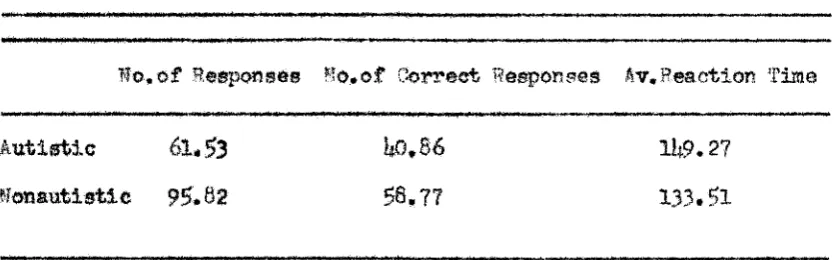
T able 2
R e la tiv e B ffeotivenesa o f Buazer v s. l i g h t (B/L x ICX))
No, o f Responses S o ,o f C orrect Responses AV, Reaction Time
A u tis tic 61.53 W .86 lb9.27
N o n a u tistie 95.82 56,77 133.51
The au d ito ry atim ulue th u s appears to be r e l a ti v e ly le s s
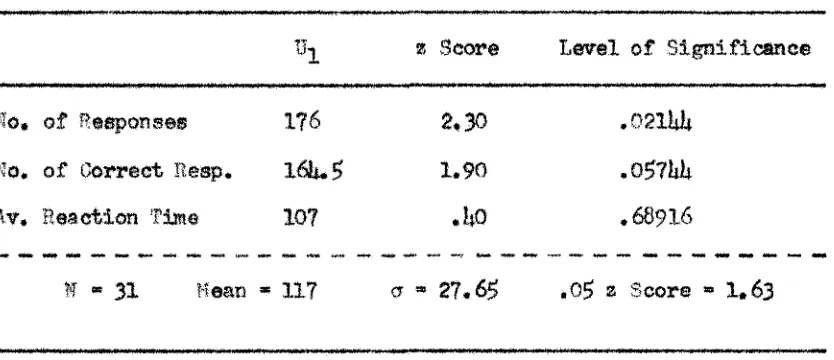
e ff e c tiv e in th e a u t i s t i c o k ild iw i. The eig n lflo a n o e o f th e d if f e r
ences between th e two groups was assessed by th e Mann-W1d.tmey U t e s t
(Moflewar, 1962, pp, 377-178). The r e s u l t s o f th i® a n a l y s i s a r e
Hi.
Table 3
R esult* o f Kann-ivbltney u T eat o f Pereentag* D lfforeooe* o f Buzzer over l i g h t Score*
Ü1 * Score Level o f S ig n ifican ce
No# o f Refgxmee* 176 2.30 .021W*
No, o f O orreet 16L 5 1.90 ,057Ui
Av. Reaction Time 107 . w .68916
CHAPTER 17
DI80USSI0M OF RESULTS
The feck t h a t th e ex p w lm w ta l group, on th e average, made
fewer responses, fewer c o rre c t resp o n ses, end slower responses to a l l
stim u lu s oondltlons than th e o o n tro ls was to be expected, as a lack
o f reeponslvemeee to th e environment i s one o f th e chare o t e r l s t l os o f
s u t l s t l e (dtLldren, Popomm was chosen ae th e reward In an attem pt to
minimise th e s e expected d iffe re n c e s . The o r ig in a l grou^ o f 12 a u t i s t i c
oh ild ren a t th e h o s p ita l had been in o rd in a te ly fm d o f two food item s,
i|k)tatochips and popcorn# F rid ay fo r them was not F rid ay , but Chlpday.
One F riday whw chips were n o t sw ved, through an o v e rsig h t on th e
p a r t o f th e k itc h en s t a f f , many o f th e c h ild ren refused t h e ir suppers.
Whenever they went on an o u tin g , popcorn was a must on th e supply
H a t , and even some o f th e e b lld reo who spoke vw y l i t t l e would say
"Popw m , popoom ", over and o v er, and th e s c a tte re d were suddenly a
group when i t was being eerved. I t was hoped, th e re fo re , th a t th e
use o f popcorn eould e l i c i t more responses from th ese ch ild ren than
o th e r types o f rew ard, However, i t l a q u estio n ab le as to whether
popcorn had th e same reward v alu e to a l l th e ch ild ren in th e c o n tro l
group# I t i e probable t h a t th e r e would be a d lffe re n o e here between
th e grade-a<Aool group and th e h o s p ita l c h ild re n , as th e former would
have more c p p o rtu n lty to g et popcorn and i t s n o n e sse n tia l d ie ta ry
16
.
©quivalent® e ith e r from p a re n t# , o th e r c h ild re n , o r w ith pocket-
money, then would th e h o s p ita l o h ild re n . Table b ehowe th e d i f f e r
ed oee between th e average number o f reqxxiee# o f th e h o s p ita l
c o n tro ls and th e g rade-sohoolers.
Table k
D lfferenoe# in th e Avwage Number o f Respweee between th e Two Control Groups
Groups
Av. Ml l i g h t
0* Responses Busser Both
AV. No, l i g h t
C orrect Responses Buzzer Both
H ospital 17.50 16.16 19.80 12.63 10.83 19.60
School 19.28 17.71 19.00 17,71 10.71 17.71
D lfferenoe# 1,78 1.55 .8 0 L 8 8 .12 1.89
There was only one h o q p ita l < ^ l d who deviated much from th e
r e e t o f th e h o s p ita l c o n tro l group. He had Men in th e h ô p i t a l only
about th r e e weeks p r io r to th e te s tin g , and was more e r r a t i c in h is
gen eral behaviour than th e o th e r childreo in t h l s group. Also he was
1@S3 w ell aoqualnted w ith th e eaominer and th e a e e ie ta n t than any o f
t h e o th e r h o s p i t a l o h ild r e n t e s t e d , in c lu d in g th e ex p e r im e n ta l g ro u p .
The school c h ild ren d iffe re d from a l l th e h o s p ita l o h ild ren ,
both a u t i s t i o and n o n & u tistic, in a t l e a s t fiv e f a c to r s . ( 1 .) The
achool ch ild ren were considered to be normal i n t h e i r general behaviour
17.
a s s i s t a n t, and l i t t l e o r none w ith th e examiner. ( 3 .) The h o a p ita l
ch ild reo went to school in th e same b u ild in g in which t b ^ liv e d , so
th a t th e f a c t th a t they were being te s te d in a room o f th e b o lld in g
which housed t h e i r school would mean l e s s to them, e a p e d a lly sin c e
a l l but s ix o f th e h o sp ita l c h ild re n , ( th e s ix newer a u t i s t i c c h il
d re n ), were te s te d a t a tim e when school had been out f o r two months,
whereas th e grade school o h ild ren were te s te d during t h e i r school year#
( D The h o s p ita l c h ild ren a l l had more t e a t s o p h is tic a tio n than th e
school c h ild ren . All th e l a t t e r had had were grotç» 1 .0 . t e s t s admini-
atered ty ttw ch ers. ( 5 .) The atmo%)here in th e h o s p ita l was perm lsaive,
epontaneity and a o tin g -o t* were more moouraged than discouraged, and
counoellora and s t a f f were not looked upon p rim a rily as a u th o rity
fig u re s .
Although a l l o f th e h o s p ita l c h ild ren made some resp o n ses,
th re e o f th e school ch ild ren f a ile d to make even one response; one
made one response to the second s e r ie s , th re e to th e th ir d and none
to th e f i r s t , and one c h ild began responding only on th e second serlea#
Moat o f th e school ch ild ren looked f o r approval from th e a s s i s t a n t ,
whereas few o f th e h o a p ita l ch ild ren d id . One o f th e school ohildren
tip to e d up to th e door each time he responded. Only one o f th e c h il
dren in th e schools showed th e sp o n tan eity ev id en t in a l l th e h o a p ita l
s u b je c ts.
In tr y in g to overcome th e se s itu a tio n a l d iffe re n c e s , a
l i t t l e e x tra tim e was spent w ith most o f th e school c h ild re n , and
more encouragement was given t o them. However, one o f th e ch ild ren
18
.
"Pretend you’r e out on th e school ground a t re c e s s ." "Don’t be
a fr a id to do whatever you w a n t." ), wag one o f th e th r e e who f a ile d
to reepond* Another wee one who f a ile d to reapond u n t i l th e second
e e rle a . Of th e f l r e t th re e e u b je cta, who did not re c e iv e as much
ex tM encouragement. Wo f a ile d to reepond a t a l l , and one wee th e
c h ild w ith no reeponeea to th e f i r s t s e r i e s , one t o th e second, end
th r e e to th e t h i r d . One o f th e se th re e c h ild re n , who did not respond
a t a l l , when aaked by *1* te a c h e r why he did n ’t "play th e ^sme", said
he was try in g to fig u re out how th e equipment worked. The o th e r ch ild
who didn’t respond watched th e room clock more then th e equipment*
The ch ild who f a ile d to reepond even w ith th e e x tra encouragement,
according to th e a s s i s t a n t, j u s t never did seem to fig u re out what i t
was a l l about.
The a u t i s t i c c h lld r w made o th e r re^^xmses than opening th e
doore* One o h lld once opw ed th e room door, an o th er turned on th e
room lig h t s during th e b u sser s e r ie e . More than one ch ild made more
th an one response o f poking h is f i s t o r fin g e r through a window.
Three attem p ts were made to come around th e back o f th e equipment.
One M ild sp e n t much o f th e time ig n o rin g th e equipment, tw ice in the
f i r s t s e r ie s (b u ss e r), punched through th e window, (only one o f th e se
tim es did ho open th e d o o r), and once he opened th e wrong door but
managed to grab th e reward from th e o th e r door. Re came around th e
equipment, and attem pted t o do so another tim e. Hie soorable responses,
however, were only two, two and one* iJhen th e t r i a l s were fin is h e d ,
he dashed behind th e equipment and began flic k ln fr sw itches, looking to
19
.
f i r s t tw elve, was mute, o fte n so ile d h im self, and had shown l i t t l e
improvement compared to th e o th w s during h is h o s p ita l s ta y , Many
o f th e resp(%8*s which th e a u t i s t i c c h ild ren made were not sc o ra h le ,
nor could i t be d etem ln ed a c c u ra te ly whether th e se were sim ply random
a c tio n s or whether th ey were a u t i s t i c reaponsea to th e s tim u li. Many
o f them o w ta ln ly appeared to be i n th e l a t t e r category.
In Table 1 i t can be seen t h a t even in th e c o n tro l group,
th e average number o f responses to th e l ig h t exceeds t h a t o f responses
to th e buzzer. Also th e n m b w o f c o rre c t responses i s s r ^ a te r fo r
th e l i g h t . The percentage o f c o rre c t responses to th e l i g h t l a 99*$2,
w hile fo r th e buzzer i t i s only $$.17, This d iffe re n c e may w ell be
due to th e equipment i t s e l f , although th e percentage c o rre c t f o r th e
a u t i s t i c grotq] was only $0 f o r th e buzzw , compared to 88,78 p e rc m t
f o r th e l i g h t . The buzzer was not a p leasan t sound, and th e space
between th e doors d id n o t a ffo rd much change in d ire c tio n o f th e
a u d ito ry stim u lu s. In th e othœr ccnditicm th e l ig h t went on d ir e c tly
above th e door, and behind th e c i r c l e o f red c lo th , which, a e s th e ti#
c a lly , was a more appealing stim u lu s. Two o f th e co n tro l c h ild re n
v erb alized t h e i r lik in g fo r th e red colour.
Thus, fo r a l l ch ild ren te s te d , th e buzzer seemed r e l a ti v e ly
le s s e ff e c tiv e than th e lig h t in e l i c i t i n g learned d iscrim in ato ry
behaviour. T)e@pite t h i s , however, and d e s p ite th e o th e r gross
d iffe re n c e s rep o rte d , i t appears t h a t th e buzzer was even leso e ffe c
GHAPTBR 7
3imAR? OOT'TCI,USIONS
Summary
An axperimaat wa$ c arried c u t t c determine th e d ifferen c o a
in th e effeotlvenesm o f a u d ltc ry and v is u a l cues i n a two-choice
d iacrlm in atltx i lea rn in g ta s k fo r a u t l e t l c and n o n a u tis tlc cM ld ren .
There were eig h teen h o a p lta liz e d a u t i s t i c c h ild re n , fiv e g i r le and
t h ir te e n hcys, and eighteen n o n a u tla tlc co n tro l c h ild re n , matched as
w e ll as p o ss ib le f o r age and ee% to th e experim ental group, Six o f
th e co n tro l group were c h ild ren from th e same h o s p ita l, c la s s if ie d
e ith e r as n e u ro tic o r c h a ra o te r d iso rd e r. The o th e r twelve ch ild ren
from two Windsor grade sch o o ls, who were c la s s if ie d ae normal
hy t h e i r teachers* ( f iv e o f th ese su b j^ o ts had to be olim lnated from
th e f i n a l a n a ly sis due to f a i l u r e to respond. ) None o f th e ch ild ren
in th e c o n tro l group were known to have schizophrenic p a re n ts.
The two stim ulus co n d itio n s were a U g h t and a buzzer. The
eaperim ental and c o n tro l groups were div id ed in to motched ^proups,
Sach groTüg) receiv ed a d if f e r e n t stim ulus o rd er o f p re s e n ta tio n , in
th r e e s e r ie s o f twenty t r i a l s each. For ozperim cntal ond co n tro l
grotgpe I , th e o rd e r o f p re se n ta tio n was l i g h t , buzzer, l ig h t and
buzzer. The o rd e r fo r experim ental groi%> PUd c o n tro l group I I , was
b u szer, l i g h t , buzzer and l i g h t . The c h ild ren had to le s m to open
th e door over which th e l i g h t shone o r behind Tfhlch th e buzzer sounded
21,
in order to g e t th e popcorn. The eohedule o f reinforcem ent wee a
reward fo r every o th er c o rre c t reeponeo. The chlldrene* behaviour
was recorded and scored f o r t o t a l mmber o f rcsponaes, nm ber o f
c o rre c t resp o n ses, and re a c tio n tim e. The e ffe c tiv e n e ss o f th e
buzzer r e l a ti v e to th e l i g h t was a ls o computed f o r th e se th re e
resixmsQ m easures.
The average responses o f th e a u t i s t i c ch ild ren t o both buzzer
and l ig h t were c o n s is te n tly fewer and slow er th an th o se o f th e non-^
a u t i s t i c group, ^o r t o t a l responses, the r e la tiv e e ffe c tiv e n e ss o f
th e buzzer was s ig n if ic a n tly lower (p » ,02) in th e a u t i s t i c groty;
th e same r e la tio n s h ip held fo r c o rre c t responses, but th e d ifferen o ee
did not q u ite reach th e conventional $;$ le v e l o f s ig n ific a n c e fp » .0 6 ),
Conolusions
I t appears, t h m , t h a t a u t i s t i c c h ild ren do not u t i l i z e
e ith e r l i g h t o r sound cues as e f f e c tiv e ly as normal ch ild ren do i n a
lea rn in g s itu a tio n , and th a t eound i s cvw l e s s e ffe c tiv e than l i g h t .
However, sin ce th e conditions In t h i s experiment were le s s id e a l f o r
th e c o n tro l group than fo r th e eaqieidmental group, i t may be th a t
th e re i s a c tu a lly a g re a te r d iffe re n c e between th e normal and a u t i s t i c
ch ild ren than a c tu a lly appears in th ese r e s u l t s , which were only s ig n i
fic a n t f o r nm ber of rei^xmsee a t th e .0$ le v e l of confidence,
Ihqw im entatioo w ith d if f e r e n t ty p e s , d is ta n c e s , and in te n
s i t i e s o f sound might show more illim ln a tin g d iffe re n c e s. This same
type o f experlmont using sound only, and d if f e r in g th e tone o r Inten#
s i t y f o r th e reward cue might a lso b a tte r in d ic a te th e reason f o r th e
Bender, L a u re tta , Schizophrenia in childhood- i t ' s re c o g n itio n , deso- rip tio n and trea tm e n t. Amer,J #O rthopaychiat. , 1956, 2 ^ It99-$G6,
îSisonborg, L ,,
&
Kenner, L* E arly i n f a n t i l e autism 19k3-$5, Amer.J,D rthopsychiat». 1956, 2 ^ $56-566, —
Flah, Rarhare L ongitudinal obaervatlone o f b io lo g ic a l d e v ia tio n s in a schizophrénie in f a n t, Amer,J , Peydhiat. , 1959, 116, 2$-31,
Qoldfarb, M. Receptor p referen ces i n eehlaopbrenic c h ild re n . A.M.A, Aron, n e u ro l, P a y c h la t,, 19$6, 6L3-6$2.
Q oldfarb, W, CMldhood Schizophrenia* Harvard D, P re ss, Cmnbridge, M ass,, I 9S C " ' ..
H a ll, K ,, & S tr id e , S. Some fa c to rs a ffe c tin g re a c tio n tim es to a u d ito ry s tin v ili in m ental p a tie n ts . J.m e n t.S o ., 195L, 100,
i.6S-W7.
---H a rris , A, Sensory d e p riv a tio n and sc h iz o p h rw la . J , m ent,S c ,, 1959# 10$. 23$"237.
Kanner, L. A u tls tio d istu rb an ces o f a f f e c tiv e co n ta ct. H erv.G blld, 19Ü3, ^ 217-2$0,
Kanner, L. E arly i n f a n t i l e autism . J .P a a d ., 19W*, 2 ^ 211-217.
Kanner, L* Child Psychiatry* (3rd e d .) Chas. 0, Thomas. S p rin g fie ld , I llin o is ^ W / pp. W^7!$2.
M e ttle r, F, P ercep tu al oapacily, fu n ctio n s o f th e corpus s t r a t i u a , and schimophrenia, P@ ychiat,<)uart.. 19$$, ^ 89- III*
Robinaon, J . The psychoses o f e a rly childhood* Amer*J*Orthopsychlat*. 1961, 33_ $36-$$0.
Rosenzweig, H. Sensory d ep riv atio n and schizophrenla, some c li.n lc a l and th e o r e tic a l s i m il a r it i e s . Amer* J * P sy ch lat. . 19$9, 116, 326-329.
S a r v ls , M ary, & Q axoia, Blanch®, E t i o l o g i c a l v a r l a b l s i n a u tis m .
P sy ch la tiy . 1961, ^ 307-317.
S h aro ff, R, Enforced r e s t r i c t i o n o f communication, i t s im pU cetlons fo r th e «motional and i n t e l l e c t u a l development o f th e deaf c h ild , Amer * J , P sy ch iat* , 19$9, 3.16, I.<l43»lil^6*
1930
%936®h7
19ü9~$0
1959
1962
Born In R iv ersid e , ( k ta r io , S ylvia H ilton Rowe#
to Francis Stanley end Anne Sduoated a t John Mmi^e end Edith
R iverelde High end e t R ivereida School.
(]evell Sohoolo, end
Oradnated w ith th e degree o f Aeeumptlon O niverelty o f Windsor, WLndecr, O nterio,