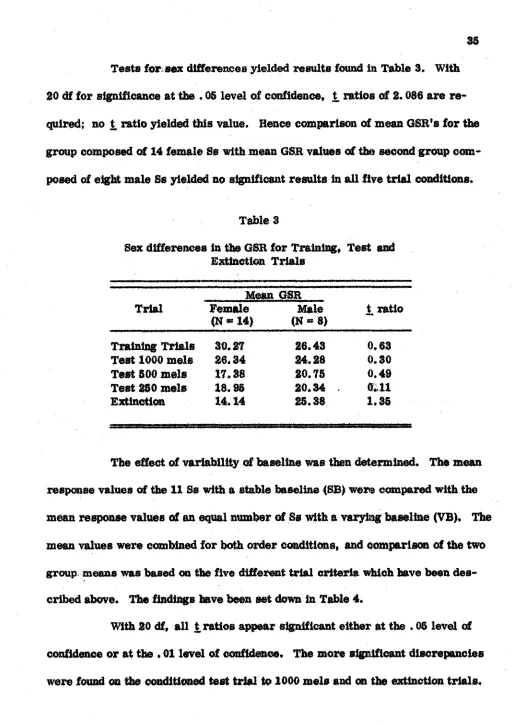
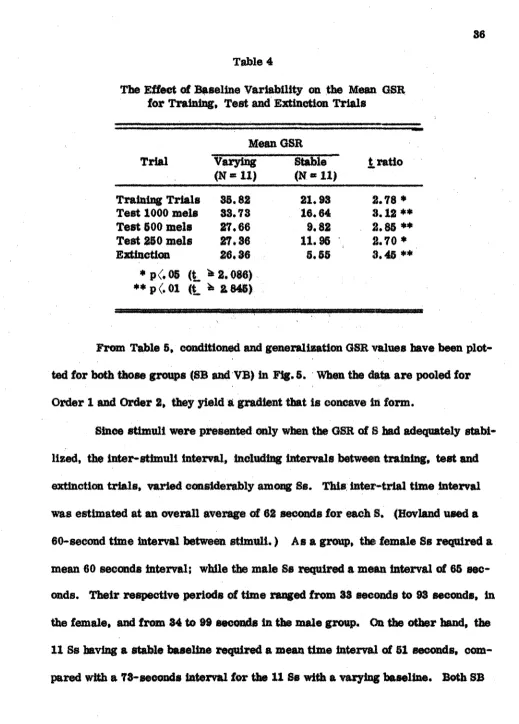
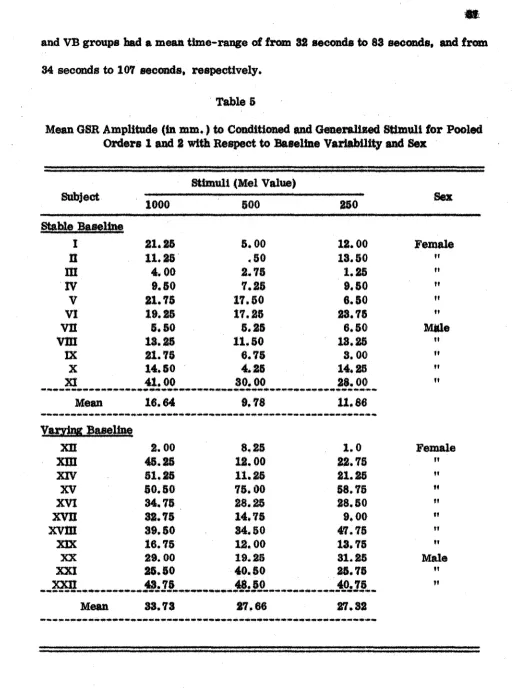
University of Windsor University of Windsor
Scholarship at UWindsor
Scholarship at UWindsor
Electronic Theses and Dissertations Theses, Dissertations, and Major Papers
1-1-1962
Subjective pitch and the generalization gradient.
Subjective pitch and the generalization gradient.
E. J. Anthony Lagan University of Windsor
Follow this and additional works at: https://scholar.uwindsor.ca/etd
Recommended Citation Recommended Citation
Lagan, E. J. Anthony, "Subjective pitch and the generalization gradient." (1962). Electronic Theses and Dissertations. 6309.
https://scholar.uwindsor.ca/etd/6309
SUBJECTIVE PITCH AMD
THE GENERALIZATION GRADIENT
A Thesis
Submitted to the Faculty of Graduate Studies through the Department of Psychology in P artial Fulflllm aat
of the fowftntja fo r the Degree of Master of A rts at Assumption
University of Windsor
by
E . J. ANTHONY LAGAN
B .A ., Assumption University erf Windsor, 1960
Windsor, Ontario, Canada 1062
ASSUMPTION U « ! T Y U B M tf
UMI N um ber: E C 5 2 4 8 8
INFORMATION TO USERS
The quality of this reproduction is dependent upon the quality of the copy submitted. Broken or indistinct print, colored or poor quality illustrations and photographs, print bleed-through, substandard margins, and improper alignment can adversely affect reproduction.
In the unlikely event that the author did not send a complete manuscript and there are missing pages, these will be noted. Also, if unauthorized copyright material had to be removed, a note will indicate the deletion.
®
UMI
UMI Microform EC52488 Copyright 2008 by ProQuest LLC.
All rights reserved. This microform edition is protected against unauthorized copying under Title 17, United States Code.
ProQuest LLC 789 E. Eisenhower Parkway
APPROVED BY:
ABSTRACT
Aa attempt was made la the preseat study to Investigate conditioned
generalization of the GSR along a subjective pitch continuum. With this purpose
in mind, Hovland's classical generalization experiment to various frequencies of
sound was, in part, repeated, using the "m el" (ratio) rather than the "jnd" (con
fusion) scale. Following Stevens* basic assumption of equivalence, on metathetic
continua, between these two subjective scales fo r pitch, it m s hypothesized that
the slope of the generalization gradient would be sim ilar in shape to that obtained
by Borland, ie ., negatively accelerated.
Using electric shock as the conditioned stimulus, 22 SS were con
ditioned to respond to a tone of 1000 mels in pitch, and tested fo r generalization
at 600 and 280 m els.
In assessing the date, statistically, significant generalization effects
were found. When mean GSR values were plotted, the resulting group curve
approached Borland's exponential function. Individual gradients also followed (he
same pattern, with no statistically significant departures from the group curve.
On the basis of this investigation, it was concluded that (a) generaliza
tion occurs to subjective pitch, and (b) the shape of the generalization gradient is
the same when pitch is scaled in either jnd or mel units. This conclusion lends
support to Stevens' suggestion of the equivalence of confusion and ratio scales on
metathetic continua. The findings further confirm the validity of Hovland's study
PREFACE
The present investigation stemmed originally out of the author's
interest in the possibility of learning the perceptual discriminations and relation
ships needed in the development of musical ability. Pitch is, of course, one of
the most important dimensions in music. The idea erf determining a conditioned
generalization gradient to subjective pitch, by duplicating in part Hovland's gen
eralization experiment of 1937, was firs t developed and discussed in the experi
mental psychology laboratory at Assumption University of Windsor, during lectures
given by D r. A. A . Sufith, His professorial teaching and guidance in this research
are greatly appreciated.
The author was fortunate to have had the assistance and encourage
ment of Rev. Brother Roger Philip, F. S. C», Ph. B ., firs t professor emeritus erf
Assumption University of Windsor, and to whom this dissertation is dedicated.
The w riter is indebted, also, to D r. W, G. Benedict, of tbs Biology Department
fo r his interest and useful suggestions. Special aeknowledgejment is made to
M rs. E. J . Broy, fo r more than ordinary care in the preparation of the final manu
script. Finally, sincere gratitude goes to the subjects who participated in the
research experiment.
Iv
TABLE OF CONTENTS
PREFACE ...
LIST OF TABLES .
LIST OF FIGURES . . .
Chapter
I INTRODUCTION . . . .
Conditioning in Learning Theory
The Conditioned Generalization Gradient Need and Purpose of Present Research
IX METHODOLOGY AND PROCEDURE
Subjects *
Apparatus . . . .
Experimental Procedure Collection of Data . .
H I PRESENTATION AND ANALYSIS OF RESULTS
iv v i v il 1 I 3 19 22 22 23 24 26 23
IV GENERAL DISCUSSION OF RESULTS
V SUMMARY AND CONCLUSIONS .
39
41
APPENDIX A
£
C
-Block Diagram of Apparatus
(1) Scores fo r Individual Subjects (F irs t Order) (2) Scores fo r Individual Subjects (Second Order)
Specimen Record . . .
44
45 46
47
GLOSSARY of Technical Terms and Symbols
BIBLIOGRAPHY
43
49
JJST OF TABLES
Table Page
1 Amplitude of the GSR (in mm♦ 1 to Conditioned and
Generalized Tonal Stim uli (in m els) . . . 31
2 Analysis of Variance of the GSR . . . 34
3 Sex Differences in the GSR for Training, Test and
Extinction T ria l# . 35
4 The Effect of Baseline V ariability on the Mean GSR
fo r Training, Test and Extinction T rials . . 36
5 Mean GSR Amplitude (in mm. 1 to Conditioned and Generalized Stimuli fo r Pooled Orders 1 and 2
with respect to Baseline V ariability and Sex . . 37
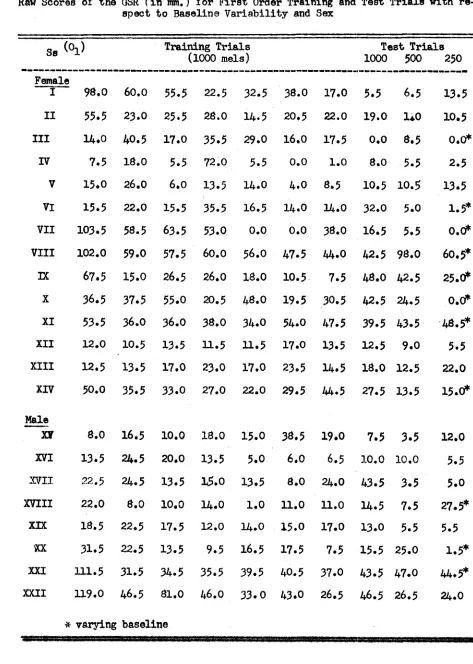
6 Raw Scores of the GSR fo r F irs t Order Training and Test T rials with Respect to Baseline V ariability
and Sex 45
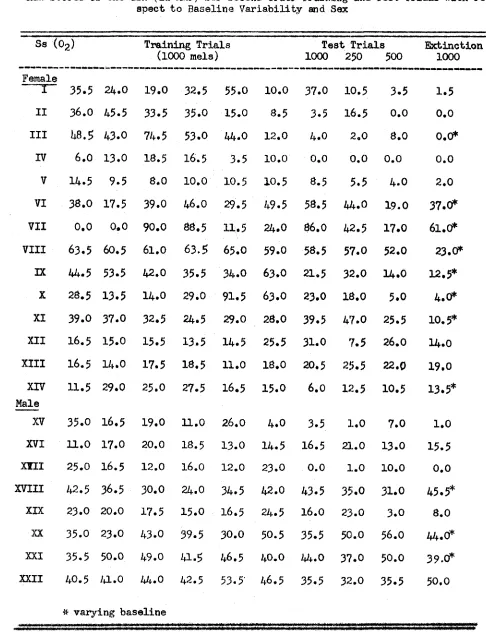
7 Raw Scores of the GSR fo r Second Order Training and Test T ria ls with Respect to Baseline V ariability
and Sex . . . 46
v i
LIST OF FIGURES
Figure
1 Block Diagram of ike Apparatus .
2 Specimen Record Showing Technique of Measuring GSR Amplitude
2 Sample Tracing of GSR Recording
4 Group Generalization Gradient of the GSR as a Funct ion of Subjective Pitch and Order of Presentation
5 Group Generalization Gradient of the GSR as a Function of Subjective Pitch, O lder of Presentation, and Baseline
V ariability . # . *
Page 44
47
29
32
CHAPTER I
INTRODUCTION
Conditioning In t .epming Theory
Conditioning has become a well-established principle of learning
In psychology. From the tim e of Pavlov (1849-1936), who originally devised
the experiments and coined the term , hundreds of articles on conditioning have
appeared. Many of the leading articles on this topic were summarized by
Hilgard and Marquis, in their book, Coudlt-iontogjind T turning, (1940). Since
that tim e, interest in this area has not slackened.
Tim terminology varies somewhat, but fo r purposes of this research
the term s and definitions given below w ill be used. The phenomenon of condi
tioning is described in the Encyclopedia Britannica (V I, 221) as follows:
Conditioning is applied to certain processes and products which characterize the acquisition of learned behaviour . . . . Grad} . . . . has two aspects: 1* a given stimulus (S j) which norm ally activates a prim ary (unconditioned) response (R j) hi made to e lic it a secondary (conditioned) response (Eg); 2. a given res ponse (R i) which is norm ally elicited by the prim ary (uncondi tioned) stimulus (S i) can now be activated by a secondary(con-ditioned) stimulus (Sg).
This definition categorizes both classical and instrumental or operant conditioning.
A third main aspect which governs the principle behind the formation of habits is
fiftiioii m ulti-response |n fdpatUnfti conditioning , a neutral
stimulus which immediately precedes or occurs simultaneously with an uncon
ditioned reflex stimulus hi a paired fashion, w ill tend to assume characteristics
1
2
of the original stimulus and thus e lic it by itself the reflex movement. This
process is sometimes referred to as "stimulus substitution". The scope of this
paper m erely allows an account of classical conditioning.
Conditioned responses were firs t tested in the laboratories of the
Russian physiologist, Pavlov. He observed that either learning or direct physio
logical methods could be adopted in controlling secretions from tike dog’s salivary
glands. Dethier and Stellar (1961, p. 83) give an appropriate illustration:
in his classical experiment, Pavlov lightly restrained a dog in a harness and repeatedly blew meat powder into its mouth and recorded accurately the amount it salivated. Then he associated the sound of a bell with the meat powder and re seated this orocedure manv. manv at successive in ter-vals. The bell, of course, did not at firs t e lic it salivation, but after repeated nairinas with meat it came to do so. In
describing Pavlov called the salivation to the
bell a conditioned reflex (CR), the beU a conditioned stimulus (CS), the salivation to the meat powder an unconditioned reflex (UCR) and the meat itself an unconditioned stimulus (UCS).
Several basic phenomena of the conditioned response were observed
and isolated by Pavlov and his co-workers within the stimulus-respisise relation
ship of conditioning. These can be enumerated as reinforcement, generalization,
diaryHwinfttirtn, and Reinforcement is the pairing of conditioned and
unconditioned stim uli* Generalization is tiie ability on the part of toe organism
to transfer or react to sim ilar stim uli; whereas its complementary process of
discrimination is described as totat ability to react to differences. Generalization
haw often been considered, by many lad in g psychologists, as a tynfe of discrim ina
tion. Repetition of the conditioned stimulus without reinforcement is known as
English in 1927, both research and theory in this area grew hi Am erica. It was
Hull <1884-1922) who firs t attempted to construct a theory fiy»* encompassed
fully ph*»n«m<nm» apH set th* psee fo r investigating tfw com
plexity of learning theory linked with it. Reviewing conditioning, Hull (1934)
Hpta numerous types of responses most cowyw^oiy conditioned, and the particu
la r types of stim uli that have been used to a great extent in human studies. The
lis t includes hand withdrawal, eyelid closure, knee Jerk, and vasomotor and
psycho-galvanic responses.
The Conditioned Generalization Gradient
Following Pavlov’s physiological findings, which form the best* for
fflwuHManiiig re search In the literature* ’’conditioned gnneraiigntinn»1 h»« come
to be regarded as one of the fundamental principles fo r the newly-forming ’'object
iv e ’* science of behaviour. Today "conditioned” h«« become the synonym fo r
’Teamed” behaviour. &yh|MMy«»Mfiyr there ♦&*» ingiAai necessity id formu
lating some pr inciple *ha» AytAnda prim ary rawtdiHrantng to a of stim uli, not
m erely to the original or An«ditiwnAd stimulus (CS). The phcmmwAnfm of "generali
zation" provides fo r Just such a principle, the* is , a mechanism whereby tide
process w ill occur with relative consistency. Assuming the* **a”
conditioned response ”R”, this same response may follow from a whole range of
stim uli "»♦, "C”, ”D ", etc. Do gAWAyaligjarf athtiMii, ttiAn, evoke responses with
tin> mnmm oy different magnitude;' end if so, what is the- relationship ? Further
m ore, ****** the strength of a response to gcney*8*!!****! ^ ty y ii he pr«»diA»Ad to vary
with its dfgywe of sim ilarity to *h«* hn«ir> cs originally conditioned ?
RSSBVnON MNEISITY UBRAItf
Hence, when a conditioned response (CR) to a particular stimulus
has been acquired by the organism, other sim ilar stim uli w ill also evoke the
response* The relatively equal ability of various stim uli to condition a response
is commonly referred to as "stimulus or sensory generalization". Sim ilarly,
generalization occurs on the response side, such that a stimulus which origi
nally elicited a particular response in the training period w ill, in certain instan
ces, evoke a different response without additional training. The degree of equi
valence among responses is known as "response generalization" (Hilgard and
Marquis, 1940).
Following Pavlov’s and Anrep's laboratory findings, cortical "irra d i
ation" of excitatory nervous processes was considered to be the cerebral mecha
nism underlying the active process of generalization. When a novel situation
develop), the organism’s successful approach to it by the conditioned reflexes
involved is preceded by a "period of generalization": (Pavlov, 192?, p. 113)
For instance, if a tone of 1000 d .v . is established as a con ditioned stimulus, many other tones spontaneously acquire sim ilar properties, such properties diminishing proportion ally to the intervals of these tones from the one of 1000 d. v. Sim ilarly, if a tactile stimulation of a circumscribed
ansa of the efcfa is into a tactile
stimulation of other skin areas w ill also e lic it sums conditioned reaction, fh# *Hi»toialifwg with increasing A\a^anr*a, of
areas from the one fo r which the conditioned reflex was originally established. The same Is observed with stimulation of other receptor organs.
Generalization of conditioned reflexes with auditory stim uli was firs t
carried out by Beritov, as reported by Hovland (198? a), who employed the condi
neural processes and their assumed proportional association to the intensity of
th eir nflftiHoi! to furnish answer to tlv* "behavioral
ftf frort0ira\iv.ptirm. •
la summary, ♦’how, is principle **>»* ovtanHia over
a range of eyfoyuftt fttitm iii - it eppiffie only to adjacent ftfo**!# which may not he
actually present a t ft*** gpoMfir* **”*0' of or training. Above it is
a natural p^A«rtTnc^wp jn everyday experience; hut in the laboratory it can easily
he H-fgpftaa^ of by tTrl€ or 1^ fmoantimjinn»' T
Various other definitions have in the pa#t been sssipod to generaliza
tion pVin«Ty>or>f» r 8om<> even have the fvft»«ibiMty t$m*t sensory generali
zation is non-existent in loaywing psychology. These theorists would profess that
what we know as tw in in g ^o.navaM’xatifm is n«tWng but a of discrim inatory
ability on the pa rt of the organism, JLashley's rats, fo r faatannft, failed to gen
eralize to certain patterns of stim uli (Hebb et a l., 1960). It is clear from the
writings of both wnii awri LasMey *^n* they stros^ly disagree on. this very
pc*nt-wiiii (1S43) sets down b*B «&*ri»»i#.t*?ift of prim ary .f*'faw«te«8 gAnewHwtHfw jn one of
nis mmn poNpRiiSQSBS cs 51100^ * us u»w Borjvwps n i!*©**.* u®»i irwui
Hovland’s investigation o f iiv a n e m of nnni-nttnnori responses* The w riter
uses Hovland’ s own Arffaiticin of conditioned tmtfnn given in the firs t of a
series of meticulous studies (1937a* b, c, d) carried out by him and, in part* dupli
cated here*
For the purpose, therefore* 1 tg«*T>eyBi* *1 win be ««*»d
throughout this study as it m s firs t conceived by Bass and Hull (1934) from whose
study the connotation of the term was used appropriately in the work of Hovland
(1951), where it is described as follows: "When a response Is conditioned to a
particular stimulus, the conditioned response is also made to jriipG **
without specific reinforcem ent," (p. 616).
A complete account of Hovlandfs (1917a) experiment at this point,
along with of deviations from it and smpplorntantfryy studies rvmtpftyflhloi
to that experiment, w ill be closely described. Hovland's purpose of the investi
gation m s , fey using farious frequencies of tone, to arrive at a "relationship be
tween the magnitude of the response and the proxim ity of the test stim uli to the
conditioned stimulus in frequency". (Hovland, 1937 a, p. 126). Tonal stim uli
could be nicely controlled, while the gftppTwutfrm of different test tones the
pitch continuum could fee accurately determined in term s of psychophysical units.
These were subjective just noticeable differences (in i's ) and were scaled equally
apart between the various tonal frequencies. The galvanic skin response (GSR)
could fee easily conditioned and satisfactorily measured in absolute m illim eter
units. When a slight electric shock was delivered to the w rist, the reaction was
presumably beyond S's voluntary control. The torn, equated fo r loudness by the
appropriate psychophysical method, served as the CS; the shock, as the UCS.
A fter sixteen pairings of CS and UCS, the tone alone caused pen deflec
tion due to a change in the GSR. Then each S m s tested with three new tonal
stim uli: 25, 50 and 75 jnd's, removed in frequency from the original tone. As a
standard fo r establishing m» rawitintitrm of subjective pitch, Hovland firs t a
reference level (. 0002 dynes/em2). The mean frequency of the tone 25 jnd’s
above the standard 1000 cps tone was 1967 cycles; that of the tone 25 jnd’s below,
was 468 cycles; the fourth point, 25 jnd’s below the latter, had a mean frequency
of 153 cycles* The respective intensities ware 60 db of attenuation fo r the stan
dard 1000 cps tone; 42. Id b fo r the tone above it; 2 7 .9db fo r the 153 cps tone;
anH 43.7 cft> fo r the infcawwaHtpte 463 cps tone* • One-half of Ms Ss were conditioned
to the highest of 1967 <*pe ywd *hop fo r to the other three
tones, with a random order of presentation. The other ten of Hovland’s 20 Ss
were conditioned to the lowest of the four frequencies, that of 153 cps, and gen
eralised on other th r*** *«***>! aMmwn-. When these two random orders M been
pooled, a ge^vyRvatley*: gradient (GG) of tb«m»> GSR’s v/as from th * entire
group. As a result of this pooling, tbs galvanometer indicated mean pen deflec
tions of 13* 30 n^mT to the original 14.91 to 'the tone 25 jnd's
removed from the standard; 13.62 mm. to the te w 30 jnd’e removed; and
12.39 mm. to the tone 75 jnd’s removed in frequency. Thus, the less sim ilarity
jyHwHwg between the new ««»d the "old1'
or
the original stimulus, loss effectivewas the new stimulus in eliciting the conditioned galvanic reaction. The absolute
mean Values of the GSR were fin ally plotted, yielded .a GG which was concave,
or negatively accelerated hi form .
It was from the foregoing experiment that Hull took over Hovland’s
findings and incorporated tiy»w in the postulate formula which assumes the ’’nega
tive exponent" of the generalised: function. Several other investigators have tested
H ull’s pfyrtyiyto fanmHem. Liftman’s (1948) repetition of Hovland’s
fo r instance, resulted in a differently shaped gradient. Twenty-two Ss were
conditioned in the same fashion and tested fo r generalization. A ll showed condi
tioning and generalization, but the Obtained function approached a zero-slope. In
view of questionable evidence regarding its form , farther research was suggested.
Another study involving three groups of Ss, conditioned to a standard
a control group to tones with frequency values of 256, 512
and 1024 cps, was carried out by Wiekens (1954). Although octave effects were
produced by this method, response generalization occurred daring stimulus gen
eralization. However, no significant difference in the frequency of the responses
AvtfltAd in the three croups.
Razran (1941) ta rrie d out a study in which the salivary responses of
21 Ss were conditioned to a tone and a word. They were then tested fo r generaliza
tion to different tones s*»d words. Conditioned gona^aii wntfam took place to certain
induced attitudes by instructions given by the experimenter, K was found that
various instructions had no radical effect on the GG’s obtained.
Grant et a l. (1952) investigated the nature of a gradient fo r the GSR
by giving 25 conditioning tria ls to visual stim uli. The used a 1 it 12 inches rect
angle as CS and shock as UCS. The CR's of different groups were then extinguished
with stim uli 1 inch wide and 9,10,11,12,13,14, or 15 inches in height. It was dis
covered that fa "the firs t extinction tria l a pure generalization curve was obtained
which was convex upward from the CS of 12 inches to the 9 inch test stimulus, and
convex upward to the 14 inch tost stimulus, but the result fo r the 15 inch tost stimu
stimulus generalization m s carried out by Wiekens et a l. (1954) under two sepa
rate conditions. In the firs t part of the experiment, 72 Ss were given pairs of
tone and shock fo r 16 tria ls , and the CR's were than extinguished to one of three
tone stim uli. The la tte r consisted of either the training tones or different teams
separated by 25 or SO jnd's. Each extinction group contained 24 Ss, and S’s res
ponses were extinguished to only one tone, hi the second experiment,
nan-reinforced ©licks were presented during training period, but very little else was
changed from the previous experiment. In the firs t experiment, the GG was more
bell-shaped than concave upward, and it was generalized by the extinction process;
Whereas in tie next experiment no
to partial reinforcement theory, to s till another generalization study, when the
eyelid response was conditioned to auditory stim uli, generalization did, in fact,
occur (Taylor, 1954).
It is evident, therefore, that sizeable discrepancies exist to the fore
going studies. Additional evidence of variation was the positive acceleration re
sulting from Hovland** arithm etical means when L ittean (1949) repeated Ms
experiments of 1987. Better GSR scaling and other improvements to measure
ment techniques were adopted. Of further evidence are Spence's medians, which
yielded a convex-shaped gradient. Bat Humphreys’ study, employing
closely-spaced stim uli with GSR, showed a negatively accelerated gradient of
generaliz-tion. Finally, experimentation carried out by Grant, Hske myt Homseth (1948),
found opposite to be the case. Htmrw, even when a number of studies are re
peated under conditions with objectives to wfarf, tt*« results
10
obtained may invariably differ a great deal one from another. Only better con
trolled research with conditioned stimulus generalization (CSG) looks promising
fo r future investigators in the field of learning.
E arly SB psychologists have tended to lean heavily fo r theory formu
lation on data from ’’the fundamentel law of irradiation .and
concentration” (Pavlov, 1927). Whether it fee ’'irradiation", "equivalence",
"transposition", or the ’law of sim ilarity", learning theorists have taken the
label "generalization" and babe tested it in the laboratory. One such theorist,
Buff (1943) has advanced the type of generalization construct that has had vast
heuristic atgnlffoaawea fo r the e^pftrtmAntaltafc,
Whereas other psychologists (Spence, 1956) deal with CSG as a
"motivational" construct, Wnii deal# with generalization as a "Tngthawiftticai" ,
construct (Osgood, 1953). Be has drawn heavily on Pavlov’s em pirical data,
although he has seemingly avoided the neuro-pbysiological terminology of the
Hessian , ha an tMrpe-rtment (Bass and Hull, 1934) vibratory stim uli were
applied at four dfffaimmt pr>tnt« q{ the aifmg g»g sid^. A fter recordirg
ihe GSR, the resulting generalization yielded a "positively accelerated" gradient
sim ilar 'to that found by Anrep in IM S . Am response to a stimulus other than
the original CS was greater than the CR.
Moreover, Borland's findings, in 1937, of a "negatively accelerated"
gyn»iff«wyt fo r both "excitatory and inhibitory wei*** form ally incor
porated hi Huff’s fe iffti’tffg theories. Hovland measured Ms stimulus continuum
t i
H ull's (1943, p. 199) form al statement of "prim ary generalization"
Is formulated la Ms POSTULATE 5:
The effective habit strength SHR Is jointly: 1. a negative growth ftinction of the strength of the habit at the point of reinforcement <S); and 2. of the magnitude of the difference (d) on the coidinuum of that
stimulus between the efferent impulses of j? s in units of dis-crimination (jnd's); where d represents a qualitative difference, the slope of the negative growth function is steeper than where it represents A quantitative difference.
The affinity of tMs viewpoint to that of Hovland can be readily seen; the latter's
findings have been incorporated in H ull's theory as set down by the principle of
"prim ary Stimulus (1947)
wnii (1943) ***** further n H n g « i between the concepts of "stimu
lus dimension" and "afferent generalization continuum". The form er aptiy des
cribes the physical character of the stimulus energy; the tetter expression refers
to ,,corriagprwrf^ng efferent discharge" used by the appropriate
receptor In activating the intensity of the stimulus. Lashley, on the other hand,
feelS fr£ *n a n *p iiK e kti*m r n p y d to p & n fl the gtHwwliifi "dimensions" wh@tl tWO Or
more stim uli are compared (Hilgard, 1943). H ull, however, bases Ms conviction
Mp^n the fact ♦hwfr «vp*>T»iiTn<3.n»a jq rfi nnyiTnarifltirtn the one-to-one relationsMp
presumably mild to exist between these two variables. With respect to this he
writes the following:
It la heM **»<»♦ the number nature of the various prim ary generalization gradients are caused jointly by the nature of the
stimulus energy and the nature of the receptor response. It is probably because of this that generalization Is a more simple and uniform function of distance on the generalization continuum when the tetter is measured in jnd’s then 'When measured in tte* ordinary physical units of the stimulus. (B ull, 1943, p. 193)
Furtherm ore, M l (ibid. 1 "demands" the presence of & second principle of gen
eralization, immediately after describing a second form of stimulus generaliza
tion, that is , "stimulus compounds". It is stated thus:
The range of prim ary stimulus generalization has lim itations, particularly hr the spread of reaction tendencies from tare recep to r to another* sHmwina equivalence in wob *»«»»« is
brought about t f an indirect process known as (indirect) secondary generalization. (H ull, 1943, p. 198)
Out of Pavlov’s laboratory firs t came "the form of the spatial gradient
of excitation and inhibition” and this gradient waft adequately plotted by Anrep, as
cited by Hovland (1937a). hr general, Hilgard (1943) tells us that the more sim i
la r one stimulus is to another, tire more nearly it can substitute fo r the other in
evoking CR’s. Hence there may be described the so-called GG. He cites the
example Hwt Anrep stimulated ppfnf of the dog’s mii-fora., go foat tests
of salivary reaction at other points yielded such a gradient, aitjwwgf*, pwiifem
Hovland’s, it was convex in shape.
Sim ilarly, following Pavlov’s em pirical data, Bass and Hull (1994)
set out to investigate th** GSR in human sublects bv anolvina vibratory eftHiitaMwui
to the «lHw at four various fhttm tun*in. th eir UnAinetti resulted in "a
con-vex gradient of excitatory gf^eralteiitteo" efawflft-1* to Anrep’s. While incorporating
Hovland's date in Ms theory, Hull (1943) recognized that only a certain group of
stim uli could be ordered along simple psychophysical continue. Hence he leaves
room fo r what he **«« testes "secondary g«y»»>r«iHy.o*irgta” whieh «h«iW net be ordered
quantitatively. These were presumably not included in his m ajor Postulate 5. He
(e. g. loudness) continua. Such observations are also mad® by Woodworth <1954)
who considers loudness a poor continuum to use in generalization experiments.
G rice ftfid Salta <1950) obtained gradients s ^ ita r to Hull’s, finding that the con
vexity or the concavity c l the gradient d ep en d e d , to a large extent, on the intensity
cf the performing «fagt
Humphreys <1089), convinced that the exact shape of the function plays
a significant role in such discrimination theories as those advanced by Spence <1936)
and Bazran (1938), decided to test the GG, measuring the generalization to tones
within the firs t M jnd’s interval, Hovland lad found this firs t interval to yield the
greatest degree of - By between Hovland’s frequencies
of 1000 and 1967 cps, Humphreys selected three frequencies of 1718 and 1311 cps
which were representative of 5 and 15 jnd’s removed from tee CS. Although
Humphreys obtained a GG that was apparently concave to form even fo r stim uli
only ftMgbtey differing from the CS, he esMtteeed that <b«>1i a decelerated
gradient-was fa r removed from the ideal type of GG,
Blackwell and Schlosberg (1943), adding to the present controversy
regarding the GG, that the pit# * diwi anatona presented difficulty in
arriving at a basic form of the ftmrtinn, to greater ga«<yrai4 ran on over the
octave than to intermediate points of the continuum. Schlosberg and Solomon (1943)
have obtained a GG approaching a straight line form . Spence (1951) and Lashley
and Wade (1946) seemed to reject H ull’s theory of generalization In the light of
their own. -empirical findings. Mttman (1949) repeated uovland's experiment and
obtained curves much shallower in form . Wickens (1943) M le d to arrive at any
type of gradient. Razran’s (1949) criticism was directed mainly at Hovland whose
Ss failed individually to reveal a consistent GG, a point which ©ember (1960)
also has attacked.
Mot only does toe shape of toe gradient depend to a large degree on
the method of training, as found by Humphreys (1939), but also ©a the stimulus
intensity and the steps used in separating the stimulus continuum. It also de
pends, in part, upon the units that measure o r scale any stimulus dimension.
Several other tafiiwmH*! investigators of toe field of genewlfmttonu such as
Philip (1961)1 et a l., have emphasized toe variability factor of the generalization
point among numerous clusters of other such points. The GO. they contend, is
generally obtained by plotting mean values of responses given at several points
along a continuum. Owing to toe variability of toe series of responses determin
ing each mean, toe actual mean is tout a sample from toe population of sim ilar
moans. As a consequence, toe true means at each point along the continuum
might is® slightly displaced either above or below toe actual mean; hence the GG
could readily be convex or concave. It has further been suggested that the stop©
of to® GG may bo a function of existing central tendency (Philip, 1947).
la view of varied criticism directed at the concept of elope of toe
gomsT-giig.atiwn toiftottoi1!, f»»d to particular at Hovland1® negative exponentia l,
much clarification is s till needed in this area of research. The shape of to® gra
dient is s till a widely disputed point in generalization theory. It seems only pro
per, therefore, that tbeGG be investigated once again. The slope of any such
gradient obviously in part on toe choice of units measuring the stimulus
u
scaling techniques, whereby "qualitative subjective judgments . . . axe dealt
with . , , in a quantitative fashion". (Gulliksen, I860, p. 1).
Of outstanding interest to the present study, then, are the various
psychophysical scaling methods that have been recently developed. Stevens (1960)
has advocated a theoretical approach of quantifying "subjective magnitudes" in
experimental psychology. Since pitch is one such dimension of sound, its pro
perties can be measured subjectively. Qualitative in nature, pitch is said to be
long to the "metathetic" continua rather than to "prothetic" or quantitative continua
to which loudness, fo r example, belongs. These new scaling techniques, while
making use of "cross-m odality comparisons" (Stevens, 1959), allow an observer
to compare or to match subjectively various tones differing in frequency. This
method borrows a great deal from traditional psychophysical procedures such as
the "method of lim its". Such an approach, moreover, has proven extremely use
ful in avoiding S’s forced decision-making to various magnitude estimations.
Although simple linearity does not exist between "ratio" and
"eonfu-sion'bcales when these axe applied to prothetic continua, such as stimulus inten
sity, they are in effect related when measured mi metathetic continua (Stevens,
1956). Hence, psychologically scaled "me1" and "jnd" units are theoretically
equivalent in their application to a particular type of continuum (Stevens, 1960).
Moreover, Luce (1959) considers that, on a ll scale mages, the feature most
peculiar to metathetic continua seems to be the subjective uniform ity of discrim i
nation throughout.
This sort of theoxteing could be tested very effectively by simple
laboratory techniques. The experiment used to investigate these basic assump*
tinn« is "conditioned geneiwlfaattoo" fo r the purpose e l determining the shape of
the GG comparing it with Met by Hovland. By closely 4hipltoatfrig
Hovland's CSG study (1937a), where the GSR was conditioned to varying frequen
cies of tone, a sim ilar negative exponential ftmction is expected. But Ms stimulus*
increment (jnd) continuum w ill be replaced with one measuring subjective pitch
in mels.
Searching for ways of measuring o r scaling sensation, Fechner long
ago claimed that the appropriate unit would he the Jnd, He lad been borrowing
from Weber's fraction, M - * k, a law suggesting that a constant m inimal
change produced a Jnd. Hence the smallest unit of sensation to
at one jnd. From (Ms point, a ll jnd's were assumed by Fechner to be perceptu
ally, subjectively and psychologically equal. Stevens (1936) feels that this is an
’’indirect” type of scaling method. He, likewise, arrived at a loudness scale
from measurements of physical -stimulus Intensity, Having advanced .in scaling
techniques to .both "ordinal” "equal interval" scales, the refinement
achieved by Stevens was the "ratio scale”. In ordinal sealing, one relationship
is m erely said to be larger or sm aller than another; equal interval scales, on
the ether involve the rnstfh^fnatinA^ relationsMp of a straight line.
Fechner was of the opinion that psychological ratios could not be
established directly in Jnd units. But in Ms investigations, Stevens has come up
with some interesting results that seam to have proved satisfactory,'5 Fechnerian
certain dimension of sound - - pitch, fo r instance — can a second one be pro
duced consistently to be twice or three tim es, etc, as large or as small ? Stevens
insists that this difference w ill be perceived with relative consistency. This is
exactly what tbs so-called "fractionation" methods of scaling have attempted to
do with subjective magnitudes of sound. For example, S must judge some other
pitch to be one-half or one-fourth as small as a standard pitch. With w
ell-trained Ss, a fa irly good matching can be obtained within lim its of experimental
e rro r. Another way by which S makes direct numerical judgments of several sub
jective impressions is by what is called magnitude, or ratio, estimation. By this
technique a stimulus is assigned a number proportional to the apparent magnitude
of a standard value unit; that is, as S him self perceives the stimulus.
In his selective investigation of the psychological magnitudes for
both pitch and loudness by direct estimation, Stevens <1956) arrived at appropri
ate scales to measure these dfmcmntrma of sound. Of particular interest, here,
is the "subjective pitch" scale he constructed following observations from five
trained Ss who were to judge "half-value" pitches of different frequencies at 60 db
loudness level. Out of these bisections or fractionations, the resulting scale
was "proportional to the perceived magnitudes" of subjective pitch. Hence, the
1000 cps tone value on this scale was assigned 1000 "subjective units" or mels of
pitch. Subsequently, a 1000 mels pitch was subjectively "twice as high" as one
of 500 mels (Stevens, Volkmsnn and Newman, 1937).
When the three types of scales, that is , partition, ratio and confu
sion, are applied to quantitative or prothetic continua, it was found teat linear
18
relationsMp was lacking. Bat on subjective, qualitative or metathetic continue,
however, a ll three "may prove linearly related and therefore essentially equi
valent subjective measures" (Stevens, 1960, p. 49). And pitch, among others,
is of this type.
In his classical experiment, Hovland (1937 a) adopted Fechner's sub
jective equality of jnd's to measure Ms stimulus continuum. The present investi
gation sets out to use the m el, the psychological unit of pitch, as a measure of
tMs continuum. Its equality has been determined, in previous research, by the
fractionation technique, a method employing bisection of the pitch stimulus. A
tone is judged by S to be subjectively half in pitch as a given standard tone; S thus
arrives at a '’numerical ratio” between the apparent differences contained within
the properties of the two pitch stim uli presented to him. The danger of committing
what Titehner has called the ’’stimulus e rro r”, however, seems ever-present when
an objective measure is predicted from the subjective judgments of any one S.
On the other hand, one efficient method that has long enjoyed much
popularity in psychology is t e l by which "activation” or ’’emotion” is measured
on the r —poeso continuum. TMs ordinarily entails the electrical con
ductance (or its inverse, resistance) prosent at any particular moment on the palm
of S’s hands. It has been found more convenient to measure resistance (in ohms)
than conductance (in mhos), mainly because of the way the measuring instrument
was built and calibrated. Since no calibrating technique was made available in
the present experiment, the unit by which resistance was measured was not suf
I I
sifiw resistance, however, haa been to be fa irly high ywi nrtnrpmtp
in measuring the response. A moistened electrode attached to the palm of the hand
can, in feet, show resistances ranging from 10,000 to 1000,000 ohms. The GSR or,
as it is otherwise referred to, the psycho-galvanic response (PGR), can readily
lower S’s resistance to about 'half its value when shock is used, in comparison to
<aily about one-twentieth reduction in resistance to verbal stim uli. Tim current
flows tk wHMgh the skfa easily be msflswrsd by the *ppn«d potential, usually a
volt or two in value (Woodworth, 1154).
Moreover, as reported 'in the same work, Haggard fpd Lacey have re
commended TMAamirtngr the GSR by the IngaHtliTn tvy« gfnymflljiifai f More recently, '
however* Davis h«s advocated *hn» logarithms should be used consistently,
where-aw *11f t ni tin !■ in ftu* SAt. Bm-4 mi Ti t. tb, rrh -aw tnrJ" ■ ,!■ Ashd*), JnmM'Mi * r* M.. WWSnil,.
8>S MaiHIO, 0t Sul* WLVB Hdw lOlffiu v£uS vl^llSIOIlIIEtK^l EOCfiSSETy• FlUftll yt
M ueller (1949) reports that Haggard send Gam er show GSR variability to be
pro-portions* to mean GSR values, an argument in favour of the appropriateness of
tynTiaformattpn, particularly if an analysis of variance is to be used. According
to their however, variance heterogeneity does not result, even .
thftiigh tfiBeilev (ibid. ) considers *tmt it should.
Th© GSR was found most effective in »s»<gn<»>g response values to the
stim uli used* Pfosc it lies outside S's voluntary control, it proved an effective meas
ure of Ms response to shook. Being a function of stimulus (shock) intensity (Hovland
ami fsfeftw, 1140), it was necessary to keep th® GSR magnuimio retsonably Mg** by
ndjwtfvg tbs level of «fo*»«k before ^na ayp^wMsmfe proper, 'the latency of ***** GSR,
reports Woodworth (1954), has been found to rem ain about equal fo r either strong
^ Personal
20
or weak stim uli, according to Davis. It Is considered to be one of the easiest
pint meet practical of responses.
Need and Purpose of Present Research
The AvpAvimg».nt under study is modelled after investigation on the gen
eralization of conditioned responses carried out by Hovland la 1937, who fo w l a
eoneavely-shaped gradient of generalization in Ms is * responses. Many such stu
dies have sinee been made with sensory generalization of responses conditioned to
tonal stim uli. Most have obtained a certain degree of generalization; few have arrived
at the same shape of GG. Some have used the GSR on the response side and sub
jective pitch on the stimulus continuum of their experiments. Frequencies of various
tones have been previously sealed along this continuum and equally separated into
Ind’s. But no studv vet been taoda in CSG. »»<»» the osvcholosrlcal watt of pitch,
the m el. in separating frequencies of tones equally along the stimulus continuum.
Thus, ftgamwiwg1 what Stevens h*»a theoretically suggested, findings fiim iiar to those
of ftffcay are jo the fthfa><«Ad results »ly>tdd throw light
on both subjective a^«Hngr mMhods y»^ ti» much disputed slope of the genewiizytinw
. .^ A t j f 1.1.,i
lunction.
Hovland*s methodology was followed as closely as possible, so as to be
of value in verifying present Antal findings. Few ftha«gAs were w ada in keep
ing with present-day technological edvpop^TPp"*, other factors remaining constant.
In f1"*1" ” 1? ""0 with our w fa hypothesis, f§ pyuMij^tvd to appear in
og-mpio of gg opAd, . Next, nw* cf «pAA^i importance, is the fact that g**wAr»i* <w,
accel-m
responses to varying frequencies of sound. wi» data, leading to the GG, was
derived from u se -of a Jnd scale. The appropriate f en)# to measure the pitch con
tinuum in subjective psychological units of pitch is the mel scale. TMs «as plot
ted agafawt response lypgyfimttiftp of the GSR, in of amplitude.
i~iW-m fiktSflf\ ShadkJWMm rifcMTltflIt mH iT •tkkMiiwuWMJhJW MMMW Mum iMMt
2 5 w v ® lB ( 1 9 0 7 1 Z^IS H p ^ i W w IW tU I% 9 OT p l y On© V A |)6 llli3 @ u t
certainly depends, totally o r in part, »p^y> »<**%> in psychophysical sofdeiF
that measure the- psychological dfmaimaiftn used *»i«ng «Hmiiina continua. More
recently, he ha« i«igg<ifited ftirtho* that, cm twotfitaaM#* *»fmiiniipt m ifariH n (jnd)
and ratio (m el) peal## should be equivalent. If this is true, than m nan conse
quently he tested by flpptlnfttjwn to frema,rylio'.sitirmn Howna tlw> hfty jf
prob-lam of prpppnt investigation Is to whether ttwa giopy of ta» predicted
gradient differs or not from that <*hfa»iiM»d by Hovland’s .n-ipaptept g&n&iMtu<r.pHrm
experiment. The mean GSR ’values of Ms 20 Ss fe ll off as a negatively exponen
tia l function cm a jnd stimulus continuum of pftefh Following a basically afowih»r
pattern, the ammmt of gftworaii y.atirwi ahnaiiri yield, accordingly, a negatively accel
erated gradient. But it, on the other hand, the generalized maun response to the
500 mol pitch turns out consistently greater than it is to die conditioned tone fre
quency of 1000 m els, a gradient sloped like the Bass-Hull positively accelerated
function w ill result.
Assuming Stevens’ suggestion of eonfusian-ratio scale equivalence on
meiathetic cpntinna to ho correct, it Ip hypothesized fhftt the m ol (ratio) ftoate w ill
yield fopth gttmwliin gftnftyylljKflticy and a grrydlant of m«wti responses. It tp further
%pothesized that. fM » gradient win be oqvFl in «h«p<» to Bcr/land’s negative
expon-ential function plotted on a jnd (confusion) continuum of subjective pitch.
c h a p te r
n
METHODOLOGY AND PROCEDURE
Subjects
Aitogetfier « ss iook part si tne experiment. j?Tom two separate
pilot studios carried oat prior to the experiment proper. It was dsts fiiftfffod which
J0IS AUhMMMlfe I dttLSM..4feJM MublMlM A~Wm .ft —— A, i.. »iJiifMM ^>1 .idhlW —— —JMCmV^tolm ,M|M —M ^ fra, M Mia, ■i ^
oi sevenu approaches wouia ensure toe most etieetiv© ct poesim© procedures. no
subject showing a n y nOtfOSSfole b A ^ r ln g A e ttm rrtfi wpw Jn a n y of tbff* gTOUpS.
The seven Ss ynwktng -op th» firs t' pilot study were post-graduate
stu-dents in Psychology, f»«d included slat males »«d ranging in age from
twenty-one to tw enty-six. wears*. The eeeand pilot group, «<«*.«! atfag of two w « i*
and three Ss, was w«»dA tip of students from introductory psychology
experim ental room.
A ll went through
mental failu re, however, made it impossible to w ore 7 of the 29 records. In com
piling the data, It was found that these rejections were due,in part, to shifting base
line variab ility (resistance), although baseline stability did not necessarily determine
Ss* selection. Some varied to a av+ant C at »1m> aSmMinii <wnM not be
n
--- --- —- # B 4hkW% SSTa*. ■M-Mfcam BAM All jhAm.iJamJi jh -*•- - -- ^ Aan f AM
The r oni ftlniii^ 22 ss wej^e 8J1 wul6i^iw«iftt6 8®eb8€si$s r^ ls w rc u in
introductory psychology courses at Assumption University of Windsor. The
wginplia fourteen awl ■m a'l&ft raiding M age f f fflw ninatA^n
to twenty-three years. They were- **Maigpmd at random to take part 'in the
expert-meat, hut when possible, male and female Ss were put through in alternate order.
A ll Ss were volunteers were unaware of what would place ffayfog the
session.
Every s was as to the mason he was asked to
in ♦M« p p rtiw iky oyjwayj-mmii, He WUS told to refrain frOm ftaftHHtig qn«fiU<ttiia until
the end of the session. He was also toetifflcfed not to talk o r move unnecessarily;
to sit h««k( while remaining femfwg E; to relax comfortably without falling asleep.
A t the end of the e?tperi’rr>f*T>ii S was asked whether he hi*i fe lt o r noticed anything
strange or unusual and if so, to relate it to E . M Ids curiosity needed satisfying
at fM « point, he was told pn»«#tlif.ng .about the apparatus and was shown Ms own
GSR chart.
Apparatus
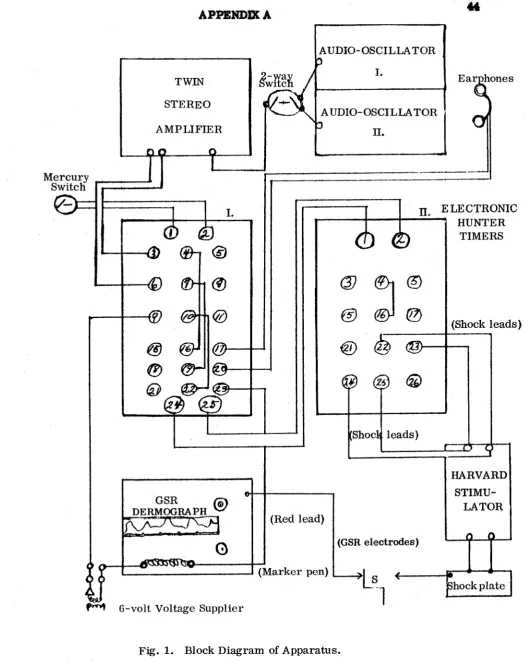
A block dfagram of the apparatus is given as Figure 1 (see Appendix A ).
A derxnograph (Stoelting, model M-24203) traced, the galvanic fikiw reflex (GSR) os
a paper strip chart (model M -ll). A second pen on the galvanometer traced the
tim e of the conditioned tmd unopTtd ltlnT>f>d stim uli (tone and shock) on the same chart.
The chart paper was fed automatically under the two perns at a uniform speed of
pfy inches per minute. Finger electrodes (Sherping type) were searf to *fr** todey
and ring fingers of S’s le ft hand, with application of electrode je lly fo r better skin
conductance. l i e bridge resistance of the apparatus m s adjusted fo r each indi
vidual S, while the am plifier gain was held constant (fixed at 30 units). The dem o*
graph was net calibrated due to inch of instrumentation available for this purpose.
It remained hidden from 8% view, to E ’s le ft side, by means of a screen.
A shock stim ulator (Harvard Apparatus, model 886A) fed a slight
shock to a reflex conditioning apparatus (Stoelting type) on which rested S’s right
hand. The shock administered was effectively instantaneous.
Two Hunter decade tim ers (model 100C), connected in series, con
trolled the duration of the tone and the tim e of occurrence of the instantaneous
shock. The "tone’' tim er was started by a silent mercury switch mounted to E's
le ft side, hidden from S’s view. The second tim er determined the shock duration.
The tone was generated by an audio-oscillator (EICO model 877)
feeding one channel of a stereo-am plifier (EICO model H F-81). The output of the
am plifier passed to head-phones (TEIM M ’’Pro" model) via the contacts of the
firs t lim iter tim er. A screen concealed the main apparatus from S.
Experimental Procedure
Both prelim inary and main experimental procedures were used. The
form er entailed adjusting the tone and the shock levels for each S; th e main
experim ent consisted of putting S through various experimental conditions. A tone
of 1080 ops, id a reasonably high level, served as toe originally conditioned stimu
lus; and, fo r purposes of analysis, wan considered to be at a pitch of 1000 mels.
25
him equal in loudness to the standard pitch (1000 m els). This was done by the
psychophysical method of '’adjustment".1 using a second EICO audio-oscillator
to facilitate comparison of the tones. During prelim inary session,
».Ha intensify of the shock was also adjusts*! wwt.ii s judged to feel uncomfort
able hut not pa inful - s was asked to place the right hand, p«i«* down, on the
reflex conditioning apparatus, and was told that the shock caused m erely a
muscle-flexing sensation to the side of the hand. Lastly, S was asked to avoid unneces
sary movement, to sit back comfortably and net to fa ll asleep.
During the «i«in gwrpivHmant., the shook level was raised occasionally
so as to maintain the magnitude of the- unconditioned ■ fisp at a satisfactory level,
the criterion fo r which was that the shock applied to the second stimulus of the
second set of tria ls be approximately equal to that yielding the second GSR of the
firs t order of tria ls . It was fe lt that this procedure would, on the average, suc
cessfully stabilise the level of shock. The tone duration was one-half second,
followed by a one-fifth of a second delay p rio r to shock. The 1000-cycle fre
quency, 40 db. above threshold, was treated as equivalent to 1000 mels in pitch;
two generalization frequencies, 404 and 161 cps., were derived mathematically
from the m el scale to be at a pitch of 500 and 250 mels respectively (Torgerson,
1958).
The choice of two separate experimental conditions (Order 1 and
Order 2) was in part determined by the results of two pilot studies carried out
1 This is a method by which S adjusts a certain stimulus until it appears subjectively equal or in some ratio to a standard; equality precision is measured by the average of erro rs © makes in any one setting.
fls s iiS iiH m s m f t E i’a y
5 8 7 %
prior to the experiment proper* In the firs t session (Order 1) S was given
seven training tria ls with the standard 1000 mels tone, paired with shock; mm
test tria l without shock, to the same pitch; and two other test tria ls to generali
zation stim uli of 500 and 250 mels in pitch. The second condition (Order 21 in
volved six training tria ls to 1000 mels, paired with shock; one test tria l to the
same mel value, but with an inverse order of generalization test tria ls of 250
and 500 m els, respectively. Immediately following this last test tria l, an extinc
tion test was administered, but only in the second session of the experiment* A
total of thirteen reinforced and seven non-reinforced tria ls was given to each S.
A ll Ss followed both order schemes. At the beginning of each order condition,
the internal bridge circuit of the dermograph was balanced against S's resistance
and his base-resistance level recorded. The potentiometer served to a lte r S’s
hcmai resistance when neusAcA At the **»d of the experiment, each S was asked
to comment on Ms experience during the experiment. These protocols were pre
served fo r future examination.
Collection of Data
Although ^aiihyatton of th* GSR onna mtuR « ,« not available,
res-ponses were recorded and measured fo r arapHtmfo i^ taking th# difference,
In m m ., between the baseline and response-peak tracings. As portrayed in
Fhrure 2. hairlines were drawn at the- of the GSR at right ancciA«
to an aptfwn»**>d baseline. The resulting twaoHna was considered to be that
straight line which, by visual determination, heat represented the average posi
procedure permitted GSR amplitude measurements to the tallest peak rising
within a fifteen seconds interval immediately following stimulation to the ear
ami skim Additional maxima were disregarded if these occurred after the
15-second interval criterion* If the pen deflection want to the maximum permitted
by the galvanometer, a fifty-per-cent increment to the already measured GSR
amplitude was a rb itra rily assigned.
Im partial observers were asked to evaluate the %% records mi the
basis of baseline variability. The criterion employed in determining pm stability
at ha«ai resistance intervals was timt no more than tmm vertical interval of the,
graphed chart be traced in a downward direction p rio r to stimulus pairings. The
firs t observer sorted the records into two groups: those whfede baseline seemed
fa irly variable and those wbOie baseline seemed fa ifly stable. This sorting
yielded ten "varying” and twelve "stable" baseline records. It was desired that
these be assigned an equal number of Ss per group fo r added statistical analysis.
Thus the task of a second im partial observer was to re-evaluate the twelve
stable records, and among these choose one that was least stable ami place this
with the ten varying-baseltae records.
^ t l A O T f l } f i t
PRESENTATION AND ANALYSIS OF RESULTS
T ie main statistical analysis entailed the application of a 3-way
analysis of variance* based »p<w the «fa»pA of the gew<vt*ft^*9:<!l* 'f>n and
other oirtftHwg irf»i^tinMiahipa. xhe m el (M ) effect referred to the ;an tinn
gradient; the subject (S) effect detected individual differences in each order con*
dition; the order (O) effect accounted fo r the overall difference in response on
two experimental sessions. Individual differences were mixed in the appropriate
( O x M x 6)> E rro r term s fo r M differences
and O conditions were their simple interaction effects (M x S a n d O x S respec
tively). The appropriate e rro r term s fo r simple interaction O x M , O x S and
M x S rested within the trip le interaction (O x M x S ) also. (MeNemar, 1955).
A maximum number of 20 GSR’s per subject was recorded; this inclu
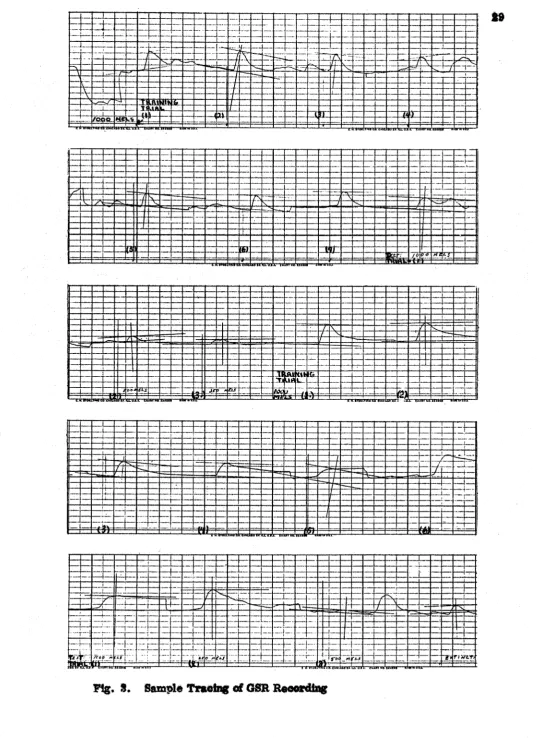
ded responses to thirteen training tria ls and seven test tria ls . A specimen record
illustrating these 20 GSR’s elicited by a single S is aptly represented by Fig. 3.
In the firs t of the two order conditions ten GSR's were evoked by: seven condition
ing tria ls (1000 mel tens followed by shock); the next, by a test tria l of the same
pitch without shock; and an additional two tria ls by generalisation stim uli of 500
and 250 m els, also without shock. In the second condition, immediately following,
six GSR’s were elicited by training tria ls Rone plus shock), three by test tria ls with
g.a.uwtfmfca. t>4ttltbHTiLiurc’,Ta»iiT'm1»?mg'
11 ' c . i f M t i w i e k t w d w 'w . 'ii r u a x ' " t u v i t W u i i d i 1
^iflrujr "iRAr
...1 ...
4-, --— —
— !— « j_
■a
- f ■ 4 ■s
[—
— - *■
/ - 7"-- "■s
i= Swa *4-.
_1
— i-— i
--H— ...... — 1— __
r
-_1 .— —
’ ! ' — i— I
. . . 1
--=rr-H “ “ ^ :r
•—r
-_ . J .
-~r
r < iV 7 c 6
m m m
f ig , S. Sample Treeing of GSR Reoordiag
30
following these test tria ls , an extinction test (1000 mels without shock) was ad
ministered; four Ss showed no response on this tria l* (Hovland gave 16 reinforc
ing and 4 non-reinforcing tria ls in m e single presentation). Slat Ss , five females
f,«d one m ale, felled to respond to seme «ttmwn when both orders of presentation
were considered. Three Ss within this group had been judged as having varying
haaaifopg, ami »ht»a>o) utehio baselines. Generally, each.S. gave an average of
I f , 13 GSR’s. The tim e interval between responses ranged on an average of 33
second minimum and 96 second maximum, fo r the group* The average session
fo r the experiment averaged 36 minutes per S fo r both order conditions.
Mtstan GSR’g resulting from conditioned sod g<*T»>rwi t fj«n tria ls fo r
i f f M JI1S1 MM ,rvWl r-. «rt ji. _|3Sar _T.L1_L Jil >,, iit.WiiJfc Bjym 6363 C ? M i lt M ik M
ZUTSw pltO S@6^Qy m*w6* vwlluttlOIIS Wolr* ^PCpImpQ Iw * HiX MjS *)»• IS ftliT vR IuOBt
measured in mm. c£ amplitude, were set down as shown in Table 1; the means
were plotted in Figure 4, in much the same Ifeahten as Hovland’s original find
ings. Tentatively entertained was the possibility of a more sophisticated method
for measuring the GSR, but course was discar ded on the b ails s « | it was
theoretically unwarranted. (Hovland’s absolute GSR’s, measured in mm. also,
fe ll off as a negative <ygp«n«*nMai bmetiee whan Ind’s were used on the stimulus
continuum.) The present study has altered the stimulus ««<* from jnd's to m els,
hut it was ty»Hgtv inadvisable to site* »rfm«it»mM'ttnriy the sbs^btte (m m .) of
GSR measurement.
On both orders of together, six Ss, four females
and two males, displayed the bi«d of g«*n«»t»nHg,nHnn typified by Hull’s negative ex
Table 1
A m p litu d e of th e GSR (in m m . ) to C o n d itio n ed and G e n e r a liz e d T o n al S tim u li (in m e l s )
S u b jec t
°1 1000
°2
M el V alu e
500
°1 °2
250
°1 °2
I 5.5 37.0 6.5 3.5 18.5 10.5
II 19.0 3.5 1.0 0.0 10.5 16.5
in 8.0 0. 0 5.5 0.0 2.5 0.0
IV 10.5 8.5 10.5 4.0 13.5 5.5
V 12.5 31.0 9.0 26.0 5.5 7.5
VI 18.0 20.5 12.5 22.0 22.0 25.5
VII 7.5 3.5 3.5 7.0 12.0 1.0
v m 10.0 16.5 10.0 13.0 5 .5 21.0
IX 43.5 0.0 3.5 10.0 5.0 i . o
X 13.0 16.0 5 .5 3.0 5 .5 23.0
XI 46.5 35.5 26.5 33.5 24.0 32.0
X II 0. 0 4.0 8.5 8. 0 0.0 2.0
x in 32.0 58.5 5.0 19.0 1.5 44.0
XIV 16.5 86.5 5 .5 17. 0 0.0 42.5
XV 42.5 58.5 98.0 52.0 60.5 57.0
XVI 48.'0 21.5 42.5 14.0 25.0 32.0
XVII 42.5 23.0 24.5 5.0 0.0 18.0
x v m 39.5 39.5 43.5 25.5 48.5 47.0
x r x 27.5 « o 13.5 10.5 15.0 12.5
XX 14.5 43.5 7.5 31.0 27.5 35.0
XXI 15.5 35.5 25.5 56.0 1.5 50.0
XXII 43.5 44. 0 47.0 50. 0 44.5 37.0
M ean 14.6 19.1 14.5 13.1 10.1 17.1
(in
m
m
,)
20
I t
18
17
m
is
14
15
IS
11
10
0
C ‘
X*
- o Order 2
-X Mean fo r
Orders 1 & 2
/
/
/
/
/
/
250 §00
Pitch Stim uli (in m els) 1000