ISSN(Online): 2320-9801 ISSN (Print): 2320-9798
I
nternational
J
ournal of
I
nnovative
R
esearch in
C
omputer
and
C
ommunication
E
ngineering
(An ISO 3297: 2007 Certified Organization)
Website: www.ijircce.com
Vol. 5, Issue 1, January 2017
A Probabilistic Capable Framework for
Constrained Spectral Clustering
M. Jaya Kumar1, V.Divya 2
M.Tech Student, Dept. of CSE, SHRI SHIRIDI SAI INSTITUTE OF SCIENCE AND ENGINEERING, Affiliated to
JNTUA, A.P, India1
Assistant Professor, Dept. of CSE, SHRI SHIRIDI SAI INSTITUTE OF SCIENCE AND ENGINEERING, Affiliated
to JNTUA, A.P, India2
ABSTRACT: An imperative type of earlier data in clustering comes in type of cannot link and must-link constraints.
We introduce a speculation of the mainstream spectral clustering procedure which coordinates such constraints. Persuaded by the as of late proposed constrained spectral clustering for the unconstrained issue, our strategy depends on a tight unwinding of the compelled standardized cut into a ceaseless streamlining issue. Inverse to every single other strategy which has been proposed for obliged spectral clustering, we can simply ensure to fulfill all constraints. Also, our delicate detailing permits to advance an exchange off between standardized cut and the quantity of abused constraints. An effective execution is given which scales to substantial datasets. We beat reliably all other proposed strategies in the tests. The idea of clustering is broadly utilized as a part of different areas like bioinformatics, therapeutic information, imaging, advertising study and wrongdoing investigation. The well-known sorts of clustering methods are spectral, various leveled, spectral, thickness based, blend displaying and so forth. Spectral clustering is a broadly utilized procedure for a large portion of the applications since it is computationally cheap. An examination of the different research works accessible on spectral clustering gives an understanding into the late issues in spectral clustering area.
KEYWORDS: Constrained Spectral Clustering, Scalability and Optimization
I. INTRODUCTION
Clustering is an undertaking of collection an arrangement of items into classes with comparative attributes. There is numerous information clustering algorithms that benefit a vocation. Be that as it may, as of late spectral strategies for information clustering have risen as an intense device for clustering information. To take care of the clustering issue we compute the eigenvectors and Eigen estimations of the chart laplacian which is a similitude measure between two information focuses. The clustering is acquired from the eigenvectors. Numerous algorithms have been proposed for spectral clustering which is little uniqueness of the above system. In this study report, we will examine spectral clustering, an all the more intense and specific clustering calculation.
Information Mining is a necessary part of the procedure of Knowledge Discovery in Databases (KDD). KDD is the general procedure of changing the crude information into helpful data. Information mining incorporates a few vital undertakings, for example, Association Analysis, Predictive displaying, Clustering,
ISSN(Online): 2320-9801 ISSN (Print): 2320-9798
I
nternational
J
ournal of
I
nnovative
R
esearch in
C
omputer
and
C
ommunication
E
ngineering
(An ISO 3297: 2007 Certified Organization)
Website: www.ijircce.com
Vol. 5, Issue 1, January 2017
dimensional datasets. Consequently the execution of the customary algorithms can be improved by joining certain requirements. This paper concentrates on the investigation and investigation of the conceivable constraints that can be connected keeping in mind the end goal to enhance the execution of the customary partitioned clustering algorithms. Spectral clustering [4] gather its name from spectral examination of a chart, which is the manner by which the information is spoken to. Spectral clustering methods lessen measurements utilizing the Eigen estimations of the comparability network of the information. The comparability framework is given as information and comprises of a quantitative assessment of the relative closeness of every match of focuses in the dataset. The spectral clustering calculation is a calculation for gathering N information focuses in an I-dimensional space into a few groups. Every bunch is parameterized by its likeness, which implies that the focuses in the same gathering are comparable and focuses in various gatherings are not at all like each other.
II. LITERATURE SURVEY
ISSN(Online): 2320-9801 ISSN (Print): 2320-9798
I
nternational
J
ournal of
I
nnovative
R
esearch in
C
omputer
and
C
ommunication
E
ngineering
(An ISO 3297: 2007 Certified Organization)
Website: www.ijircce.com
Vol. 5, Issue 1, January 2017
III. EXISTING SYSTEM
Data in a wide variety of areas tend to large scales. For many traditional learning based data mining algorithms, it is a big challenge to efficiently mine knowledge from the fast increasing data such as information streams, images and even videos.
To over-come the challenge, it is important to develop scalable learning algorithms. Constrained clustering is an important area in the research communities of machine learning. Researchers proposed many new algorithms.
Straightforward integration of the constrained normalized cuts and the sparse coding based graph construction, and the formulated scalable constrained normalized-cuts problem.
IV. PROPOSED SYSTEM
In this paper, we develop associate economical and climbable CSC rule which will we tend toll handle moderate and enormous datasets. The SCACS rule is understood as a climbable version of the well-designed however less economical rule referred to as versatile unnatural Spectral clump (FCSC).
To our greatest data, our formula is that the 1st economical and scalable version during this space, that springs by associate degree integration of 2 recent studies, the affected normalized cuts and also the graph construction methodology supported distributed committal to writing. However, it's by no means that clear-cut to integrate the 2 existing ways
SYSTEM ARCHITECTURE
Fig.1 System Architecture
IMPLEMENTATION: A. Text anomaly detection
Dataset of social networking site like Facebook, tweeter is given to module of text anomaly detection. Content preprocessing is next step which consists of many other processes as follows:
ISSN(Online): 2320-9801 ISSN (Print): 2320-9798
I
nternational
J
ournal of
I
nnovative
R
esearch in
C
omputer
and
C
ommunication
E
ngineering
(An ISO 3297: 2007 Certified Organization)
Website: www.ijircce.com
Vol. 5, Issue 1, January 2017
b) Stop word removal: In some cases stop words can causes problems when searching for phrase that include them.
c) Stemming: Variant forms of a word are reduced to a common form. Stemming is the process of retrieving root or stem of word.
d) Weight assignment to word: Whatever words extracted from previous steps are assigned weight to them depending on prediction made from word.
e) Frequency of words: how many times particular words appear in a given time period is calculated. Bayesian probability model for classification-Bayesian probability model will predict the probability of message being an anomalous or not. Result of it forwarded to decision factor module.
B. Link anomaly detection
Dataset of social networking site is also given to link anomaly detection module. A step performed in this module is as follows:
a)Clustering of vertices having same features: We can do clustering of vertices depending on same communication behavior and build profile for each cluster. Individual vertex profiles are also built depending on the communication behavior of a vertex.
b) Preprocessing: For dynamic graph time span is divided into disjoint time interval. For particular time period static graph is built to summarize dynamic graph. For each vertex link based features are extracted and feature vector is generated. Cluster profiles and individual profiles are building based on these feature vectors.
c) Individual deviation: Under normal circumstances vertices should show close behavior to its cluster center and some variations are allowed its own individual center. If vertex will show significant deviation from cluster center or individual deviation then it introduce false alarm.
d) Cluster deviation: Cluster deviation of a vertex in a given time period is distance between current feature vector and cluster center. If distance is maximum then vertex will show cluster deviation and it introduce false alarm.
e) False alarm: False alarm introduces by individual and cluster deviations are taken into consideration and final false alarm is identified and possible anomaly score is forwarded to decision factor.
C. Decision factor: Result obtained from link anomaly module and text anomaly module is compared in decision factor and final anomaly is predicted.
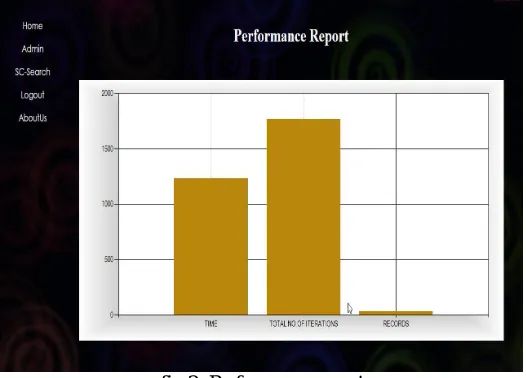
fig 2: Performance report
V. CONCLUSION
ISSN(Online): 2320-9801 ISSN (Print): 2320-9798
I
nternational
J
ournal of
I
nnovative
R
esearch in
C
omputer
and
C
ommunication
E
ngineering
(An ISO 3297: 2007 Certified Organization)
Website: www.ijircce.com
Vol. 5, Issue 1, January 2017
unsupervised baseline; (2) with less computational time, our algorithm can obtain high clustering accuracies close to those of the state-of-the-art; (3) It is easy to select the input parameters; (4) our algorithm performs well in grouping high-dimensional image data. In the future, we are considering an active selection of pairwise instances for labelling; we will also apply our algorithm to group urban transportation big data, which might significantly boost sensor placement optimization
REFERENCES
[1] K. Wagstaff and C. Cardie, “Clustering with instance-level constraints,” in Proc. 17th Int. Conf. Mach. Learn., 2000, pp. 1103–1110.
[2] K. Wagstaff, C. Cardie, S. Rogers, and S. Schroedl, “Constrained k-means clustering with background knowledge,” in Proc. 18th Int. Conf. Mach. Learn., 2001, pp. 577–584.
[3] S. Basu, A. Banerjee, and R. Mooney, “Semi-supervised clustering by seeding,” in Proc. 19th Int. Conf. Mach. Learn., 2002, pp. 27–34. [4] E. P. Xing, A. Y. Ng, M. I. Jordan, and S. J. Russell, “Distance metric learning with application to clustering with side-information,” in Proc. Adv. Neural Inf. Process. Syst., 2003, pp. 505–512.
[5] S. Basu, B. I. Lenko, and R. J. Mooney, “A probabilistic framework for semisupervised clustering,” in Proc. ACM SIGKDD Int. Conf. Knowl. Discov. Data Mining, 2004, pp. 59–68.
[6] N. Shental, A. Bar-hillel, T. Hertz, and D. Weinshall, “Computing gaussian mixture models with em using equivalence constraints,” in Proc. Adv. Neural Inf. Process. Syst. 16, 2003, pp. 505–512.
[7] B. Kulis, S. Basu, I. Dhillon, and R. Mooney, “Semi-supervised graph clustering: A kernel approach,” in Proc. 22nd Int. Conf. Mach. Learn., 2005, pp. 457–464.
[8] Y.-M. Cheung and H. Zeng, “Semi-supervised maximum margin clustering with pairwise constraints,” IEEE Trans. Knowl. Data Eng., vol. 24, no. 5, pp. 926–939, May 2012.
[9] S. X. Yu and J. B. Shi, “Grouping with bias,” in Proc. Adv. Neural Inf. Process. Syst., 2001, pp. 1327–1334.