ISSN(Online): 2320-9801
ISSN (Print): 2320-9798
I
nternational
J
ournal of
I
nnovative
R
esearch in
C
omputer
and
C
ommunication
E
ngineering
(An ISO 3297: 2007 Certified Organization)
Vol. 4, Issue 9, September 2016
An Agile Project Management Framework for
Efficient Requisition Systems
Sagar Bhojwani1, Ajinkya Gutti1, Sneha Binani2, Meghna Peswani2
B.E. Student, Dept. of Computer Engineering, Vivekanand Education Society’s Institute of Technology, Mumbai, India1
B.E. Student, Dept. of Information Technology, Vivekanand Education Society’s Institute of Technology, Mumbai, India2
ABSTRACT: IT Project Management has always been an important phase in developing any successful project. The
planning, decision making and execution of project systems majorly depends on the efficiency of its project management framework. Cost, Schedule and Quality are the main aspects of a successful project management strategy and they should be studied in detail before starting the project. This paper illustrates an agile project management framework, by using the example of an Automated Requisition Management System. Such systems are beginning to gain momentum in almost all sectors due to the ease of use and reduced dependency of manpower that they offer. A feasibility study has been performed to further examine the effectiveness of this framework.
KEYWORDS: Project Management, Cost Control, Cost Estimation, Risk Management, RMMM, Feasibility Analysis,
Project Failure, Project Manager, Project Planning
I. INTRODUCTION
Project Management is the practice of efficient organizing, planned decision making and formulation of optimal solutions with the common aim to achieve certain objectives in a defined problem. It is the approach of minimizing the costs and maximizing the productivity of the given project, while meeting the deadlines. Traditional project management methodologies follow an established timeline of achieving the various milestones in the making of a project. This has been easily managed by means of various software project tools made available in the market, which help in designing, analysing and developing the project based on the requirements and constraints set by the client. However, every project is different and needs certain activities that are tailored to the end products expected by the company. Often, the software project tools available to the public are unable to render exactly to the organisational needs. For this reason, an agile project management framework becomes necessary.
The project management scheme for a venture includes many stages, including project planning, resource levelling, scheduling and budgeting, cost and risk control, quality testing, client interaction and proper documentation. Efficient decision making is characterised by the acumen of the project lead to devise optimum plans in terms of accomplishing the aforementioned tasks with enough buffer time in hand in case of any further changes to the original plan.
Since the nature of software projects is becoming more complex by the day, practitioners are finding it increasingly difficult to define solid modules to manage the projects efficiently. It is, thus, evident that a new and improved project management framework with a agile-oriented approach is of utmost importance [1]. Let us see how this framework can be applied to daily life projects, by explaining it using the example of a Management Requisition System.
II. AUTOMATED REQUISITION MANAGEMENT SYSTEMS
ISSN(Online): 2320-9801
ISSN (Print): 2320-9798
I
nternational
J
ournal of
I
nnovative
R
esearch in
C
omputer
and
C
ommunication
E
ngineering
(An ISO 3297: 2007 Certified Organization)
Vol. 4, Issue 9, September 2016
to help with the documentation and maintenance of tasks, employee details, statistics, as well as the approvals for various processes.
Requisition Systems can be of many types. The most common type of requisition system is that of purchases. The objective of a Purchase Requisition System is to approve incoming orders, notify the concerned department of the purchase orders and generating time frame to deliver the order. It may also include the features to authorize certain departments to intervene into the purchases if the need arises, and producing a detailed report of all the purchases made during some fixed intervals of time. This data can then be used to develop statistics about the general functioning of the purchase department of the organisation.
Some other types of Requisition Systems are: Recruitment Requisition (internal management of the organisation’s job creation, job opening, job description and staff maintenance), Medical Requisition (helpful to doctors and physicians to order medical equipment, update patient medical history, request tests and other procedures), E-Requisition (it is a form of electronic requisition which enables the vendor to keep track of payments and facilitate ordering of workflows using the online compendium) and Just-In-Time Requisition (two way computer communication to transfer blocks of data relating to a particular requisition of an item). [3]
The primary purpose of the Requisition Management Systems is to increase the efficiency of the processes of the industries by automated technologies, thereby making them less dependent on human labour. Industriesare usually very inclined to adapt to automated systems for data collectionbecause it promises an increase in efficiency and less dependency on manpower owing to its erratic availability. The automated requisition system will help the businesses to coordinate the various processes involved in the completion of the task; it will also assign jobs and job deadlines for timely completion of the task. As a result all the orders will be automatically managed from the beginning till they are successfully completed. The system will also provide estimated cost and delivery time along with other details to the client. These features are favourable for organisations.
Below figure shows the general workflow for the development of anAutomated Requisition Management System (ARMS).
Fig.1. Phase wise development of ARMS
Some benefits of automating the requisitioning process are:
Quicker Approvals: Since there are no paper based signature approvals, it is easy to approve via an online platform with a single mouse click, without having to backtrack and check all the specifications of the request.
ISSN(Online): 2320-9801
ISSN (Print): 2320-9798
I
nternational
J
ournal of
I
nnovative
R
esearch in
C
omputer
and
C
ommunication
E
ngineering
(An ISO 3297: 2007 Certified Organization)
Vol. 4, Issue 9, September 2016
Upgrading from traditional methods: Other means of keeping records like spreadsheets and emails are not ideal and can be avoided if this requisition system is used to store all information (specifications, requests, documents).
Centralised Procurement: Negotiation for more favourable contracts is made possible due to the central procurement of the requests and processes, through a funnel into the concerned department of the organisation.
Easy Tracking: The status of requests can be tracked quickly and easily on a central platform by the buyers and requesters. There is no hassle of having to respond to individuals worried about the updates on their order requests.
Efficient Management on the Cloud: With the shift of the entire maintenance process of the organisation online, it is just a click away and can be accessed from anywhere. This makes the management quick and efficient, and allows for enhanced focus on other jobs of the company.
III.CRITERIA FOR SUCCESS
Success criteria are a definitive measure of how successfully the objectives of the project have been metand whetherthe stakeholders are satisfied with the end result. Defining success criteria is very important to understand if the developed model has been implemented to the expectations of the client, and whether changes are required to further enhance the system to fulfil the success criteria. Without success criteria, it becomes difficult to say if the project is successful or unsuccessful. The success of the project need not be measured only upon its completion, or at the end of certain phases of the project. In order to remain on correct track of system development, we should evaluate the success criteria at every stage of the project. A continuous evaluation of success criteria will increase the probability of the overall project being a success for both the developers and the users. Unless all the stakeholders accept that the success criteria have been met, the project cannot be a success.
The following are the success criteria for Automated Requisition ManagementSystem:
A. REDUCED DEPENDENCY ON MANPOWER :
It is necessary for an automated system to be computer operated without needing any interference from the human operator. In ideal cases, the role of the human is to enter the values at the very beginning to system definition and set paths for acquiring fresh data. The system would then automatically fetch the new data entries from the pre set path and feed it into the master database. This database would then supply information for organization statistics, requests and other miscellaneous features of the requisition system.
B. NEGLIGIBLE TIME DELAYS:
The response time of the system should be quick and updates should be done as soon as the databases are modified. This ensures that there is absolutely no miscommunication or redundancy in the data coming to the server from multiple machines on the same unit. Also, reducing delays in delivery of purchased orders and requests help to make the users trust the system’s authenticity.
C. CLOUD ADOPTION:
If the ARMS is integrated directly on the cloud, it allows for operators to supervise or make changes to the system from anywhere. Physical presence of operator on site is no more required and the work can be done within the deadline. This also avoids time delays caused by absence of the approver for certifying orders and requests otherwise done by signing on papers.
D. MEETING BUDGET AND SCHEDULE CONSTRAINTS:
ISSN(Online): 2320-9801
ISSN (Print): 2320-9798
I
nternational
J
ournal of
I
nnovative
R
esearch in
C
omputer
and
C
ommunication
E
ngineering
(An ISO 3297: 2007 Certified Organization)
Vol. 4, Issue 9, September 2016
E. USER SATISFACTION:
This is probably the most important success criteria of any system. Success, while determined primarily by the stakeholders, is also majorly dependent on whether the end users are satisfied with the functioning or if they would like to see something different in the system. This can be done by means of feedback and surveys.
IV.COST, RISK AND CONTROL
Cost is a very important aspect to consider while making a project. A project manager is responsible for managing the project and he/she needs to manage the cost very well which affects the overall budget of the project. One may come across terms like Cost Estimation, Cost management, Budget determination and cost controlling. All these terms are important which increases the productivity of the project and help in the success of the same.
Risk affects the completion of a project and may contribute to the failure of a project. A risk is not a problem because problem is something which has already occurred; rather risk is a possibility that a problem might occur and steps should be taken to avoid such problems. It is any condition or event whose occurrence is not certain, but if were to occur it would have a negative impact on the outcome of the project. Risks are a natural accompaniment of IT projects; on the other hand IT projects are themselves a risk, as technology change may make the project redundant before it were even to be completed. The positive side is that risks are foreseeable events that the project management team can plan for. Hence risk management plan is an important necessity for managing large IT projects and is included in the project management plan. The project management plan provides detail as to how the risks will be identified, analysed and controlled. There are different phases in Risk management like identifying the risk, analysing and quantifying the risk, responding to risk and managing and controlling risk.
A. POSSIBLE REASONS FOR FAILURE OF THE ARMS:
ARMS may fail when the data is not sufficient and also when the user inputs are poor and requirements are vague. Some of the reasons for failure include lack of knowledge and experience of the person who has estimated the cost, time, budget etc. Also, sometimes conflicts between stakeholders may lead to failure of ARMS. Risks are unexpected in a project and hence poor risk management will lead to the failure of the project. Apart from this, due to continuous and drastic advancements in technologies, new methodologies are needed which changes the project or do not meets users’ expectations leading to its failure. [4]
These are the possible reasons why the ARMS may fail:
Cost Escalation: One of the most regular problems faced by project managers while implementing IT projects is cost escalation. In simple terms, it can be defined as the increase in the cost of the project beyond the budgeted cost. Although, there could be various reasons for cost escalation the most common reason is when the project takes more time for completion than originally envisaged. User involvement, unnecessary requirements inflation, Schedule flaws, Specifications Breakdown, Technology and Risk, Lack of skilled professionals are few of the reasons for cost escalation. [5]
Software risks: Risks are conditions, which may or may not arise, that can have a positive or negative effect on the project’s ability to reach its set objective. Software risks are when the software used in the project malfunctions due to some faulty code or error. The risk management is an integral component of the overall project management plan. During the development of the risk, the major event is the identification of risk and its management. The risk analysis process starts with the detailing the risks under the various risk analysis factors as mitigate, monitor and manage. Delivery schedules, financial risks, technical risks, functional risks etc. are some of the software risks.
B. CONTROLLING COST IN THE ARMS:
Engineers, project managers, and cost estimators often overlook or fail to recognize project uncertainty early in the project development process. As a result they do not communicate project uncertainty and its effect to stakeholders. A comprehensive cost and risk management approach can help project teams identify, assess, mitigate, and control project risks.
ISSN(Online): 2320-9801
ISSN (Print): 2320-9798
I
nternational
J
ournal of
I
nnovative
R
esearch in
C
omputer
and
C
ommunication
E
ngineering
(An ISO 3297: 2007 Certified Organization)
Vol. 4, Issue 9, September 2016
facilitates the management to finance the project in phases rather than make a single provision. This approach is convenient for IT projects as IT scenario changes rapidly and it is difficult to estimate for actions in the future. The project team can get to work on the immediate deliverables rather than working for the unseen future.Cost estimates translate system requirements associated with programs, project, proposals, or process into budget requirements, and determine and communicate a realistic view of the likely cost outcome, which can form the basis of the plan for executing the work. Cost estimation is an important tool that can affect the planning and budgeting of a project. Doing cost estimation during the entire life cycle allows for the refinement of the estimate because there is more data available. Periodic re-estimation is a way to gauge the progress of the project and check whether deadlines will be met. Cost estimation can also have important effect on resource allocation. Effective cost monitoring and control of the software costs is required for the verification and improvement of the accuracy of the estimates. Some of the project budgeting methods are Bottom-Up cost estimate, Top-down cost estimate, Analogous estimating, parametric modelling etc. Cost of the project can be kept under check by doing the following [6]:
Repeated forecasting of budget during the process of development
Regular forecasting of resource usage and its availability
Keeping all the team members in loop regarding the various developments of the revisions of the budget
Limiting the scope to a feasible extent
C. CONTROLLING RISK IN THE ARMS:
The determination of possible risks to the project is of great importance to determine what would be the best possible control mechanism to reduce the ill effects of the risk happening. The different phases involved in the Risk Management of the project are:
Risk identification: It is an iterative process, wherein the project manager and his team are always on the lookout for risk that may sneak into the project or may have already sneaked in. Risk identification needs to be done throughout the project lifecycle, because as the project develops new risk is likely to emanate and pose a threat to the project. The risk components are defined and identified on the criteria of the performance, support, cost and the schedule of the project. There are several tools available that can help the project managers in identifying risks. Some of them are Project documents, SWOT Analysis, Brainstorming, Delphi Technique, Assumption Analysis and Root Cause Analysis.
Risk Assessment: The next step in the risk management plan is to analyze the identified risks. The identified
risk need to be analysed to determine the probability of their occurrence and the quantum of impact they would be having on the project. The procedure for analysis is to conduct the qualitative analysis and once the risk qualifies then the quantitative analysis is carried out. Qualitative analysis does not involve a detailed analysis of the risk. . It is fast and subjective approach to risk analysis. Qualitative risk analysis is carried out using a risk matrix also called as a probability impact matrix. Once the risk has passed the qualitative test it is time to take it more seriously and research the risk events to gauge their true potential and probability of impact. The risk in quantitative risk analysis is subject to detailed analysis that takes time and has a budget associated with it.
Risk response planning and projection: Once the risks have been identified, we have to come up with proper
response to achieve appropriate, achievable and affordable action plans. It also involves Risk Analysis which is used to identify, analyse and asses thee high end risk in software development. A successful risk analysis includes important elements like problem definition, problem description, data analysis and designing. [7]
Risk control: An effective strategy for dealing with risk must consider three issues and they are also known as RMMM, Risk Mitigation, Risk Monitoring and Risk management and contingency plan. The aim is to identify all potential risks and evaluate them to find the probability and affect of occurring. Post that, risk management planning is done. Intensity of consequence of risk depends on how early the risks are identified. The better the project, the easier is the development and risk management. [8]
ISSN(Online): 2320-9801
ISSN (Print): 2320-9798
I
nternational
J
ournal of
I
nnovative
R
esearch in
C
omputer
and
C
ommunication
E
ngineering
(An ISO 3297: 2007 Certified Organization)
Vol. 4, Issue 9, September 2016
V. FEASIBILITY ANALYSIS
Feasibility analysis is analysis of the project for the viability of the idea. It takes into consideration multiple factors to determine if the project is viable or not. Factors like technology used, capital needs, hardware and equipment needs, requirement of skilled labour and experts, etc. The analysis determines whether the project is feasible economically and technically. In other words, it helps answer questions like, ‘can this project be successfully implemented?’, ‘will it be completed in the required time?’, ‘will this project be profitable?’, ‘how fast can I expect to earn money from it?’ and many more. Software development is a complex and time consuming process. Some projects carry a risk of being under development for an unviable period of time others may be too complex to be implemented with the technology being used. At times, the projects even though completely implemented, may not provide the returns expected. With so many risks involved, doing a feasibility analysis of the project seems obligatory before an entity invests money, time and labour into a project. [9]
The core problem which the ARMS aims to solve is the delay in delivery of products due to mismanagement of orders.The manufacturing companies focus on increasing their output rather than efficiently processing order or customer satisfaction.This lack of efficiency leads to delays in the product delivery and errors in the actual quantity/requirement of products ordered.A manual system exists which is implemented in an inefficient way which leads to a complex paper trail and it becomes difficult to track the orders.This gives rise to added costs and also increases the processing time of the orders.
Our main aim is to automate the order processing system by implementing a web based system which will reduce the paper trail thereby saving the companies time and financial resources.This would include a user-friendly interface to give the customer all the product information needed and help in making the best decision. Complete automation of the order management system is thus done and saves the company a lot of time and money.In addition to this, the company can expand its reach and target more customers thereby increasing profits as well.Such a system would improve delivery times and give the customers and opportunity to track their orders, which in turn leads to increased customer satisfaction.
ISSN(Online): 2320-9801
ISSN (Print): 2320-9798
I
nternational
J
ournal of
I
nnovative
R
esearch in
C
omputer
and
C
ommunication
E
ngineering
(An ISO 3297: 2007 Certified Organization)
Vol. 4, Issue 9, September 2016
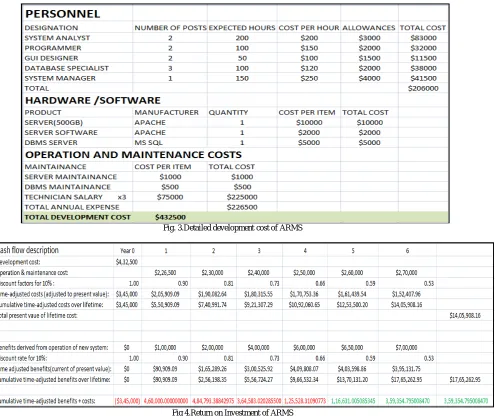
A further deeper estimate of the cost of development and required staff for the development of the project was done for a more accurate analysis. This analysis also included return on investment which is one of the most important factors that any entity looks at before investing in a software project. Return on investment gives an estimate time that will be required since the start of the development of the project to recover all the money invested in the project and start earning profits. The following tables provide a detailed view of the development cost along with the annual maintenance cost as well as the estimated return on investment.
Fig. 3.Detailed development cost of ARMS
Fig 4.Return on Investment of ARMS
VI.CONCLUSION AND FUTURE WORK
ISSN(Online): 2320-9801
ISSN (Print): 2320-9798
I
nternational
J
ournal of
I
nnovative
R
esearch in
C
omputer
and
C
ommunication
E
ngineering
(An ISO 3297: 2007 Certified Organization)
Vol. 4, Issue 9, September 2016
REFERENCES
1. Ali Tizkar Sadabadi1 and Nazri Kama, “A Conceptual-operative Framework for in-process Decision Support of Software Project Management
Practice”, International Journal of Software Engineering and Its Applications, Vol.8, No.1, pp.287-302, 2014.
2. Franz Färber, Sang Kyun Cha, Jürgen Primsch, ChristofBornhövd, Stefan Sigg and Wolfgang Lehner, "SAP HANA database: data
management for modern business applications", Vol.40, Iss: 4, pp.45-51,December 2011.
3. James M. Johnson and Douglas A. Momyer, “Just-in-time requisition and inventory management system”, United States Patent No.
US5712989A, 27 January 1998.
4. ArunaShrivastava and Prof. LeenaSahu, “Software Cost Estimation: A Survey of Current Practices”, International Journal of Engineering and
Technical Research (IJETR), Volume-3, Issue-5, ISSN: 2321-0869, May 2015.
5. Linda Wallace and Mark Keil, "Software project risks and their effect on outcomes", Communications of the ACM, Vol. 47,Iss: 4, pp.68-73,
April 2004.
6. Chris Fortune, "Process standardisation and the impact of professional judgement on the formulation of building project budget price advice",
Construction Management and Economics, Vol.24, Iss: 10, pp.1091-1098, 2007.
7. Ammar Ahmed, Berman Kayis, SatapornAmornsawadwatana, "A review of techniques for risk management in projects", Benchmarking: An
International Journal, Vol.14 Iss: 1, pp.22 - 36, 1999.
8. George A. Zsidisin, Alex Panelli, Rebecca Upton, "Purchasing organization involvement in risk assessments, contingency plans, and risk
management: an exploratory study", Supply Chain Management: An International Journal, Vol. 5 Iss: 4, pp.187 - 198. 703- 707, 2012.
9. Li-yin Shena, Vivian W.Y. Tamb, Leona Tamc and Ying-boJia, "Project feasibility study: the key to successful implementation of sustainable