Semantic Frame-based Statistical Approach for Topic Detection
Yung-Chun Chang1,2Yu-Lun Hsieh2,3Cen-Chieh Chen2,3 Chad Liu2 Chun-Hung Lu4 Wen-Lian Hsu2
1Department of Information Management, National Taiwan University, Taiwan 2Institute of Information Science, Academia Sinica, Taiwan
3Department of Computer Science, National Chengchi University, Taiwan 4Innovative Digitech-Enabled Applications & Services Institute, III, Taiwan
{changyc,morphe,can,hsu}@iis.sinica.edu.tw, 4[email protected]
Abstract
We propose a statistical frame-based approach (FBA) for natural language processing, and demonstrate its advantage over traditional ma-chine learning methods by using topic detec-tion as a case study. FBA perceives and iden-tifies semantic knowledge in a more general manner by collecting important linguistic pat-terns within documents through a unique flex-ible matching scheme that allows word inser-tion, deletion and substitution (IDS) to cap-ture linguistic struccap-tures within the text. In ad-dition, FBA can also overcome major issues of the rule-based approach by reducing hu-man effort through its highly automated pat-tern generation and summarization. Using Ya-hoo! Chinese news corpus containing about 140,000 news articles, we provide a compre-hensive performance evaluation that demon-strates the effectiveness of FBA in detecting the topic of a document by exploiting the semantic association and the context within the text. Moreover, it outperforms common topic models like Na¨ıve Bayes, Vector Space Model, and LDA-SVM.
1 Introduction
Due to recent technological advances, we are over-whelmed by the sheer number of documents. While keyword search systems nowadays can efficiently retrieve documents, users still have difficulty assimi-lating knowledge of interest from them. To promote research on this subject, the Defense Advanced Re-search Projects Agency (DARPA) initiated the Topic Detection and Tracking (TDT) project, with a goal
of automatically detecting topics and tracking re-lated documents from document streams such as on-line news feeds. In essence, a topic is associated with specific times, places, and persons (Nallapati et al., 2004). Thus, detecting the topic of a doc-ument can help readers construct the background of the topic and facilitate document comprehension, which is an active research area in information re-trieval (IR).
Linguistic information provides useful features to many natural language processing (NLP) tasks, cluding topic detection (Nallapati, 2003). Such in-formation is usually represented as rules or tem-plates. The main advantages of the rule-based ap-proach are its high precision as well as the capabil-ity of knowledge accumulation. When confronting a new domain, they can be adapted by adding rules that exploit the missing knowledge. However, only a limited number of cases can be captured by a single rule, and increasing the number of rules could create undesired conflicts. Thus, the inflexibility of rule-based systems has put their competence for NLP tasks in doubt.
as-sociated features, one often needs to annotate the features in documents, which is rarely done in most machine learning models (Scott and Matwin, 1999). Those models have encountered bottlenecks due to knowledge shortage, data sparseness problem, and inability to make generalizations. Once the domain is changed, the models need to be re-trained to ob-tain satisfactory results. Besides, fine-grained lin-guistic knowledge that is crucial in human under-standing cannot be easily modeled, resulting in less desirable performance. One can easily find two sen-tences that are literally different but convey similar semantic knowledge, which could confuse most ma-chine learning models. On the other hand, the main shortcoming of template-based or knowledge-based methods is the need of human effort to craft precise templates or rules.
In light of this, we propose a flexible frame-based approach (FBA), and use topic detection as a case study to demonstrate its advantages. FBA is a highly automated process that integrates similar knowledge and reduces the total number of patterns through pattern summarization. Furthermore, a matching mechanism allowing insertion, deletion, and substi-tution (IDS) of words and phrases is employed to-gether with a statistical scoring mechanism. To cre-ate linguistic patterns with higher level of general-ity, we adopt the dominating set algorithm to re-duce 350,000 patterns to a total of 500. Dominat-ing set has been used extensively in network routDominat-ing researches, e.g., Das and Bharghavan (1997), Du et al. (2013), and adopted in NLP related tasks such as text summarization (Shen and Li, 2010).
In the training phase, we consider keywords, con-text, and semantic associations to automatically gen-erate frames. Thus, the obtained frames can be acknowledged as the essential knowledge for each topic that is comprehensible for humans. Results demonstrated that our method is more effective than the following approaches: the word vector model-based method (Li et al., 2010) and the latent Dirich-let allocation (LDA) method (Blei et al., 2003), a Bayesian networks-based topic model widely used to identify topics.
The structure of this paper is as follows. We dis-cuss some of the previous work that apply statistical NLP methods to the topic detection problem in Sec-tion 2. SecSec-tion 3 describes in detail the architecture
and components of our system. Section 4 presents the performance comparison of various systems, and . Finally, we conclude our work in Section 5.
2 Related Work
can substantially decrease the sparseness. More-over, the models of such approaches need to be re-trained or re-tuned to obtain satisfactory results when applying to a different domain. Such problem can be easily tackled in our approach by including more knowledge in the knowledge base. Besides, a more comprehensive linguistic knowledge can also be encoded and utilized in the proposed system. The hierarchical nature of our semantic features is necessary for a deeper understanding of the natural language.
One of the resources that is related to the orga-nization of human knowledge is ontology. It is the conceptualization of a domain into a human under-standable and machine-readable format consisting of entities, attributes, relationships, and axioms (Tho et al., 2006). It can also be used repeatedly, making it a very powerful method for representing domain knowledge. Ontology related applications have been involved in many research fields. For instance, Alani et al. (2003) proposed the Artequakt that attempts to identify entity relationships using ontology re-lation declarations and lexical information to auto-matically extract knowledge about artists from the Web. Garc´ıa-S´anchez et al. (2006) proposed an ontology-based recruitment system to provide intel-ligent matching between employer advertisements and the curriculum vitae of the candidates. More-over, Lee et al. (2009) used ontology to construct the knowledge of Tainan City travel and further in-tegrated fuzzy inference with ant colony optimiza-tion to recommend a personalized travel route that effectively meets the tourist’s requirements to en-joy Tainan City. Some document detection meth-ods made use of ontology and utilized the structured information in Wikipedia to enhance their perfor-mance (Grineva et al., 2009). Other ontologies like the WordNet may be included in the proposed sys-tem to further extend the scope of its knowledge.
Our method differs from existing approaches in a number of aspects. First, the FBA mimics the per-ceptual behavior of humans in understanding. Sec-ond, the generated semantic frames can be repre-sented as the domain knowledge required for detect-ing topics. In addition, we further consider the sur-rounding context and semantic associations to effi-ciently recognize topics. Finally, our research dif-fers from other Chinese researches that rely on word
segmentation for preprocessing by utilizing ontol-ogy for semantic class labeling.
3 System Architecture
We define the topic detection task as the following. Let W = {w1, w2,· · · , wm} be a set of words,
D = {d1, d2,· · ·, dk} be a set of documents, and
T = {t1, t2,· · ·, tn} be a set of topics . Each
document d is a set of words such that d ✓ W. Our goal is to decide the most appropriate topicti
for a document dj, although one or multiple
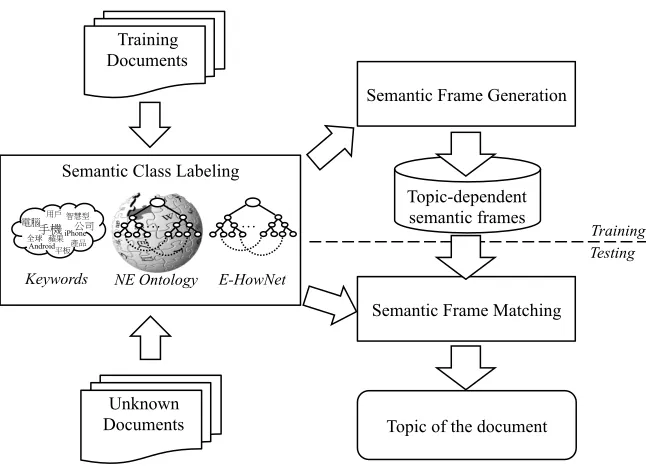
top-ics can be associated with each document. Our sys-tem mainly consists of three components, Semantic Class Labeling (SCL), Semantic Frame Generation (SFG), and Semantic Frame Matching (SFM), as shown in Figure 1. The SCL first uses prior knowl-edge of each topic to mark the semantic classes of words in the corpus. Then the SFG generates frames for each topic. These frames are stored in the topic-dependent knowledge base to provide domain-specific knowledge for our topic detection. During detection, an article is first labeled by the SCL as well. Then, the SFM applies an alignment-based al-gorithm which utilizes our knowledge base to calcu-late the similarity between each topic and the article to determine the main topic of this article. Details of these components will be explained in the following sections.
3.1 Semantic Class Labeling, SCL
Semantic Frame Matching Semantic Frame Generation
Topic-dependent semantic frames
Topic of the document
Training Testing
Training Documents
Unknown Documents Semantic Class Labeling
…
E-HowNet Keywords
!
!
!
! ! !
! ! iPhone Android
…
NE Ontology
Figure 1: Architecture of our semantic frame-based topic detection system
2
log
⇣
p(w p(w)N(w^T)(1 p(w))N(T) N(w^T)p(w)N(w^¬T)(1 p(w))N(¬T) N(w^¬T)|T)N(w^T)(1 p(w|T))N(T) N(w^T)p(w|¬T)N(w^¬T)(1 p(w|¬T))N(¬T) N(w^¬T)
⌘
(1)
N(T)andN(¬T)are the numbers of on-topic and
off-topic documents, respectively; andN(w^T)is
the number of document on-topic having w. The probabilitiesp(w), p(w|T), and p(w|^T) are
es-timated using maximum likelihood estimation. A word with a large LLR value is closely associated with the topic. We rank the words in the training dataset based on their LLR values and select the top 1,000 to compile a topic keyword list.
Recognizing named entities from text can fa-cilitate document comprehension and improve the performance of identifying topics (Bashaddadh and Mohd, 2011). Therefore, we construct the Named Entity Ontology semi-automatically by using Wikipedia for semantic class labeling. Wikipedia category tags are used to label NEs rec-ognized by the Stanford NER tools. We select the category tag to which the most topic pathsare as-sociated, and use them to represent the main se-mantic label of NEs in documents. Topic paths can be considered as the traversal from general categories to more specific ones. Thus, more topic paths may indicate that this category is more
bet-Domain Keyword
A clause of article: Cn
NE Concept
Filtering E-HowNet
Clause
Sequence of semantic classes
LeBron James leads the Miami Heat to defeat the Indiana Pacers today
LeBron James
LeBron James NBA team NBA team
LeBron James today lead city NBA team defeat city NBA team
LeBron James today lead city NBA team defeat city NBA team
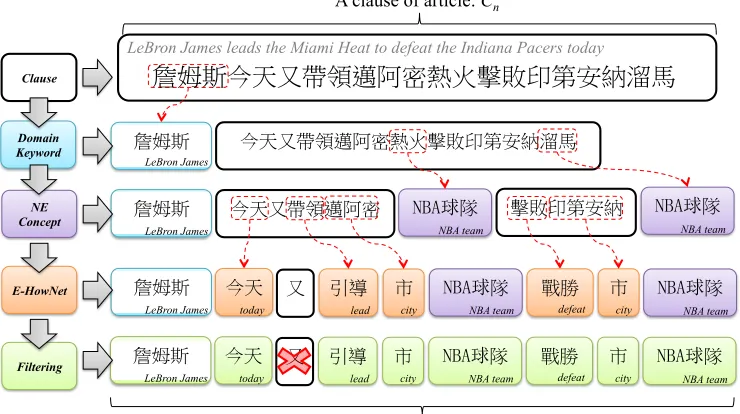
Figure 2: Semantic class labeling process
ter fit its semantic representation, as well as distinct definition of function and content words. A total of four basic semantic classes are applied, namely, object, act, attribute, and value. Furthermore, com-pared to the HowNet, EHowNet possesses a layered definition scheme and complex relationship formu-lation, and uses simpler concepts to replacesememes as the basic element when defining a more complex concept or relationship. To illustrate the content of the E-HowNet, let’s take “KS(Operation)” for ex-ample. It is defined as the following:
Simple Definition:
{affairs|ãŸ: CoEvent ={ã |HaveOperation}} Expanded Definition:
{affairs|ãŸ: CoEvent = {split|4ã: purpose =
{doctor|´ª}}}
We can see that the definitions in E-HowNet enable us to combine or dissect the meaning of words by using its semantic components. Therefore, we use it to label the remaining texts with their sense labels after all the NEs have been tagged.
To illustrate the process of SCL, consider the sen-tence Cn = “y∆Ø )»6⇠Å?∆±k W
p,â ú¨ (LeBron James leads the Miami Heat to defeat the Indiana Pacers again today)”, as shown in Figure 2. First, “y∆Ø (LeBron James)” is found in the keyword dictionary and
tagged. Then, NEs like “±k (Heat)”, “ú¨ (Pacers)” are found in NE ontology and tagged as “[NBA⇤ä (NBA teams)]”. Finally, other terms like “Å?∆ (Miami)”, “ )(today)”, and “ W (defeat)” are labeled with their corresponding E-HowNet senses. Evidently, the SCL can not only prevent errors caused by Chinese word segmenta-tion, but also group the synonyms together. This enables us to generate distinctive and prominent se-mantic classes for a topic in the next stage.
3.2 Semantic Frame Generation, SFG
(look)]-[≤ÔSû(Internet terminology)]”. We can think of various semantically similar sentences that were covered by this frame, e.g., “( iPhone
Ü✏ΩË=< (use iPhone to browse weblog)”
or “Ñ( iPhone fl↵˚Pıˆ (utilize iPhone to check email)”.
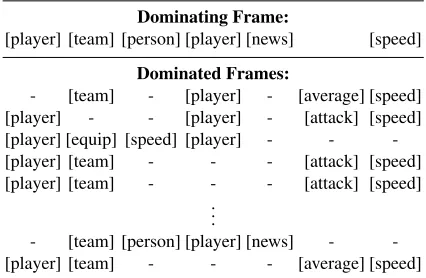
The dominating set algorithm is adopted for SFG, and it has been proven that finding the dominat-ing set on a graph is NP-hard (Garey and Johnson, 1979). Thus, several approximations have been pro-posed (Guha and Khuller, 1998; Kuhn and Watten-hofer, 2005; Shen and Li, 2010, i.a.). We also im-plemented an approximation based on the greedy al-gorithm. First of all, we construct a directed graph G = {V, E}, in which vertices V contains all se-mantic frames{SF1,· · · , SFm} in each topic, and edgesErepresent the dominating relations between frames. If a frame SFx dominates SFy, there is an edge SFx ! SFy. There are three criteria for constructing the dominating relations. First, only high frequency frames were selected for the inators. Secondly, in general, longer frames dom-inate shorter frames, except for those mentioned in the following rule. Lastly, shorter frames would only be dominated if their head and tail semantic classes are identical to those of longer frames. The inter-mediate semantic classes could be skipped, as they can be identified as insertions and given scores based on their statistical distribution in this topic during the matching process. An illustration of a dominat-ing frame and some dominated frames are shown in Table 1. Using dominating set to find frequent patterns on semantic graphs can help us capture the most prominent and representative frames within a topic. Afterwards, the dominating frames undergo a selection process that is similar to our keyword extraction method mentioned above. We use the LLR to discriminate semantic classes between ics. Given training data comprised of different top-ics, the LLR calculates the likelihood that the oc-currence of a semantic class in the topic is not ran-dom. Those with a larger LLR value are considered as closely associated with the topic. Lastly, we rank the frames based on a sum of semantic classes LLR values and retain the top 100 from approx. 350,000 frames. By doing so, we can reduce the number of frames to 0.2% while keeping the most prominent and distinctive ones. Moreover, such reduction of
the frames allows the execution of more sophisti-cated text classification algorithms, which leads to improved results. Existing algorithms cannot be ex-ecuted on the original semantic class graph because the excessive execution times required makes them impractical (Baeza-Yates and Ribeiro-Neto, 2011). Therefore, selecting semantic frames closely associ-ated with the topic would improve the performance of topic detection.
Dominating Frame:
[player] [team] [person] [player] [news] [speed] Dominated Frames:
- [team] - [player] - [average] [speed] [player] - - [player] - [attack] [speed] [player] [equip] [speed] [player] - - -[player] [team] - - - [attack] [speed] [player] [team] - - - [attack] [speed]
.. .
- [team] [person] [player] [news] - -[player] [team] - - - [average] [speed]
Table 1: Illustration of a dominating frame and some dominated frames in the topic “Sports” generated by SFG.
3.3 Semantic Frame Matching, SFM
During matching, an unknown article is first labeled by SCL and a alignment-like algorithm (Needleman and Wunsch, 1970) is applied to determine the sim-ilarity between the article and the frames derived by SFG. It enables a single frame to match multiple se-mantically similar expressions. The SFM compares all sequences of semantic classes in an article to all the frames in each topic, and calculates the sum of scores for each topic. Unlike normal templates that involve mostly rigid left-right relation, we consider them as scoring criteria during frame alignment. The topictiwith the highest sum of scores defined in (2) is considered as the winner.
T opic= arg max t2T opic
where
Score(Document, ti)
= X
sfi2SFtopic,slj2SLdocument
(sfi, slj)
+LLR(k, ti), (3)
in which
(sf, sl) =X i
X
j
(sf·sci, sl·scj), (4)
wheresciandscj represent theithsemantic class of
sfandjthsemantic class ofsl, respectively. We use a keyword score computed from the LLR mentioned in Section 3.1, denoted asLLR(k, ti)in (3). As for
scoring of the matched and unmatched components in frames, the details are as follows. Ifsf·sciandsl·
scj are identical, we add a matched score obtained
from the frequency of the semantic class in a topic times a normalizing factor = 100, as in (5).
M atched(sc) = Pmfsc i=1fsci
(5)
Otherwise, the score of insertions and deletions are added. An insertion, defined as (6), can be ac-counted for by the inversed entropy of this class, rep-resenting the uniqueness or generality of this class among topics. And a deletion, defined as (7), is computed from the log frequency of this class in this topic. It denotes the importance of a class in a topic. The detailed algorithm is described in Algorithm 1.
Insertion(sc) = Pm 1
i=1P(ti)log2 P(ti)
(6)
Deletion(sc) = logPmfsc
i=1fsci (7)
4 Performance Evaluation
4.1 Dataset and Experimental Settings
To the best of our knowledge, there is no official corpus for Chinese topic detection. Therefore, we compiled a news corpus for the evaluations from Ya-hoo! Chinese news website between the year 2010 and 2014. It contains a total of 140,000 docu-ments with six different topics, and the number of
Algorithm 1Semantic Frame Matching
Input: A semantic frameF ={S1, ..., Sm},S:
seman-tic class; A sequence of semanseman-tic class from a clause C={s1, ..., sn}
Output: Matching score betweenF andC
1: pos 0;
2: fori= 1tomdo
3: pos current matched position inC;
4: if foundsj =SiinCafterposthen
5: + MatchedScore(Si);
6: isM atched true;
7: end if 8: end for
9: if isM atched=f alsethen
10: -(insertion or deletion) score ofSi; 11: end if
documents of each topic is included in the paren-theses, i.e., “Sports” (28,920), “Politics” (29,024), “Travel” (22,257), “Technology” (27,032), and “Ed-ucation” (15,024). For each topic, 10,000 docu-ments are selected as the training data, while the rest are used for testing. The evaluation metrics used are the precision, recall, andF1-measure. A
and VSM, which is a common add-one smoothing method. And an LDA toolkit is used to perform the detection of LDA-SVM.
4.2 Results
A comparison of the five topic detection methods is displayed in Table 2. Our FBA system achieved the best performance on the topic “Politics”, with the precision, recall, andF1-measure scores of 78.37%,
92.12%, and 84.69%, respectively. Nevertheless, performances with high precision and low recall were found in the topics “Travel” and “Technology”, as the FBA system obtained precisions over 90% with recalls only around 40%. On the contrary, the FBA system showed lower precisions of 57% and 72% and higher recalls of 95% and 93% for the topics “Sports” and “Health”, respectively. Over-all, the FBA system achieved an average precision of 78.17%, average recall of 69.39% and an average
F1-measure of 69.14%.
To further investigate the competence of our sys-tem, four other methods were also evaluated for comparison. As expected, the random baseline has the lowest performance among all methods with av-erage P/R/F values around 17%. The Na¨ıve Bayes classifier significantly outperforms the random base-line. Nevertheless, in the topics “Travel”, “Technol-ogy”, and “Education”, this method obtained a rel-atively lower recall compared with others. On the other hand, VSM surpasses the overall performance of Na¨ıve Bayes by about 20%. It is worth noting that VSM shares some of the low recall topics of the Na¨ıve Bayes method, while acquiring the highest precision scores in three out of the six topics. For the topic “Technology”, it has the best P/R/F scores of 93%, 50%, and 65%, respectively. As for the
LDA-SVM, the difference is not as obvious. It achieved an improvement over the VSM’s averageF1-measure
by 4%. It also obtained the highest recalls among all systems in two of the six topics: “Travel” and “Education”. Finally, the FBA outperforms LDA-SVM in the overallF1-measure by 2%. In general,
FBA has a higher precision while LDA-SVM has a higher recall, and FBA achieved the highest overall
F1-measure of all methods compared.
4.3 Discussion
To begin with, we provide an analysis of the dif-ference in the average performance among different methods. The improvement in performance from the random baseline to the Na¨ıve Bayes classifier in-dicates that keyword information is indispensable. The VSM benefits from weighing keywords in dif-ferent topics by vectors in order to discover unique words and leave out less distinctive ones in each topic, thereby outperforming the Na¨ıve Bayes clas-sifier. However, since VSM considers similarity be-tween two words as a cosine function with indepen-dent dimensions, it is difficult to represent the rela-tions among many words.
On the other hand, when compared with the LDA-SVM method, our system has a higher precision and lower recall, resulting in a subtle increase of over-all F1-measure over the LDA-SVM. It may be
at-tributed to the use of Chinese word segmentation tool in LDA-SVM for constructing a word dictio-nary as background knowledge, in addition to a probabilistic graph with weighted edge representing between-word relations. By contrast, our system re-lies on a NE database for semantic class labeling and frame generation, which is constrained by the scope of the data. Moreover, some keyword
infor-Topic Random Na¨ıve Bayes VSM LDA-SVM FBA
Sport 24.45/16.62/19.79 57.09/55.81/56.45 94.76/67.92/79.13 94.40/85.85/89.92 57.15/95.06/71.38 Politics 24.85/16.94/20.15 47.67/78.50/59.31 91.86/48.69/63.65 80.34/82.94/81.62 78.37/92.12/84.69 Travel 15.95/17.00/16.46 30.86/15.88/20.97 76.92/59.18/66.89 80.58/62.11/70.16 91.06/43.87/59.21 Technology 21.96/16.82/19.05 73.32/27.52/40.02 92.87/50.39/65.33 70.56/47.38/56.69 92.68/40.47/56.34 Health 10.28/16.26/12.59 38.43/69.65/49.53 57.49/78.92/66.31 44.41/70.56/54.51 71.56/93.00/80.88 Education 10.15/16.07/12.44 46.88/46.50/46.69 29.04/70.08/41.07 37.18/82.06/51.17 78.19/51.82/62.33 µ-Average 17.94/18.29/16.75 49.04/48.98/45.50 73.82/62.53/63.73 67.91/71.82/67.35 78.17/69.39/69.14
Table 2: Precision/Recall/F1-measure(%) and micro-average of different topic detection systems. The highest numbers
mation in the original document is discarded by the labeling process, which is retained in other keyword-based models. Potentially crucial information may be abandoned in this manner and impair the cover-age of our system. Despite the slightly lower recall, our system is unique in the ability to generate and accumulate knowledge during the process. This en-ables us to capture essential information beyond the word-level for a topic, and generate frames that can capture the relations between them. The generated frames can describe the semantic relations within a document and assist in detecting the topic. We con-sider them as the foundation for a more profound understanding of topics that extends beyond the sur-face words.
Of the six topics, our system performed best on the topic “Politics” due to the abundant specific nouns in the articles of this topic, such as “⌘;Ë
(Democratic Party)” or “PÙ¨(Obama)”. In
addi-tion, unique political terms like “√p·(Senator)” and “g£ (Cabinet)” are also common. The inte-gration of key terms and frames contributes to the stability and uniqueness of the semantic frames of this topic, resulting in a higher overallF1-measure. As for the topics “Sports” and “Health”, we spec-ulate that the NEs of athletes or disease names and other organizations are common among these arti-cles. Thus, the frames in these topics are very exten-sive, leading to a broader coverage and higher recall. Other methods simply relying on keyword informa-tion can achieve a higher precision. Nonetheless, without long-distance information such as those en-coded by frames, the recall can be limited. Regard-ing other topics, although the FBA can obtain the highest precision, insufficient knowledge may be the major cause of a restricted coverage. For example, the precision of the topic “Technology” is 92.68%, the highest among all topics. We believe this is due to the fact that specific technological terms, such as “iPhone” or “Æfl(Microsoft)”, are predominant in these topics. Terms of such are very competent in determining the topic of these documents. However, considering the fact that novel terms are emerging frequently, we will have to integrate new knowledge into our system. Fortunately, under our framework, expanding and accumulating the knowledge base is easily done. Therefore, the advancement of our sys-tem is foreseeable.
Interestingly, it can be observed that the topics “Travel” and “Technology” generally have lower re-call, regardless of the system used. This may be due to the fact that context information in these topics is hard to be captured by the current systems. Using only the word it self or word-related features is not enough. Even for a semantically-based system like the LDA-SVM or FBA, such information is still not fully encoded. Further research on the integration of richer and wider semantic context may be fruitful.
In sum, our approach can automatically generate frames that retain the benefit of knowledge-based approaches, including high precision and knowledge accumulation, while retaining considerable amount of recall. It can be continuously upgraded as more knowledge is incorporated. Hence, it has great potential in overcoming common disadvantages of other systems.
5 Concluding Remarks
This research proposes the FBA, a flexible and auto-matic approach to the topic detection task based on knowledge sources and automatic frame generation. It differs from popular machine learning methods as it can create an adaptable and extensible topic-dependent knowledge base, while preserving the ac-curacy of rule-based models. Results showed that FBA can effectively detect the topic of articles, as well as assist the user in constructing background knowledge of each topic in order to better under-stand the essence of them. In the future, we plan to expand this approach to include more topics, and even apply it to other applications in NLP. Also, further studies can be done on combining statistical models into different components in FBA.
Acknowledgment
This study is conducted under the NSC 102-3114-Y-307-026 “A Research on Social Influence and Decision Sup-port Analytics” of the Institute for Information Industry which is subsidized by the National Science Council.
References