Models and Tools for Collaborative Annotation
Xiaoyi Ma, Haejoong Lee, Steven Bird and Kazuaki Maeda
Linguistic Data Consortium, University of Pennsylvania 3615 Market Street, Philadelphia, PA 19104-2608, USA
xma, haejoong, sb, maeda @ldc.upenn.edu
Abstract
The Annotation Graph Toolkit (AGTK) is a collection of software which facilitates development of linguistic annotation tools. AGTK provides a database interface which allows applications to use a database server for persistent storage. This paper discusses various modes of collaborative annotation and how they can be supported with tools built using AGTK and its database interface. We describe the relational database schema and API, and describe a version of the TableTrans tool which supports collaborative annotation. The remainder of the paper discusses a high-level query language for annotation graphs, along with optimizations, in support of expressive and efficient access to the annotations held on a large central server. The paper demonstrates that it is straightforward to support a variety of different levels of collaborative annotation with existing AGTK-based tools, with a minimum of additional programming effort.
1.
Introduction
Annotation graphs provide a comprehensive formal framework for constructing, maintaining and searching lin-guistic annotations, while remaining consistent with many alternative data structures and file formats. An annotation graph is a directed acyclic graph where edges are labeled with fielded records, and nodes are (optionally) labeled with time offsets. The annotation graph model is capable of representing virtually all types of linguistic annotation in widespread use today (Bird and Liberman, 2001).
The Annotation Graph Toolkit (AGTK) provides soft-ware infrastructure based on annotation graphs, allowing developers to quickly create special-purpose annotation tools using common components. AGTK consists of three parts: the annotation graph library, which is the internal data structure of annotation graphs, the I/O library, which handles the input and output of files of different formats, and wrappers which provide interfaces for scripting lan-guages Tcl and Python.
AGTK also provides a model and tools to facilitate col-laborative annotation. In typical annotation projects, tasks are divided into multiple passes; different people work on different passes individually or together. At any given time, only one person edits an annotation file. With AGTK it is straightforward to develop tools that permit a group of peo-ple (who may be geographically dispersed) to collaborate on the same annotation project. AGTK provides a database interface which allows users to load or retrieve annotation graphs from a shared server. The database interface is flex-ible with respect to the database server software and with respect to the location of the data.
This paper is organized as follows. Section 2 describes various kinds of collaborative annotation, while section 3 lays out the database schema and the related API functions. Section 4 is a case study of real world problem and how it was addressed with the model we propose. Section 5 describes our efforts towards more expressive and efficient annotation graph queries, and section 6 concludes the pa-per.
2.
Collaborative Annotation
In recent years, annotation projects have grown in size and complexity, and it is now standard for multiple annota-tors and sites to be involved in a single large project. Man-aging this collaboration becomes a significant task in its own right.
At a minimum, we would like to be able to control ac-cess to different regions and types of annotation, to log modifications, and track the quality checks that have been made. While version control software and database servers may meet these requirements, it is not trivial to incorporate this functionality into annotation tools and expose it to end-users. Instead, we seek lightweight solutions that can easily be integrated with existing tools.
In this section we describe three approaches to this problem that we are pursuing in the context of the Annota-tion Graph Toolkit. These are treated in order of increasing difficulty.
2.1. Exploiting the annotations
Annotation graphs permit labels to contain fielded records. There is constraint on the name and content of the fields, except that they must be strings. There can be an arbitrary number of fields. We can exploit this flexibility in managing an annotation project by storing management information with the annotations themselves. Thus, there could be fields for such things as the identity of the last person who edited the annotation, various significant dates in the lifetime of the annotation, the level of quality con-trol which has been completed, the chapter and verse of the coding manual which justifies the annotation, free text com-ments about additional checks that should be undertaken, and so forth.
API functions that provide search capabilities over the annotation label data permit exactly the same functionality for this management information. Tools can hide this infor-mation, but use it in presenting annotation content to users. For instance, annotations may have a QC feature whose val-ues ranges from 1 to 5. For a particular task, the tool could highlight all annotations with QC level less than 3.
formats. When saving to particular formats, the appropri-ate export module only queries the annotation graph library for the relevant fields; all other fields are ignored. Thus, an-notation graphs can be enriched with management informa-tion in unforseen ways, yet saved in the existing supported formats without any modification to the export modules.
This feature of annotation graphs is amenable to collab-orative annotation, since it is easy for the cooperating par-ties to agree on additional fields which help document and manage their joint work. We will not have anything further to say about this approach here, but want to emphasize that it is adequate for managing many kinds of collaborative an-notation.
2.2. Exploiting the database
The database access method provided by the annota-tion graph library uses the ODBC standard (Open Database Connectivity). In the past, if a single program needed to connect to an Oracle database, an Informix database or a MySQL database, it was necessary to maintain three ver-sions of the interface code, one for each database. With ODBC, applications write to the ODBC API and let the ODBC Manager and Driver take care of the database lan-guage specifics.
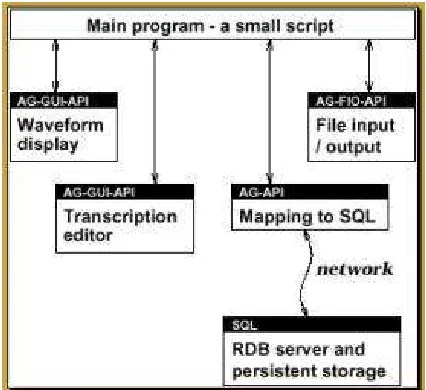
The annotation graph database schema, which is ex-plained in detail in next section, allows annotation graphs to be stored and retrieved in any relational database server that supports ODBC. The annotations can then be queried di-rectly in SQL or in a customized query language. A client-side annotation tool can initiate queries and display anno-tation content on behalf of the end user. An annoanno-tation tool and server, integrated using the model shown below, en-ables users to access local or remote annotation databases transparently.
Figure 1: Interactions Among Annotation Tools and the Annotation Server
Incorporating ODBC support in AGTK greatly facili-tates data sharing and collaborative annotation. Different users may be granted different levels of access to the server, e.g. to modify existing annotations, or just to add
commen-tary to existing annotations (e.g. write a prose recommen-dation that a certain annotation be changed).
Annotation graph based annotation tools can also be tai-lored to permit certain categories of user to do certain kinds of edits. This supports annotation projects where there is a high degree of specialization amongst the geographically separated collaborators (e.g. if we were annotating dis-course and intonation, and if junior annotators were given simple tasks, and senior annotators and researchers added their own specialized annotations, and checked the work of the junior annotators).
Updates may occur at various levels of granularity. For example, with record-level locking, two annotators could be working on the same annotation region without interfer-ing with each other’s work. Section 4 also gives an exam-ple of how annotators can collaborate using column lock-ing where different annotators are given different read/write permissions to edit certain annotation features.
So far we have focussed on collaborative annotation as the key benefit derived from moving to a relational database model. There are several other advantages as well.
With ODBC, an annotation application can access re-mote annotation servers. The user simply tells the applica-tion what annotaapplica-tion graph database on which server he/she wants to access by using an ODBC connect string which contains information of the name of the server, the name of the database, the user name and password. Note that the signal data does not need to reside in the same place as the annotation data. Distributed annotators may have local copies of large signal files while storing their annotations in a common central location.
While other annotation tools are able to store their an-notations in a database (Cassidy, 1999), we are not aware of any projects which use this to support collaborative an-notation.
We briefly note one final, significant benefit of storing all annotations in relational form. As Cieri and Bird Cieri and Bird (2001) have discussed, many annotated record-ings come with a variety of non-temporal data, such as speaker demographics, lexicons, and the like. These tables can be stored in relational form alongside the annotations, enabling us to integrate all of the data. Now, queries can perform joins across the temporal and atemporal data. For further discussion the reader is referred to (Cieri and Bird, 2001).
2.3. Exploiting the query language
In many annotation projects, the only way to view an annotation is with the same software that was used to cre-ate it. For any large annotation task – especially those in-volving collaboration – browsing individual annotations is usually not an efficient way to identify annotations requir-ing further work. The standard solution is to create special-purpose scripts which scan a collection of annotation files, opening the editor on each file which satisfies the user’s re-quirements.
has some expressive limitations which render it unsuitable for certain kinds of query. For instance, we cannot express kleene closure over the annotation relation, since this re-quires a variable number of joins. However, regular ex-pressions are a common feature of linguistic queries, and are heavily used in the special-purpose scripts (mentioned above).
In section 5 we will report the result of our experiments on pre-compiling the kleene closure so that these linguisti-cally natural queries can be expressed. This work promises to greatly improve the flexibility of the annotation tools, permitting users to identify and load previously-created an-notations according to complex criteria without leaving the annotation tool.
3.
Relational Representation
This section discusses the database schema and the API that are used for storing and accessing a set of annotation graphs.
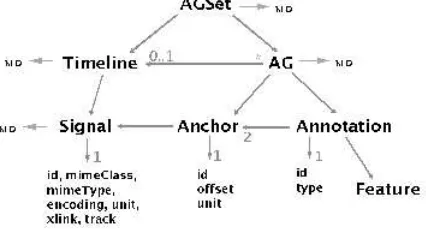
The design of the relational database schema is closely related to the AG library’s C++ implementation. Figure 2 depicts how AG library objects relate to each other. As the diagram shows, an AGSet is a collection of timelines and AGs. A timeline is a collection of signals. An AG contains multiple anchors and annotations. The annotation graph library objects also reference each other, for example, an annotation graph can reference a timeline; an annotation references two anchors (the start and end anchor); a Meta-data object (’MD’ in the figure) could be referenced by an AGSet, AG, timeline or signal. There are also attributes as-sociated with each library object, as shown in the picture. Please see (Maeda et al., 2002) for further details.
Figure 2: The Annotation Graph Object Model
3.1. Schema
The model described above is represented in a relational database as follows.
AGSET Table AGSET stores attributes of all AGSets. XMLNS is the XML namespace of the ATLAS In-terchange Format (AIF). XLINK specifies the XML Linking Language (XLink) specification the AGSet is using.
CREATE TABLE AGSET (
AGSETID VARCHAR(50) NOT NULL, VERSION CHAR(10),
XMLNS CHAR(30), XLINK CHAR(30), PRIMARY KEY (AGSETID))
AG Table AG stores attributes of all AGs. AGSETID spec-ifies the AGSet an AG belongs to. TIMELINEID in-dicates the timeline an AG is associated with. An AG can also have an optional type, indicated by TYPE.
CREATE TABLE AG (
AGID VARCHAR(50) NOT NULL, AGSETID VARCHAR(50) NOT NULL, TIMELINEID VARCHAR(50),
TYPE CHAR(10), PRIMARY KEY (AGID),
FOREIGN KEY (AGSETID) REFERENCES AGSET)
TIMELINE Table TIMELINE stores attributes of all timelines.
CREATE TABLE TIMELINE (
AGSETID VARCHAR(50) NOT NULL, TIMELINEID VARCHAR(50) NOT NULL, PRIMARY KEY (TIMELINEID)
FOREIGN KEY (AGSETID) REFERENCES AGSET)
SIGNAL Table SIGNAL keeps attributes of all signals. AGSETID and TIMELINEID specify the AGSet and timeline a signal belongs to.
CREATE TABLE SIGNAL (
AGSETID VARCHAR(50) NOT NULL, TIMELINEID VARCHAR(50) NOT NULL, SIGNALID VARCHAR(50) NOT NULL, MIMECLASS VARCHAR(50),
MIMETYPE VARCHAR(50), ENCODING VARCHAR(50), UNIT VARCHAR(50), XLINKTYPE VARCHAR(50), XLINKHREF VARCHAR(50), TRACK VARCHAR(50), PRIMARY KEY (SIGNALID),
FOREIGN KEY (AGSETID) REFERENCES AGSET, FOREIGN KEY (TIMELINEID) REFERENCES TIMELINE)
ANNOTATION Table ANNOTATION keeps attributes of all annotations. AGSETID and AGID specifies the AGSet and the AG an annotation belongs to. STAR-TANCHOR and ENDANCHOR are the IDs of the start anchor and end anchor of the annotation. An an-notation also has an type.
CREATE TABLE ANNOTATION (
AGSETID VARCHAR(50) NOT NULL, AGID VARCHAR(50) NOT NULL, ANNOTATIONID VARCHAR(50) NOT NULL, STARTANCHOR VARCHAR(50),
ENDANCHOR VARCHAR(50), TYPE VARCHAR(50), PRIMARY KEY (ANNOTATIONID), FOREIGN KEY (AGID) REFERENCES AG, FOREIGN KEY (AGSETID) REFERENCES AGSET)
ODBC connect string arguments What the argument specifies
DSN Registered ODBC Data Source Name. SERVER The hostname of the database server. UID User name as established on the server.
SQL Server this is the login name.
PWD Password that corresponds with the login name. DATABASE Database to connect to. If not given, DSN is used.
Table 1: Parameters in Connect String
start and end times and classifying the call types. Observa-tions may be dense, or very sparse with extended periods in which nothing is coded. Each observation is entered into a row of a spreadsheet, and rows may have upwards of a dozen columns, each covering a different aspect of the ob-servation, e.g.: recording offsets, tape number, date, time, location, animal id, group id, context (foraging/predator), call type, signal quality, and comments. Each row may also contain quantities derived from the corresponding pe-riod of the signal, such as mean energy. In this way, many thousands of observations are coded. Quantitative analysis of these tables addresses research questions in behavioral ecology and language evolution.
Much of the coding task is relatively straightforward and does not require highly trained annotators. Working from a digitized recording and field notes, an annotator can convert tape counter numbers to millisecond offsets, and enter such fields as the tape number, date, time and loca-tion. This work is typically done at a digitization station; while tapes are being uploaded to disk, the annotator works on previously uploaded materials. The result is a set of spreadsheets in which each row corresponds to an extent of audio, but where certain columns are left empty.
In the original version of this process, annotation files would remain on the digitization station until the first round of annotation was complete, at which time they would be transferred to a specialist – usually the original field re-searcher – for further annotation. The specialist would fill in columns that require a greater degree of critical judge-ment, such as the call type. However, during the course of listening to hundreds of calls, the untrained annotator grad-ually learns to discriminate most call types, and can use-fully make a first pass at annotating some of the specialized columns. Later, these can be reviewed and post-edited by the specialist.
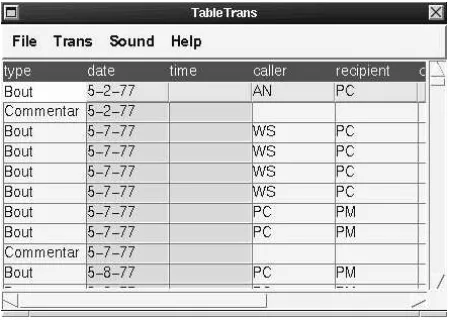
The unfortunate consequence of this regime is that the collaboration between the annotator and the specialist re-quires copies of the annotations to be circulated (e.g. by email) and/or arranging meetings. Neither of these is an ef-ficient way to quickly resolve the unpredictable questions that may arise (and hold up) the annotation process. In ad-dressing this problem, we have developed a new version of the TableTrans tool that stores all of its annotations in a central database. The configurations for the trainee and spe-cialist versions of the tool specify which columns are avail-able for read-only access, and which columns are availavail-able for read-write access. Even if physically separated, both parties can review the same material, listen to the audio seg-ments, and discuss judgements (e.g. by email or telephone).
In this way, collaboration, training and quality control can be done remotely, while each person has full access to the up-to-date annotations. The tool is able to prevent unau-thorized modification of read-only columns, and indicates these columns by shading (see Figure 3).
Figure 3: TableTrans With Read-Only Columns
This mode of collaborative annotation is possible be-cause the data resides on a shared server, and bebe-cause the tool can enforce a simple policy for the permission to edit particular spreadsheet columns.
5.
Efficient AG Queries
Given that annotation graphs are stored in a relational database, it seems reasonable to use SQL for search. How-ever, SQL turns out to be unsuitable for annotation graphs in terms of expressiveness and optimizability. Thus, a new query language for annotation graphs has been proposed (Bird et al., 2000). In most cases, the new query language can be mapped into SQL. Therefore, it is still possible to utilize SQL and relational database technologies. There are a couple of advantages in this approach. First, given that we are taking full advantage of a relational database sys-tem, implementation is straightforward; we only need to map between query languages. Second, the optimization problem is reduced to the optimization of SQL queries, in which there is relatively little room for improvement.
5.1. The experimental database
For the experiment, we set up a test database on a Linux PC running at 500 MHz. PostgreSQL (PostgreSQL Global Development Group, 2002) was used for the rela-tional database. For test data, a part of the TIMIT corpus (Garofolo et al., 1986) was used, consisting of 1,680 TIMIT speech annotations. The contents of the database are sum-marized in the following table:1
Object Count
Agset 1
Ag 1,680
Annotation 80,378 txt 1,680 wrd 14,553 phn 64,145
Anchor 67,375
5.2. AG query example
Consider the following annotation graph query against our test database:
Query 1. Find word arcs whose phonetic transcription starts with a ‘hv’ and contains a ‘dcl’.
This query can be depicted by an annotation graph pat-tern as shown in Figure 4. It matches any wrd annotation that starts at anchor and ends at anchor such that there exist a phn annotation labeled ‘hv’ that starts at anchor and ends at anchor , a phn annotation labeled ‘dcl’ that starts at anchor and ends at anchor , paths and
of phn annotations.
X phn/hv A Y
wrd/?
B phn/dcl C
Figure 4: Annotation graph pattern for query 1.
This pattern can be written as follows using annotation graph query syntax:
X.[].Y <- db/wrd
X.[:hv].[]*.[:dcl].[]*.Y <- db/phn
Here is a complete annotation graph query for query 1.
SELECT I
WHERE X.[id:I].Y <- db/wrd AND
X.[:hv].[]*.[:dcl].[]*.Y <- db/phn;
Note thatid:Iis added to the pattern to select ids of matched annotations. Also note that there is no direct map-ping to SQL for the above query because of the paths of phn annotations. The solution for this problem is discussed in the following sections.
1The test database can be tuned up for better performance. For
instance, some additional indices can be added, and management queries can be used for clean-up. We used a tuned database in the experiments reported here.
SELECT W.annotationid
FROM (SELECT AnnotationId, StartAnchor, EndAnchor FROM Annotation
WHERE Type=’wrd’) AS W,
(SELECT StartAnchor, EndAnchor FROM Annotation A, TIMIT F WHERE A.Type=’phn’ AND
A.AnnotationId=F.annotationId AND F.Label=’hv’) AS P1,
(SELECT StartAnchor, EndAnchor FROM Annotation A, TIMIT F WHERE A.Type=’phn’ AND
A.AnnotationId=F.annotationId AND F.Label=’dcl’) AS P2,
(SELECT StartAnchor, EndAnchor FROM Kstar
WHERE Type=’phn’) AS K1,
(SELECT StartAnchor, EndAnchor FROM Kstar
WHERE Type=’phn’) AS K2
WHERE W.StartAnchor=P1.StartAnchor AND P1.EndAnchor=K1.StartAnchor AND K1.EndAnchor=P2.StartAnchor AND P2.EndAnchor=K2.StartAnchor AND K2.EndAnchor=W.EndAnchor ;
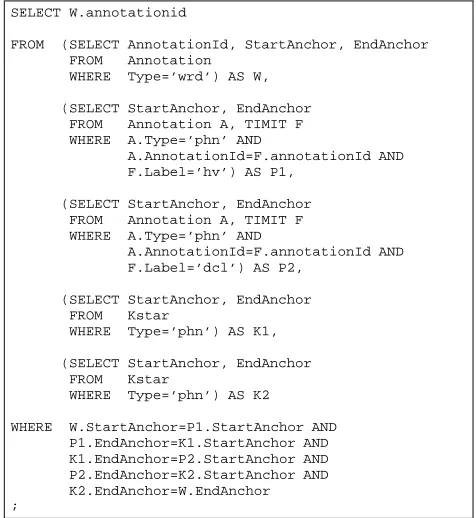
Figure 5: SQL query for query 1.
5.3. : Transitive closure of annotations
is a table containing connectability information be-tween anchors. For example, if there is a path from anchor
to anchor following annotations of type, should contain a tuple , and vice versa. The schema for
is shown below:
CREATE TABLE Kstar ( StartAnchor VARCHAR(50), EndAnchor VARCHAR(50), Type VARCHAR(20),
PRIMARY KEY (StartAnchor,EndAnchor,Type),
FOREIGN KEY (StartAnchor,EndAnchor) REFERENCES Anchor);
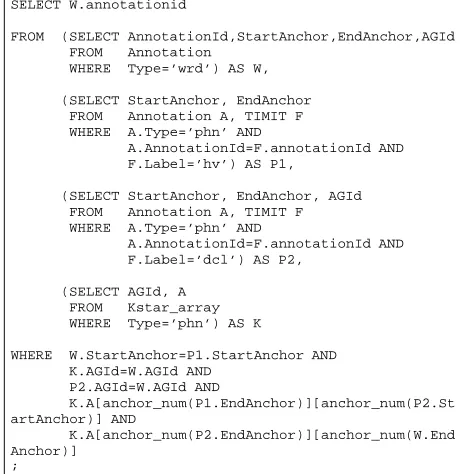
Precomputing , the transitive closure of annotations, eliminates the mapping problem. In fact, query 1 is now translated to SQL in Figure 5.
Domain Restriction In the query in Figure 5, tuples of type phn are used. This is wasteful because it allows irrelevant anchors to be considered in the computation. For example, for two connected anchors, the SQL query will take those anchors into consideration as long as they are connected by phn annotations, even though they belong to different words.
Figure 6: Long joins with .
Type Count
wrd 91,960
phn 1,423,134 phn/wrd 271,323 Total 1,786,417
The following queries are variations of query 1.
Query 2. Find word arcs whose phonetic transcription starts with a ‘hv’:
SELECT I
WHERE X.[id:I].Y <- db/wrd X.[:hv].[]*.Y <- db/phn;
Query 3. Find word arcs whose phonetic transcription starts with a ‘hv’ and ends with a ‘ix’:
SELECT I
WHERE X.[id:I].Y <- db/wrd
X.[:hv].[]*.[:ix].Y <- db/phn;
Query 4. Find word arcs whose phonetic transcription contains a ‘dcl’:
SELECT I
WHERE X.[id:I].Y <- db/wrd
X.[]*.[:dcl].[]*.Y <- db/phn;
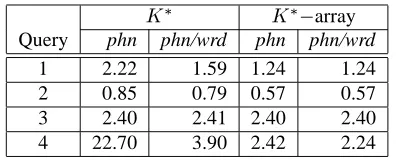
The following table shows the performance of those queries and the effect of domain restriction.
Query phn phn/wrd
1 2.22 1.59
2 0.85 0.79
3 2.40 2.41
4 22.70 3.90
Since is a huge table, it is expected that queries with many references to will suffer from the size of . In considering this issue, suppose that we have the following general pattern for an annotation graph query:
X.[].Y <- db/wrd
X.[:l1].[]*.[:l2].[]*...[:ln].[]*.Y <- db/phn
The pattern has phn annotations and each pair of phn annotations has an intervening reference, a total of
references. Figure 6 shows how the performance scales as the number of references increases. With 5 refer-ences, it took 23 hours and 40 minutes with a lot of memory swapping.
SELECT W.annotationid
FROM (SELECT AnnotationId,StartAnchor,EndAnchor,AGId FROM Annotation
WHERE Type=’wrd’) AS W,
(SELECT StartAnchor, EndAnchor FROM Annotation A, TIMIT F WHERE A.Type=’phn’ AND
A.AnnotationId=F.annotationId AND F.Label=’hv’) AS P1,
(SELECT StartAnchor, EndAnchor, AGId FROM Annotation A, TIMIT F WHERE A.Type=’phn’ AND
A.AnnotationId=F.annotationId AND F.Label=’dcl’) AS P2,
(SELECT AGId, A FROM Kstar_array WHERE Type=’phn’) AS K
WHERE W.StartAnchor=P1.StartAnchor AND K.AGId=W.AGId AND
P2.AGId=W.AGId AND
K.A[anchor_num(P1.EndAnchor)][anchor_num(P2.St artAnchor)] AND
K.A[anchor_num(P2.EndAnchor)][anchor_num(W.End Anchor)]
;
Figure 7: SQL query for query 1 with array.
5.4. array: Alternative to
shows poor performance when the query contains large number of references. In this section, we propose an alternative to to solve the problem.
Consider a boolean matrix, where is the num-ber of anchors in an annotation graph. We require a distinct matrix for each type . The value of cell
is true iff there is a path from anchor
to anchor following annota-tions of type.
2In general, the number of matrices required
for an annotation graph is (number of annotation types) + (number of domain restrictions). Therefore, if tuples have a matrix as their attribute, the size of the table can be reduced to (+ ) (number of annotation graphs).
A table is built as described above, using PostgreSQL’s array data type, and we call it array. The schema is shown below:
CREATE TABLE Kstar ( AGId VARCHAR(50),
A BOOL[][],
Type VARCHAR(20), PRIMARY KEY (AGId, Type),
FOREIGN KEY (AGId) REFERENCES AG);
The size of array for our test database is 5,040; re-member the size of is 1.8 million. Note that array reduces not only the size of the table but also the number of joins. For instance, Figure 7 is the array version of the SQL query in Figure 5, where two connectability tests are done by one array join. (anchor num()is a function to map anchor ids to a natural number.) We can expect that this will improve performance for queries involving a large number of joins.
The following table shows the effect of the array for queries 1-4. There are clearly time savings, although there is little benefit from domain restriction.
2
Note that it is still possible to apply domain restriction. For example, the value of cell is false if both and don’t belong
Figure 8: Long joins with array.
array
Query phn phn/wrd phn phn/wrd
1 2.22 1.59 1.24 1.24
2 0.85 0.79 0.57 0.57
3 2.40 2.41 2.40 2.40
4 22.70 3.90 2.42 2.24
Figure 8 demonstrates that the array can handle queries having a large number of joins.
5.5. Future work
The result of these experiments shows that this approach to implementing annotation query is quite promising. There are, however, remaining tasks to complete the implementa-tion. Tasks include: (i) implementation of translator (or mapper) from annotation graph query to SQL, (ii) further experimentation on vertical queries to allow efficient search on hierarchical information between annotations such as in-clusion and overlapping, and (iii) specifying details of the query language syntax.
6.
Conclusion
This paper has reported on models and tools for collab-orative annotation based on annotation graphs. Annotation graphs are an extremely general and versatile data model for representing all kinds of annotation data. Moreover, they can be stored in a relational database and accessed remotely. The Annotation Graph Toolkit supports connec-tions to ODBC-compliant database servers, making it easy for developers to create annotation tools that store all their data in a server. Apart from the obvious benefits for data management, this storage method opens up new possibil-ities for collaborative annotation, as reported above. We hope to have shown that it is completely straightforward to support a variety of different levels of collaborative anno-tation with existing AGTK-based tools, with a minimum of additional programming effort.
Acknowledgements
This material is based upon work supported by the Na-tional Science Foundation under Grant Nos. 9978056 and 9980009 (Talkbank).
7.
References
Bird S. and Liberman M. 2001. A formal framework for linguistic annotation. Speech Communication, 33:23– 60.
Bird S. and Simons G. 2001. The OLAC metadata set and controlled vocabularies. In Proceedings of ACL/EACL Workshop on Sharing Tools and Resources for Re-search and Education. http://arXiv.org/abs/ cs/0105030.
Bird S., Buneman P., and Tan W.-C. 2000. Towards a query language for annotation graphs. In Proceedings of the Second International Conference on Language sources and Evaluation. Paris: European Language Re-sources Association.
Cassidy S. 1999. Compiling multi-tiered speech databases into the relational model: experiments with the Emu system. In Proceedings of the 6th Euro-pean Conference on Speech Communication and Tech-nology. http://www.shlrc.mq.edu.au/emu/ eurospeech99.shtml.
Cieri C. and Bird S. 2001. Annotation graphs and servers and multi-modal resources: Infrastructure for interdis-ciplinary education, research and development. In Pro-ceedings of ACL/EACL Workshop on Sharing Tools and Resources, pages 23–30. Somerset, NJ: Association for Computational Linguistics.
Garofolo J. S., Lamel L. F., Fisher W. M., Fiscus J. G., Pal-lett D. S., and Dahlgren N. L. 1986. The DARPA TIMIT Acoustic-Phonetic Continuous Speech Corpus CDROM.
NIST. http://www.ldc.upenn.edu/Catalog/
LDC93S1.html.
Maeda K., Bird S., Ma X., and Lee H. 2002. Creating an-notation tools with the anan-notation graph toolkit. In Pro-ceedings of the Third International Conference on Lan-guage Resources and Evaluation.