Annotation Driven Concordancing: the PAX Toolkit
Thorsten Trippel, Dafydd Gibbon
Department of Linguistics and Literary Studies Bielefeld University
Postf. 100131 33501 Bielefeld
Germany
ttrippel, gibbon @spectrum.uni-bielefeld.de
Abstract
We describe PAX, ”Portable Audio Concordance System”, a proof-of-concept prototype of a multipurpose, multilingual audio concor-dance toolkit. The primary goal is to support efficient grammar and lexicon construction in the documentation of unwritten languages; languages currently included are Ega, Anyi, and Koulango (Ivory Coast), additional samples in German and English. The approach combines methods from corpus linguistics, annotation theory and practice, phonetics and lexicography.
1.
Objectives
Finding occurences of selected utterances in multi-modal corpora for multimulti-modal lexica is the objective of the
Portable Audio Concordance System (PAX)1.
Modern dictionaries these days claim to be corpus based, for example lexica from the COBUILD project (see (Sinclair, 1987)). This is in the sense that
1. the order of different meanings corresponds to the fre-quency in a defined corpus
2. the examples for the use of different words are taken from real world data, i.e. corpora.
This presupposes a sufficiently preprocessed (marked-up) textual source. For written texts there are a number of corpora used for this purpose such as the British National
Corpus (British National Corpus, 2001) for English or the
copora available via (COSMAS, 2002) for German. However, these corpora contain written texts, and there are concordances for lexical analysis of written texts, which are well known (see for example (van Eynde and Gibbon, 2000)), but no adequate concordancing tools for spoken language exist. The concordancing task for spoken lan-guage is difficult: units are less well identified, access to both transcription text and speech signal is required, and standard aids like word statistics need to be supplemented by visualised transformations of the speech signal.
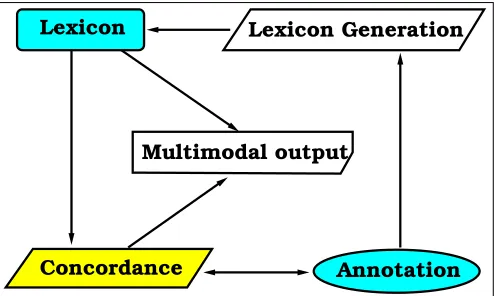
We demonstrate an enhanced KeyWord in Context (KWIC) concordance, based on a search space as defined by the annotation graph (Bird and Liberman, 2001), rep-resenting the transcription, and a search, which includes a variety of complex criteria. The XML formalism is based on the TASX format as described by (Milde and Gut, 2001). The position of a concordance in a concordance based multimodal lexicon system is described by Figure 1. Start-ing from the annotation of a multimodal source a lexicon is generated that falls back onto the annotation via the con-cordance for exemplified usages and possibly for evaluation of generated lexicon entries. The annotation itself is used
1The acronym is derived from PACS by merging the final
let-ters.
Lexicon
Multimodal output
Lexicon Generation
Annotation Concordance
Figure 1: Concordances in a multimodal Lexicon system
by the concordance as data input as well, and the annota-tion can be refined within fixed environments by using a concordance. Hence there is a bidirectional connection be-tween the concordance and annotation.
1.1. Methodology
The PAX concordance design is based on a function
! "#$ where is a set of annotated signals parti-tioned for different languages, KWIC is the keyword in context concordance, and
! "#
is a set of signal output renderings (audio, waveform,%'& , spectrogram). The corpus consists of digital signals, which were annotated at different levels.
The process of concordance generation consists of four functions, namely:
1. )(*,+)-.
lexicon generation function for spoken lan-guage dictionaries
)(*,+)-.#/)0132547698;:3<,=>/)? 2. A@CBABED
annotation generation function
Acquisition Annotated Text
Start (TASX)
Typed keywords
Language
Corpus
Filters Search parameters
Selected keyword
Search
Other tiers in time interval Reference to signal file Keyword instances in corpus + timestamps in annotation
USER
INTERACTION USER INTERACTION
Signal selection (time stamp)
Request for filters − audio selection − representation of − oscillogram − spectrogram
....
Analysis
... Output selection e.g. oscillograms spectrograms, Signal
Time stamp Signal
Annotation tier
Subcorpus Selected tier
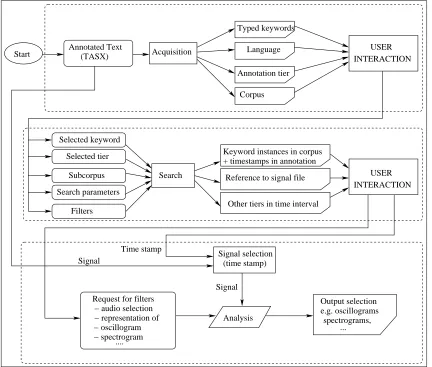
Figure 2: Design of PAX, based on TASX corpus format
KWIC context is supplemented with a further selec-tion panel specifying a set of choices for access to the signal: a range within the context; waveform or spec-trogramme or pitch track; selection of further output in the same window or a new window.
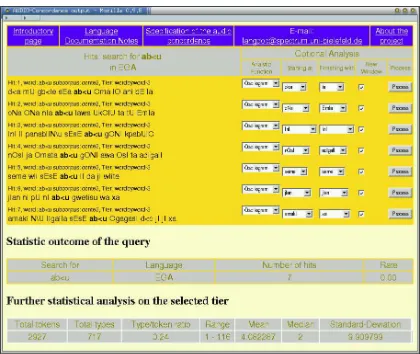
The consultation module provides some basic sta-tistical information as well. Based on the distribu-tion funcdistribu-tion measures of variability are given (Oakes, 1998), such as mean, range and median, standard devi-ation, type/token ratio (for simple tokens). The num-ber ratio of matches is also given. However, the in-terpretation of these measures is left to the user as it is dependent on the data types whether a measures is relevant or not.
Signal analysis: The KWIC output contains selection
pan-els for further processing on the signal level; segments are selected on the level of time-stamps assigned to the selected context. These segments are passed to signal processing for further analysis.
3.
Implementation
Input data are time-aligned in SAMPA standard ASCII IPA coding (modified for efficient tone language coding), using Praat, Transcriber or esps/waves . These opera-tional formats are converted to an XML annotation graph
format (Bird and Liberman, 2001) the TASX DTD (Milde and Gut, 2001), retaining SAMPA coding. TASX-XML and SAMPA fulfil the archive exchange and low-end avail-ability requirements. The TASX DTD is available at:
coli.lili.uni-bielefeld.de/˜milde/tasx/
The wordlist extraction, KWIC concordance construc-tion modules and format converters are in Perl, signal ex-traction and processing modules are in Praat scripts and Java. These modules feed three independent GUI modules, see section 3.2..
This hybrid implementation strategy fulfils the low-cost, low-end, on/offline and interoperability requirements.
3.1. Pragmatic Choice of Programming Language
PAX is implemented with a hybrid component structure, and the programming languages for the components were selected on a pragmatic basis:
Perl: the modules itself are implemented in Perl, as it
is available for many computer systems (including UNIX/Linux systems, MS-Windows, MacOS) and re-source friendly. Additionally it provides a rich re-source of regular expression capabilities and many inter-face format libraries, covering command line access, graphical user interfaces and CGI-access.
and can be used to call other modules from within the program.
Java: large-scale signal processing is impossible with
tra-ditional scripting languages such as Perl. For signal processing we selected Java as a suitable language that is system independent. The problem of Java being rel-atively resource unfriendly could be neglected for the present implementation as Java plays a minor role in the toolkit and does not result in a bottle-neck in per-formance. On the other hand no comparable system independence could be accomplished by using other programming languages.
Praat: for signal processing the routines of the Praat
pro-gramme for enhancing phonetic productivity are used. These are easy to incorporate since Praat provides a scripting language and interface that can be invoked by other programs. Praat is also available for all major platforms.
R: the statistical functions provided by the R-statistics package are connected to the concordance for effec-tive availability of various statistic functions. Rwas chosen because it is freely available under GNU pub-lic pub-licence and because it is available for all major plat-forms (Gentleman and Ihaka, 1997 2002).
3.2. Select the User interface
The PAX implementation exists with different user in-terfaces, all built upon the same core algorithms; they cor-respond to the design specification, including wordlist traction and KWIC concordance modules in Perl, signal ex-traction and processing. They are:
1. a CGI application with HTML and WAV output for use with a web server
2. a TK application for offline use and without a local www server
3. a low end command line based access, also used as an interface for other programs.
3.3. Interface Structure
The interfaces are clearly structured for easy access.
Enter the concordance system by selecting a language. This directs the system to the designated location, holding a corpus for a specific language in the TASX format.
Selecting a keyword in a subcorpus and tier is possi-ble in the next interface. At the present stage the keyword, subcorpus and tier can be selected independently from each other so the result is only related to the selected subcorpus and tiers. Additionally the user can select the environment by a specifying a numerical values of words before or be-hind the keyword.
Resulting contexts are presented with numberous addi-tional options on the signal analysis containing the word and a further specified context. Additional statistical infor-mation is produced and presented here as well in a simple table form. A sample interface of results is shown in Figure 3.
Figure 3: Keywords in context with additional options for further signal analysis; corpus statistics at the bottom of the page
Analytic functionality is achieved by the use of Praat, producing appropriate images and value tables.
4.
Evaluation
The toolkit was evaluated following EAGLES guide-lines as defined in (Gibbon et al., 1997), with
1. inhouse testing for correctness of results,
2. in-project testing with respect to substantive and er-gonomic user requirements,
3. extension to quite different corpora, including the VerbMobil German speech database and a German-English language acquisition corpus.
5.
Summary and Further Development
The PAX tool was developed specifically as part of an environment for efficiently analysing spoken language, in particular unwritten languages, including African tone lan-guage annotations with tone markup. The specifications for the tool were established on the basis of experience in previous work on encyclopedia modelling for African lan-guages funded by the Deutscher Akademischer Austausch-dienst, work on the efficient analysis of endangered lan-guages funded by the Volkswagen Foundation, and work on the construction of multimodal lexica funded by the Deutsche Forschungsgemeinschaft. At the present time the PAX application contains corpora from five languages, three West African tone languages (Anyi, Ega, Koulango) and two European languages (English, German).
Current work is directed towards tagging enhancement, modules for further spoken language corpus analysis, and time-aligned multimodal data.
6.
References
Steven Bird and Mark Liberman. 2001. A formal frame-work for linguistic annotation. Speech Communication, (33 (1,2)):23–60.
British National Corpus. 2001. British national corpus. CD-Rom.
COSMAS. 2002. Corpus storage, maintenance and access system. http://corpora.ids-mannheim.de/ cosmas/. Robert Gentleman and Ross Ihaka, 1997 - 2002. The
R Project for Statistical Computing. http://www.r-project.org.
Dafydd Gibbon, Roger Moore, and Richard Winski, edi-tors. 1997. Handbook of Standards and Resources for
Spoken Language Systems. Mouton de Gruyter, Berlin.
David McKelvie and Henry S. Thompson. 1997. Hyper-link semantics for standoff markup of read-only docu-ments. In Proceedings of SGML Europe’97, Barcelona, May.
Jan-Torsten Milde and Ulrike Gut. 2001. The tasx-engine: an xml-based corpus database for time aligned language data. In Proceedings of the IRCS Workshop on Linguistic
Databases, Philadelphia. University of Pennsylvania.
Michael P. Oakes. 1998. Statistics for Corpus
Linguis-tics. Edinburgh Textbooks in Empirical LinguisLinguis-tics.
Ed-inburgh University Press, EdEd-inburgh.
Serge Sharoff. 2002. Meaning as use: exploitation of aligned corpora for the contrastive study of lexical se-mantics. In Proceedings of LREC 2002, volume this vol-ume, Las Palmas.
J. M. Sinclair, editor. 1987. Looking up. Collins ELT, Lon-don.
Frank van Eynde and Dafydd Gibbon. 2000. Lexicon
De-velopment for Speech and Language Processing. Kluwer