International Journal of Scientific Research in Computer Science, Engineering and Information Technology © 2017 IJSRCSEIT | Volume 2 | Issue 6 | ISSN : 2456-3307
A Survey on Study of Bistro Reviews Using Amalgam
Classification Methods
B. Sreeja
*1, R. Aruna Flarence
2*1M.Tech, CSE, Gokaraju Rangaraju Institute of Engineering and Technology, Hyderabad, Telangana, India 2Associate Professor, CSE, Gokaraju Rangaraju Institute of Engineering and Technology, Hyderabad, Telangana,
India
ABSTRACT
The region of estimation mining (additionally called assumption extraction, conclusion mining, supposition extraction, opinion investigation, and so on.) has seen an extensive increment in scholarly enthusiasm for the most recent couple of years. Specialists in the territories of common dialect preparing, information mining, machine learning, and others have tried an assortment of techniques for robotizing the slant investigation process. In this examination work, new half breed order strategy is proposed in consideration of coupling characterization techniques utilizing arcing classifier and their exhibitions are investigated regarding precision. A Classifier outfit was composed utilizing Naïve Bayes(NB), Support Vector Machine (SVM) and Genetic Algorithm (GA). In the proposed work, a relative investigation of the feasibility of gathering system is made for opinion arrangement. The attainability and the advantages of the proposed approaches are shown by methods for eatery audit that is generally utilized as a part of the field of notion order. An extensive variety of relative trials is directed lastly, some inside and out discourse is exhibited and conclusions are drawn about the feasibility of outfit strategy for assessment grouping. Keywords: Accuracy, Arcing classifier, Genetic Algorithm (GA). Naïve Bayes(NB), Sentiment Mining, Support Vector Machine (SVM)
I.
INTRODUCTION
Yelp clients give evaluations and compose audits about organizations and administrations on Cry. These audits and rating assist other cry clients with evaluating a business or an administration and resolve on a decision. The issue most clients confront these days is the absence of time; the vast majority can't read the surveys and simply be certain of the business' appraisals. This can misdirect. While appraisals are helpful to pass on the general understanding, they don't pass on the setting that drove clients to that experience. For instance, if there ought to be an occurrence of a bistro, the food, the ambience, the administration or even the rebates offered can regularly impact the client appraisals. This data isn't possible from rating alone; in any case, it is available in the audits that clients compose.
The grouping of yelp bistro surveys into at least one, “Food”,“Service”,“Ambience”,"Arrangements/Rebates ", and "Value", classes is the issue in thought.
Information sources are the Howl eatery audits and survey appraisals. The multi-mark classifier yields the rundown of significant classifications that apply to the given Howl audit. Consider a Cry audit: "They have not the best upbeat hours, but rather the sustenance is great, and administration is stunningly better. When it is winter we progress toward becoming regulars". It is effectively construed that this survey discusses "sustenance" and "administration" in a positive slant, and "arrangements/rebates" (upbeat hours) in a negative supposition. Removing grouping data from the survey and showing it to the client should enable the client to comprehend why an analyst evaluated the eatery "high" or "low" and choose a more educated choice, staying away from the tedious procedure of perusing the whole rundown of eatery audits.
experimental results and discussion. Finally, results are summarized and concluded in section 6
II.
RELATED WORK
There are expansive amount of documents on related subjects, for instance, proposal frameworks (Adomavicius, G and et al., 2005), informative peer-prediction method (Nolan Mill operator and et al., 2005), and rating expectation. Adomavicius, G and et al., (2005) presents us an outline of suggest frameworks. In addition, it depicts the present rendition of suggestion strategies that are basically isolated into three classifications, content-based, community, and half and half proposal approaches. Be that as it may, there are confinements on these methodologies. This paper discuss about a few conceivable augmentations that can enhance proposal capacities, and also make suggestion frameworks relevant to a more extensive scope of use.
Michael J and et al., (2007) presents us an essential substance based suggestion framework; it prescribes a thing in consideration of the depiction of this thing, and also the profile of the client's advantage. These two factors together decide the last, proposal. In spite of the fact that the points of interest of a thing may vary in various proposal frameworks, there are things remaining in like manner. For instance, the way to look at thing highlights.
Gayatree Ganu and et al., (2009) gave us a more comparable case. A free-content arrangement survey is troublesome for PCs to examine, comprehend and total. To distinguish the data in the content surveys, this paper introduces new impromptu and relapse based proposal strategies that mulls over the literary part of client audits. Beforehand utilized strategies for assumption order can be grouped into three categories. These incorporate machine learning calculations, interface examination techniques, and score based methodologies.
Throb et al, 2002, assess the feasibility of machine learning systems when connected to assessment characterization assignments in the spearheading research. Ziqiong Zhang and et al., (2011) utilized standard machine learning strategies guileless Bayes and SVM are consolidated into the region of online Cantonese-composed eatery audits to naturally order
client surveys as positive or negative. The impact of highlight introductions and highlight sizes on order execution are talked about.
Genetic algorithms are seeking heuristics that are like the method of organic development and common determination and endurance of the fittest. Genetic Algorithms (GAs) are probabilistic pursuit techniques. GAs are connected for regular determination and characteristic hereditary qualities in manmade brainpower to discover the internationally ideal arrangement from the understanding of plausible arrangements (S Chandrakala et al, 2012).
The ensemble procedure, which joins the yields of a small number of base arrangement models to shape an incorporated yield, has bowed into a viable order strategy for some areas (T. Ho, 1994; J. Kittler,, 1998). In topical content characterization, a few scientists have accomplished changes in grouping exactness by the ensemble strategy. In the early work (L. Larkey et al, 1996), a blend of various arrangement calculations (k-NN, Importance input and Bayesian classifier) delivers preferred outcomes over any single sort of classifier. Freund and Schapire (1995,1996) proposed aalgorithm the premise of which is to adaptively resample and consolidate (hence the acronym- - arcing) so the weights in the resampling are expanded for those cases frequently misclassified and the joining is finished by weighted voting.
In this examination work, proposes another crossover technique for supposition mining issue. Another engineering in view of coupling characterization strategies (NB, SVM and GA) utilizing arcing classifier adjusted to notion mining issue is characterized keeping in mind the end goal to show signs of development comes about.
III.
IMPLEMENTATION OF PROPOSED
METHODOLOGY
Naïve Bayes (NB), Support Vector Machine (SVM) and Genetic Algorithm (GA) are built to foresee grouping scores. The purpose behind that decision is that they are illustrative order strategies and extremely heterogeneous procedures as far as their methods of insight and qualities. All order tests were directed utilizing 10 × 10-crease cross-approval for assessing precision. Also, surely understood heterogeneous group strategy is performed with bottom classifiers to get a decent speculation execution. The plausibility and the advantages of the projected approaches are exhibited by methods for eatery audit that is broadly utilized as a part of the field of opinion arrangement. An extensive variety of similar investigations are led lastly, some top to bottom exchange is introduced and conclusions are drawn about the adequacy of troupe method for assessment grouping.
This exploration work proposes new half breed strategy for assumption mining issue. Another design in consideration of coupling arrangement strategies utilizing arcing classifier adjusted to assessment mining issue is characterized keeping in mind the end goal to show signs of development comes about. The primary inventiveness of the proposed approach depends on five principle parts: Preprocessing stage, Record Ordering stage, highlight decrease stage, characterization stage and joining stage to total the best arrangement comes about.
A.Data Pre-processing
Diverse pre-handling methods were connected to expel the clamor from out informational index. It diminished the extent of our informational index, and henceforth constructing more exact classifier, in less time.
The principle steps included are i) document pre-processing, ii) feature extraction / selection, iii) model selection, iv) training and testing the classifier.
Information pre-handling lessens the extent of the info content archives altogether. It includes exercises like sentence limit assurance, common dialect particular stop-word disposal and stemming. Stop-words are practical words which happen every now and again in the dialect of the content (for instance, „a‟, ‟the‟, ‟an‟, ‟of‟ and so on in English dialect), with the goal that they are not helpful for grouping. Stemming is the activity of diminishing words to their root or base shape. For English dialect, the Porter‟s stemmer is a prevalent calculation, which is a postfix stripping grouping of efficient strides for stemming an English
word, diminishing the vocabulary of the preparation message by roughly 33% of its unique size. For instance, utilizing the Porter‟s stemmer, the English word "speculations" would along these lines be stemmed as "speculations → speculation → sum up → general → gener". In situations where the source records are site pages, extra pre-preparing is required to evacuate/adjust HTML and other content labels.
Highlight extraction/determination distinguishes critical words in a content archive. This is finished utilizing strategies like TF-IDF (term frequency-inverse document frequency), LSI (latent semantic indexing), multi-word etc. and so forth. With regards to content order, highlights or properties generally mean huge words, multi-words or regularly happening phrases characteristic of the content classification.
After component determination, the content report is spoken to as an archive vector, and a fitting machine learning calculation is developing to prepare the content classifier. The prepared classifier is tried utilizing a test set of content records. On the rotten possibility that the grouping accuracy of the prepared classifier is pragmatic to be worthy for the test set, at that point this model is utilized to characterize new occasions of content reports.
B. Document Indexing
Making a component vector or other portrayal of a report is a procedure that is referred to in the IR people group as ordering. There are an collection of approaches to speak to literary information in include vector frame, however most depend on word co-event designs. In these methodologies, a vocabulary of words is characterized for the portrayals, which are on the whole conceivable words that may be critical to arrangement. This is normally done by extricating all words experience over a specific number of times (maybe 3 times), and characterizing your component space with the goal that each measurement compares to one of these words.
each other quality) will be zero. This is well-known as the ``bag of words'' approach. One essential inquiry is the thing that esteems to utilize when the word is available. Maybe the most widely recognized approach is to weight each present word utilizing its recurrence in the report and maybe its recurrence in the preparation corpus in general. The most widely recognized weighting capacity is the tfidf (term recurrence reverse report recurrence) measure, however different methodologies exist. In most slant characterization work, a parallel weighting capacity is utilized. Allocating 1 if the word is available, 0 generally, has been appeared to be best.
C. Dimensionality Reduction
Dimension Reduction systems are proposed as an information pre-handling step. This procedure recognizes a reasonable low-dimensional portrayal of unique information. Diminishing the dimensionality enhances the computational productivity and accuracy of the information examination.
Steps:
Choose the dataset.
Act upon discretization for pre-processing the data.
Apply Best First Search algorithm to filter out redundant & super flows attributes.
Using the redundant attributes apply classification algorithm and compare their performance.
Identify the Best One.
Best first Search
Best First Search (BFS) utilizes classifier assessment model to appraise the reimbursement of traits. The qualities with high legitimacy esteem is considered as potential traits and utilized for grouping Ventures the space of characteristic subsets by increasing with a backtracking office. Best initially may begin with the vacant arrangement of traits and inquiry forward, or begin with the full arrangement of qualities and hunt in reverse, or begin anytime and seek in the two bearings.
Existing Classification Methods
Three grouping strategies are adjusted for each preparation set. The most focused arrangement strategies are utilized for a given corpus. The outcomes are assessed utilizing the cross approval strategy on eatery audit in view of the arrangement exactness. 1) Naive Bayes (NB)
The Naive Bayes presumption of property autonomy functions admirably for content classification at the word highlight level. At the point when the amount of traits is huge, the autonomy supposition considers the parameters of each credit to be adapted independently, extraordinarily disentangling the learning method.
There are two diverse occasion models. The multi-variate show utilizes a record occasion display, with the twofold event of words being properties of the occasion. Here the model neglects to represent numerous events of words inside a similar report, which is a more straightforward model. Be that as it may, if different word events are significant, at that point a multinomial model ought to be utilized rather, where a multinomial dissemination represents various word events. Here, the words turn into the occasions.
Support Vector Machine (SVM)
The support vector machine (SVM) is an as of late created procedure for multi dimensional capacity estimate. The target of help vector machines is to decide a classifier or relapse work which limits the observational hazard (that is the preparation set blunder) and the certainty interim (which relates to the speculation or test set mistake).
Given a set of N linearly separable training Examples S={ xi ϵ Rn|i=1,2,…,N}
example belongs to one of the two classes, represented by yi ϵ {1,-1, the SVM learning method seeks the
optimal hyperplane w . x +b = 0, as the decision surface, which separates the positive and negative examples with the largest margins. The decision function for classifying linearly
separable data is:
f ( X )= sign(W.X+b) (1)
Where w and b are found from the training set by solving a constrained quadratic optimization problem. The final decision function is
F(x) = sign[∑ ] (2)
can be reached out to the non straight case by utilizing the nonlinear bits that maps the information space to a high dimensional component space. In this high dimensional element space, direct characterization can be performed. The SVM classifier has turned out to be extremely well known for the reason that its superior exhibitions in viable applications, for example, content arrangement and example acknowledgment.
The help vector relapse varies from SVM utilized as a part of grouping issue by presenting an option misfortune work that is adjusted to incorporate a separation measure. Also, the parameters that control the relapse quality are the cost of mistake C, the width of tube and the mapping capacity.
In this research work, the values for polynomial degree will be in the range of 0 to 5. In this work, best kernel to make the prediction is polynomial kernel with epsilon = 1.0E-12, parameter d=4 and parameter c=1.0.
Genetic Algorithm (GA)
The genetic algorithm (A. Abbasi, et al., 2008) is a model of machine taking in which gets its conduct from an illustration of a part of the instruments of development in nature. This done by the creation inside a machine of a populace of people spoke to by chromosomes, generally an collection of character strings.
The group has a word to hopeful answers for the streamlining issue being unraveled. In genetic algorithms, the people are regularly spoken to by n-bit paired vectors. The subsequent inquiry space compares to a n– dimensional boolean space. It is estimated that the nature of every competitor arrangement can be assessed utilizing a wellness work.
Genetic algorithms utilize some type of wellness subordinate probabilistic choice of people from the present populace to deliver people for the people to come. They chose people are submitted to the activity of hereditary administrators to acquire new people that constitute the people to come. Change and Amalgam are two of the most generally utilized administrators that are utilized with (3. 1) hereditary calculations that speak to people as parallel strings. Transformation works on a solitary string and for the most part changes a bit aimlessly while Amalgam works on two parent strings to create two off springs. Other hereditary
portrayals require the employment of proper hereditary administrators.
The method of wellness subordinate determination and use of hereditary administrators to produce progressive ages of people is rehashed commonly until the point when a suitable arrangement is found. By and by, the implementation of hereditary calculation relies upon various elements including: the decision of hereditary portrayal and administrators, the wellness work, the points of interest of the wellness subordinate choice method, and the different client decided parameters, for example, populace estimate, likelihood of use of various hereditary administrators, and so forth. The essential operation of the hereditary calculation is sketched out as takes after:
Procedure: begin
t<-0 initialize P(t)
while (not termination condition) t<- t + 1
select P(t) from p(t - 1) crossover P(t) mutate P(t) evaluate P(t)
end end.
Our commitment depends on the relationship of the considerable number of systems utilized as a part of our technique. To start with the little determination in syntactic classifications and the utilization of bi-grams upgrade the data contained in the vector portrayal; at that point the space decrease permits getting more effective and exact calculations, and afterward the voting framework improve the consequences of every classifier. The general procedure comes to be extremely aggressive.
Proposed Amalgam Method
unknown tuple, X, each classifier, Mi, returns its class prediction, which counts as one vote. The Amalgam classifier (NB, SVM and GA), M*, counts the votes and assigns the class with the most votes to X.
Algorithm: Amalgam Method using Arcing Classifier Input:
D, a set of d tuples.
k = 3, the number of models in the ensemble.
Base Classifiers (NB, SVM and GA) Output: Amalgam Method, M*.
Procedure:
1. For i = 1 to k do // Create k models 2. Create a new training dataset, Di, by
sampling D with replacement. Same example from given dataset D may occur more than once in the training dataset Di.
3. Use Di to derive a model, Mi
4. Classify each example d in training data Di and initialized the weight, Wi for the model, Mi, based on the accuracies of percentage of correctly classified example in training data Di.
5. endfor
To use the Amalgam model on a tuple, X: 1. if classification then
2. let each of the k models classify X and return the majority vote;
3. if prediction then
4. let each of the k models predict a value for X and return the average predicted value;
The basic idea in Arcing is like bagging, but some of the original tuples of D may not be included in Di, where as others may occur more than once.
IV.
PERFORMANCE EVALUATION MEASURES
A.Cross Validation Technique
Cross-approval, some of the time called pivot estimation, is a procedure for surveying how the consequences of a measurable examination will sum equal to a free informational index. It is for the majority utilized as a part of settings where the objective is expectation, and one needs to gauge how
precisely a prescient model will perform by and by. 10-overlay cross approval is normally utilized. In stratified K-overlay cross-approval, the folds are chosen with the goal that the mean reaction esteem is around measure up to in every one of the folds.
B. Criteria for Evaluation
The essential metric for assessing classifier execution is characterization Precision – the level of test tests that are accurately arranged. The exactness of a classifier alludes to the capacity of an offered classifier to effectively anticipate the mark of new or already concealed information (i.e. tuples without class mark data). Also, the exactness of an indicator alludes to how well a given indicator can figure the inference of the anticipated characteristic for new or already concealed information.
V.
EXPERIMENTAL RESULTS
This exploration is performed with the information from the Cry Dataset Test. This dataset incorporates business, audit, client, and check-in information as partitioned JSON objects. A business question incorporates data about the kind of business, area, rating, classifications, and business name, and in addition contains an extraordinary id. A survey question has a rating, audit message, and is related with a particular business id and client id.
VI.
RESULTS AND DISCUSSION
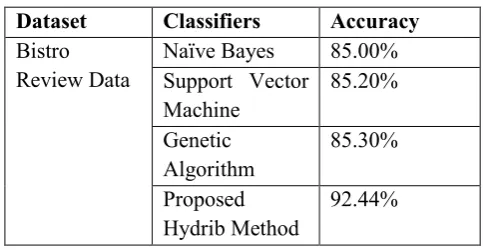
Table 1. The Performance of Base and Amalgam Classifier for Bistro Review Data
Dataset Classifiers Accuracy
Bistro Review Data
Naïve Bayes 85.00% Support Vector
Machine
85.20%
Genetic Algorithm
85.30%
Proposed Hydrib Method
Figure 1. Classification Accuracy of Bistro Review The informational index portrayed in area 2 is being utilized to test the implementation of base classifiers and mixture classifier. Grouping exactness was assessed utilizing 10-overlay cross approval. In the proposed approach, first the base classifiers Innocent Bayes, SVM and GA are built separately to get a decent speculation execution. Besides, the gathering of Credulous Bayes, SVM and GA is planned. In the gathering approach, the last yield is chosen as takes after: base classifier's yield is given a weight (0– 1 scale) contingent upon the speculation execution as given in Table 1. As indicated by Table 1, the proposed crossover demonstrate indicates fundamentally bigger change of characterization precision than the base classifiers and the outcomes are pragmatic to be measurably noteworthy. The proposed outfit of Guileless Bayes, SVM and GA are appeared to be better than individual methodologies for Eatery survey information regarding Characterization exactness.
VII.
CONCLUSION
In this examination, another crossover procedure is researched for Eatery surveys and assessed their execution in radiance of the Eatery audit information and after that characterizing the lessened information by NB, SVM and GA. Next a half and half model and NB, SVM, GA models as base classifiers are planned. At long last, a half and half framework is proposed to make ideal utilization of the best exhibitions conveyed by the individual base classifiers and the mixture approach. The half breed display indicates higher level of arrangement exactness than the base classifiers and improves the testing time because of information measurements lessening.
VIII.
REFERENCES
[1]. A. Abbasi, H. Chen and A. Salem, (2008), "Sentiment Analysis in Multiple Languages:
Feature Selection for Opinion Classification in Web Forums", ACM Transactions on Information Systems, Vol. 26, No. 3, PP.
[2]. Adomavicius, G. ,Tuzhilin, A. (2005), "Toward the next generation of recommender systems: a survey of the state-of-the-art and possible extensions", IEEE Transactions on Knowledge and Data Engineering, Volume 17, Issue 6. [3]. L. Brieman. (1996), "Bias, Variance, and Arcing
Classifiers", Technical Report 460, Department of Statistics, University of California at Berkeley, CA 94720.
[4]. S Chandrakala and C Sindhu, (2012), "Opinion Mining and sentiment classification a survey", ICTACT journal on soft computing, volume: 03, issue: 01, pp. 420-427.
[5]. Freund, Y. and Schapire, R. (1995), "A decision-theoretic generalization of on-line learning and an application to boosting", In proceedings of the Second European Conference on Computational Learning Theory, pp. 23-37.
[6]. Freund, Y. and Schapire, R. (1996), "Experiments with a new boosting algorithm", In Proceedings of the Thirteenth International Conference on Machine Learning, Bari, Italy, pp.148-156.
[7]. Gayatree Ganu, No´emie Elhadad, Am´elie Marian, (2009), "Beyond the Stars: Improving Rating Predictions using Review Text Content", Twelfth International Workshop on the Web and Databases, Providence, Rhode Island, USA [8]. T. Ho, J. Hull, S. Srihari, (1994), "Decision
combination in multiple classifier systems", IEEE Transactions on Pattern Analysis and Machine Intelligence, 16, pp. 66-75.
[9]. Kim S., Han K., Rim H., and Myaeng S. H. (2006), "Some effective techniques for naive bayes text classification", IEEE Transactions on Knowledge and Data Engineering, vol. 18, no. 11, pp. 1457-1466.
[10]. J. Kittler, (1998), "Combining classifiers: a theoretical framework", Pattern Analysis and Applications, 1, pp.18-27.
[11]. L. Larkey, W. Croft, (1996), "Combining classifiers in text categorization", in: Proceeding of ACM SIGIR Conference, ACM, New York, NY, USA, pp. 289-297.
International Conference on Natural Language Processing and Knowledge Engineering (NLP-KE 07), pp. 135-140.
[13]. Michael J. Pazzani and Daniel Billsus, (2007), "Content-Based Recommendation Systems", Lecture Notes in Computer Science Volume 4321, pp 325-341
[14]. Mullen, Tony and Nigel Collier. (2004), "Sentiment analysis using Support Vector Machines with diverse information sources", In Dekang Lin and Dekai Wu, editors, Proceedings of EMNLP, PP. 412-418, Barcelona, Spain. Association for Computational Linguistics. [15]. Nolan Miller, Paul Resnick, Richard Zeckhauser,
(2005), "Eliciting Informative Feedback: The Peer-Prediction Method" management science Vol. 51, No. 9, pp. 1359-1373.
[16]. B. Pang, L. Lee, S. Vaithyanathan, (2002), "Thumbs up? Sentiment classification using machine learning techniques", Proceedings of the Conference on Empirical Methods in Natural Language Processing (EMNLP), pp. 79-86. [17]. Rui Xia, Chengqing Zong, Shoushan Li , (2011),
"Ensemble of feature sets and classification algorithms for sentiment classification", Information Sciences, 181, pp. 1138-1152. [18]. D. Tax, M. Breukelen, R. Duin, and J. Kittler,
(2000), "Combining multiple classifiers by averaging or by mutliplying?", Pattern Recognition, Vol 33, pp. 1475-1485.
[19]. http://www.yelp.com/dataset_challenge/