CSEIT1172542 | Received : 20 Nov 2017 | Accepted : 10 Dec 2017 | November-December-2017 [(2)6: 679-685]
International Journal of Scientific Research in Computer Science, Engineering and Information Technology © 2017 IJSRCSEIT | Volume 2 | Issue 6 | ISSN : 2456-3307
679
Smart & Scalable Cloud Computing: Towards the Green
Initiatives in Education Sector
Ab Rashid Dar
1, Dr.D.Ravindran
2, M.Ramya
31Department of Computer Science, St. Joseph’s College (Autonomous), Tiruchirappalli, Tamil Nadu, India 2Department of Computer Science, St. Joseph’s College (Autonomous), Tiruchirappalli,Tamil Nadu, India 3
Department of Computer Science, Seethalakshmi Ramaswami College, Tiruchirappalli, Tamil Nadu, India
ABSTRACT
Education is the basic need for all mankind and it plays an important role in maintaining the economic growth of any country. The modern day education system where each and every individual is becoming technology oriented, the learning and teaching methods are totally changing at rapid pace which is replacing the traditional education system. Cloud Paradigms with the help of enabling and synergistic technologies are becoming the powerful enabling tools which reform the traditional education system mostly in the countries which are still under devolving phase. The smart classrooms and labs are implemented with virtual reality technique maintaining and managing all the academic programs. The live and deferred teaching sessions now provides the ease to the academicians who stuck in congested traffic or somehow did not attend the classrooms in time. Cloud computing with IoT is changing the ways of the individual’s learning and interactive teaching methods. Here in this paper, discussed the use of cloud computing paradigms as solution for educational system which is having high noticeable impact on new learning and teaching methodologies. Information and Communication Technologies (ICT) are more capable tools for educational setup & infrastructure reform by introducing new methodologies of teaching and pursuing the research as well as provisioning deprovision of educational facilities & services for online learning, teaching and research sharing among all the parties
Keywords: Cloud paradigms, Internet of Things, Traditional, Education sector, I CT.
I.
INTRODUCTION
The educational system nowadays is experiencing the new change and expanding the both interactive learning and teaching methodologies, from the basic primary level education to the higher education, the learning and teaching experience is now totally different than the traditional ways of teaching and learning. Advancement in the information technologies are evolving at rapid pace, the traditional educational system is gradually changing into modern day teaching and learning trends. The latest technologies like IoT, the classrooms with Virtual reality are giving more and more tools to the individuals which are the part of the education system. It is essential to adopt the new teaching and learning tools in order to overcome the traditional means of educational system. The new methodologies make it interesting for every individual whether a student or a teacher as the learning and
Paradigms. Different educational software and tools should be made available with great ease to access them. It is the need of the hour that government should invest in it and provide the most interactive learning IT infrastructure and high quality softwares which can act as an intermediate to share the information all over the internet in a distributed manner. Providing such high quality, improved & more dynamic means of education not only going to benefit the students but will automatically check the necessities of the educational institutions to look after their academic attendance, their current achievements & involvement in extra curriculum activities. This technology provides the access to any vital information of their interest by using the portable or unportable devices remotely across the globe in a distributed manner. By using the different deployment models of cloud computing along with the IoT will ensure the better facilities & services if the institutions are having less resources.
II.
CLOUD COMPUTING
NIST definition, ―Cloud computing is a model for enabling ubiquitous, convenient, on-demand network access to a shared pool of configurable computing resources (e.g., networks, servers, storage, applications, and services) that can be rapidly provisioned and released with minimal management efforts or service provider intervention. Cloud Computing is a recent and most emerging as computational model in information sector. The services and applications are accessible to the different clients using proper internet protocols and internet network standards. Cloud computing is becoming a highly demanded utility due to its versatile nature like availability, scalability , flexibility, high computing power, cost effective services, better performance & ease to access the resources with minimal cost & efforts.
III.
CLOUD SERVICE MODELS
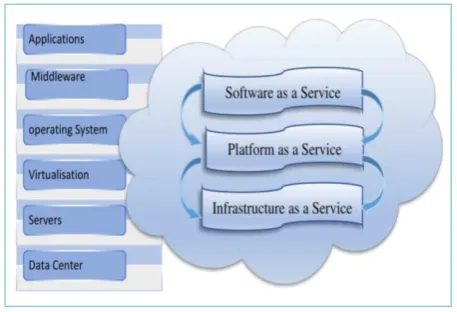
A. Software as a Service
Application is hosted as a service to users and are provided the access to cloud through internet connection. Users can have access to their applications anywhere on the go with high speed internet connection. Client uses the service provider’s applications running on cloud infrastructure, applications are designed for end-users, delivered and managed by vendor, delivered across the internet.
Some of the examples of Software as a Service include, Google Apps, innkeypos, Quickbooks Online, Limelight Video Platform, Salesforce.com, and Microsoft Office 365, Gmail.
B. Platform as a Service
It is a delivery application model that offers resources required to build applications and services with internet without bothering to purchase them. Usually the software programmers and different information service providers adopt this platform on commercial scale basis, try to gain the market and concentrate on get more and more money by publishing the advertisements and attract the cloud users to buy their developed applications and services. The developers develop their software application and deploy these on cloud platform without the cost and trouble. Examples of Platform as a Service are Amazon Elastic Beanstalk, Cloud Foundry, Heroku, Force.com, Engine Yard, Mendix, Google App Engine, Microsoft Azure and OrangeScape
C. Infrastructure as a Service
The hardware tools and software applications needed for the clients are offered by the vendors as Infrastructure as a Service and users can run anything they like on cloud platform. It offers them the necessary resources like server space, CPU cycles, network equipments, memory and storage to the users on rent basis, pay as per their requirement and acquire only desired resources. It can be obtained as public or private infrastructure or a combination of the two. Examples of IaaS are as, Amazon Elastic Compute Cloud (EC2), Eucalyptus, GoGrid, FlexiScale, Linode, RackSpace Cloud, Terremark.
IV.CLOUD DEPLOYMENT MODELS
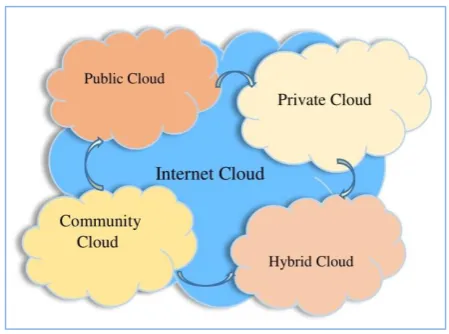
A. Public Cloud Public
Clouds are made available to the general public by a service provider who hosts the cloud infrastructure. Generally, public cloud providers like Amazon AWS, Microsoft and Google own and operate the infrastructure and offer access over the Internet. With this model, customers have no visibility or control over where the infrastructure is located. It is important to note that all customers on public clouds share the same infrastructure pool with limited configuration, security protections and availability variances.
B. Private Cloud
It is cloud infrastructure dedicated to a particular organization. Private clouds allow businesses to host applications in the cloud, while addressing concerns regarding data security and control, which is often lacking in a public cloud environment. It is not shared with other organizations, whether managed internally or by a third-party, and it can be hosted internally or externally.
C. Hybrid cloud
It is a composition of two or more clouds (private, community or public) that remain unique entities but are bound together offering the advantages of multiple deployment models. In a hybrid cloud, you can leverage third party cloud providers in either a full or partial manner; increasing the flexibility of computing [3, 1]. Augmenting a traditional private cloud with the resources of a public cloud can be used to manage any unexpected surges in workload.
D. Community
It is a multi-tenant cloud service model that is shared among several or organizations and that is governed, managed and secured commonly by all the participating organizations or a third party managed service provider. Community clouds are a hybrid form of private clouds built and operated specifically for a targeted group. These communities have similar cloud requirements and their main purpose is to work in co-ordination or collaboration to achieve their business objectives.
Figure 2. Cloud Deployment Models
IV.
CURRENT TRADITIONAL SCENARIO OF
EDUCATION SYSTEM
V.
THE NEED OF CLOUD COMPUTING IN
EDUCATION SYSTEM
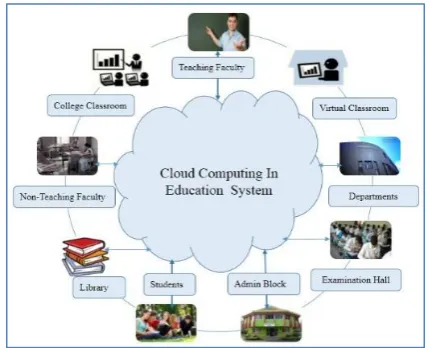
Cloud Computing comes with immense potential to provide unlimited number of services and facilities to the cloud users with minimal efforts and costs. Cloud being dynamic, flexible, elastic and agile in nature, it can be accessed on the go with. With high-speed internet connection users can be connected with cloud, will have access to its resources any time. Cloud Computing technology brings new life to the education domain in its different aspects, its emergence make the academic so enrich and interactive, reshaped the classrooms worldwide, The learning and teaching methods with the advancements in Cloud technologies is totally revolutionized the education sector. It enhance the system to deliver the more with its potential to information, redefine and reshaped the information communication structure. Cloud possess the vast benefits and delivers the powerful computing resources on demand basis and pay as you grow, so users had nothing to worry about paying for unused services. It had its impacts on every aspect of mankind and education sector is no significant one. Monitoring of the resources and assets becomes much systematic & sophisticated. As shown in the given diagram the every individual in the educational institute are interlinked with each other and share the resource of common interest. Teachers can upload their study materials or any related content on Education cloud and student can access these materials and content on the go with 24/7 hours availability with better services and facilities like as;
a.Storage:It is no more a limitation when clients are using cloud platform and don’t have to buy now the blocky and costly hardwarical components like servers and storage devices etc. Cloud users have access to the unlimited storage capability. When the demand arise, users can add or remove the resources at any point of time.
b.Capability: When the demand arise, users can add or remove the resources at any point of time. c.Backup and Disaster Recovery: The days of tape
back-up where users used to store and save their vital data are no longer existing. The cloud vendors provide their users platforms and comfort to back up their vital data, at any point of disastrous
situations, the vendors offer them the ease to recover their lost data any time.
d.Mobility provides the cloud the “on the go” feature. It makes cloud easy to operate from anywhere on the globe and clients can access their applications and other resources from various devices like smart phones, tabs, desktops etc. e.Cost Efficiency Cost is one of the constraints that
abide the clients to use and access the IT resources like storage, servers, and network. But since the advancement of cloud computing paradigm the Clients can use software or applications, with minimal service charges. It’s because cloud computing offers the most exciting feature as multi-tenancy, service level agreement and also cloud also offers some of open source products. f.Availability Cloud possesses the property of being
available 24X7 hours. The availability feature makes cloud every organizations their first choice to run their business. The e-commerce organizations like Amazon, Flipkart etc. are dependent on the availability of cloud.
Figure 3. Cloud Education
VI.
CLOUD COPUTING CHARACTERISTICS
a.On Demand Self Service: Cloud Computing allows the users to use web services and resources on demand. One can logon to a website at any time and use them.
b.Broad Network Access: Since cloud computing is completely web based, it can be accessed from anywhere and at any time.
can share single physical instance of hardware, database and basic infrastructure.
d.Scaling of resources: means the ability of resources to deal with increasing or decreasing demand. The resources being used by customers at any given point of time are automatically monitored.
e.Measured Service: In this service cloud provider controls and monitors all the aspects of cloud service. Resource optimization, billing, and capacity planning etc. depend on it.
VII.
ADVENTAGES OF CLOUD IN ACADEMICS
The introduction of cloud computing in education sector is proving to be fruitful in different ways as;
i. Mobile Learning: It makes teaching/learning experience much sophisticated, Student involvement, availability of resources & simplified methods of teaching/learning processes.
ii. Online Academies and Open Education Platforms: The advancement in cloud computing technology is reflected in the emergence of online academies and open education platforms that enable students to enroll specific courses remotely. It provides fun, enjoyment, entertainment, Convenience & experience to explore more online.
iii. Language Learning: To learn the languages of different regions, states, nations cloud computing is the best platform to learn them. Mobile applications hosted on cloud and social networks have raised language learning onto a new level, enabling students to get in touch with native speakers and gain first-hand insight into other cultures. Specific areas of language proficiency such as casual communication and pronunciation can now be more efficiently practiced outside of a brick-and-wall classroom through different language learning applications, language forums and Skype. iv. Scaling Up-Down of Resources: the most
advantageous feature of using cloud computing in academics is that the resource provisioning & de-provisioning as up to the user.
VIII.
CLOUD EDUCATIONAL INSTITUTIONS
Some of the leading cloud service providers have recognized the importance of adjusting their computing services specifically to the needs of educational institutions. These are customized & utility and affordable software packages that more institutions can avail them.
i. Microsoft for Education: Microsoft Office 365 Education, a cloud-based communication and collaboration tool is currently used by 110 million students, faculty and staff.
ii. Google Apps for Education: Google Apps for Education is a widely used platform for outsourcing free web-based email, calendar and documents for collaborative study.
iii. AWS in Education: The global community of AWS education services has reached the number of 2,400 schools in 2013 and is continued process
iv. Chromebooks for Education: is one of the most important Google’s projects aimed at education innovation. Malaysian Ministry of Education has recently joined the project and introduced 4G high-speed internet access and Samsung Chromebooks in 10,000 national schools in 2013 and is still continued process.
IX.
TRADITIONAL TEACHING-LEARNING
METHOD & CONSEQUENCES
wild life as well, cutting the trees destroy their habitat which compel them to move towards the human colonies. To overcome this problem of concern Cloud Computing offers the solution, by implementing the Cloud Education. It offers lot of benefits & opportunities whether it is an educational or an ecommerce organization. Every nations Government should implement this technology in order to stop the deforestation in future, with this paper consumption will be minimized to the maximum. The old age traditional way of teaching-learning can be eradicated by availing the cloud education facilities. All academic records like students details and faculty profile, departments, library resources need to be data hosted & published on Cloud platform. The augmented applications, 3D virtual teaching classrooms, live chat and interactive sessions, Internet of Things with versatile features are the means to replace the heavy weighted school bags that are bowing down the shoulders of the young budding and grooming kids.
X.
SMART E-BOARD TEACHING/LEARNING
METHODS REPLACING WHITE CHALK
BLACK BOARD
The white chalk & blackboard teaching method is the oldest & most widely used method of teaching/learning. It has its advantages as well as disadvantages too. One among the all is that it is having health hazardous issues on both tutor & learner, it is not an ecofriendly method. To overcome the flaws in this method of learning/teaching Smart e-Boards are proving to be the much beneficial. It is smart & stylish, with finger print sensors both tutor & learner make most out of it. This method is transforming classrooms, enabling students to sit at their desks and stay connected with the teacher, as well as the entire class, with interactive whiteboards.
Figure 4. Smart e-Board Teaching/Learning
XI.
CONCLUSION
The involvement of distributed technologies has revolutionized the each & every aspect of mankind especially education & e-commerce sector. Cloud computing is one of the major innovations that entered worldwide classrooms in recent years and is being used to replace the traditional methods of teaching and learning. Educational institutions can acquire most of the benefits from cloud computing paradigm, it allows to access the work and progress on the go anywhere and anytime and can share the vital information among all the participants. Modernizing learning methods and techniques with the help of latest technologies in classrooms which encourage students to develop and enhanced their learning skills to be successful in every aspect of life, it provides the knowledge necessary for achieving their academic and professional goals. By this approach it is clear that how important, valuable and worthy cloud platforms are for education sector to make it much interactive and easily accessible to everyone with minimal cost. From this perspective it quite clear not only is cloud important in education sector but it enlightens the every aspect of mankind like the business and trade sector, many e-commerce sites like amazon, flipkart are dominating in the field of commerce sector, the shopping is becoming nowadays quite easy people buy online rather than going outside with minimal cost. However “everything glitters is not the gold”, adaptation of Cloud Computing in Education Sector arises some of the challenging and key issues like Security & Privacy, Service Quality, Performance, and Integration which are not yet being handled and managed systematically. It is the need of an hour, researchers have to come up with best proposals and solutions which can enhance and improve Cloud Computing adoption and implementation in Education Sector
XII.
REFERENCES
[1]. Ms.Tanvi Desai, Ms.Rikita Patel and Mr.Parvin Patel,"Cloud Computing in Education Sector", IJIRST –International Journal for Innovative Research in Science & Technology, Volume 2, Issue 10, 2016, pp.192-194
[3]. Kiran Yadav,"Role of Cloud Computing in Education", International Journal of Innovative Research in Computer and Communication Engineering, Volume 2, Issue 2, 2014, pp-3108-3112
[4]. Ab Rashid Dar, Dr.D.Ravindran," Survey on Scalability in Cloud Environment", International Journal of Advanced Research in Computer Engineering & Technology, Volume 5, Issue 7, 2016, pp.440-445
[5]. M.Kriushanth, L.Arockiam and G.Justy Mirobi ,"Auto Scaling in Cloud Computing: An Overview", International Journal of Advanced Research in Computer and Communication Engineering Volume 2, Issue 7, 2013, pp.2870-2875
[6]. Rumana Javali,"Cloud Computing in Education System", International Journal of Advanced Research in Computer Science and Software Engineering, Volume 6, Issue 10, 2016, pp.189-192
[7]. Chetan Bulla, Basavaraj Hunshal and Sankalp Mehta,"Adoption of Cloud Computing In Education System: A Survey", IJESC, Volume 6, Issue 6
[8]. Kumar, A.Dalvin Vinoth, PD Sheba Kezia Malarchelvi, and L.Arockiam."CALDUEL: Cost and Load overhead Reduction for Route discovery in LOAD Protocol", Advances in Computer and Computational Sciences.Springer, Singapore, 2017, pp.229-237.
[9]. Whitepaper by http://www.crucial.com.au.
[10]. https://www.tutorialspoint.com/cloudcomputing