Hydra: A Modal Logic Tool for Wordnet Development, Validation and
Exploration
Borislav Rizov
Department of Computational Linguistics, Institute for Bulgarian Language, Bulgarian Academy of Science 52 Shipchenski prohod, building 17, Sofia 1113, Bulgaria
Abstract
This paper presents a multipurpose system for wordnet (WN) development, named Hydra. Hydra is an application for data editing and validation, as well as for data retrieval and synchronization between wordnets for different languages. The use of modal language for wordnet, the representation of wordnet as a relational database and the concurrent access are among its main advantages (Rizov, 2006).
1.
Introduction
Concurrently with wordnets’ development for a great vari-ety of languages, several tools for WordNet have been de-signed such as Princeton viewer(Miller et al., 1990), Word-Net viewer/editor VisDic1, and lately DebVisDic. At the same time, with the development of the Bulgarian word-net - BulNet 2, the need for a more powerful application for wordnet development enabling specific tasks related to the consistency and completeness of the wordnet database arose. Existing systems have grown inadequate in some very important respects: Application programing interface (API) for WordNet processing that uses abstract language independent of the data representation, multiple-user con-current access, automatic consistency checks. Beside the above features Hydra supports other user requirements in-cluding optimization of visualization of data and relations between certain portions of data, as well as enhancement of editing, undo/redo functions, etc. The system has the following features:
• library for wordnet processing that includes:
– search engine working with WN modal language. It supports regular expressions.
– objects that represent entities in the wordnet structure such as synsets and literals.
– objects representing the relations between the above entities. All these objects have the appro-priate interface for the modification of a wordnet structure.
• innovative recursive view/editor
• tree view, which is an enhanced version of the tree view in VisDic
• multiple-user concurrent access for editing and brows-ing any number of monolbrows-ingual wordnets
• verifications for data consistency during editing
• parametrized common lookups
1
http://nlp.fi.muni.cz/projekty/visdic/ 2http://dcl.bas.bg/wordnet en.html
• synchronization
• undo/redo of the users operations
Tasks other than editing are reduced to retrieving a set of objects that satisfy a certain property. Provided that a prop-erty is definable as a formula in the modal language de-scribed below, the system determines all the objects in the WordNet structure validating the formula, and hence the property. Hydra’s language is based on the language pre-sented in (Koeva et al., 2004)3. Hydra supports a syn-chronized view of and access to different wordnets through synsets encoding equivalent word senses. This provides ex-ploitation of wordnet as a multilingual multipurpose lex-icon, as well as an explanatory dictionary, a dictionary of synonyms, antonyms, hyperonyms, thematic dictionary, etc. In this respect Hydra may be regarded as a browsable and searchable lexicon user interface.
2.
WordNet
WordNet is a lexical database that organises lexical infor-mation in terms of word meanings (Miller et al., 1990) grouped into sets of strong synonyms, called synsets. Thus, a synset encodes a lexicalized concept and each lexeme denoting the concept (called a literal) is a member of the synset. Each synset is supplied with a gloss (an explana-tory definition), examples of the usage with real language sentences, and possibly with various notes on grammatical, semantic, pragmatic characteristics of the synset or of par-ticular literals. The synsets are interlinked through various conceptual-semantic and lexical relations having different properties. Some of the most prominent are hyperonymy (relation between a superordinate and subordinate concept), meronymy (part-whole relation), antonymy (oppositeness relation), etc. Every synset is supplied with a unique iden-tification key that is identical for equivalent synsets in all languages (Miller et al., 1990).
3.
Modal Language for WordNet
The principal purpose of the modal WordNet language in-troduced here is to provide a clean and uniform formal-ism for expressing complex queries with sufficient
lan-select id from Literal; select id from Synset; select id from Notes;
• LetB ∈
Bili, Bpos, Bdef, Bbcs, Blang , qtype value ∈
B. Forqvaluetype we have:
select id from Synset where type = value;
• LetB∈
Bword, Blemma, Bsense ,qtype
value ∈B. For
qtypevaluewe have:
select id from Literal where type = value;
• Letqvaluetype ∈Bnote. Forq type
valuewe have:
select id from Notes where type = value;
• Let V T be the table presenting the valuation of the variablex, then:
select id from VT;
• We retrieve the universe of the model using the fol-lowing formula:
qLiteral∨qSynset∨qN otes
Let P, Q and R be the translations of the formulaeϕ,
ψand the relationRwhile F is the translation of the above formula (defining the universe). Then we have:
• ¬ϕ
select id from F where not exists
(select 1 from P where P.id = F.id)
• ϕ∧ψ
select P.id from Synset inner join Q
on P.id = Q.id;
• ϕ∨ψ
P union Q;
• hRiϕ
select distinct Rel.id1 as id from Rel inner join P
on Rel.id2 = P.id and rel = R;
ϕ→ψ, ϕ↔ψ,[R]ϕare expressed by means of the already defined formulae.
4.
Novel features of Hydra
4.1. Searching
Hydra has a Searcher with options for searching by for-mula, by literal and by literal using regular expression. With formulae, one may also use regular expressions when providing values for constants. Below is expressed the first of the example queries (RLiteral
qword cat ).
<Literal>word(’cat’)
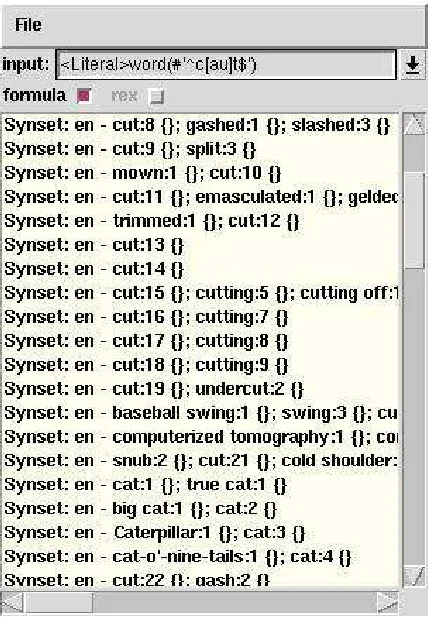
The following formula uses a regular expression4 to find the synsets containing words cat or cut (the use of regular expression is marked with #):
<Literal>word(#’ˆc[au]t’)
Figure 1: Search by a formula using regular expression
4.2. Visualization of WordNet
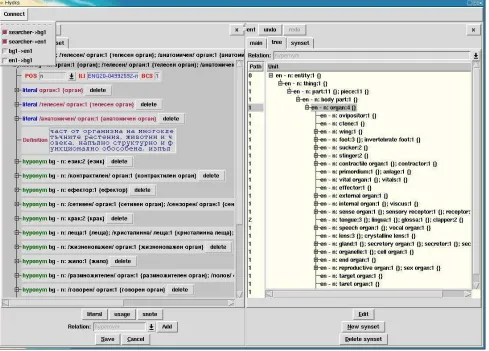
Hydra synchronizes different languages through the synsets encoding equivalent senses. Hydra has several views for the display of LUs in any language. The most sophisti-cated one – MainView provides edit functions over LUs, functions for addition and removal of relations, as well as creation and deletion of LUs and cloning of synsets from other languages available. Edit is performed in a user in-terface which uses both the modal language and SQL. An-other important feature of the tool is the recursive presen-tation of the WordNet relational structure, visualized as a tree structure. Every node of the tree that represents a LU
is expandable (displaying its data and relations). The edges represent the relations between LUs and are named accord-ingly. This view has configurable ’look and feel’ through an XML configuration file (where data and relation can be edited for specifying control type, order and color). Another important view is the TreeView where relations are shown as tree structures. This view visualizes only acyclic relations. LetR be such relation. A successor of a nodel in the tree is each neighbour LU –{x | lRx}. This view contains two columns. The tree on the right side shows LUs, while the left column displays the antecedents of the corresponding LU. If the antecedents of a LU are more than one, the antecedent to be used for the path up-ward can be selected by the user.
The SimpleView displays the characteristic data of a synset to be selected for visualization. The neighbours of the synset are shown, as well.
4.3. Undo/Redo
Hydra has a high quality system for managing user opera-tions in a way that can be easily cancelled and redone.
4.4. Concurrent access
Undo/redo operations complicate the maintenance of con-current access since different users may happen to edit si-multaneously the same objects in the structure. Special strategies are used to take care of such cases. Consistency checks after user’s modifications in the wordnet structure must be made. A database manager is not capable of cop-ing with these problems alone. To this end, in addition to the manager Hydra uses locking of the currently edited LU and its neighbours, and other strategies.
5.
Implementation
The tool is implemented in Python 5. GUI is in Tkinter and Tix. As a platform-independent system, Hydra has been successfully tested under Linux and Windows. The RDBMS used in the implementation is MySQL (¿5.0). Al-most all of the design patterns proposed by GoF (Gamma et al., 1995) are used in the implementation. The result-ing system is a robust and extendable one. Hydra’s data retrieval engine is used in several other applications. UTF-8 database encoding makes Hydra language-independent. The system has been tested successfully on Bulgarian, En-glish and French.
6.
Conclusion
As shown in the present paper, Hydra is an innovative system for managing (development, validation and explo-ration) WordNet database that uses modal logic. Hydra’s development is still in progress. Future work will include exploitation of the propositional variables. One option is for variables to be evaluated over the result of a query. An-other option is for them to be initialized with a value rep-resented by a table (this table may be retrieved outside the system). A Web Interface GUI implementation is also con-sidered.
5http://www.python.org
Hydra is currently used at the Department of computational linguistics, IBL-BAS in the development of the Bulgarian wordnet.
7.
Acknowledgements
I am indebted to my scientific advisor Assoc. Prof. PhD. Tinko Tinchev for the valuable help and comments in my work on Hydra’s design and development, as well as in dis-cussing versions of this paper.
8.
References
E. Gamma, R. Helm, R. Johnson, and J. Vlissides. 1995. Design Patterns: Elements of Reusable Object-Oriented Software. Addison-Wesley.
S. Koeva, S. Mihov, and T. Tinchev. 2004. Bulgarian word-net - structure and validation. Romanian J. Of Inf. Sci. And Technology, 7, No. 1-2:61–78.
George A. Miller, Richard Beckwith, Christiane Fellbaum, Derek Gross, and Katherine Miller. 1990. Introduction to wordnet: An on-line lexical database. International Journal of Lexicography, 3, No 4:235–244.