Classification procedures for software evaluation
Muriel Amar
1, Sophie David
2, Rachel Panckhurst
3, Lisa Whistlecroft
41Urfist de Paris - ´Ecole nationale des Chartes, 17, rue des Bernardins, 75005 Paris, France, 2CNRS UMR 7114, MoDyCo, Universit´e Paris 10, bˆat. L-R12A,
200, av. de la R´epublique, 92001 Nanterre cedex,France,
3Praxiling UMR 5267 CNRS, Universit´e Paul-Val´ery Montpellier 3, 34199 Montpellier cedex 5, France, 4PALATINE, The Great Hall, Lancaster University, Lancaster, LA1 4YW, UK.
E-mail: [email protected], [email protected], [email protected], [email protected]
Abstract
We outline a methodological classification for evaluation approaches of software in general. This classification was initiated partly owing to involvement in a biennial European competition (the European Academic Software Award, EASA) which was held for over a decade. The evaluation grid used in EASA gradually became obsolete and inappropriate in recent years, and therefore needed to be revised. In order to do this, it was important to situate the competition in relation to other software evaluation procedures. A methodological perspective for the classification is adopted rather than a conceptual one, since a number of difficulties arise with the latter. We focus on three main questions: what to evaluate? how to evaluate? and who evaluates? The classification is therefore hybrid: it allows one to account for the most common evaluation approaches and is also an observatory. Two main approaches are differentiated: system and usage. We conclude that any evaluation always constructs its own object, and the objects to be evaluated only partially determine the evaluation which can be applied to them. Generally speaking, this allows one to begin apprehending what type of knowledge is objectified when one or another approach is chosen.
Keywords: Evaluation, Methodological classification, Software, Competitions, TREC, MUC, EASA, Epistemology.
1.
Introduction
Over approximately the past twenty years, the domain of evaluation has attempted to become an independent field, through international conferences (e.g. TREC, Text Re-trieval Conference; MUC, Message Understanding
Con-ference; LREC,Language Resources and Evaluation
Con-ference), competitions (e.g. EASA, European Academic
Software Award (Panckhurst et al. 2004)), publications
(e.g. Sparck-Jones & Gallier, 1996; Chaudiron, 2004), and international agencies (e.g. ELDA, a FrenchAgency
for evaluation & distribution of linguistic resources; NIST
National Institute of Standards and Technology). The
production of new software devices has increased; it has mainly emerged in response to professional demand, e.g. in natural language processing or engineering: spelling and grammar checkers, tokenisers, machine translation sys-tems, voice recognisers, etc.; but technological develop-ments also emerged early on in information retrieval (IR) (Chaudiron, 2004). At the same time, social demands have made it necessary to account for the appropriateness of this research, and evaluation procedures have been de-veloped, thereby extending longstanding traditions of eval-uation principles for software devices both in linguistics and IR (cf. for the first evaluation reports in linguistics and data processing, Bar-Hillel, 1960, ALPAC report, 1966, and for a state of the art historical perspective, Coriet al., 2002, Cori & L´eon 2002). Much work has been done, and evaluation approaches can now be studied as such: i) pro-cedures can be classified, owing to their relative diversity, which is now well-documented; ii) the way to characterise objects to be evaluated can be queried.
This work includes several aims: 1) produce a
classifica-tion, which is methodological in nature; 2) focus on the complex nature of all evaluation approaches; 3) start stipu-lating what type of knowledge is objectified throughout all evaluation approaches.
First, we situate the context of our study (the EASA com-petition, which partly provided the initial impetus at the on-set of our research) and the issues at stake (§2.). Then we defend the relevance of a methodological classification for evaluation approaches of software in general (§3.), before proposing different elements to produce a classification of the most common evaluation approaches (§ 4.). We fi-nally discuss the two fundamental types of approach which emerge from this classification (§5.).
2.
The context
2.1. The EASA Competition
The European Academic Software Award (EASA) was ini-tiated in 1994 and the last competition was held in 2004. It was a biennial competition which was organised by the European Knowledge Media Association (EKMA). Aca-demics and students were able to submit software they had developed which was then evaluated by a team of European jurors. After an expert juror evaluation process of 150 to 200 submissions, 30 to 35 items were selected to proceed to the third and final stage. The finalists’ submissions were evaluated once more and 10 prizes were then allocated to the winners. Over the years some aspects of the evaluation process and criteria became inappropriate or obsolete, due to several factors:
2. objects to be evaluated partially determine the proced-ure which can be applied to them. This is what one can explicitly perceive in the examples associated with the classification, where the same object can be evaluated according to different procedures.
3.
A methodological classification
The classification proposed below (§4.) relies on a meth-odological approach to evaluation. Classifying approaches with different aims does not allow the development of con-ceptual observatories as such. This is due to the fact that: (i) evaluation aims may include differing scientific, social, financial, etc. considerations (Habermas’ (1973) definition of a practice is more relevant here than that of a conceptual domain); (ii) evaluation is applied to fundamentally mul-tidisciplinary objects (in computer sciences, linguistics, IR, communication, learning, etc.). If these objects were con-ceptually characterised, one would have, at best, a set of concepts elaborated in all implied disciplines, but this set could not form an integrated theory. Furthermore, articu-lating the conceptual framework, which produces the data, with the conceptual framework which produces their inter-pretation (see §2.2. for examples) would become neces-sary, which is not a trivial problem; (iii) outside the clas-sification framework, can a specific evaluation be linked with conceptual knowledge? If this is the case, concepts and theories need to be determined; nothing of the kind has been convincingly demonstrated so far, including specific elements of the domain: for instance glassbox/blackbox are not concepts that belong to a particular theory (or the-ories) of evaluation but are only methodological notions. Though it is proposed by many authors (e.g. Sparck-Jones & Gallier, 1996: “this section introduces some basic, gen-eral evaluation concepts” (p. 19); “The main problem in evaluation is finding measures, i.e. concepts which are both instantiations of generic notions and are operable as measures” (p. 20); or Chaudiron 2004, who extends El-lis’ work (1992), by using the term “paradigm”; see also Chaudiron & Mustafa el Hadi, 2007, for usage of this term). It is not sufficient to name a notion a “concept” for it to really become one. The concept would have to be integ-rated into a conceptual network, and be defined according to a “study object”; (iv) the multi-disciplinarity of the ob-jects to be evaluated prevents one from giving a stabilised definition of what could be a “study object” of the eval-uation, in this case as a conceptual discipline. More pre-cisely, a definition of a “study object” as such does not ex-ist, in the way it does in linguistics for instance (“charac-terise ‘language’ in relation to ‘non-language’”, according to Milner’s (1989) research program); or even in inform-ation sciences, where the study object is the study of the “process of research and exploitation of the intentional in-formation” (or “communicated knowledge”, which differs from “news-information”, “data-information” “knowledge-information”, Fondin 2006). For these reasons, could a theory exist, which dominates all other theories implied in both the building of measures and of interpretations? Fa-cing this epistemological issue, we have chosen a stance which solely posits “methodological distinctions”. As these “methodological distinctions” can be applied to allap-proaches, they can be compared. And, as is shown below, methodological questioning allows the construction of an observatory (Milner, 1989). Three questions are sufficient for classifying the most common approaches (but not for describing each one in detail, but this is not our purpose). These 3 questions are: What to evaluate? How to evaluate? Who evaluates?
4.
Elements of the classification
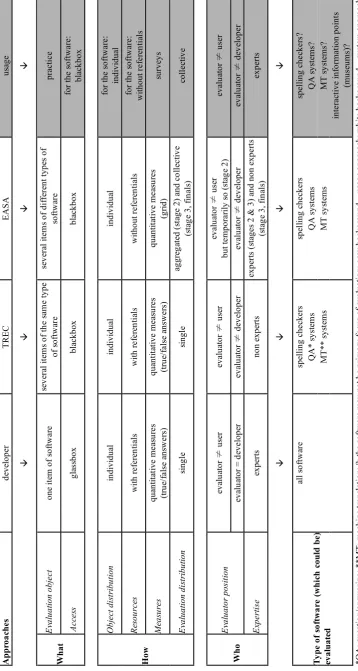
We now review the different elements and sub-elements that we have posited. The general classification appears in Table 1 (see Appendix).
4.1. What to evaluate? 4.1.1. Objects to be evaluated
This indicates whether the evaluation primarily takes into account the software, or primarily considers usage:
1. The objects which are evaluated are items ofsoftware, isolated from their context of use. They may consist of one or several items of software. The latter may consist of the same or different types of software. 2. Another method is centred onusage. The item of
soft-ware is evaluated in its context of use. The evaluation must therefore take into account many other factors, which form a complex device (purpose, users, expect-ations, etc.). Research conducted by Le Marec (2004) on evaluation in the context of museums is an ex-ample. She illustrates how computerised information points in museums are used, and that they are only one factor among many which form a complex device of institutional communication, including: expectations, itineraries, pieces of information appearing near the information points, etc. In actual fact, it may not be the computerised information point as such, which should be evaluated, she stresses, but rather the situation as a whole.
4.1.2. Access
The evaluator engages with different elements of the soft-ware depending on the type of access. Two methods appear:
1. Theglassbox method implies that the evaluator has access to the whole computing process (structure, al-gorithms, programming). It includes detailed eval-uation, and is often accompanied with measures of intrinsic performance of the software. Reasons and causes of errors/bugs are investigated from a com-puter programming perspective. Several key stages are analysed and the results influence later development; consequences are both financial and human. The de-veloper often conducts this sort of evaluation (Falke-dal, 1998).
4.2. How to evaluate?
4.2.1. Object distribution: individual or comparative This refers to the evaluation of multiple items.
1. The items of software are evaluatedone by one. The evaluation procedure (which may be fairly detailed) is applied to each item of software individually. This is the most common method used in competitions (e.g., TREC, MUC, EASA, etc.).
2. The items of software are evaluatedcomparatively, to-gether. A common point of view is established, allow-ing for similarities/differences. This perspective is not detailed and is alwaysad hoc, since it is constructed on the basis of participating items of software (con-sidered in a sense as tokens but not as the instance of a type). Compared to 1), only a small number of items of software may be evaluated. This method is usually used in order to create connections between software developers. For instance, this was the initial frame-work chosen for the evaluation project of information extracting devices (funded by the Agence universitaire pour la francophonie, AUF, Amar & David, 2001).
4.2.2. Resources
This aspect refers to the means used during the evaluation :
1. Referentials are used when stable, consensual and normed knowledge exists, or when expected results can be stated in advance; referentials give a form of ex-ternal calibration (for instance spelling and grammat-ical rules for a spelling and grammar checker). The results produced by the software are considered to be correct or incorrect. This method is often used when ranking of software is required, since the referentials are used to make comparisons between items of com-peting software.
2. No referentials are used when stable and normed knowledge does not exist, or when expected results cannot be stated in advance. This is often the case for situations which are more or less consensual or when one focuses on needs which can change according to differing practice and context. Instructional software may be typical of this sort of approach, but also soft-ware for indexing (Amar & David, 2001) or automatic summarisers, for instance, in which needs change ac-cording to differing practice & context (bibliograph-ical summaries, those produced in academia, firms, etc., Abbou 2000; and for a review Minel, 2004), or machine translation systems (different people, such as engineers, experts, academics, etc. have different needs: translating a word, a sentence, an article, etc.; King & Falkedal 1990; N¨ubel & Seewald, 1998).
4.2.3. Measures
Quantitative vs. qualitative methods can be applied.
1. In quantitative methods, a mark is attributed to evalu-ated aspects (via sets of tests/questions about content, interface ergonomics, etc.). Marks are usually associ-ated with true/false answers or check-boxes on a grid. Quantitative methods are often used in competitions since marks are then ranked. Gold-standard methods
can be included here: the software is measured against a given gold standard (which is established from a set of expected answers).
2. A qualitative method refers to a particular issue; in this instance, a methodology and a questionnaire are often used. The result is usually a report including recom-mendations. This does not mean that all aspects are excluded from any sort of measure, but simply that the measure is never seen to be the final result of the eval-uation (Le Marec, 2004).
4.2.4. Evaluation distribution
This is where we consider the number of evaluations and the ways in which the evaluators work.
1. Single: The software may be evaluated by one evalu-ator.
2. Aggregated: The software may be evaluated by sev-eral evaluators and the evaluation results of the sevsev-eral evaluations combined.
3. Collective: The software may be evaluated by several evaluators who produce a single, agreed or negotiated evaluation.
4.3. Who evaluates?
4.3.1. Position of the evaluator Two positions are differentiated:
1. Evaluator and developer: evaluator and developer (of the object being evaluated) are rarely combined, ex-cept in glassbox methods. In competitions, ethics re-quire these to be two different people.
2. Evaluator and user: (i) if the evaluator observes the user of the software in situation, evaluator and user are never the same person; (ii) the evaluator can tem-porarily adopt the position of user.
4.3.2. Evaluator expertise
Expertise is a complex notion, since one can be an expert in a particular domain (rarely in several), and even within a specific area there are variable degrees of expertise.
1. Non-expert evaluators are often used in methods with referentials, as they are given a set of points which need to be checked and then indicate the answers that match appropriately.
2. Expert evaluators usually intervene in methods with or without referentials, and they judge the qual-ity/relevance of the answer in the given context.
In methods without referentials, expert evaluators will nor-mally be required. However, it may be appropriate for the evaluators to be expert in evaluation but non-expert in the subject domain.
4.4. Conclusion
Our classification in§3. is based on 3 questions (What?,
How?, Who?). Each question consists of different
sub-elements, for which distinct answers can be given. This may lead to a very high number of possibilities, if each combination of parameters is envisaged.
King M., Falkedal K. (1990),«Using Test Suites in Evalu-ation of Machine TranslEvalu-ation Systems»,Coling, vol. 2, 211-216.
Language and Machines. Computers in translation and
linguistics (1966), A report by the Automatic
Lan-guage Processing Advisory Committee (ALPAC), Na-tional Academy of Sciences, NaNa-tional Research Council. Lavenus K., Lapalme G. (2002),«Evaluation des syst`emes de question r´eponse. Aspects m´ethodologiques».TAL :
Probl`emes ´epist´emologiques, 43 (3), 181-208.
Le Marec, J. (2001), «L’usage et ses mod`eles: quelques r´eflexions m´ethodologiques»,Spirale, 28, 105-122. Le Marec, J. (2004), « Les ´etudes d’usage », in
Chaud-iron S. (ed.), Evaluation des syst`emes de traitement de
l’information, Paris : Herm`es, 353-372.
Medida Prix:http://www.medidaprix.org Milner J.-Cl. (1989), Introduction `a une science du
lan-gage, Paris : Le Seuil.
Minel J.-L. (2004), «Evaluation des syst`emes de r´esum´e´ automatique », in Chaudiron S. (´ed.), Evaluation des´
syst`emes de traitement de l’information, Paris : Herm`es,
p. 171-184.
MUC: http://www-nlpir.nist.gov/related_ projects/muc/
N¨ubel R., Seewald-Heeg U. (´eds) (1998),Evaluation of the
Linguistic Performance of Machine Translation Systems,
St-Augustin : Gardez ! Verlag.
Panckhurst, R., David, S., Whistlecroft, L. (Eds), 2004, Evaluation in e-learning: the European
Aca-demic Software Award, Montpellier : Publications
de l’universit´e Paul-Val´ery,http://www.pulm.fr/ evaluation-in-e-learning-easa
Pariente J.-CL. (1973), Le langage et l’individuel, Paris : Armand Colin.
Sparck-Jones K., Gallier J. R. (1996),Evaluating Natural
Language Processing Systems: an Analysis and Review,
Berlin: Springer-Verlag.