A Python Toolkit for Universal Transliteration
Ting Qian
1, Kristy Hollingshead
2, Su-youn Yoon
3, Kyoung-young Kim
4, Richard Sproat
5University of Rochester1, OHSU2, ETS3, UIUC4, OHSU5
[email protected], [email protected], [email protected], [email protected], [email protected]
Abstract
We describe ScriptTranscriber, an open source toolkit for extracting transliterations in comparable corpora from lan-guages written in different scripts. The system includes various methods for extracting potential terms of interest from raw text, for providing guesses on the pronunciations of terms, and for comparing two strings as possible transliterations using both phonetic and temporal measures. The system works with any script in the Unicode Basic Multilingual Plane and is easily extended to include new modules. Given comparable corpora, such as newswire text, in a pair of languages that use different scripts, ScriptTranscriberprovides an easy way to mine transliterations from the comparable texts. This is particularly useful for underresourced languages, where training data for transliteration may be lacking, and where it is thus hard to train good transliterators. ScriptTranscriberprovides an open source package that allows for ready incorporation of more sophisticated modules — e.g. a trained transliteration model for a particular language pair.
ScriptTranscriberis available as part of the nltk contrib source tree athttp://code.google.com/p/nltk/.
1.
Introduction
This paper reports on a toolkit for extract-ing transliteration pairs between scripts called ScriptTranscriber. ScriptTranscriber includes modules for producing guesses at pronunciations for any word in any script in the Unicode Basic Multi-lingual Plane; for computing edit distances between strings using a variety of measures including phonetic distance; for computing time correlations between terms in comparable corpora; and providing a set of prepackaged recipes for mining possible transliteration pairs from comparable corpora. ScriptTranscriber is useful in two major ways:
1. Given comparable corpora, such as newswire text, in a pair of languages that use different scripts, ScriptTranscriber provides an easy way to mine transliterations from the comparable texts. This is particularly useful for underresourced lan-guages, where training data for transliteration may be lacking, and where it is thus hard to train good transliterators.
2. ScriptTranscriber provides an open source package that allows for ready incorporation of more sophisticated modules — e.g. a trained transliteration model for a particular language pair.
ScriptTranscriber consists of approximately 7,500 lines of object-oriented Python. Some of the mod-ules require PySNoW, the Python interface to the SNoW machine-learning package (Carlson et al., 1999) available from the Cognitive Computation Group at the University of Illinois at Urbana-Champaign.1 ScriptTranscriber is available as part of the nltk contrib source tree athttp://code.google.com/ p/nltk/(Loper and Bird, 2002).
1
PySNoW must be downloaded separately fromhttp: //l2r.cs.uiuc.edu/~cogcomp/.
2.
Modules and classes
The modules and classes of ScriptTranscriber are as follows.
First there is the XML document structure mod-ule, an example of which is shown in Figure 1. The top-level XML representation consists of a set of tu-pled documents, ordered according to some reasonable criterion such as time. Each doc element consists of one or more lang elements, which represent the origi-nal document(s) in the named language. Within each
lang are a set of tokens, in no particular order, which represent terms—typically names—that have been ex-tracted during the term extraction phase described be-low, along with a set of possible pronunciations and their counts. Within each doc, the lang elements are intended to consist of terms derived from comparable or parallel texts. For example, in Figure 1 the English document is assumed to be comparable to the Chinese document.
The term extractor class extracts interesting terms from raw text, i.e. terms that are likely to be translit-erated across scripts. We provide five specializations of this:
• A simple capitalization-based extractor that looks for sentence medial capitalized terms if the script supports capitalization; otherwise just returns all terms.
• A Chinese foreign name extractor. This extractor uses a list of characters that are commonly used to transliterate foreign words in Chinese, and ex-tracts sequences of at least three such characters.
• A Chinese personal name extractor. This uses a list of family names to find possible Chinese per-sonal names.
• A katakana extractor, that extracts regions of
com-Figure 1: Sample comparable texts and extracted XML document structure (including just the extracted names) for
ScriptTranscriber.
monly used to transliterate foreign terms in Japanese.
• A Thai extractor. This uses a discriminative model (built using SNoW) to predict word bound-aries in unsegmented Thai text, and then returns all found terms.
Users can easily define their own extractors so that, for example, if they have a good named entity extractor for a language, they can simply define an interface to that as a derived class ofExtractor.
We also provide a morphological analyzer class, a placeholder for a range of possible morphological ana-lyzers. The one provided looks for words that share common substrings and groups them into tentative morphological equivalence classes, along the lines of (Klementiev and Roth, 2006).
Thepronouncermodule provides a number of classes to convert Unicode strings into phonetic strings; the current version of the software uses WorldBet (Hi-eronymus, 1993), an ASCII implementation of the In-ternational Phonetic Alphabet (IPA). There are three specializations of the pronouncermodule provided:
• Unitran (Yoon et al., 2007), which provides guesses on pronunciations for most grapheme code points in the Unicode Basic Multilingual Plane that are also used as scripts for languages. (For
example, the IPA code points are not covered, since IPA is not used as the standard orthogra-phy for any language.) So, for example, Korean
hangul 마 is given pronunciation ma, Cyrillic Ж is given pronunciation Z, and Japanese katakana
マis given pronunciationmA.
• English pronouncer: provides Festival-derived pronunciations (Taylor et al., 1998) for about 2.9 million words.
pro-Figure 3: Interactive use of theScriptTranscribertools. (Note that ’>>>’ is the standard Python prompt. System responses are indented to the left margin. The two script examples are Cherokee and Hanzi.) The Hanzi pronouncer produces one Chinese and one Native Japanese pronunciation guess for the string. It is the Chinese one — lalakwa — that will match with the Cherokee example.
and in Cherokee.
4.
Performance
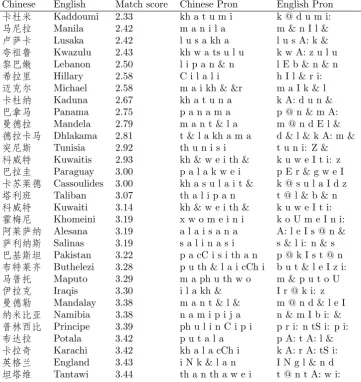
ScriptTranscriber, since it is written in Python is not blindingly fast. To give a sense of the speed we computed comparisons between 10,000 Chinese and English parallel sentences from the ISI Chinese-English Automatically Extracted Parallel Text Corpus (http://www.ldc.upenn.edu/Catalog/ CatalogEntry.jsp?catalogId=LDC2007T09). On an Intel Pentium 1.80GHz Dual CPU with 2G of mem-ory, it takes about 18 seconds to load the sentences, parse the sentences into documents, and run the Chi-nese and English extractors. It takes an additional 22 seconds to compute 16,700 matches (760 matches per second) using the phonetic distance comparator of (Tao et al., 2006; Yoon et al., 2007) between English and Chinese potential transliterations, and extract a total of 320 matches that were above threshold. The top 30 strongest matches from this corpus are given in Table 1.
5.
Summary
This short paper described ScriptTranscriber, an open source Python toolkit for extracting transliter-ation pairs from comparable corpora in languages that use different scripts. It works with any script in the Unicode Basic Multilingual Plane. The object-oriented design of ScriptTranscribermeans that it is easy to extend to incorporate other more sophisticated mod-els. ScriptTranscriber is available as part of the nltk contrib source tree athttp://code.google.com/ p/nltk/
6.
Acknowledgments
Work reported here was partially funded by NBCHC040176 from the US Department of the Interior, a Google Research Award, and the National
Science Foundation under grant #0705708 to the Center for Language and Speech Processing at tne Johns Hopkins University.
7.
References
Andrew Carlson, Chad Cumby, Je L. Rosen, and Dan Roth. 1999. The SNoW learning architecture. Tech-nical Report UIUCDCS-R-99-2101, UIUC CS Dept. Jim Hieronymus. 1993. Ascii phonetic symbols for the
world’s languages: Worldbet.
Alexandre Klementiev and Dan Roth. 2006. Weakly supervised named entity transliteration and discov-ery from multilingual comparable corpora. In Pro-ceedings of COLING-ACL 2006, Sydney, Australia, July.
Edward Loper and Steven Bird. 2002. Nltk: the nat-ural language toolkit. InProceedings of the ACL-02 Workshop on Effective tools and methodologies for teaching natural language processing and computa-tional linguistics, pages 63–70.
Richard Sproat, Tao Tao, and ChengXiang Zhai. 2006. Named entity transliteration with comparable cor-pora. In Proceedings of COLING-ACL 2006, Syd-ney, July.
Tao Tao, Su-Youn Yoon, Andrew Fister, Richard Sproat, and ChengXiang Zhai. 2006. Unsupervised named entity transliteration using temporal and phonetic correlation. InEMNLP 2006, Sydney, July. Paul Taylor, Alan Black, and Richard Caley. 1998. The architecture of the Festival speech synthesis sys-tem. In Proceedings of the Third ESCA Workshop on Speech Synthesis, pages 147–151, Jenolan Caves, Australia.
Chinese English Match score Chinese Pron English Pron
卡杜米 Kaddoumi 2.33 kh a t u m i k @ d u m i:
马尼拉 Manila 2.42 m a n i l a m & n I l &
卢萨卡 Lusaka 2.42 l u s a kh a l u s A: k &
夸祖鲁 Kwazulu 2.43 kh w a ts u l u k w A: z u l u
黎巴嫩 Lebanon 2.50 l i p a n & n l E b & n & n
希拉里 Hillary 2.58 C i l a l i h I l & r i:
迈克尔 Michael 2.58 m a i kh & &r m a I k & l
卡杜纳 Kaduna 2.67 kh a t u n a k A: d u n &
巴拿马 Panama 2.75 p a n a m a p @ n & m A:
曼德拉 Mandela 2.79 m a n t & l a m @ n d E l &
德拉卡马 Dhlakama 2.81 t & l a kh a m a d & l & k A: m &
突尼斯 Tunisia 2.92 th u n i s i t u n i: Z &
科威特 Kuwaitis 2.93 kh & w e i th & k u w e I t i: z
巴拉圭 Paraguay 3.00 p a l a k w e i p E r & g w e I
卡苏莱德 Cassoulides 3.00 kh a s u l a i t & k @ s u l a I d z
塔利班 Taliban 3.07 th a l i p a n t @ l & b & n
科威特 Kuwaiti 3.14 kh & w e i th & k u w e I t i:
霍梅尼 Khomeini 3.19 x w o m e i n i k o U m e I n i:
阿莱萨纳 Alesana 3.19 a l a i s a n a A: l e I s @ n &
萨利纳斯 Salinas 3.19 s a l i n a s i s & l i: n & s
巴基斯坦 Pakistan 3.22 p a cC i s i th a n p @ k I s t @ n
布特莱齐 Buthelezi 3.28 p u th & l a i cCh i b u t & l e I z i:
马普托 Maputo 3.29 m a ph u th w o m & p u t o U
伊拉克 Iraqis 3.30 i l a kh & I r @ k i: z
曼德勒 Mandalay 3.38 m a n t & l & m @ n d & l e I
纳米比亚 Namibia 3.38 n a m i p i j a n & m I b i: &
普林西比 Principe 3.39 ph u l i n C i p i p r i: n tS i: p i:
布达拉 Potala 3.42 p u t a l a p A: t A: l &
卡拉奇 Karachi 3.42 kh a l a cCh i k A: r A: tS i:
英格兰 England 3.43 i N k & l a n I N g l & n d
坦塔维 Tantawi 3.44 th a n th a w e i t @ n t A: w i: