Assigning Connotation Values to Events
Tommaso Caselli
†
, Irene Russo
‡
, Francesco Rubino
‡
Dept. of Chinese and Bilingual Studies† Dip. Linguistica “T. Bolelli”† Istituto di Linguistica Computazionale‡
Hong Kong Polytechnic University Università degli Studi di Pisa CNR Hum Hong, HKSAR Via S.ta Maria, 36 56126 Pisa Via G. Moruzzi, 1 56124 Pisa
E-mail: [email protected], [email protected], [email protected]
Abstract
Sentiment Analysis (SA) and Opinion Mining (OM) have become a popular task in recent years in NLP with the development of language resources, corpora and annotation schemes. The possibility to discriminate between objective and subjective expressions contributes to the identification of a document’s semantic orientation and to the detection of the opinions and sentiments expressed by the authors or attributed to other participants in the document. Subjectivity word sense disambiguation helps in this task, automatically determining which word senses in a corpus are being used subjectively and which are being used objectively. This paper reports on a methodology to assign in a semi-automatic way connotative values to eventive nouns usually labelled as neutral through syntagmatic patterns that express cause-effect relations between emotion cause events and emotion words. We have applied our method to nouns and we have been able reduce the number of OBJ polarity values associated to event noun.
Keywords: cause emotion events, event connotative values, sentiment polarity
1.
Introduction
Sentiment Analysis (SA) and Opinion Mining (OM) have become a popular task in recent years in NLP and a central topic for the management of Word-of-Mouth content in social media. Different language resources (LRs) such as lexica (WordNet-Affect (Valitutti and Strapparava, 2004), SentiWordNet (Esuli and Sebastiani, 2006; Baccianella et al., 2010)), corpora (MPQA corpus (Stoyanov et al., 2004; Stoyanov et al., 2005)) and annotation schemes (Wiebe et al; 2005; Boldrini et al., 2010) have been developed and made publicly available. One of the basic assumptions in this research area is the possibility to discriminate between objective and subjective expressions which contribute to the identification of a document’s semantic orientation (polarity) and, thus, to the detection of the opinions and sentiments expressed by authors or attributed to other participants in the document. Two interesting recent sub-tasks which have been developed in this field are i.) the
detection of the emotion cause event (ECE, Lee et al., 2010; Chen et al., 2010), which focuses on the identification of the phrase (if present) mentioning an event which causes a certain emotional state/response; and ii.)subjectivity word sense disambiguation (SWSD, Akkaya et al. 2009) which aims at automatically determining which word senses in a corpus are being used subjectively and which are being used objectively. The following examples are reported in order to clarify these tasks. Example 1. refers to the first subtask, ECE detection, where the ECE is reported in bold and the associated emotional state initalics; example 2. is taken from Akkaya et al. (2009). The words in bold refer to the word to bedisambiguated and the labels S and O refer to
their subjective or objective word sense.
• Non poteva mancare un accenno alla strage di Bologna, che costringe l' animo a infinita vergogna.
co-occurrence contexts. In addition to this, we have extended this set with a list of 6 intrasentential relevant collocational patterns manually identified on the basis of the authors' judgments which express cause-effect relationships between a nominal cause emotion event and an associated emotion word. In Table 2 we report some the parts-of-speech patterns we have identified. The parts-of-speech abbreviations have been obtained from the Tanl tagset1 , based on the ILC-PAROLE tagset and
conformant to the EAGLES international standard. The elements in brackets are optional, i.e. they do not necessarily has to be in the pattern. In addition to this, notice that to avoid biases on the cause-effect relationship, each pattern specifies the position of the emotion word (SE) and that of the nominal cause emotion
event (sECE).
Extracted patterns
from La Repubblica R S | SSE E SECEECE | S V RI A SE E RI SE ...ECE | SECE E
Manually identified
patterns SSEECE per RD/RI (A) S E/EA S suscitare RI/RD ECE | RD/RI
(A) SE ...
Table 2 – Instances of the extracted syntagmatic patterns
To clarify, we report below some instances of patterns extracted from the La Repubblica corpus:
• amoreS [per]PER laRD musicaS [love for music]
Pattern: SE PER RD SECE
• pauraS delEA terremotoS [fear of the earthquake]
Pattern: SE EA SECE
• laRD morteS diE LazzatiS [ha scuscitato]SUSCITARE unRI grandeA doloreS [the death of Lazzati
caused a big grief]
Pattern: RD SECE E S SUSCITARE RI A SE
4.
Amending SentiWordNet polarity
values
We applied the 53 validated pattens on two Italian corpora La Repubblica and ItaWaC2 (Baroni et al.;
2009) in order to extract contextual data on connotative meaning of events. In this way, we have been able to
1http://medialab.di.unipi.it/wiki/Tanl_POS_Tagset 2http://wacky.sslmit.unibo.it
identify 143 nominal lemmas which represent elegible cause-events of emotions. Since we have used WN-Affect as a starting point, where emotion words are
“classified” as being positive, negative, ambiguous or neutral with no polarity measure, has posed some issues
on the following aspects:
•
dealing with ambiguous emotions: in this case, we will consider the emotion cause event as perfectly balanced between positive andnegative polarity;
•
dealing with neutral emotions: in this case, we will not assign any polarity value and consider the emotion cause event as occurring in aobjective, unemotional context.
In order to use It-SWN as a benchmark test suite and, at the same time, try to contribute to its extensions, we have
developed the following heuristics:
•
we compute the global event polarity by summing the different scores of eventive synsets and dividing it by the number of synsets, as already proposed in Denecke (2008);•
we will assign the obtained polarity value only to those synsets whose supersense(s) corresponds to one of the top eventive four nodes “event”, “act”, “phenomenon” and“state”;
•
a minimum threshold of 10 occurrences of the emotion cause event noun has been set in order to avoid biases due to hapax and idiosyncratic expressions;•
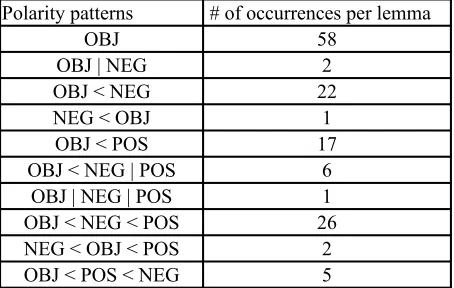
we rescale the polarity values to the measures proposed in SentiWordNet on the basis of the frequency of co-occurrences the emotion cause event with the emotion lemma, following a methods similar to that described in BraaschBy analyzing the polarity patterns and comparing them with their corresponding patterns forms in It-SWN,we have identified the following data:
•
no pattern repeats in either of the two resources. Clearly, such a result could be influenced by the fact that we were extracting data from the corpora by exploiting patterns which specifically identified relations ofcause-effect between an eventive nouns and an emotion keyword. Nevertheless, the OBJ value is still present, thus suggesting that the approach we have adopted, even if not perfect, is correct. As a matter of fact our aim was to improve the polarity analysis of events, so that they could be applied in open domain texts in order to facilitate implicit SA and O.
•
50 new polarity patterns have been identified; these patterns are instances of shifts from pure OBJ pattern in It-SWN to new polarity values which either completely exclude the old OBJ value (e.g. from OBJ to POS) or spread the polarity values along the three classes (e.g.from OBJ to NEG < POS < OBJ);
•
37 polarity patterns have different polarity configurations with respect to the polarity patterns of It-SWN and, at the same time, they have a different hierarchy of the polarity values in the pattern. For instance, the pattern OBJ < POS for the cause emotion noun “sciopero” ischanged to NEG < OBJ | POS.
•
32 polarity patterns have different polarity configurations with respect to the polarity patterns of It-SWN, but at the same time, they reinforce the polarity hierarchy of the NEG and OBJ values. For instance, a pattern like OBJ < NEG < POS is changed to NEG < POS < OBJ.•
1 pattern introduces new polarity values which were not present in It-SWN.The data for the polarity patterns obtained from the
corpus data can be grouped into three groups, namely: a) those which shift the polarity values from OBJ to POS and NEG, thus assigning a strong polarity value to events; b) those which downgrade the OBJ value and at the same time suggest a different configuration, or hierarchy, of the POS and NEG values with respect to the one proposed in It-SWN; and c) those which downgrade the OBJ value and at the same time reinforce the configuration, or hierarchy, of the POS and NEG values. With respect to the data encoded in It-SWN, our resource clearly tends to maximize the polarity values of NEG and POS, thus providing more “opinionated” data. Thus, in the perspective of using It-SWN as test set for the validation of our approach and collected data, we need to keep in mind this aspect. So far, the best conclusion we can draw, is that events do not always have a null polarity value (i.e. OBJ) but are perceived as bearer of polarity, i.e. they have a connotative value. The newly proposed polarity values go in this direction. In addition to this, it is also interesting to point out that, if we exclude the OBJ value, in 32 cases (26.6%) the corpus data are in-line with respect to the values in It-SWN and that in 37 cases (30.8%) there is a shift in the hierarchy of the POS and NEG values, thus suggesting modification to the “weight” of POS and NEG in It-SWN.
Going through the corpus frequency and co-occorrences, it is interesting to observe that on a total of 91,350 occurrences of the syntagmatic patterns for emotion cause events - emotions, the vast majority of them is composed by negative emotions (53,927), followed by positive emotions (31,009), ambiguous emotions (4,958),
and, finally, by neutral emotions (1,256).
5.
Conclusion and future works
This work has described a methodology to assign in a semi-automatic way connotative values to events through syntagmatic patterns that express cause-effect relations between events (emotion cause events. ECEs) and emotion words. At this level of development, we focused on nominal events.
the values NEG and POS. In particular, we have also discovered higher occurrence of negative emotions with respect to positive ones, a trend that should be tested on a
wider dataset.
As future works, we are planning to assign new polarity values to all eventive synsests in It-SWN (including verbs) and run an evaluation experiment on polarity classification by exploiting this newly created resource.
Acknowledgments
This work has been partly supported by the EU FP7 project METANET (grant agreement n° 249119) and the EU Erasmus Mundus Action 2 program MULTI (grant
agreement n° 2009-5259-5).
References
Akkaya C., J. Wiebe, and R. Mihalcea. (2009). Subjectivity Word Sense Disambiguation. Proceedings of
EMNLP 200.
Baccianella S., A. Esuli and F. Sebastiani. (2010). SentiWordNet 3.0: An Enhanced Lexical Resource for Sentiment Analysis and Opinion Mining. Proceedings of the 7th conference on International Language Resources
and Evaluation (LREC 2010), Malta, May 2010.
Baroni M., S. Bernardini, F. Comastri, L. Piccioni, A. Volpi, G. Aston and M. Mazzoleni. (2004). Introducing the la Repubblica corpus: A large, annotated, TEI(XML)-compliant corpus of newspaper Italian. In Proceedings of the 4th conference on International Language Resources and Evaluation (LREC 2004), Lisboa, May
2004.
Baroni M., S. Bernardini, A. Ferraresi and E. Zanchetta. (2009). The WaCky Wide Web: A collection of very large linguistically processed Web-crawled corpora. In Journal of Language Resources and Evaluation 43 (3),
pp. 209-226.
Boldrini E, A. Balahur, P. Martìnez-Barco and A. Montoyo. (2010). EmotiBlog: a finer-grained and more precise learning of subjectivity expression models. Proceedings of the Fourth Linguistic Annotation
Workshop (LAW IV '10).
Braasch, A. & B.S. Pedersen. (2010). Encoding Attitude and Connotation in Wordnets. The 14th EURALEX International Congress, Leeuwarden , The Netherlands.
Chen Y., S.Y.M. Lee, S. Li, and C. Huang. (2010) Emotion Cause Detection with Linguistic Constructions. Proceeding of the 23rd International Conference on
Computational Linguistics (COLING 2010).
Denecke, K. (2008). Using SentiWordNet for Multilingual Sentiment Analysis. IEEE 24th International Conference on Data Engineering - ICDEW
2008.
Esuli, A. and F. Sebastiani. SentiWordNet: A Publicly Available Lexical Resource for Opinion Mining. In Proceedings of the 5th Conference on Language Resources and Evaluation (LREC 2006), Genova, May
2006.
Huang, C. (2010). Emotions as Events (and Cause as Pre-Events). Communication at the Chinese Temporal/discourse annotation workshop, Los Angeles,
June 2010.
Miller, G. (1969). The organization of lexical memory: Are word associations sufficient? In G.A. Talland & N.C. Waugh (eds.), The pathology of memory. New
York: Academic Press, pp. 223-237.
Lee S.Y.M., Y. Chen, C. Huang. (2010). A Text-driven Rule-based System for Emotion Cause Detection. Proceedings of the NAACL HLT 2010 Workshop on Computational Approaches to Analysis and Generation
of Emotion in Text.
Pianta E., L. Bentivogli and C. Girardi. (2002) MultiWordNet: Developing and Aligned Multilingual Database. In Proceedings of the First International Conference on Global WordNet, Mysore, India, January 21-25, 2002, pp. 293-30.
Schulte Im Walde, S. (2008). Human associations and the choice of features for semantic verb classification. Research on Language and Computation, 6(1), pp.
79-111.
Spencer, D. P. and K. C. Owens. (1990). Lexical co-occurrence and association strength. Journal of
Stoyanov, V., C. Cardie, D. Litman, and J. Wiebe. (2004). Evaluating an Opinion Annotation Scheme Using a New Multi-Perspective Question and Answer Corpus. Working Notes of the 2004 AAAI Spring Symposium on Exploring Attitude and Affect in Text: Theories and Applications.
Stoyanov, V., C. Cardie, and J. Wiebe. (2005). Multi-Perspective Question Answering Using the OpQA Corpus.Proceedings of HLT/EMNLP 2005, Vancouver,
Canada.
Strapparava C. and A. Valitutti. (2004) WordNet-Affect: an affective extension ofWordNet". Proceedings of the 4th International Conference on Language Resources and Evaluation (LREC 2004), Lisbon, May 2004.
Wiebe, J., T. Wilson, and C. Cardie. (2005). Annotating expressions of opinions and emotions in language. Language Resources and Evaluation 39 (2-3), pp.165-210.