CSEIT172444 | Received : 12 July 2017 | Accepted : 22 July 2017 | July-August-2017 [(2)4: 135-140]
International Journal of Scientific Research in Computer Science, Engineering and Information Technology © 2017 IJSRCSEIT | Volume 2 | Issue 4 | ISSN : 2456-3307
135
Black Hole Attack Prevention and Detection Solutions on AODV
Routing Protocol in MANET
Pandi Selvam Raman
Assistant Professor & Head, Department of CS & IT, Ananda College, Devakottai, Sivaganga, Tamil Nadu, India
ABSTRACT
Mobile ad hoc network (MANET) is a self-configuring network that is formed via wireless links by a collection of mobile nodes without the help of a fixed infrastructure or centralized management. Securing wireless ad hoc networks is particularly difficult for many reasons including vulnerability of channels and nodes, absence of
infrastructure, dynamically changing topology and etc. Black Hole attack is one of the major attack and this
detection and prevention is still considered as a challenging task in ad hoc networks. Therefore this paper compares various Black Hole attack prevention and detection solutions that are explored recently.
Keywords: MANET, Routing, AODV routing protocol and Black hole attack
I.
INTRODUCTION
A MANET is a self-configuring (autonomous) system of mobile hosts connected by wireless links. The nodes are free to move randomly and organize themselves arbitrarily; thus, the network's wireless topology may change rapidly and unpredictably [1]. An ad hoc network can be set up anywhere without any assistance of external infrastructure like wires or base stations. Networks are formed on-the-fly i.e. devices can leave and join the network during its lifetime. In general, MANET can operate in two modes namely peer-to-peer (communicate directly within their radio range) and multi-hop (communicate via intermediate nodes outside their radio range) [2]. MANETs are used at business meetings and conferences to confidentially exchange data, at the library to access the Internet with a laptop, and at hospitals to transfer confidential data from a medical device to a doctor‟s PDA etc.
Routing is the process of exchanging information from one station to the other stations of the network [3]. It may divide into different aspects. Route construction (topology) based it further divided into three types namely i. Tree based ii. Mesh based and iii. Hybrid. The
tree based routing scheme has single path between the source and receiver. In mesh based approach multiple redundant paths connect the source and the destination. The hybrid approach attempt has been made to combine both the mesh-based and the tree-based approaches.
Based on routing update mechanism protocols are classified as table driven (proactive or pre-computed routing), on-demand (reactive routing) or hybrid. In proactive routing, nodes are continuously evaluate the routes to all reachable nodes and attempts to maintain up-to-date routing information. In reactive nodes do not maintain routing information if there is no communication. In hybrid, the nodes are balanced which delay and overhead of both proactive and reactive [4].
The structure based routing protocols are classified as flat and hierarchical. In a flat structure, all nodes in a network are at the same level and have the same routing functionality. In hierarchical, nodes are dynamically organized into partitions called clusters [5].
Volume 2 | Issue 4 | July-August -2017 | www.ijsrcseit.com
136
much more vulnerable to attack because of its non-trivial challenges such as lack of fixed infrastructure, dynamic topology, link variation and energy constraints. So, each and every node in the network has to prepare for attacks at any point of time. And also as there is no central based controlling identity for the participating nodes; the attacks are much easier to launch in MANET.
Black Hole Attacks are a kind of serious security service where a malicious node advertise itself a shortest path during routing discovery and redirect the data towards malicious node. Malicious node dropped the data or its desired destination instead of original destination.
This paper organized as follows: Section II describes AODV routing protocol. Section III discusses how the Black Hole attacks have an effect on ad hoc network. Comparison of recent researches against black hole attacks on AODV are presented in Section IV followed by conclusions is Section V.
II.
AODV ROUTING PROTOCOL
Ad hoc On-demand Distance Vector (AODV) is one of the most effective routing protocol in MANET [6]. AODV is an On-Demand routing protocol that discovers route only when there is demand from mobile node. AODV uses three control messages. They are
RREQ: Initially when any node wants to communicate
with other node but no any route is available already, the source node starts a route discovery process by flooding a Route REQuest (RREQ) message in the network. This message is broadcasted by each node to its neighbour.
RREP: When node in the network receive RREQ,if it is a destination node or an intermediate node has a valid route to the desired destination, it replies to a RREQ by unicasting a Route REPly (RREP) message back to the source node.
RERR: If a path breaks, the intermediate node
generates a Route ERR or (RERR) message to inform its end nodes of the occurred link break.
The process of route discovery is started with checking route availability. Whenever a packet is to be sent by a node, it first checks with its routing table to determine whether a route to the destination is already available or not. If required path is already available, it uses that route to send the packets to the destination. But if a route is not available or the previously entered route is inactivated, then the node initiates a new route discovery process by flooding RREQ (Route REQuest) packet in network.
Every node (neighbour) that receives the RREQ packet first checks if it is the destination for that packet and if so, it unicast back an RREP (Route Reply) packet. If it is not the destination, then it checks with its routing table to determine if it has got a route to the destination previously. If not, it relays the RREQ packet by broadcasting it to its neighbors. If its routing table does contain an entry to the destination, then the next step is the comparison of the „Destination Sequence‟ number in its routing table to that present in the RREQ packet.
RREQ packet contains the hop count, Source IP and Sequence number, Destination IP and sequence number in its packet format. If the number in the routing table is higher than the number in the packet, it denotes that the route is a „fresh route‟ and packets can be sent through this route otherwise it is outdated route.
The RREP packet gets relayed back to the source through the reverse route. The source node then updates its routing table and sends its packet through this route. During the operation, if any node identifies a link failure it sends a RERR (Route ERRor) packet to all other nodes that uses this link for their communication to other nodes. For such a reporting RERR contains a list of possible neighbors.
Figure1. Illustrates the AODV protocol where S is
source node and D is destination node. First, the
source node S refers to the route map at the start of
communication to check previous available routes. In
case when there is no route to destination node D, it
broadcasts RREQ message. RREQ ID increases one
Volume 2 | Issue 4 | July-August -2017 | www.ijsrcseit.com
137
Figure 1. Working of AODV Routing ProtocolNode A and B which have received RREQ generate
and renew the route to its previous hop. They also judge if this is a repeated RREQ. If such RREQ is
received, it will be discarded. If A or B has a valid
route to the destination D, they send a RREP message
to node S. This process goes on until the packet is
received by destination node. When node D receives
the RREQ, it sends RREP to node S through reverse
path. When node S receives the RREP, then a route is
established. In case a node receives multiple RREPs, it will select a RREP whose destination sequence number (Dst_Seq) is largest among all previously received RREPs. But if Dst_Seq were same, it will select the RREP whose hop count is the smallest because it indicates that particular route have shortest distance towards destination.
III. BLACK HOLE ATTACK
Black hole Attack is a type of Denial of Service Attack. Black hole Attack is a malicious node uses its routing protocol to advertise itself having the shortest path towards destination node. When route is established, then malicious node drops the packets or forwards it to the attacker desired address [7].
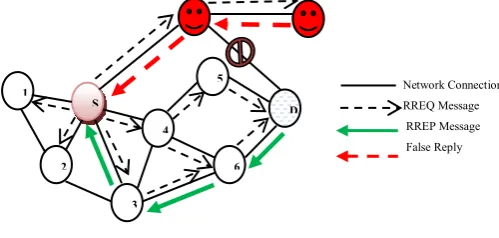
In the Black Hole Attack the attacker must create a RREP with Dst_Seq greater than the destination sequence of the receiver node. The sender node believes that black hole node and further communicates with this black hole node instead of
original destination node. This misbehaving mostly damage nodes interface and hence wasting all resource utilization in addition to losing packets. Black hole Attacks are classified into two categories [8].
Single Black Hole Attack: Single Black Hole attack
uses only single node acts as malicious node within a zone.
Figure 2. Single Black hole attack
Cooperative Black Hole Attack: Collaborative Black
Hole Attack uses multiple nodes in a group act as malicious node to drop all the data packets.
Figure 3. Cooperative Black hole attack
IV. RECENT PREVENTION AND DETECTION
AGAINST AODV ROUTING PROTOCOL
Network Connection RREQ Message RREP Message False Reply 1
S
2
4
6 5
D
3 2
Network Connection RREQ Message RREP Message False Reply 1
S
2
4
6 5
D
Volume 2 | Issue 4 | July-August -2017 | www.ijsrcseit.com
138
SL.NO
AUTHOR PAPER TITLE METHOD NAME DETECTION TYPE TOOL USED REMARKS PUBLICATION YEAR
1
Ayesha Siddiqua
et. al.[9]
Preventing Black Hole Attacks in MANETs Using
Detection NS-2.35
Ensure data delivery to receiver node and finds packet drop reasons before declaring node
as a black hole node. attack and its
performance
Detection NS-2.35
Malicious Node Detection for AODV (MDSAODV) checks route reply against fake
reply Hole Attack in
AODV using
Detection EXata-cyber
Node defines a trust value for its neighbor node and inserts a timer
with each data packet.
2015
Information Cooperative Detection Opnet 14.5
Source node checks the Next_Hop_Node and Previous_Hop_Node of the RREP in order to check the malicious nodes in the
path. 2015 Effects of Black hole Attacks on AODV Routing
Detection NS-2
Modified the AODV routing protocol by ignoring the first RREP
packet reaching the source node
Function Cooperative Detection NS-2
First RREP reject from its neighbor and will
select the second optimal path
Detection NS-2.35
Individual nodes monitor the routing behavior of
their neighbors for detecting run-time violation of the
specifications Drop Attacks in Mobile Ad-hoc
Detection - node from the network Finds packet dropper 2014
10 with TrueLink in
MANET
Detection NS-2
True-Link-crosschecking method is designed to isolate and mitigate the effect of black
hole
attack.
Volume 2 | Issue 4 | July-August -2017 | www.ijsrcseit.com
139
IV. CONCLUSION
Mobile Ad-hoc network (MANET) is one form of temporary network which may get unprotected under different types of attacks. Black hole attack is a type of attack still which is an active research field. Therefore, this paper compared a few existing solutions of Black Hole Attack in AODV protocol. The researchers have considered many detection and prevention techniques for black hole attack whether single or cooperative. These solutions are discussed and compared with each other based on various metrics.
V.
REFERENCES
[1] Ram Ramanathan and Jason Redi, “A Brief
Overview of Ad hoc Networks: Challenges and
Directions,” IEEE Computer Magazine, pp.20-22,
2002.
[2] Sheltami, Tarek, “Ad hoc Network Overview,”
http://www.ccse.kfupm.edu.sa/~tarek, Ad hoc network Technology, 2003.
[3] Changling Liu and Jorg Kaiser, “A Survey of
Mobile Ad hoc Network Routing Protocols,”
Univ. of Ulm, Tech. Rep.Series, 2005.
[4] Krishna Gorantala, “Routing Protocols in Mobile
Ad hoc Networks,” Master Thesis in Computing
Science, Umea University, Sweden, 2006.
[5] Geetha Jayakumar, and G. Gopinath, “Ad Hoc
Mobile Wireless Networks Routing Protocols –
A Review,” Journal of Computer Science 3 (8),
pp.574-582, 2007.
[6] S. Kalwar, "Introduction to reactive protocol,"
Potentials, IEEE, vol. 29, pp. 34-35, 2010.
[7] Ranjan, Rakesh, Nirnemesh Kumar Singh, and
Ajay Singh. "Security issues of black hole attacks
in MANET." Computing, Communication &
Automation (ICCCA), International Conference
on. IEEE, 2015.
[8] Kishor Jyoti Sarma, Rupam Sharma, Rajdeep
Das, “A Survey of Black Hole Attack Detection in Manet.” IEEE, 2014
[9] Ayesha Siddiqua, Kotari Sridevi, and Arshad
Ahmad Khan Mohammed. "Preventing black hole attacks in MANETs using secure knowledge
algorithm." Signal Processing and
Communication Engineering Systems (SPACES), 2015 International Conference on. IEEE, 2015.
[10] Miss Bhandare A. S., and S. B. Patil. "Securing
MANET against Co-operative Black Hole Attack and Its Performance Analysis-A Case Study."
Computing Communication Control and
Automation (ICCUBEA), International
Conference on. IEEE, 2015.
[11] Nidhi Choudhary, and Lokesh Tharani.
"Preventing black hole attack in AODV using
timer-based detection mechanism." Signal
SL.
NO
AUTHOR PAPER TITLE METHOD NAME DETECTION TYPE TOOL USED REMARKS PUBLICATION YEAR
11 attack in Mobile Ad hoc Network Using AODV method of clock synchronization
Cooperative
Detection NS-2.34
The time sequence of internal and external clock
compared with standard threshold time clock.
2014
Discovery Detection Single NS-2
Verify the sequence numbers in the RREQ and RREP messages based on defined thresholds before establishing a connection.
2013
Detection NS-2.34
Neighbors node maintains two counters Forward count-fcount and Receive Count-rcount for forwarded
packets and number of received packets
respectively
Volume 2 | Issue 4 | July-August -2017 | www.ijsrcseit.com
140
processing and communication engineeringsystems (SPACES), International conference on. IEEE, 2015.
[12] Ali Dorri and Hamed Nikdel. "A new approach
for detecting and eliminating cooperative black
hole nodes in MANET." Information and
Knowledge Technology (IKT), 2015 7th Conference on. IEEE, 2015.
[13] Ashish Kumar Jain and Vrinda Tokekar.
"Mitigating the effects of Black hole attacks on AODV routing protocol in Mobile Ad hoc
Networks." Pervasive computing (ICPC), 2015
international conference on. IEEE, 2015.
[14] Anand A.Aware and Kiran Bhandari.
"Prevention of Black hole Attack on AODV in
MANET using hash function." Reliability,
Infocom Technologies and Optimization (ICRITO)(Trends and Future Directions), 2014 3rd International Conference on. IEEE, 2014.
[15] Kriti Patidar and Vandana Dubey. "Modification
in routing mechanism of AODV for defending
blackhole and wormhole attacks." IT in Business,
Industry and Government (CSIBIG), 2014 Conference on. IEEE, 2014.
[16] Vishvas Kshirsagar, Ashok M. Kanthe, and Dina
Simunic. "Analytical approach towards packet drop attacks in mobile ad-hoc networks."
Computational Intelligence and Computing Research (ICCIC), 2014 IEEE International Conference on. IEEE, 2014.
[17] Gayatri Wahane, Ashok M. Kanthe, and Dina
Simunic. "Detection of cooperative black hole attack using crosschecking with truelink in
MANET." Computational Intelligence and
Computing Research (ICCIC), 2014 IEEE International Conference on. IEEE, 2014.
[18] Harsh Pratap Singh and Rashmi Singh. "A
mechanism for discovery and prevention of coopeartive black hole attack in mobile ad hoc
network using AODV protocol." Electronics and
Communication Systems (ICECS), 2014
International Conference on. IEEE, 2014.
[19] Seryvuth Tan and Keecheon Kim. "Secure Route
Discovery for preventing black hole attacks on
AODV-based MANETs." High Performance
Computing and Communications & 2013 IEEE International Conference on Embedded and Ubiquitous Computing (HPCC_EUC), 2013 IEEE 10th International Conference on. IEEE, 2013.
[20] Durgesh Kshirsagar and Abhijit Patil. "Blackhole
attack detection and prevention by real time
monitoring." Computing, Communications and