Research Article
STANDARDIZATION, DEVELOPMENT AND VALIDATION OF SPECTROPHOTOMETRIC
METHOD FOR SIMULTANEOUS ESTIMATION OF EMBELIN AND GALLIC ACID AS INDIVIDUAL
AND IN COMBINATION IN AYURVEDIC CHURNA FORMULATION
IMRAN KHAN PATHAN*
1, RAKESH K PATEL
2, ANIL BHANDARI
3.
1Dept. of Pharmacognosy, Faculty of Pharmaceutical Sciences, Jodhpur National University, Jodhpur. 2Dept. of Pharmacognosy, SKPCPER,
Ganpat University, Mehsana, Gujarat, 3Dept. of Pharmachemistry, Faculty of Pharmaceutical Sciences, Jodhpur National University,
Jodhpur. Email: [email protected]
Received: 7 September 2013, Revised and Accepted: 28 September 2013
ABSTRACT
Objectives: A new simple spectrophotometric method for simultaneous estimation of Embelin and Gallic Acid in Vidang, Harade and Vidangadi Churna was investigated. The λmax of Embelin and Gallic Acid were found to be 341 and 258 nm.
Method: The graphical absorbance ratio method was used for simultaneous estimation of Embelin and Gallic acid in Vidangadi Churna, and the Isoabsorbtive point for simultaneous estimation of both the drug were found to be 307.5 nm. The method obeys Beers law in the concentration range from 2-12 μg/ml. The correlation coefficient was found to be 0.9973 for Embelin and 0.998 for Gallic Acid. The method was validated as per ICH guidelines.
Results: The result of estimation of Embelin in Vidang, Gallic acid in Harade and both in Vidangadi Churna were found to be 1.05 %, 1.04 %, and 1.85. The proposed method was validated for linearity, accuracy and application for assay as per ICH guidelines.
Conclusion: The study showed good reproducibility and recovery with % RSD less than 2. So, the proposed method was found to be simple, specific, precise, and accurate. Hence it can be applied for simultaneous estimation of Embelin and Gallic Acid in various Ayurvedic Ch urna formulations.
Keywords: Embelin, Vidang. Gallic Acid, Harade, Vidangadi Churna.
INTRODUCTION
Vidangadi Churna is well known Ayurvedic preparations mentioned in the chapters Krimicikitsa of the Ayurvedic literature – Cakradatta
for the treatment of Krimiroga. The usefulness of this formulation is mentioned in the sloka 7 of the Krimicikitsa.
Ayurvedic data base gives information about botanicals that can be used as single drug in natural form or in processed form. It also gives wide range of multi-ingredients combination comprising of simple mixture to complex processed dosage form. Although, modern medicine prefers uses of pure material which has distinct advantages of known it helps in knowledge precise dose response relationship[2]. These formulations are very popular in India. The
growth of the herbal medicine and food supplements has been very impressive worldwide and quite phenomenal. The share of Indian herbal medicinal plants and Ayurvedic formulations in the world market is very unimpressive. This is due to a number of laps like, the active compounds responsible for the proposed activity are not properly identified, there is no uniformity in the process of manufacturing, no SOPs are available for production and validation of formulation and important one is the formulation part, which is almost untouched. The Present study was based on the development and Validation of a simple spectroscopic method for the simultaneous estimation of Embelin and Gallic Acid in Vidang, Harade and Vidangadi Churna. Embelin is (2,5-dihydroxy-3-undecyl-1,4-benzoquinone) an active constituent of the Vidang and Gallic Acid (3,4,5-trihydroxybenzoate) having potent anthelmintic and purgative properties. The Chemical Structure has shown in figure 1 and 2.
Figure1: Chemical Structure of Embelin
R = (CH2)10-CH3
EmbelinR = (CH2)8-CH3
HomoembelinR = (CH2)12-CH3
RapanoneFigure 2: Chemical Structure of Gallic acid
MATERIALS AND METHODS
Powdered sample of Vidang and Harade, were procured from the well known Ayurvedic drug supplier, Ms. L. V. Gandhi & Sons, Ahmedabad (Sample-I). Vidang and Harade were also procured from other reputed herbal drug supplier, Ms. Sanjivani Ausadhalay, Bhavnagar (Sample-II). The raw material was authenticated at Government Ayurved College, Junagadh, Gujarat. Standard Embelin and Gallic acid were obtained from department of Pharmacognosy SKPCPER, Ganpat University, Mehsana. Spectroscopic grade methanol was purchased from Merck India Ltd. Analysis was performed on a Double Beam UV-Vis. Spectrophotometer CE7400 Cecil, UK and the detection was carried out at 258, 307.5 and 341 nm.
STANDARDIZATION OF RAW MATERIAL
Methodology
Foreign Matter [1-4]
100 gm sample of the powdered plants material was spread in the thin layer and sorted for foreign matter in to groups by visual inspection, using a magnifying lens (10X). The remainder of the sample was shifted through a 250 # sieve. Dust was regarded as mineral admixture. The portion of this sorted foreign matter was calculated as the content of each group in gram per 100 gm of air dried sample. Results are given in table no. 1.
Loss on Drying [1-4]
Vol 6, Suppl 5, 2013 ISSN - 0974-2441
O
O OH R O
To estimate the loss on drying, 5 gm of the air dried powdered plant
Table1: Foreign matter and loss on drying of Vidang and Harade
S.no Name of Drug Foreign Matter
3 gm of the ground air material was taken and accurately weighed, in a previously changed and tared crucible (silica). The material was placed in an even layer and ignited by gradually increasing the heat to 500-600 o C until it appeared completely white, indicating the
absence of carbon. The material called ash was cooled in a desiccator and weighed. Again the residue was moistened with about 2ml of water and dried on a water bath, then on a hot plate and ignited to constant weight. The residue was cooled in a desiccator for 30 minutes and then weight. Without delay, the content of total ash was determined with respect to air-dried plants material. Results are given in table no. 2.
Acid insoluble ash
To the crucible containing the total ash 25 ml of 2N HCl was added, covered with a watch glass and boiled gently for 5 minutes. The watch glass was rinsed with 5 ml hot water and washing was added to the crucible. Insoluble matter was collected on an ash less filter paper and washing of this filter paper was carried out with hot water until the filtrate was remaining neutral. The filter paper was containing the insoluble matter was transferred to the original crucible, which is then dried on a hot plate and ignited to constant weight. Allowed the residue to cool in a suitable desiccator for 30
minutes, and then weight without delay. The content of acid- insoluble ash was calculated with respected to the weight of air-dried powdered plants material. Results are given in table no. 2.
Water-soluble ash
To the crucible containing total ash, 25 ml water was added and boiled for 5 minutes. Insoluble matter was collected on an ash less filter paper. The residue was washed with hot water and ignited in a crucible for 15 minutes at a temperature not exceeding 450 oC. The
weight of the residue was subtracted front hr weight of total ash. The content of water soluble ash was determined with respect to the weight of the air-dried powdered plant material. Results are given in
table no. 2.
Determination of Extractives [1-4]
Hot extraction with water (Water soluble extractives)
Accurately weighted 4 gm of coarsely powdered air-dried material was taken in glass Stoppered conical flask. One hundred ml of distilled water was added and weight to obtain the total weight including the flask. The flask was shaken well and allowed to stand for 1 hour. The content was refluxed for one hour and then cooled and weighed. The weight was readjusted to the original total weight with distilled water. The flask was shaken well and filtered rapidly through dry filter paper. Transferred 25 ml of the filtrate to a tared flat bottomed dish and evaporated to dryness on a water bath and then dried at 105 oC for 6 hour. The extract was cooled in a
desiccator for 30 minutes and weighed without delay. Percent water soluble extractive value was calculated with respect to the weight of the air dried material.
Cold maceration with ethanol (Alcohol soluble extractives)
Accurately weigh 4.0 gm of coarse air dried powdered material was taken in glass Stoppered conical flask. The content was macerated Table 2: Ash Value and Extractive Value of Vidang and Harade
S.no Name of Drug Ash Value (% w/w) Extractives (% w/w) Total Acid insoluble Water soluble Water Soluble Ethanol Soluble
1. Vidang Sample-1 3.7 0.65 1.66 10 14.2
Sample-2 4.1 0.66 2.85 9.2 13
2. Harade Sample-1 4.8 0.33 0.61 59 44.1
Sample-2 5.1 0.42 0.72 60 46.2
Phytochemical Investigation [2]
All the drugs samples were extracted three times with methanol and all the extracted were combined and concentrated. all the extract were subjected to various qualitative tests for the identification of
various plants constituents like alkaloids, Glycosides, Volatile oil & fixed oils, Tannins & Phenolics compounds, amino acids and protein, steroids Carbohydrates and sugar and Flavonoids present in this species as per guideline8. Results are given in table no. 3
Table3: Phytochemical Investigation of Vidang and Harade
S.no Test for Phytoconstituents Name of tests Vidang Harade
1.
Alkaloids
Dragandroff’s ++ --
Mayer’s ++ --
Glycosides
Anthraquinones
glycosides -- ++ --
Saponin glycoside ++ ++ --
8. Flavanoids Shinoda test -- --
Present “+, ++, +++”, Absent “-“
TLC Identity test [6]
TLC identity of all four raw materials was carried out to detect the presence of active markers in the samples. TLC study was carried out on precoated aluminium backed silica gel 60 F254 plates. (E.Merck). the spot of the extract and standard was applied using Linomate –IV spotter (Camag). The prepared mobile phase was allowed to saturate the chamber for 30 min. The chromatographic conditions applied for TLC development are as follow.
TLC chromatographic Condition for Vidang [9]
Mobile Phase : n- Propenol: n- Butanol: 4N ammonia (7:1:2)
Standard Solution : Embelin dissolved in methanol
Test sample : Powder drug of Vidang was extracted with methanol
Detection : (A) Normal Light
(B) UV 254 nm (Short)
(C) UV 365 nm (Long)
Sample ID : ‘E’ for standard Embelin and ‘V’ for Vidang powder.
Results are given in figure no 3 and Rf Value in table no. 4
TLC chromatographic Condition for Harade [10]
Mobile Phase : Toluene: Ethyl acetate: Formic acid: Methanol (6:6:1.8:0.25)
Standard Solution : Gallic acid dissolved in methanol
Test sample : Powder drug of Harade was extracted with methanol
Detection : (A) Normal Light
(B) UV 254 nm (Short)
(C) UV 365 nm (Long)
Detecting reagent : 5% Fecl3 in methanol
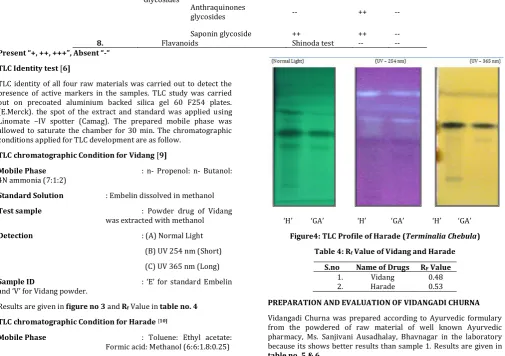
Sample ID : ‘GA’ for standard Gallic acid & ‘H’ for Harade powder
Results are given in figure no 4 and Rf Value in table no. 4.
‘E’ ‘V’ ‘E ‘V’ ‘E’ ‘V’
Figure3: TLC Profile of Vidang (Embelia ribs)
‘H’ ‘GA’ ‘H’ ‘GA’ ‘H’ ‘GA’
Figure4: TLC Profile of Harade (Terminalia Chebula)
Table 4: Rf Value of Vidang and Harade
S.no Name of Drugs RF Value
1. Vidang 0.48 2. Harade 0.53
PREPARATION AND EVALUATION OF VIDANGADI CHURNA
Vidangadi Churna was prepared according to Ayurvedic formulary from the powdered of raw material of well known Ayurvedic pharmacy, Ms. Sanjivani Ausadhalay, Bhavnagar in the laboratory because its shows better results than sample 1. Results are given in
table no. 5 & 6
Preparation of Vidangadi Churna [12]
Formula:
1. Vidanga (Fruit) -20 gm
2. Kampilaka (hairs in the fruit) -20 gm
3. Haritaki (fruit pulp) -20 gm
4. Sindhava -20 gm
5. Yavaksara -20 gm
Table 5: Physicochemical parameter of Vidangadi Churna
S.no Physicochemical Parameters
Name of Parameters
Vidangadi Churna (%w/w) 1. Foreign Matter --- 2.10
2. Loss on Drying --- 2.50
3. Ash Value
Total 46.12 Acid insoluble 1.30 Water soluble 40.0
4. Extractives Value Water soluble 58 Alcohol Soluble 28
Table 6: Phytochemical Investigation of Vidangadi Churna
S.no Test for Phytoconstituents Name of tests
Vidangadi Churna
1.
Alkaloids
Dragandroff’s +
Mayer’s +
2.Phenolics compounds and
tannins
Ferric
chloride +++ Lead acetate +++
4.Protein Biuret test --
5.Steroids
Liebermann –Burchard test
--
6.Carbohydrates and sugars Molish’s test --
7.
Glycosides
Cardiac
glycosides -- -- Anthraquinones
glycosides + --
Saponin
glycoside + +
8. Flavanoids Shinoda test +
Present “+, ++, +++”, Absent “-“
The fruit of Vidang and Harade and the glandular trichomes of Kamala are cleaned, dried and powered separately and passed through 60 # sieve. These three powders are mixed well in equal proportions and then fine powders of Sindhava and Yavaksara are added, all the ingredients are mixed uniformly.
Method Development for Simultaneous Estimation of Embelin and Gallic Acid as Individual and In Combination in Vidangadi Churna by Spectrophotometric Method[13]
Preparation of stock solution and determination of absorption maxima of Embelin and Gallic acid in 7.4 Phosphate buffer solution.
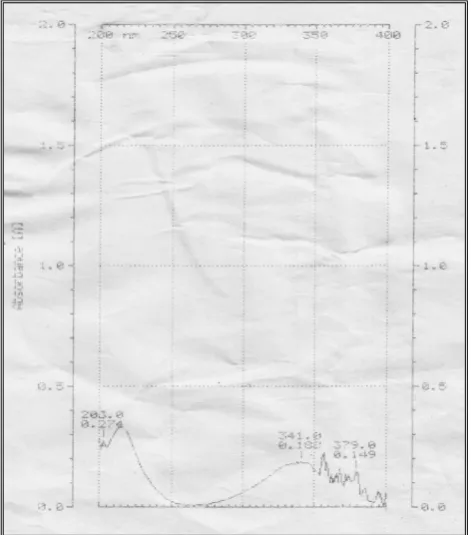
10 mg of each Embelin and Gallic acid was dissolved in 1 ml of methanol and q.s. to 10 ml with 7.4 Phosphate buffer solutions. 1 ml of this solution was further diluted to 10ml in volumetric flask with 7.4 Phosphate buffer solutions. This was serving as a standard stock solution (100µg/ml). The spectrum of the Embelin and Gallic acid was obtained by scanning this solution in the range of 200 nm- 400 nm against 7.4 Phosphate buffer solution as blank to fix absorption maxima. The graph so obtained was shown in figure 5, 6 and 7.
Figure 5: UV Spectrum of Standard Embelin in 7.4 PBS
Figure 6: UV Spectrum of Standard Gallic acid in 7.4 PBS
Figure7: UV Spectrum of Isoabsorbtive point of Standard Embelin and Gallic acid in 7.4 PBS
Construction of calibration curve
Table 7: Calibration curve data for standard Embelin and Gallic acid
S. No. Conc. (µg/ml) Absorbance* Embelin Gallic acid
1. 2 0.15 0.1
2. 4 0.22 0.153
3. 6 0.29 0.21
4. 8 0.35 0.268
5. 10 0.4 0.335
6. 12 0.47 0.4
Mean Of Triplicate*
Figure 8: Calibration curve of Standard Embelin in 7.4 PBS at 341 nm
Figure9: Calibration curve of Standard Gallic acid in 7.4 PBS at 258 nm
Beer’s law data and Regression characteristic (optical Parameters)
The data for molar absorptivity, Beer’s law limit, slope, intercept and correlation coefficient are shown in table 8.
Table8: Beer’s law data and Regression characteristic for standard Embelin and Gallic acid in 7.4 PBS
S.
no. Parameters
Values
Embelin Gallic acid 1. Beer’s law limit 2-12 (g/ml) 2-12 (g/ml)
2. Molar absorptivity 9126.4 (lit. gm1 cm-1)
5103.6(lit. gm-1
cm-1)
3. Regression equation
(Y = a + bc)
0.0314x + 0.0933
0.0301x + 0.0339
4. Correlation
coefficient (r2) 0.9973 0.998
5. Slope (b) 0.0933 0.0339
6. Intercept (a) 0.0314 0.0301
Preparation of Test solution
The 5 gm of Vidangadi Churna and 5 gm each Vidang and harade, were powdered and extracted three times with 100 ml of methanol. The extract were combined and concentrated at reduce temperature
(50o C) on water bath up to 100 ml. The 10 mg of dry extract of each
was dissolved in 7.4 Phosphate buffer solution and absorbance was taken.
Estimation of Embelin and Gallic acid as individual and in combination in Vidangadi Churna, Vidang and Harade (Application of developed method)
The absorbances of test solutions were taken at 258, 341 and 307.5 with 7.4 PBS as blank. The amount of Embelin and Gallic acid were calculated from using calibration curve of Embelin, Gallic acid and Isoabsorbtive point in 7.4 PBS. The result so obtained was shown in
table 9.
Table 9: Estimation of Embelin and Gallic acid as individual and in combination in Vidangadi Churna, Vidang and Harade
S.no. Sample Amount in (% w/w) Embelin Gallic acid 1.Vidangadi
Churna 1.85 1.85
2.Vidang 1.05 ---
3.Harade --- 1.04
VALIDATION OF DEVELOPED METHOD ACCORDING TO I.C.H. GUIDELINES
Following parameters were taken into consideration for validation of developed method.
Linearity
An aliquot of concentration of 2-12 µg/ml were prepared. The linearity was calculated by the Least Square Regression Method.
Precision
Repeatability
The precision of method was assessed by carrying out six replicate determination of artificial mixture of standard Embelin and Gallic acid at a concentration of 8 µg/ml in 7.4 Phosphate buffer solution. The data of repeatability are shown in table. 10.
Intraday precision
For Intraday precision of the method, solution of artificial mixture of standard Embelin and Gallic acid were prepared at three concentration levels 6.4, 8.0, 9.6 (µg/ml) each in triplicate. These solutions were analyzed three times within one day. The results of intraday precision are shown in table 10.
Interday precision
For Interday precision of the method, solution of artificial mixture of standard Embelin and Gallic acid were prepared at three concentration levels 6.4, 8.0, 9.6 (µg/ml) each in triplicate. These solutions were analyzed for three consecutive days. The results of interday precision study are shown in table 10.
Limit of Detection (LOD)
The limit of detection was calculated by using following equation
LOD = 3.3 /S
The results of limit of detection are shown in table 10.
Limit of Quantification (LOQ)
The limit of Quantification was calculated by using following equation
LOQ = 10 /S
The results of limit of quantitation are shown in table 10.
Accuracy
prepare the sample matrix of the blank drug. Again 10 ml of sample was taken in three, 100 ml volumetric flasks. To these three flasks 6.4, 8.0 and 9.6 ml of standard stock solution of artificial mixture of standard Embelin and Gallic acid was added and volume was made
up to 100 ml. The absorbance of sample matrix and after standard addition was measured in triplicate. The recovery data are shown in
table 10.
Table10: Validation Parameters for artificial mixture of standard Embelin and Gallic acid in 7.4 Phosphate Buffer Solution at 307.5 nm and 341 nm
S.no Repeatability (% RSD)
Intraday (Mean % RSD)
Interday (Mean % RSD)
LOD (µg/ml)
LOQ (µg/ml)
Accuracy (% Recovery) 307.5 341 307.5 341 307.5 341 307.5 341 307.5 341 307.5 341
1. 1.78 1.38 1.18 1.62 1.01 0.937 0.027 0.033 0.084 0.102 98.75 to 100.10 98.75 to 100.10
RESULT AND DISCUSSION
A simple, selective, accurate, precise spectroscopic method for simultaneous estimation of Embelin and Gallic acid in Vidang, Harade and Vidangadi Churna has been developed and validated. The linearity range in the concentration range of 2-12μg/ ml (r2═
0.9973 and 0.998 for Embelin and Gallic Acid). It indicated that the concentrations of artificial mixture of standard Embelin and Gallic Acid had good linearity. The amount of Embelin and Gallic acid in Vidang, Harade and Vidangadi Churna were calculated as1.05%, 1.04% and 1.85%. The LOD and LOQ were found to be (0.027, 0.033μg/ ml) and (0.084 and 0.102) respectively. Further the precision of the method was confirmed by the repeatable analysis of solution. The % RSD was found to be (1.78 and 1.38) %. It indicated that the method has good precision. The percentage recovery was found to be in the range of 98.75 – 100.10 %. Hence, the accuracy of the method was confirmed.
CONCLUSION
The proposed method is simple, accurate, precise and selective for the estimation of Embelin and Gallic Acid in Vidang, Harade and Vidangadi Churna. The method is economical, rapid and do not require any sophisticated instruments contrast to chromatographic method. Hence it can be effectively applied for the routine simultaneous analysis of Embelin and Gallic Acid in various Ayurvedic formulations contains both.
ACKNOWLEDGEMENTS
The authors would like to acknowledge the staff and management of the Faculty of Pharmaceutical Sciences, Jodhpur National University for providing all the facilities to carry out the present research work.
REFERNCES
1. T.E. Wallis, “Text book of Pharmacognosy”, 15th ed. CBS
Publisher & Distributors, New Delhi, 578.
2. Khandelwal K.R. “Practical Pharmacognosy: Techniques and Experiments”, Nirali Prakashan 162.
3. Anonymous, “The Ayurvedic Pharmacopoeia of India”, Part-I, Vol.-Part-I, 1st ed. Govt. of India, Ministry of Health and Family
Welfare, 1986, 123 and 137.
4. Anonymous, “Quality Control Methods for Medicinal Plant materials”, 1st Indian ed. 2002, world Health Organization,
Geneva.
5. Anonymous, “Indian Herbal Pharmacopoeia 1996”, Part-II Appendix-3 Govt. Of India, Ministry of health and family welfare, A-34.
6. Mukherjee P.K., “Quality Control of Herbal Drugs” Business Horizons, New Delhi, India, 2005, 183.
7. Khandelwal K.R. “Practical Pharmacognosy: Techniques and Experiments”, Nirali Prakashan 157.
8. Khandelwal K.R. “Practical Pharmacognosy: Techniques and Experiments”, Nirali Prakashan 149.
9. Anonymous, “Indian Herbal Pharmacopoeia”, Indian Drug Manufacturer’s Association, Mumbai, 2002, 206.
10. Mukherjee P.K., “Quality Control of Herbal Drugs” Business Horizons, New Delhi, India, 2005, 741.
11. Anonymous, “Quality Standards of Indian Medicinal Plants”, Vol-I, Published by Indian Council of Medicinal Research, 2003, 205.
12. Anonymous, “The Ayurvedic Formulary of India”, Part-II, Govt. of India, Ministry of Health and Family Welfare, Dept. of Indian Systems of Medicine and Homeopathy, New Delhi, 128.
13. Rubesh Kumar S*, Ram Kishan J,Venkateshwar Roa K.N, Duganath N, R. Kumanam “Simultaneous Spectrophotometric Estimation of Curcuminoids and Gallic Acid in Bulk Drug and AyurvedicPolyherbal Tablet Dosage Form” International Journal of Pharmaceutical Quality Assurance 2010; 2(1): 56-59.