An LDA-based Topic Selection Approach to Language Model Adaptation
for Handwritten Text Recognition
Jafar Tanha, Jesse de Does and Katrien Depuydt Institute for Dutch Lexicology (INL)
[email protected], {jesse.dedoes, katrien.depuydt}@inl.nl
Abstract
Typically, only a very limited amount of in-domain data is available for training the language model component of an Hand-written Text Recognition (HTR) system for historical data. One has to rely on a combination of in-domain and out-of-domain data to develop language models. Accordingly, domain adaptation is a cen-tral issue in language modeling for HTR. We pursue a topic modeling approach to handle this issue, and propose two algo-rithms based on this approach. The first algorithm relies on posterior inference for topic modeling to construct a language model adapted to the development set, and the second algorithm proceeds by iterative selection, using a new ranking criterion, of topic-dependent language models. Our experimental results show that both ap-proaches clearly outperform a strong base-line method.
1 Introduction
Huge amounts of handwritten historical docu-ments are nowadays being published by on-line digital libraries as document images. The content of these documents is of great interest to histori-ans, linguists and literary scholars alike. How-ever, if the transcription of the documents is not available for information retrieval, we can hardly consider this content to be accessible for research. Full manual transcription is slow and costly, but the development of efficient and cost-effective ap-proaches for the indexing, search and full tran-scription of historical handwritten document im-ages can benefit from modern Handwritten Text Recognition (HTR) technology (S´anchez et al., 2013).
An indispensable component of state-of-the-art HTR is language modeling (Pl¨otz and Fink, 2009)
(Espana-Boquera et al., 2011), which is neces-sary to guide the decoding process by ranking and constraining the possible recognition hypotheses. Language modeling has proven extremely suc-cessful in improving results of Automatic Speech Recognition (Chelba et al., 2012), which is a very similar task from the technical point of view. Highly effective language models in this field have been developed from huge language corpora. cf. for instance (Chelba et al., 2012). Language mod-els are usually constructed from large text cor-pora which – ideally – are in-domain, linguisti-cally close to the language of the document col-lection which is being processed. However, for HTR of historical documents, obtaining effective models is much less straightforward: models built from the strictly in-domain data are generally un-satisfactory because not enough data can be ob-tained to avoid overfitting, and in order to exploit the larger pool of out-domain data one has to sur-mount two difficulties: (1) indiscriminate use of
out-of-domaindata may not benefit, in fact even deteriorate system performance and (2) the use of the complete out-domain data for training may in-crease the complexity of the system, making the decoding process almost untractable (Axelrod et al., 2011; Tanha et al., 2014).
The above-mentioned issues are typically dealt with by usingdomain adaptationtechniques (Ax-elrod et al., 2011) (Foster et al., 2010) (Jiang and Zhai, 2007), which aim to leverage the knowledge that can be obtained from the out-of-domain data by tuning it to the in-domain data.
In this paper, we study the application of topic modeling-based approaches to the task of im-proving the language modeling component of the HTR system by domain adaptation. Our approach is characterized by the combination of the topic modeling approach withintelligent sample selec-tion methods. We first propose a Latent Dirich-let Allocation (LDA)-based language model
tation framework (Blei et al., 2003). We then develop an algorithm for language model adap-tation using the result of topic modeling and a new language model ranking criterion to select the most relevant topics. In our experiments, we use theTRANSCRIPTORIUMHTR engine described in (S´anchez et al., 2013) on a set of digitised images of manuscripts written by the 18th and early 19th-century British philosopher Jeremy Bentham1. We show that our techniques improve the performance of the HTR system. Besides producing an adapted language model, the proposed methods also re-duce the computational resources needed to ex-ploit a large amount of out-domain data in the de-coding process of the HTR system.
The rest of the paper is organised as follows. We refer the reader to related work in section 2. Our approaches to sample selection are described in detail in section 3 and evaluated in section 4. Results are reported in section 5. Section 6 ad-dresses the discussion and conclusion.
2 Related Work
Statistical language models assign probabilities to sequences of words. Typically, the probability of a word is estimated on the basis of a limited his-tory, consisting of some fixed number n of pre-ceding words. This has the drawback that long-range dependencies cannot be exploited. Sev-eral approaches have been proposed to overcome this problem, such as Cache-based (Kuhn and De Mori, 1990) or Trigger-based (Lau et al., 1993) language models.
Taking into account that a language model built for domain-specific data can give low perplexity, topic modeling can be a promising approach for language model adaptation. A language model training corpus may contain many topics. As a re-sult, the corpus can be divided into topic-specific subcorpora. The distribution of topics in the cor-pus may be determined manually, or by automatic, unsupervised techniques. A practical approach to language modeling will have to rely on the latter approach.
The leading paradigm in unsupervised topic modeling is Latent Dirichlet Allocation (LDA) (Blei et al., 2003). LDA and similar approaches can be used for the language model adaptation 1Images and transcriptions have been produced in the Transcribe Bentham project (Moyle et al., 2011), http://www.ucl.ac.uk/transcribe-bentham
problem. There are several studies for language model adaptation using LDA models. In (Liu and Liu, 2008) a new mixture topic model is proposed for LDA based language model adaptation. Hsuet al.(2006) proposed a method for adaptation using hidden Markov model with LDA model. In (Ei-delman et al., 2012) LDA model is used to com-pute topic-dependent lexical weighting probabil-ities for domain adaptation. Iyer et al. (1996) used a clustering approach to build topic clusters for language model adaptation. In (Bellegarda, 2000) Latent Semantic Analysis is applied to map documents into a topic space for language model adaptation. Gildea et al. (1999) proposed a lan-guage model adaptation approach using the prob-abilistic extension of LSA (pLSA). In (Tam and Schultz, 2005), an LDA model is applied to lan-guage model adaptation. This method interpolates the background language model with the dynamic unigram language model generated by the LDA model. Heidelet al.(2007) applied an LDA-based topic inference approach to language model adap-tation.
As mentioned in the introduction, the main characteristic of our approach is that we use topic modeling in conjunction with Intelligent sample selection techniques. Unlike current approaches, like (Liu and Liu, 2008) (Eidelman et al., 2012), which use all documents of each topic for adapta-tion, we select the most relevant resources. In this way, language model adaptation yields a model that matches better to the domain, but also reduces the computational complexity of the HTR system by producing more compact language models.
More specifically, we propose an iterative ap-proach to language model adaptation using LDA modeling. Since perplexity does not always corre-late well to the recognition accuracy of the HTR system, we use a new criterion for related topic selection using the combination of the perplexity and the size of out of vocabulary of the documents. We then use a topic mixture approach for language model adaptation.
3 Topic Modeling for Language Model Adaptation
3.1 LDA Models and Language Model Adaptation
The frequency distribution of words in text is highly dependent on the “topic” of the text. A topic model captures this intuition in a mathe-matical framework, and allows discovering a set of topics from a collection of documents. Blei
et al. (2003) introduced a new approach, Latent Dirichlet Allocation (LDA). LDA is a generative approach characterized by the topic-word distribu-tion φand the topic distribution θfor each docu-ment. This method imposes a Dirichlet distribu-tion on the topic mixture weights corresponding to the documents in the corpus. Figure 1 shows the graphical representation of the LDA model, where
α is the parameter of the Dirichlet prior on the per-document topic distribution, Dis the number of documents,β is the parameter of the Dirichlet prior on the per-topic word distribution,θdis the
topic distribution for documentd,N is the number of words in documentd zd,nis the topic for thedth
word in documentn, andwd,nis the specific word.
wd,n
zd,n
θd
α
β
D N
Figure 1: The graphical representation of LDA.
In order to apply topic-based language model-ing, we need to be able to determine the topic distribution for an unseen document (topic infer-ence). We use the collapsed variational inference method (CVB) for LDA (Mukherjee and Blei, 2009) in our experiments.
3.2 Problem Formulation
In this paper, we use topic modeling to identify relevant resources for language model adaptation. We assume a partition (B0, B1) of the in-domain corpusB, see Figure 2. In the setting of handwrit-ten text recognition, B0 could for instance be the HTR training set or some other portion of a tran-scribed corpus, andB1 is the rest of the text. We then useEcorpus as a general large out-of-domain corpus. Our goal here is to find an informative subsetE1of resources from theEcorpus, which is
relevant to theB0collection, and to exploit this for domain adaptation.
The adapted language model can be then ob-tained as follows: for a word sequenceW, let
P(W) =λB0PB0(W) +λB1PB1(W) +λE1PE1(W) (1)
whereλB0, λB1andλE1 are interpolation weights. We use theSRILMtoolkit (Stolcke et al., 2011) to find the optimal values for the weights in equation (1).
In (1) the third term is the resulting adapted lan-guage model, which we formulate as:
PE1(W) = ΣK 0
i=1γiPzj(wi|wi−ni−1+1) (2)
whereγiis the mixture weight andK0is the
num-ber of relevant topics to the domain (K0 K).
Based on this formulation, we propose two algo-rithms to handle the equation (2).
B0
B1
E
E1
E1
E1
Figure 2: Resource situation consisting of in-domain corporaB0andB1and out-of-domain cor-pusE. The aim of intelligent sample selection is to pick out the informative bitsE1fromE.
3.3 LDA Inference for LM Adaptation We first introduce an unsupervised language model adaptation method using posterior infer-ence for LDA, which we call Inference-Based Topic Selection. In accordance with the sample selection approach, the goal is to pick the most rel-evant documents to in-domain data from the out-of-domain corpus. We start by applying LDA to the E corpus to construct a model with N top-ics, and we select, for each topic found, the set of most relevant (high-confidence) documents from
ing function combiningOOV rate and perplexity:
Rank(LMi) = logP P L×|OOV|
|V| (3)
We apply thisMultiplicativeranking function to rank resources for sample selection in algorithm 2. 4 Experiments
In this section we perform several experiments on linguistic resources to show the effect of the pro-posed methods for language model adaption on the HTR system. In order to evaluate the pro-posed methods, it is important to compare them to a strong baseline, in our case a well-tuned lin-ear interpolation of in-domain and out-of-domain language models.
4.1 Dataset
We make use of the English-language data pro-cessed in theTRANSCRIPTORIUM(S´anchez et al., 2013) project for the evaluation of HTR perfor-mance. This collection consists of a set of images and with ground truth transcriptions of Bentham manuscripts. Part of the ground truth transcrip-tions is used for language modeling, a held-out set is used for testing HTR. In addition to this, we use the corpus of all transcribed Bentham manuscripts (about 15.000 pages and 5m words), as obtained from the Transcribe Bentham project (Moyle et al., 2011), and the public part of the ECCO ( Eigh-teenth Century Collections Online2), about 70m words.
With these two corpora, we make a two-level in-domain/out-domain distinction: The ECCO cor-pus is considered as a general out-of-domain re-source. Within the set of Bentham transcriptions, we distinguish the set of Batch 1 ground truth transcriptions as an in-domain resource and the rest of the available transcriptions as Bentham out-of-domain.
In the experiments, we use a separate develop-ment set for tuning parameters of the proposed methods and a separate test set for evaluating the HTR system, consisting of the held-out data from the “Batch 1” set.
4.2 Experimental Setup
We perform the following experiments to eval-uate the baseline methods and the proposed Inference-Based Topic-Selection and Iterative Topic-Selection algorithms.
2http://www.textcreationpartnership.org/tcp-ecco/
Baseline: Language model interpolation Our first set of experiments is about finding an optimal way to combine in-domain and out-of domain resources by language model interpolation. We explore the effect of tuning language model interpolation parameters and HTR dictionary selection settings on the performance of the HTR system. We have applied the following scenarios in our experiments:
1. Combining two Bentham resources (B0andB1) and using a dictionary from the merged data to train the language model ( Merged-InOut-Dic-InOut).
2. Interpolating BenthamB0 andB1 resources us-ing a HTR dictionary from bothB0 andB1 do-main data (Inter-InOut-Dic-InOut).
3. Interpolating BenthamB0andB1resources with the ECCO collection using the dictionary from Bentham B0 and B1 data (
Inter-InOutECCO-Dic-InOut).
4. Interpolating the BenthamB0 andB1 resources with ECCO collection using dictionary from all of them (Inter-InOutECCO-Dic-InOutECCO). Inference-Based Topic-Selection We
per-form several experiments with different numbers of topics and different values for theθthreshold.
Iterative Topic-Selection The following sce-narios are used for the Iterative Topic-Selection algorithm:
Single Iteration (Best Topic): In this scenario, a single iteration of the algorithm is used to select the most relevant topic. The selected set is then used to build a language model. We vary the number of topics and the thresh-old for document selection.
Multiple Iterations: In this scenario, the al-gorithms perform several iterations. At each iteration the resulting best-fitted language model is interpolated with the last language model.
5 Results
We have considered three main evaluation criteria for each experiment, the general word error rate (WER), the word error rate without taking the first word of each line into account3, and the character error rate (CER).
Method WER % WER without first word
CER % OOV % Size of model (1-grams,2-grams) Initial model using only Batch 1
training set 34.5 34.3 19.9 9.44 (1894 , 6641)
Merged-InOut-Dic-InOut 34.01 - - - (13211 , 808724)
Inter-InOut-Dic-InOut 30.02 24.57 - - (12966, 795029)
Inter-In+OutECCO-Dic-InOutECCO 31.7 26 16.5 - (12966 , 2817124)
Inter-InOutECCO-Dic-InOut 30.7 25.3 15.9 - (12966, 2833622)
Inter-InOutECCO-Dic-InOutECCO 28.3 22.7 14.7 5.4 (64416, 5811657)
Table 1: The results of the baseline methods for HTR system
Number of Topics WER% WER without
first word CER% Size of model(1-grams,2-grams) #Topics Threshold for
docu-ment selection θ
30 0.3 0.2 27.4 22.0 14.4 (51682, 1281779)
30 0.8 0.2 27.4 22.0 - (40010, 984660)
40 0.4 0.1 27.3 22.0 14.4 (55054, 1073172)
50 0.7 0.2 27.5 22.1 - (41091, 996482)
70 0.2 0.2 27.4 22.1 - (41476, 1005868)
70 0.2 0.1 27.4 22.1 - (49755, 132526)
100 0.2 0.1 27.3 22.0 - (56533, 1312630)
Table 2: The results of Inference Best-Topic approach
Number of Topics WER % WER withoutfirst word CER% Size of model(1-grams,2-grams) #Topics Threshold for
docu-ment selection
10 0.5 27.2 21.9 14.3 (63379, 1595014)
10 0.8 27.2 21.7 - (47839, 1345021)
20 0.3 27.5 22.1 - (54626, 1355764)
40 0.3 27.3 21.9 - (46880, 1164894)
40 0.4 27.2 21.8 14.3 (46227, 1180713)
50 0.3 27.3 22.0 - (49517, 1286652)
50 0.4 27.3 21.9 - (53761, 1187976)
100 0.3 27.6 22.2 - (51512, 1457114)
Table 3: The results of the Best-Topic approach
Number of Topics WER % WER without
first word CER% Size of model #Topics Threshold for
docu-ment selection
10 0.9 27.3 22.0 14.4 (64034, 1439691)
15 0.9 27.8 22.5 - (53159, 1605800)
20 0.9 27.3 22.0 - (63113, 1355451)
30 0.9 27.4 22.0 - (58891, 1235159)
40 0.9 27.4 22.0 - (48768, 1078245)
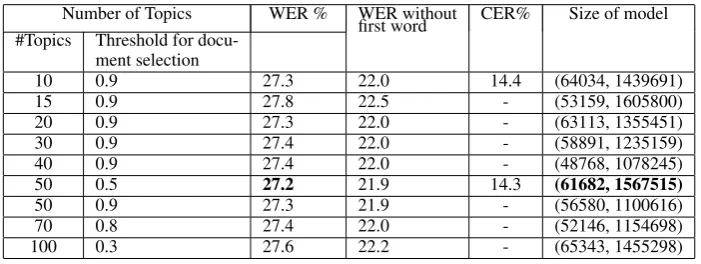
50 0.5 27.2 21.9 14.3 (61682, 1567515)
50 0.9 27.3 21.9 - (56580, 1100616)
70 0.8 27.4 22.0 - (52146, 1154698)
100 0.3 27.6 22.2 - (65343, 1455298)
In the first experiment we also include the size of OOV sets. In each table the best results have been boldfaced.
Table 1 shows the results of interpolating the language model from Bentham in-domain data with the language models from the Bentham out-of-domain and ECCO resources. This procedure improves the performance of the HTR system by 6.2%. In other words, these results emphasize that the out-of-domain data contains useful informa-tion.
Table 2 shows the performance of the HTR sys-tem using the proposed Inference Best-Topic al-gorithm. In Table 2 the first column shows the number of topics identified. The second and third columns are the threshold for document selection for each topic and the threshold for the related topic selection respectively. The Inference Best-Topic algorithm performs better than the baseline methods in most of the cases. Furthermore, the resulting language model is much more compact than the baseline model.
We continue with the experiments for the Iter-ative Topic-Selection algorithm. In the first ex-periment, the Iterative Topic-Selection algorithm (single iteration) finds the most relevant language model for adaptation. Table 3 shows the results of this experiment.
The Iterative Topic-Selection algorithm (mul-tiple iterations) deploys the interpolation of the most relevant language models. The results have been reported in Table 4. The results of both experiments emphasize that the proposed meth-ods for language model adaptation outperform the baseline and produce a more domain-specific lan-guage model.
6 Conclusion
We have studied and tested several ways in which domain adapted language modeling can improve hand-written text recognition results, when the resulting language models are deployed in the TRANSCRIPTORIUM HTR system. Our methods for the combination of in-domain and out-of do-main data have been shown to yield improvement in HTR results, both using established techniques (model interpolation) and novel approaches for language model adaptation. Consistent to our hy-pothesis, the proposed methods outperform the baseline, both in terms of HTR accuracy and in terms of model complexity. The experimental
re-sults show that our proposed approaches for do-main adaptation can effectively exploit informa-tive data from the out of domain data and improve the recognition performance of the HTR system significantly.
Acknowledgment
The research leading to these results has re-ceived funding from the European Union’s Sev-enth Framework Programme (FP7/2007-2013) un-der grant agreement no. 600707 - tranScriptorium.
References
Amittai Axelrod, Xiaodong He, and Jianfeng Gao. 2011. Domain adaptation via pseudo in-domain data selection. InProceedings of the Conference on Em-pirical Methods in Natural Language Processing, pages 355–362. ACL.
J.R. Bellegarda. 2000. Exploiting latent semantic information in statistical language modeling. Pro-ceedings of the IEEE, 88(8):1279–1296, Aug.
David M Blei, Andrew Y Ng, and Michael I Jordan. 2003. Latent dirichlet allocation. the Journal of ma-chine Learning research, 3:993–1022.
Ciprian Chelba, Dan Bikel, Maria Shugrina, Patrick Nguyen, and Shankar Kumar. 2012. Large scale language modeling in automatic speech recognition. Technical report, Google.
Vladimir Eidelman, Jordan Boyd-Graber, and Philip Resnik. 2012. Topic models for dynamic transla-tion model adaptatransla-tion. InProceedings of the 50th Annual Meeting of the ACL: Short Papers-Volume 2, pages 115–119. ACL.
Salvador Espana-Boquera, Maria Jose Castro-Bleda, Jorge Gorbe-Moya, and Francisco Zamora-Martinez. 2011. Improving offline handwritten text recognition with hybrid hmm/ann models. PAMI, IEEE Transactions on, 33(4):767–779.
George Foster, Cyril Goutte, and Roland Kuhn. 2010. Discriminative instance weighting for domain adap-tation in statistical machine translation. In Proceed-ings of the 2010 Conference on EMNLP, pages 451– 459.
Jing Jiang and ChengXiang Zhai. 2007. Instance weighting for domain adaptation in nlp. In ACL, volume 2007, page 22.
R. Lau, R. Rosenfeld, and S. Roukos. 1993. Trigger-based language models: A maximum entropy ap-proach. InProceedings IEEE International Confer-ence on Acoustics, Speech and Signal Processing, volume 2, pages 45–48, Minneapolis MN.
Yang Liu and Feifan Liu. 2008. Unsupervised lan-guage model adaptation via topic modeling based on named entity hypotheses. In Acoustics, Speech and Signal Processing, ICASSP, pages 4921–4924. IEEE.
Robert C Moore and William Lewis. 2010. Intelligent selection of language model training data. In Pro-ceedings of the ACL 2010 Conference Short Papers, pages 220–224. Association for Computational Lin-guistics.
Martin Moyle, Justin Tonra, and Valerie Wallace. 2011. Manuscript transcription by crowdsourcing: Transcribe bentham. LIBER Quarterly, 20(3). Indraneel Mukherjee and David M Blei. 2009.
Rela-tive performance guarantees for approximate infer-ence in latent dirichlet allocation. In NIPS, pages 1129–1136.
Thomas Pl¨otz and Gernot A Fink. 2009. Markov models for offline handwriting recognition: a sur-vey. Journal on Document Analysis and Recogni-tion, 12(4):269–298.
Joan Andreu S´anchez, G¨unter M¨uhlberger, Basilis Gatos, Philip Schofield, Katrien Depuydt, Richard M Davis, Enrique Vidal, and Jesse de Does. 2013. transcriptorium: a european project on handwritten text recognition. InProceedings of the 2013 ACM symposium on Document engineering, pages 227–228. ACM.
Andreas Stolcke, Jing Zheng, Wen Wang, and Victor Abrash. 2011. Srilm at sixteen: Update and out-look. In Proceedings of IEEE Automatic Speech Recognition and Understanding Workshop, page 5. Yik-Cheung Tam and Tanja Schultz. 2005. Dynamic
language model adaptation using variational bayes inference. InINTERSPEECH, pages 5–8. Citeseer. Jafar Tanha, Jesse de Does, and Katrien Depuydt.