A b s t r a c t
| 2
Abstract
A dynamic environment such as the technological industry often causes firms to give priority to knowledge and the managing of this knowledge. However, a first important step in the managing of knowledge is the creation of it. Since small- and medium enterprises have a lack of internal resources, managers of these firms are more often resulting to informal ways to create the knowledge they need. With the rising volume of web-based applications such as social media, it remains the question whether these applications can aid these managers in this knowledge creation process. Previous studies have reported that this is certainly possible, but much of this research has been descriptive in nature. From the practical side, managers are aware that social media has value but this remains unexplored due to a lack of knowledge and/or time. Therefore the purpose of this research is to bridge this gap in literature and practice by using the knowledge creation model developed by Nonaka and Takeuchi (1994), the SECI cycle of knowledge creation. A design science research approach is taken, to systematically combine the academic literature with the practical needs of companies. The current literature on the SECI cycle in an online environment is reviewed to form requirements, which are used to systematically search through the social media literature. The study finds that the 3M-Framework of Gallaugher and Ransbotham (2010) is most suited to meet these requirements. However, the main drawback of the framework is its metaphoric nature, so this is tackled through analogies that result in two social media phases of distribution and extraction. These two social media phases are modeled into a new method (SM-SECI) that includes the use of a log file for distribution and the use of tags for extraction. To empirically expand SM-SECI, three case studies were conducted at high-tech SMEs. The main observations made that were not supported by SM-SECI were a lack of coordination, use of tools which cause for distraction and a lack of interaction. The lack of interaction was examined further through a second design cycle which proposed that the log file can be kept in Microsoft Excel and that interaction can be monitored using NodeXL. The results of this study broaden our understanding on the social media phenomenon by providing a distinctive perspective. Moreover, the results reinforce the utility of the SECI cycle in a practical high-tech SME context.
D u t c h a b s t r a c t
| 3
Dutch abstract
Een dynamische omgeving zoals de technologische industrie heeft vaak als gevolg dat bedrijven prioriteit geven aan kennis en het managen van deze kennis. Een belangrijke eerste stap in het managen van kennis is het creëren hiervan. Doordat midden- en kleinbedrijven een gebrek aan interne middelen hebben, zijn managers vaak geneigd deze kennis via wat meer informele wegen te creëren. Met het stijgend aantal web-applicaties zoals sociale media blijft het de vraag of deze applicaties enige nut bieden voor deze kenniscreatie. Eerdere studies hebben beweerd dat dit zeker mogelijk is, maar veel van dit onderzoek is beschrijvend in aard. Aan de praktische kant valt op dat managers wel bewust zijn van de waarde van sociale media, maar dat dit niet verder wordt bestudeerd door een gebrek aan kennis en/of tijd. Hierdoor is het doel van dit onderzoek om deze kloof in literatuur en praktijk te overbruggen met behulp van de kenniscreatie model ontwikkeld door Nonaka en Takeuchi (1994), de SECI cyclus van kenniscreatie. Er wordt gebruik gemaakt van een ontwerpgerichte benadering om systematisch de academische literatuur te combineren met praktische behoeften van bedrijven. De huidige literatuur over de SECI-cyclus in een online-omgeving wordt bestudeerd om eisen op te stellen, die worden gebruikt voor het systematisch zoeken in de sociale media-literatuur. Zo wordt er gevonden dat het 3M-kader van Gallaugher en Ransbotham (2010) het meest geschikt is om aan deze eisen te voldoen. Het model is echter te metaforisch in aard, waardoor analogieën worden gebruikt om de kern te bestuderen, wat resulteert in twee sociale media fasen: distributie en extractie. Deze twee fasen worden gemodelleerd in een nieuwe methode (SM-SECI) waarin het gebruik van een log voor distributie en het gebruik van een tag voor extractie centraal staan. Om deze methode empirisch uit te breiden, zijn semigestructureerde interviews gehouden bij drie technologische MKBs. De hoofdobservaties die bij deze bedrijven zijn gedaan waar SM-SECI geen toevoeging aan biedt zijn een gebrek aan coördinatie, gebruik van tools wat vaak tot afleiding leidt en een gebrek aan interactie. Het gebrek aan interactie op sociale media werd verder onderzocht, waarbij werd voorgesteld dat het logbestand in Microsoft Excel gehouden kan worden en NodeXL opties biedt om de interactie op sociale netwerken te meten. De resultaten van deze studie geven een nieuw perspectief aan op het gebruik van sociale media en zorgen ervoor dat de waarde van de SECI cyclus bevestigd wordt in een praktische technologische MKB context.
P r e f a c e
| 4
Preface
This thesis makes up the final element in my bachelor studies Industrial Engineering and Management. If I look back on these three years, I am happy to say that I really shaped my own learning, and in doing this I experienced the real value of developing myself into a researcher and working on my own critical thinking. This of course was facilitated by the exceptional learning environment I perceived at this university.
The eagerness in me to learn translates to my interest in the research field of knowledge management and how companies can shape and master such a complex process. The writing of this thesis was not possible without the help of a few individuals. First and foremost, I want to thank my supervisor, Fons Wijnhoven, for his sharp eye for detail and valuable guidance in staying focused and on track. I was amazed at how much I could learn from him in such a short time. I also want to thank my second supervisor, Tom de Schryver for his excitement on wanting to add his expertise in evaluating this piece. Of course a thank you word is in place for the managers who cooperated with their time and the knowledge on their companies.
But most of all, I think I would be nowhere without the help of my mother who always knows what to tell me and how to motivate me to complete my goals in life. I also want to give a special thank you to my friends, whom were always there when needed and always strongly believed in my capabilities. I am convinced to go from the bachelor to the master as a developed student and am excited for what the future holds for me.
The content in this thesis is an original product of the author,
Daury Jansen
July 10nd 2014
L i s t o f f i g u r e s a n d t a b l e s 0 F
| 5
List of figures and tables
1F
IGURE1
C
AUSAL RELATIONSHIP BETWEEN VARIABLES... 11
F
IGURE2
THESIS STRUCTURE... 12
F
IGURE3
DESIGN SCIENCE RESEARCH CYCLES... 13
F
IGUUR4
S
PIRAL OF KNOWLEDGE CREATION... 17
F
IGURE5
U
SAGGE OF SOCIAL MEDIA TOOLS FORSECI
MODES... 18
F
IGURE6
3M-F
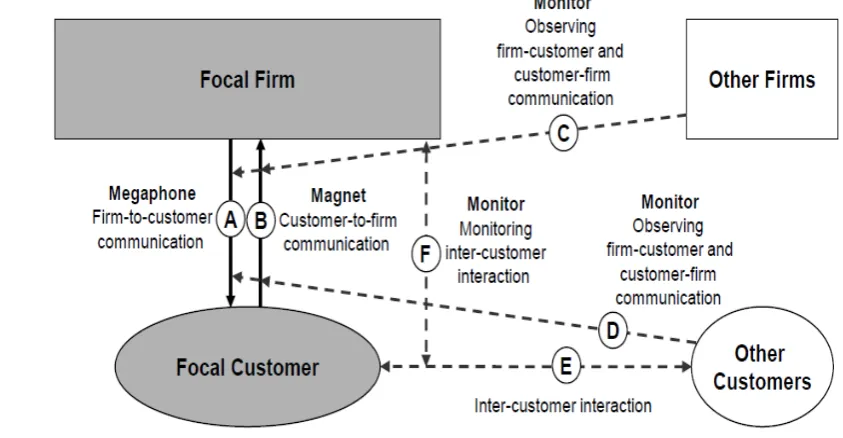
RAMEWORK... 24
F
IGURE7
SM-SECI ... 28
F
IGURE8
W
ORKSHEETS INM
ICROSOFTE
XCEL... 36
F
IGURE9
LOG FILE EXAMPLAR... 36
F
IGURE10
R
EVISEDSM-SECI
... 37
F
IGURE11
ADDITION TO KNOWLEDGE CREATION SPIRAL... 40
T
ABLE1
SECI
M
EETS SOCIAL MEDIA TRANSLATED TO REQUIREMENTS... 20
T
ABLE2
J
OURNALS SELECTED... 21
T
ABLE3
L
ITERATURE SEARCH... 22
T
ABLE4
O
BEJCTIVE,
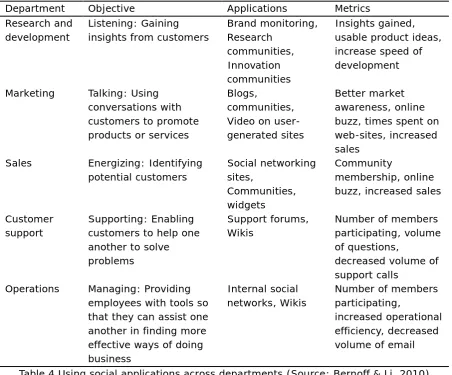
APPLICATIONS AND METRICS... 23
T
ABLE5
M
AIN CODES FROM CODING PROCEDURE... 30
T
ABLE6
MATRIX OF OBSERVATIONS... 34
1 Each table and figure includes a source, with the citing of a particular article from which the table or figure
C o n t e n t s
| 6
Contents
ABSTRACT ... 2
DUTCH ABSTRACT ... 3
PREFACE ... 4
LIST OF FIGURES AND TABLES... 5
1
INTRODUCTION ... 8
1.1
R
ESEARCH BACKGROUND... 8
1.2
R
ESEARCH INITIALIZATION... 10
1.2.1 Problem statement ... 10
1.2.2 Research questions ... 12
1.3
S
TRUCTURE OF THE THESIS... 12
2
DESIGN SCIENCE RESEARCH ... 13
2.1
K
ERNEL THEORY AND CYCLES... 13
2.2
C
ASE STUDIES... 14
3
OBJECTIVES OF A SOLUTION ... 16
3.1
C
HALLENGE IN OPERATIONALIZINGSECI ... 16
3.2
SECI
MEETS SOCIAL MEDIA... 17
3.3
F
ORMATION OF REQUIREMENTS... 19
4
DESIGN CYCLE ONE: CONSTRUCTION OF SM-SECI ... 21
4.1
L
ITERATURE SEARCH... 21
4.2
T
HEORETICAL MODELS FOR SOCIAL MEDIA USE... 22
4.2.1 The groundswell ... 22
4.2.2 The 3M-Framework ... 23
4.2.3 The honeycomb of social media ... 24
4.2.4 Ecosystems ... 25
4.3
C
HOICE OF SOCIAL MEDIA MODEL... 25
4.4
S
TRENGTHENING THE3M-F
RAMEWORK... 26
4.5
D
ISTRIBUTION AND EXTRACTION THROUGHSECI
CYCLE... 27
5
EMPIRICAL FINDINGS ... 30
5.1
N
ETWORK ANALYSIS AND CODES... 30
5.2
C
OMPANYA... 30
5.3
C
OMPANYB ... 32
5.4
C
OMPANYC ... 32
5.5
S
UMMARIZING EMPIRICAL FINDINGS... 33
6
DESIGN CYCLE TWO: REFINEMENT OF SM-SECI ... 35
6.1
D
OMINANT OBSERVATION... 35
C o n t e n t s
| 7
DISCUSSION AND CONCLUSION ... 38
7
7.1
K
EY FINDINGS... 38
7.2
A
CADEMIC AND SOCIAL CONTRIBUTIONS... 39
7.3
L
IMITATIONS... 40
7.4
S
UGGESTIONS FOR FURTHER RESEARCH... 41
REFERENCES ... 42
APPENDIX... 46
A
I
NTERVIEW... 46
A.1 Protocol ... 46
A.2 Transcripts ... 47
A.3 Classification of codes ... 47
B
J
OURNAL SELECTION AND USE... 49
B.1 Articles used for objectives of a solution and corresponding journals ... 49
I n t r o d u c t i o n
| 11
relationship is still poorly understood in the academic literature and is even less understood in practice. Some studies have attempted to link knowledge creation and social media (Wagner, Vollmar & Wagner, 2014; Chatti et al., 2007) or to model how personal knowledge or tacit knowledge is shared in such spaces (Panahi, Watson & Partridge, 2013), but these articles are limited as to how exactly information technologies should be used in accordance with the SECI cycle. One reason for this could be that we have still not grasped the full concept of organizational learning as many knowledge management models are in need of more empirical testing (De Schryver & Rosendaal, 2013). Moreover, social media presents many barriers towards its use, including a lack of time or knowledge of the tools available, in addition to the common cautions that are raised about information security (Frenken, 2013). This causes the social media literature to often be ineffective, mostly focused on promotion (Mangold & Faulds, 2009), while few studies see it as a source of information and knowledge (Crawford, 2009).
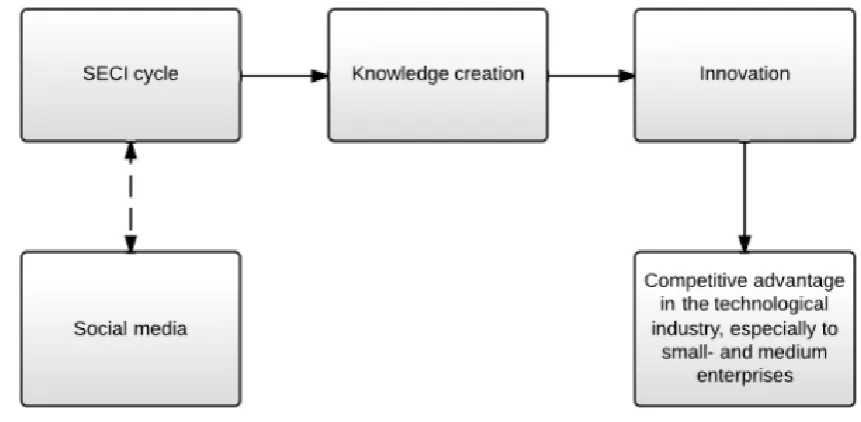
The theory of Nonaka and Takeuchi (1994) as a knowledge creation model seems valuable in bridging this gap in both research and practice as the model has been empirically tested in a variety of industries (Delgado-Verde, Martín-de Castro & Navas-López, 2011; Constandse, 2013) and has also been found to be significantly present in smaller firms (Desouza & Awazu, 2006). From this analysis one can proceed to draw up variables which have been identified as important to this study as shown in figure 1.
The solid lines represent relationships established in literature, while the dotted line represents the relationship under investigation in this study. Figure 1 indicates that this thesis assumes that the SECI cycle leads to knowledge creation; therefore no other knowledge creation models are discussed. The dotted line represents the contribution that the theory of Nonaka and Takeuchi (1994) has to social media. This results in the adoption of the following problem statement in this study:
“The SECI cycle of Nonaka and Takeuchi (1994) can make a contribution to social media use, but this has not yet been studied in a high-tech SME context.”
I n t r o d u c t i o n
| 12
SM-SECI
Chapter 7: Discussion and Conclusion
Chapter 6: Design cycle two: Refinement of SM-SECI
Chapter 5: Empirical findings
Chapter 4: Design cycle one: Construction of SM-SECI
Chapter 3: Objectives of a solution
Chapter 2: Design science research
Chapter 1: Introduction
1.2.2
Research questions
The purpose of this thesis is to contribute to solving the problem statement, and it therefore maps out the contribution that the SECI cycle makes to social media use in a high-tech SME context. This is done by developing a social media method for such firms, which is designed by integrating both theoretical and practical findings into a workable solution. In order to guide the research process, the following research question is formulated:
“How can the SECI cycle of knowledge creation be used to design a social media method for high-tech SMEs?”
Since this is a broad research question, a set of four sub-questions is used. These are sequential in nature, meaning that the output of each sub-question serves as the input for the other:
a) What are the requirements set out by the SECI cycle for the creation of
knowledge on social media?
b) What model for social media use best suits these requirements?
c) How can this model be integrated with the SECI cycle to form social media
SECI (SM-SECI)?
d) How can SM-SECI be made useful to high-tech SMEs?
1.3
Structure of the thesis
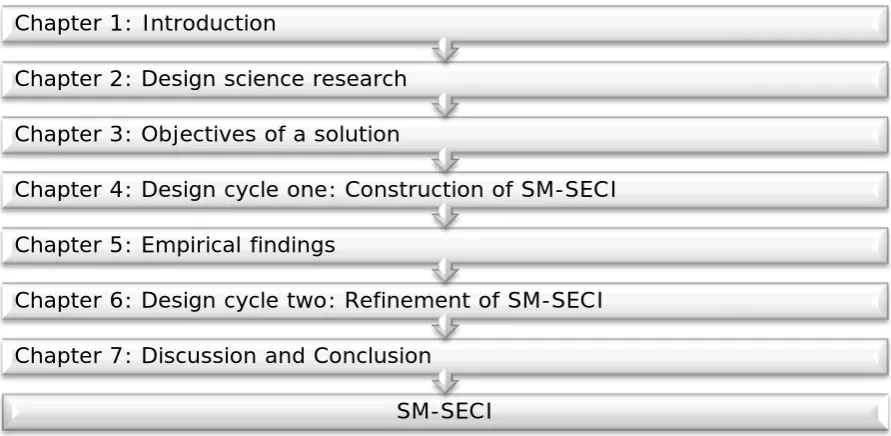
As can be seen in the research question, a central concept in this research is that of design. This means that design will be the key activity guiding the research. Design science research (Hevner, March, Park & Ram, 2004) is therefore used and a detailed explanation of this is given in the next chapter. The structure of the thesis follows this research process, meaning that it passes through the design cycles in order to establish the final social media SECI cycle, referred to as SM-SCI.
D e s i g n s c i e n c e r e s e a r c h
| 13
2
D
ESIGN SCIENCE RESEARCH
This chapter describes the methodology adhered to in this research. While this has been partly explained in Chapter One, this chapter further elaborates on the concept of design science research and describes how empirical data is collected and analyzed from high-tech SMEs to include in the design.
2.1
Kernel theory and cycles
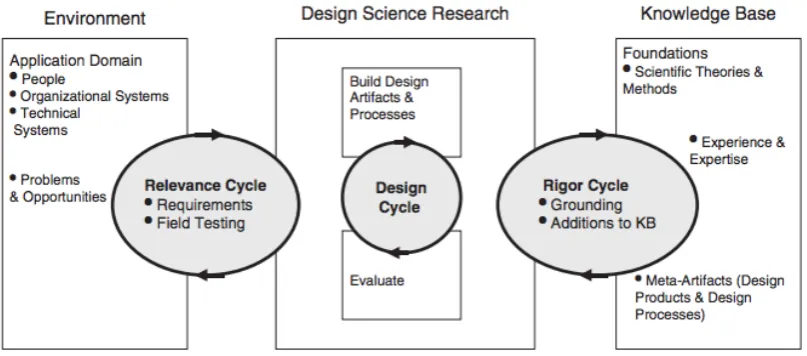
This thesis is aimed at investigating an unexplored area of study by combining observations from literature and practice in order to construct a method that serves managerial use. Design science research is suitable for this type of practical research due to its relevant and rigorous nature (Hevner et al., 2004). As published in a later Chapter in the book Design Research in Information Systems: Theory and Practice Hevner and Chatterjee (2010) point out how their 2004 MISQ paper did not include an actual way for a researcher to perform design research. Therefore Hevner and Chatterjee highlight the existence of three design cycles, which are displayed in figure 3. The environment domain is mainly based on the business field and ensures a clear understanding of the people and systems involved. The knowledge base includes scientific theories which are used for the design of products and services. Both the environment and the knowledge base produce a relevance cycle and a rigor cycle respectively, which serve to inform the construction of a design cycle in which the artefact is build.
To ensure that the building of this artefact is done effectively, Hevner et al. (2004) propose to work with guidelines. The following is an explanation of these seven guidelines and how they have been applied in this thesis. Guideline (1) Designing an artefact, is achieved through the creation of the SM-SECI cycle with its corresponding design propositions, which relate to how the artefact should function (Van Aken, 2004). Guideline (2) Stating the problem relevance, is achieved by noting the importance of knowledge creation in the high-tech industry and the problems that arise when managing social media. Therefore, viewing social media from a knowledge creation approach is a valid study with both social and scientific relevance. Guideline (3) Evaluating the design, is done through three cases in which a semi-structured
O b j e c t i v e s o f a s o l u t i o n
| 17
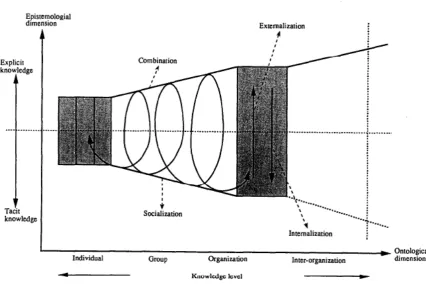
(Nonaka and Takeuchi, 1994). An organization thus learns as it is constantly externalizing and internalizing, which is also shown in figure 4.
Figure 4 Spiral of knowledge creation (Source: Nonaka and Takeuchi, 1994)
3.2
SECI meets social media
Tremendous changes have occurred over the past few years in the World Wide Web, as the internet has grown from one stream way of information (Web 1.0) to a high level of social interactions (Web 2.0) (O’Reilly, 2005). Platforms that have been developed based on the Web 2.0 concept are given many names, such as social software and social media. Seen collectively, these names refer to a group of applications aimed at supporting, extending or deriving value from human behavior (Back & Koch, 2011). The high volume of interaction found on social media platforms, means that it does not require much thought to realize that these interactions will significantly influence the SECI cycle. How this happens, however, is only marginally touched upon in the literature. This section describes the articles that have discussed this relationship in order to develop our own understanding of this phenomenon. A listing of the articles and their corresponding journals can be found in Appendix B.1.
O b j e c t i v e s o f a s o l u t i o n
| 18
precisely what social media facilitates. Note that, Kimmerle et al. (2010) summarize the knowledge creation process only by using externalization and internalization. They state the following regarding these two:
• Externalization involves both externalization and combination as people need to articulate their knowledge. However, to be able to do this, they need to be able to combine existing pieces of information, or to edit this information.
• Internalization involves both internalization and socialization as people use a shared digital artefact to browse for relevant information. However, to transfer this relevant information to their cognitive system requires a specific situation, meaning an originating context.
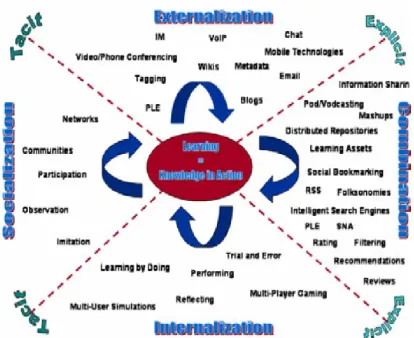
According to Chatti, Klamma, Jarke and Naeve (2007) all four modes of the SECI cycle can be supported separately by certain tools. Socialization is for instance supported by communities of practice, including for instance online social networks. Blogs are particularly useful for articulating knowledge as they allow for storytelling. This makes such tools useful in supporting externalization. The findings of Chatti et al. (2007) are presented in Figure 5. As a side note, however, one should be aware of the methodological limitations of this study, as there is no clear explanation how tools were chosen, nor does the study indicate how the tools should be used to support each mode
.
D e s i g n c y c l e o n e : c o n s t r u c t i o n o f S M - S E C I
| 22
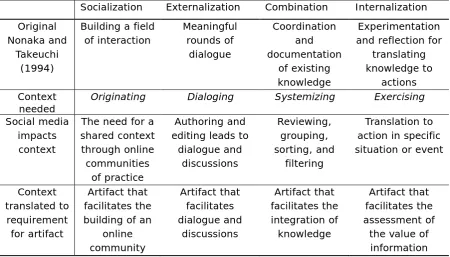
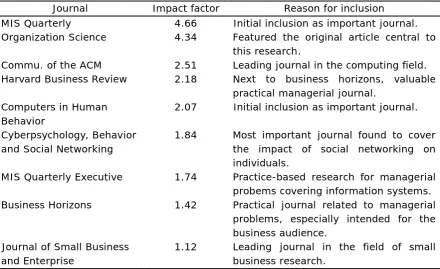
The list of journals shown in Table 2 was used to form a Scopus syntax, which is displayed in Appendix B.2. The Scopus database was consulted on May 16th 2014
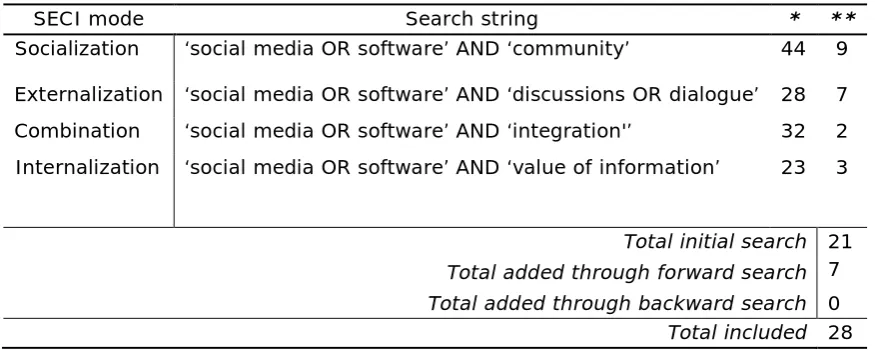
using this syntax. Scopus was selected for this task due to its many filtering capabilitites, its connections to many other databses and its inclusion of a large number of peer-reviewed articles. Using this syntax, search strings were used that matched the requirements identified in the previous chapter. Table 3 shows the results, with * being the initial output and ** the articles selected. This resulted in a total of 21 articles. The references in these articles — a so-called forward search — yielded seven additional sources. The citations did not yield any additional sources.
SECI mode Search string * **
Socialization ‘social media OR software’ AND ‘community’ 44 9
Externalization ‘social media OR software’ AND ‘discussions OR dialogue’ 28 7
Combination ‘social media OR software’ AND ‘integration'’ 32 2
Internalization ‘social media OR software’ AND ‘value of information’ 23 3
Total initial search 21 7 Total added through forward search Total added through backward search 0
Total included 28 Table 3 Literature search (own table)
4.2
Theoretical models for social media use
By now, managers are not completely new to the social media field. However, as Back and Koch (2011) argue the problem lies mainly in the fact that social media is often seen as a means and not a means to an end. This end implies a goal or an objective, which has to be set and followed for social media to lead the desired results. Therefore the literature on social media use is focused on how to plan activities and how to engage with the target audience and through which platforms to do this. Most of these theories are represented in so-called models, which are created and validated through best-practices case studies. These studies help researchers and practitioners to define and position social media in literature. This thesis includes four of these models, which are well cited in the literature and provide a sufficient picture of how social media should be used by companies.
4.2.1
The groundswell
D e s i g n c y c l e o n e : c o n s t r u c t i o n o f S M - S E C I
| 24
.
As can be seen in Figure 6, there are six possible communication paths that social media opens, which are denoted by the letters A to F. Paths A and B are solid lines and represent traditional communication patterns that have always been present. Paths C to F are dotted lines and represent the communication patterns that are enabled by social media use. As can be seen in the figure, the megaphone can be used to communicate with the focal customer, while the magnet can be used if the customer seeks to communicate with the firm. The remaining communication patterns occur as the firm taps into inter-customer interactions as well as the interactions between other customers and other firms.
4.2.3
The honeycomb of social media
Kietzmann, Hermkens, McCarthy and Silvestre (2011) developed what they called the ‘honeycomb’ of social media, in which seven building blocks together form a honeycomb on which the functionality of these platforms resides. These seven building blocks are identity, conversations, sharing, presence, relationships, reputation and groups. These building blocks are supported by many authors, such as Piskorski (2011) who emphasizes that social networks are more about relationships than anything else. These seven functionalities are based on the user and provide an understanding on how organizations should behave on such platforms in order to reach their full potential. The authors note that many platforms do not focus on only one of the blocks, but make use of several blocks. For example, LinkedIn is highly focused on identity, but also focuses on relationships and reputation. Using these patterns of thought, the following four Cs can be identified as a guide to developing a strategy around social media.
Cognize: Understanding the social media landscape will allow the organizations to know where their position is in this landscape. Moreover, it is also important for them to know where the conversations of the firms are occurring and how this can be explained by the functional building blocks.
Congruity: This step is about ensuring alignment between the functionalities of the platforms used and the business goals of the firm. A firm should focus on
D e s i g n c y c l e o n e : c o n s t r u c t i o n o f S M - S E C I
| 29
Two central central tools that are used in each phase of social media use are a log file and tags. Since these two tools are central in our method, they can be used to develop the so-called technical rules or design propositions (Van Aken, 2004). Design propositions are commonly used in design science research in order to represent a design. They are defined as a ‘chunk of general knowledge, linking an intervention or artefact with an expected outcome or performance in a certain field of application’ (p. 228). These design propositions are shown below. The design propositions are left to be broad as their purpose is to summarize the essence of the design.
Main proposition 1: The use of a log file facilitates the distribution of content on social media according to a SECI cycle, through observation, documentation, comparison and actual distribution.
Main proposition 2: The use of tags facilitates the extraction of knowledge from
E m p i r i c a l f i n d i n g s
| 30
5
E
MPIRICAL FINDINGS
This chapter aims to extend our design and propositions by augmenting them with knowledge from the business environment. As explained in Chapter Two, this is done through case studies in which observations are made on how knowledge is currently created by high-tech SMEs and on the value of social media in this process.
5.1
Network analysis and codes
Chapter Two gives a complete overview of how the companies were recruited and how the interview was set up and analyzed. Before visiting the company, the social media networks were analyzed to determine the online community that these firms had. Company A currently uses Twitter primarily for recruitment and has a network of 541 Twitter followers. Company B uses Twitter largely for the promotion of network events and the publishing of scientific articles that relate technical issues; it has a network consisting of 25 Twitter followers. Company C uses Twitter for identity building and often uses tags such as #productdevelopment to indicate what is currently being done; its network consists of 203 Twitter followers. One particular observation made in the network is that the responses the company get on their content is low, meaning it is noted that there is a lack of interaction in the online social network.
Following the coding procedure explained in Chapter Two resulted in the main codes as shown in the three boxes below. This was done by building a code network through the code manager option of Atlas.ti. The codes displayed in Table 5 were subsequently related to each mode of SECI and this is shown in Appendix A.3
Company A main codes
Interaction, engineers do not interact, need interaction, reacting, ties individuals to you, need for problem statement and addressing reaction, posting technical questions, receiving answers, static updating leads to no results, obstacles coordinating, difficulty getting knowledge at the right place, distraction and difficulty obtaining knowledge on social media.
Company B main codes
Recruitment, broadcasting network event, no creation of knowledge, content is everything, growing process, interaction, low usage of social media, introvert, ad-hoc, unexplored area, information out more relevant than information in.
Company C main codes
Observation, community, Facebook for image, LinkedIn for recruitment, culture building, increase in Twitter usage, Twitter news, knowledge in the network or Google, expectation to gain new clients but does not happen, social media use is market dependent, assessing customer needs is difficult, Hootsuite leads to distractions.
Table 5 Main codes found from coding procedure (own table)
5.2
Company A
D e s i g n c y c l e t w o : R e f i n e m e n t o f S M - S E C I
| 36
between organizational dyads, that is, the ‘transfer of technical information between the source and the recipient’ (p. 8). The findings of Sosa (2011) indicate that a lack of network cohesion favors for creative interactions, as individuals do not feel the social pressure to respond and also do not have to deal with information redundancy. However, interestingly enough tie strength was found to be a significant predictor of a recipient receiving novel and useful ideas through interactions.
Tie strength and network cohesion are concepts that are rooted in the theoretical discipline of Social Network Analysis (SNA). Social Network Analysis uses concepts from network theory in order to visualize, map and assess a network’s properties. For the purposes of SM-SECI design, the book by Hansen, Shneiderman and Smith (2010) is found particularly useful for SNA. This book was initially found through the backward search mentioned in section 4.1, as it was cited by Hanna et al. (2011). The tool that Hansen et al. (2010) highlight in their book is referred to as NodeXL. Due to the abilities that NodeXL can give a company in monitoring both tie strength and network cohesion, it is argued that NodeXL is a valuable tool for the execution of SM-SECI. For example, if a firm decides to share content that it has been created by running the distribution phase of SM-SECI, it can decide to monitor the effect that this content has had on the tie strength of the firm, whether its network has grown and whether it has become more interactive with its current community. In order to do this, it is advisable to work with two main worksheets in Microsoft Excel, shown in figure 8. The Reason why Microsoft Excel is advised is because NodeXL itself works as an add-on to this software, facilitating the creation of one document. The two worksheets will serve as a sort of knowledge portal in which the user gets a complete overview of how they are executing SM-SECI.
In the distribution worksheet, a log file can be created, for which an example is shown in Figure 9. As can be seen below, Microsoft Excel enables a proper comparison between the log files on social media, and the internal log file, referring to the way the firm publishes content.
Figure 8 Worksheets in Microsoft Excel (own figure)
D e s i g n c y c l e t w o : R e f i n e m e n t o f S M - S E C I
| 37
In the extraction worksheet, the NodeXL tool can be used to import social media data that can be edited and reconfigured in a variety of ways. Additionally, NodeXL allows the insertion of search queries. For a complete guide on how to use NodeXL, one should consult the book by Hansen, Shneiderman and Smith (2010). For the purposes of this thesis, it is sufficient to state the proposal that Microsoft Excel and NodeXL can be used to create a knowledge portal, providing a solid foundation for the execution of SM-SECI. Figure 10 represents the revised SM-SECI framework. The design propositions are also displayed below the figure, in which the changes are bold faced.
Main proposition 1: The use of a log file in Microsoft Excel facilitates the distribution of content on social media according to a SECI cycle, through observation, documentation, comparison and actual distribution.
Main proposition 2: After monitoring interaction with NodeXL, tags can be used
to facilitate the extraction of knowledge from social media according to a SECI cycle, through a knowledge need, a tag as a search query, content aggregators and assessing the value of information based on the knowledge need.
D i s c u s s i o n a n d c o n c l u s i o n
| 40
7.3
Limitations
The findings of this thesis are subject to a set of limitations. First, the sample that was used consisted of firms that are located mainly in the eastern part of the Netherlands. This is so due to the usage of a convenience sample. Additionally, the study suffered from a low response rate. This causes us to state that future case studies are needed in order to generalize the findings. The second limitation of this research lies in the data collection method, which could be biased as individuals were asked about their opinion in combination with experiences they have had. The assumption that the manager interviewed contained the needed expertise was not checked. Nevertheless, by trading in dialogue with the manager this was overcome and sufficient views could be provided and combined with actual facts from the social network of the companies. A third and final limitation that needs to be mentioned is the wide scope of the research area, which limited us to study additional concepts which could also be very valuable in this line of research. As was mentioned in Chapter Three much more work is needed on how firms integrate external knowledge into their knowledge base, for which the study of Kraaijenbrink et al. (2007) has provided a solid start towards a kernel theory. A final limitation of this study is the exclusion of information security and data reliability, as not everything that is included on social media platforms can be considered as reliable and true, for which the concept of information triangulation can serve as a valuable solution.
D i s c u s s i o n a n d c o n c l u s i o n
| 41
7.4
Suggestions for further research
Limitations present themselves as opportunities for future researchers to tackle up the interesting and challenging landscape of social media and knowledge creation and sharing. New research following this research should primarily focus on conducting more design cycles, in which the method proposed here is empirically tested through for instance a longitudinal case study. Managers can be observed as they use a log file or actively use tags, in which their activities are matched with each mode of the SECI cycle. As a result of the findings, future research could also focus on certain interaction patterns on social media and which ones lead to a certain mode of knowledge creation.
D i s c u s s i o n a n d c o n c l u s i o n
| 42
References
Alavi, M., & E Leidner, D. (2001). Review: Knowledge Management and Knowledge Management Systems: Conceptual Foundations and Research Issues. MIS Quarterly, 25(1), 107-136.
Ambrosini, V., & Bowman , C. (2001). Tacit knowledge: Some suggestions for operationalization. Journal of Management Studies, 38(6), 811-829.
Back, A., & Koch , M. (2011). Broadening participation in Knowledge Management in Enterprise 2.0. Information technology, 53(3), 135-141.
Bernoff, J., & Li, C. (2010). Harnessing the power of the oh-so-social web. IEEE Engineering Management Review, 38(3), 8-15.
Charsombut, N. (2010). Collaborative Knowledge Management in Organization from SECI model Framework. Paper presented at TIIM conference, Pattaya , Thailand. doi:10.1504/IJMOM.2011.039529
Chatti, M. A., Klamma, R., Jarke, N., & Naeve, A. (2007). The Web 2.0 Driven SECI Model based Learning Process. Paper presented at Seventh IEEE International Conference on Advanced Learning Technologies, Niigata, Japan .
doi:ICALT.2007.256
Constandse , J. M. (2013). Exploring organizational knowledge creation: What is the practical value of Nonaka’s Hypertext model and how can it be applied? University of Twente Faculty Management and Governance, Enschede. Retrieved from http://purl.utwente.nl/essays/62752
Cook, S. D. N., & Brown , J. S. (1999). Bridging epistemologies: the generative dance between organizational knowledge and organizational knowing. Organization Science, 10(4), 381-400.
Crawford , K. (2009). Following you: Disciplines of listening on social media. Continuum: Journal of Media & Cultural Studies, 23(4), 525-535.
Crossan, M. M., Lane , H. W., & White , R. E. (1999). An Organizational Learning Framework: From Intuition to Institution. The Academy of Management Review, 21(3), 522-537.
CSES . (2012). Evaluation of the SME Definition. Retrieved from
http://ec.europa.eu/enterprise/policies/sme/files/studies/executive-summary-evaluation-sme-definition_en.pdf
Dass, M., & Kumar , S. (2013). Bringing product and consumer ecosystems to the strategic forefront.. Business Horizons, 57(2), 225-234.
R e f e r e n c e s
| 43
Learning, Knowledge and Capabilities, Valencia , Spain . Retrieved from http://purl.utwente.nl/publications/87364
De Vera, J. C., & Murray, B. (2013). The art of listening: Social media toolkit for non-profits (The Greenlining Institute). Retrieved from http://greenlining.org/wp- content/uploads/2013/09/The-Art-of-Listening-Social-Media-Toolkit-for-Nonprofits.pdf
Delgado-Verde, M., Martín-de Castro, G., & Navas-López, J. (2011). Organizational knowledge assets and innovation capability: Evidence from Spanish
manufacturing firms. Journal of Intellectual Capital, 12(1), 5-19.
Dellarocas , C., Katona , Z., & Rand , W. (2010). Media, Aggregators and the Link Economy: Strategic Hyperlink Formation in Content Networks (Boston University School of Management). Retrieved from
http://ssrn.com/abstract=1694370
Dermham, R., Cragg, P., & Morrish, S. (2011). Creating Value: An SME and Social Media. PACIS 2011 Proceedings, 53(1), 1-9. Retrieved from
http://aisel.aisnet.org/pacis2011/53
Desouza, K. C., & Awazu, Y. (2006). Knowledge management at SMEs: five peculiarities. Journal of Knowledge Management., 10(1), 32-43.
Frenken, R. R. M. (2013). Enabling entrepreneurs to perform more efficient market research using social media (University of Twente, Faculty Management and Governance, Enschede). Retrieved from http://purl.utwente.nl/essays/63468 Gallaugher, J., & Ransbotham, S. (2010). Social media and customer dialogue
management at Starbucks. MIS Quarterly Executive , 9(4), 197-212. Gibbs, G. R. (2007). Analyzing Qualitative data. California , United States: SAGE
Publications.
Gourlay, S. (2006). Conceptualizing knowledge creation: a critique of Nonaka’s theory. Journal of Management Studies, 43(7), 1415-1436.
Gourlay, S., & Nurse , A. (2005). Flaws in the “engine” of knowledge creation: A critique of Nonaka’s theory. Issues in Knowledge Management, 5, 293-316. Haefliger, S., Monteiro, E., Foray, D., & Von Krogh, G. (2011). Social Software and
Strategy. Long Range Planning, 44(5-6), 297-316.
Hanna, R., Rohm, A., & Crittenden, V. L. (2011). We’re all connected: The power of the social media ecosystem. Business horizons, 54(1), 265-273.
R e f e r e n c e s
| 44
Hevner, A. R., & Chatterjee, S. (2010). Design science research in information systems. Design Research in Information Systems: Theory and Practice, 1, 9-22.
Hevner, A. R., March, S. T., Park, J., & Ram, S. (2004). Design Science in Information Systems Research. MIS Quarterly, 28(1), 75-105.
Hey, J., Linsey, J., Agogino, A., & Wood, K. (2008). Analogies and Metaphors in Creative Design. International Journal of Engineering Education, 24(2), 283-294.
Huang, K., & Güney, S. (2012). Toward a Framework of Web 2.0-Driven
Organizational Learning. Communications of the Association for Information Systems, 31(6), 130-53.
Hutchinson, V., & Quintas, P. (2008). Do SMEs do Knowledge Management?: Or Simply Manage what they Know? International Small Business Journal, 26(2), 131-154.
Kaplan, A. M., & Haenlein, M. (2010). Users of the world, unite! The challenges and opportunities of Social Media. Business Horizons, 53(1), 59-68.
Kaplan, A. M., & Haenlein, M. (2011). The early bird catches the news: Nine things you should know about micro-blogging. Business Horizons, 54(2), 105-113. Kietzmann, J. H., Hermkens, K., McCarthy, I. P., & Silvestre, B. S. (2011). ). Social
media? Get Serious! Understanding the functional building blocks of social media. Business horizons, 54(3), 241-251.
Kimmerle, J., & Cress, U. (2010). The interplay between individual and collective knowledge: Technologies for organizational learning and knowledge building. Knowledge Management Research and Practice, 8(1), 33-44.
Kraaijenbrink, J., Wijnhoven, F., & Groen, A. (2007). Towards a kernel theory of external knowledge integration for high-tech firms; Exploring a failed theory test. Technological forecasting & social change, 74, 1215-1233.
Löwik, S. J. A. (2013). Micro-foundations of absorptive capacity : a study on knowledge processes for innovation in SMEs. Retrieved from
http://purl.utwente.nl/publications/85545
Mangold, W. G., & Faulds, D. J. (2009). Social media: The new hybrid element of the promotion mix. Business Horizons , 52(4), 357-365.
Nissen, M. E. (2002). An Extended model of knowledge-flow dynamics.
Communications of the Association for Information Systems , 8(1), 1-18. Nonaka, I., & Konno, N. (1998). The Concept of „Ba‟: Building a Foundation for
Knowledge Creation. California Management Review, 40(3), 40-54.
R e f e r e n c e s
| 45
Nonaka, I., & Von Krogh, G. (2009). Perspective--Tacit Knowledge and Knowledge Conversion: Controversy and Advancement in Organizational Knowledge Creation Theory. Organization Science, 20(3), 635-652.
O’Reilly, T. (2005, September 30). What is Web 2.0: Design patterns and business models for the next generation of software. Retrieved from
http://www.oreillynet.com/pub/a/oreilly/tim/news/2005/09/30/what-is-web-20.html
Panahi, S., Watson, J., & Partridge, H. (2013). Towards tacit knowledge sharing over social web tools. Journal of Knowledge Management, 17(3), 379-397.
Piskorski, M. J. (2011). Social strategies that work . Harvard Business Review , 89(11), 166-122.
Polanyi, M. (1966). The Tacit Dimension. New York, United States: Doubleday. Popadiuk, S., & Choo, C. W. (2006). Innovation and knowledge creation: How are
these concepts related? International Journal of Information Management, 26(4), 302-312.
Sosa, M. E. (2011). Where do Creative Interactions Come From? The role of Tie content and Social Networks. Organization Science, 22(1), 1-21.
Sparrow, J. (2001). Knowledge Management in small firms. Knowledge and process Management, 8(1), 3-16.
Van Aken, J. E. (2004). Management Research Based on the Paradigm of the Design Sciences: The Quest for Field-Tested and Grounded Technological Rules. Journal of Management Studies, 41(2), 219-246.
Wagner, D., Vollmar, G., & Wagner, H. (2014). The impact of information technology on knowledge creation: An affordance approach to social media. Journal of Enterprise Information Management, 27(1), 31-44.
Webster, J., & Watson, R. T. (2002). Analyzing the past to prepare for the future: Writing a literature review. MIS Quarterly, 26(2), 13-23.
Wijnhoven, F. (2008). Manufacturing Knowledge Work: The European Perspective. In Methods and Tools for Effective Knowledge Life-Cycle-Management (pp. 23-44). New York, United States: Springer Berlin Heidelberg.
Wijnhoven, F. (2012). Information services design: A Design Science Approach for Sustainable Knowledge. Routledge, New York, United States.
Wijnhoven, F. (2013). Enabling the collective brain for organizations: a QuickStart in management software skills (University of Twente, Faculty Management and Governance, Enschede). Retrieved from
A p p e n d i x
| 46
Appendix
A Interview
A.1 Protocol
The interviews conducted were all semi-structured in nature meaning the protocol mentioned here serves a guideline but was not always followed as the focus of the interview was to trade into a discussion with the manager of the value of social media in the way knowledge is currently being created. To faciliate this discussions a general introduction was given, followed by knowledge creation questions, social media questions and a short feedback session on the SM-SECI cycle.
Introduction
First and foremost introductory note. For note-taking purposes this interview will be recorded using a mobile phone, so I would like to ask for permission to do this. The transcripts will only be used for research purposes, viewed by the researchers and not made publicly available. The purpose of this study is to develop a method that facilitates knowledge creation through social media for high-tech SMEs, thus using social platforms or social media to obtain the knowledge that is relevant for your organization. So I will be asking you a few questions on how you are currently dealing with the concept of knowledge and I will also be asking you questions about your experiences with social media and the way you view this as valid knowlede creation tool. I will also provide you with an examplar of the SM-SECI method, a prelimar form in the design process, for which I would like your opinion.
Profile of executive and organization
1. What is your function within this organization or what are your tasks? 2. How would you describe the structure and culture of this organization? 3. What distinguishes this firm from other high-tech SMEs?
[Explain the difference between tacit and explicit knowledge and knowledge creation]
Knowledge creation
4. How was does your firm create knowledge?
a. Socialization: keywords interaction and community
b. Externalization: keywords dialogue and discussions
c. Combination: keywords intergration
d. Internalization: keywords value of information
A p p e n d i x
| 47
a. Socialization: keywords interaction and community
b. Externalization: keywords dialogue and discussions
c. Combination: keywords intergration
d. Internalization: keywords value of information
Social media
6. What is your opinion on social media for corporate use?
7. What are your experiences with social media inside [insert company name]?
8. Do you use any platforms and how or why (not)?
9. Do you think it is difficult to create knowledge using social media and why?
Method feedback
[Show SM-SECI method, explain how it was developed from the methods in theory, allow for reading and digesting]
10.Do you recognize parts from the method? Are you applying some parts now? 11.What is your opinion on the method?
12.What elements of this method are you missing relevant to your firm?
[Thank interviewee. The company name and the transcripts will not be included in the thesis. A full copy of the report will be available to the respondent after the research is concluded. ]
A.2 Transcripts
{not available in public version}
A.3 Classification of codes
A p p e n d i x
| 48
Company B
A p p e n d i x
| 49
B Journal selection and use
B.1 Articles used for objectives of a solution and corresponding journals
Article Corresponding journal or conference
Nonaka and Takeuchi (1994) Organization Science
Huang and Güney (2012) Communications of the Association for the
information systems
Kimmerle, Cress and Held
(2010) Knowledge Management Research and Practice
Chatti, Klamma, Jarke and
Naeve (2007) IEEE International Conference on Advanced Learning Technologies
Panahi, Watson and Partridge
(2013) Journal of Knowledge Management
Wagner, Vollmar and Wagner
(2014) Journal of Enterprise Information Management
B.2 Scopus search syntax
TITLE-ABS-KEY(keyword)AND (LIMIT-TO(EXACTSRCTITLE,"Computers in human behavior" ) OR LIMIT-TO(EXACTSRCTITLE,"MIS Quarterly: Management Information systems" )
OR LIMIT-TO(EXACTSRCTITLE,"Organization Science" ) OR LIMIT-TO(EXACTSRCTITLE,"Business horizons" )
OR LIMIT-TO(EXACTSRCTITLE,"Cyberpsychology, behavior and social networking" ) OR LIMIT-TO(EXACTSRCTITLE,"Communications of the ACM "
OR LIMIT-TO(EXACTSRCTITLE,"MIS Quarterly Executive") OR LIMIT-TO(EXACTSRCTITLE,"Harvard business review” )
OR LIMIT-TO(EXACTSRCTITLE,"Journal of small business and enterprise development " )) AND (EXCLUDE(SUBJAREA,"ARTS" ) )