© 2018 IJSRCSEIT | Volume 3 | Issue 3 | ISSN : 2456-3307
Free Voice Web Application
Deepak Vezer, Himanshu Advani, Sagar Kataria, Suyash Kedia
ABSTRACT
As an alternative to the older communication meth-ods like telephony and telegraph, chat applications are more popularly used for communication. These applications come with advanced features that enable the users to use it for different applications. The immediate requirement is to be able to exchange text messages however recent applications also provide support for multimedia content exchange. Free Voice is a web application to facilitate communication with different departments within an organization. This system is controlled by the users and its security is autonomously managed. The communicating parties authenticate each other before exchanging messages. Using this application the user can login and select the department to which message has to be sent. It provides an alternative to send messages publicly or privately. Each category will have a category owner. Response to any message can be provided by the respective category owner. It also provides faster searching by applying filters. The application will be governed by an administrator who will have access to all messages and categories.
Keywords: Client-Server, Socket, Object-Oriented Design, JAVA, User-Interfaces.
I.
INTRODUCTION
Communication stands out as a basic need of people for exchanging messages. Traditionally, people communicated using telephony and telegraph. With
emergence of computer networking and
telecommunication technologies, there is a drastic change in the trend for communication. This allows faster communication and also cuts down the cost involved via traditional methods. Not only text, but also multimedia data transfer is supported with these web applications.
The communication via web applications provides secure and faster data transfer and eliminates all third party ele-ments. The communicating parties authenticate each other be-fore exchanging messages. Communication through computer networks is
client or server, depending upon whether it is requester or provider of the service.
The Client-Server Model allows the user details to be stored in a database at server side so that any user that attempts to log in, is authenticated first. This prevents the organization’s information or any important data to leak out to malicious/unauthorized users. But this model generates single point of failure i.e. the Server which may lead to breakdown of the system and also causes resource consumption concentrated on the server side.
The chat applications have become important communication tools while people are using it for different purposes like business, education, etc.
adding/deleting/updating different departments and the corre-sponding users, access all messages which is not proposed in Mr. Ibrahim Muhammad Abba etal[2] had porposed the LAN chat messenger using JAVA programming. It proposed the features like sending mesages, file transfer, etc. As the required application is network based and multiple users are involved, there is also a need of security. The messages should be encrypted and decrypted at the sender and the receiver side using appropriate algorithms. This type of model is proposed in [3]. For communication between different users, there is a need of creating multiple sockets to support both, TCP and UDP communication where TCP/IP provides reliable communication and UDP provides smart addressing operation to control the destination of data being transfered. In our application, there is a need to provide security by privately sending messages using encryption techniques and there is also a need to broadcast messages to and from any department which lacks in [4]. Mr. Maha Sabri Altemem etal discussed a model which proposed that if a socket program is written in JAVA, it would still be able to connect with other socket programs written in C or C++. In short, this model supported the transparency feature[5].
There is a need for storing the messages as the admin has the right to access all the messages exchanged. This is not proposed in [6]. Depending on the number of users, there may be overload on the server. One of the alternative to this problem is using multi-threading i.e whenever a client requests for a new connection to the server, the server creates a new individual thread for that client as stated in [7]. Security measures are also important when it comes to web based applications. User Authentication using
OAuth protocol is proposed in [8] which prevents the third party applications to access the user’s information.
Mr. Samer EL Sawda etal[9] developed a model for communication based on SIP protocol. As this model mainly addresses a trusted communication, the concept of SIP SIGN is implemented which means that there is a redirected server named ’Proxy Signatory’ which provides the caller a mecha-nism for signing the message at the time of sending and the callee can verify the caller identity. SIP protocol also provides acknowledgement for sending and receiving messages which is stated in [10].
A. Methodology
The Idea of this proposed application is to store the data in a centralized database and one can use the credentials to log in and have access to the data as preferred. This surely provides some level of robustness but the main challenge here is to protect the centralized database from any type of attacks. In this application, when a user wants to communicate to another user, he first has to connect to the user and the server authenticates this client. After successful log in, the user can send the message publicly or privately communicate with other users. Some important idea of this:
There is a centralized server for log in authentication and data storage.
Single log in is required to communicate to multiple users.
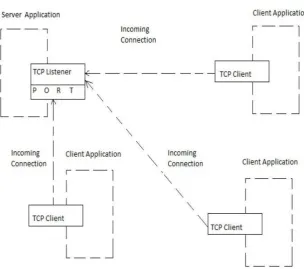
With the use of socket, the message is sent by one staff into the socket and is passed to another staff on the receiving side. In case of group chat, a central socket is used that collects the message and broadcasts it to all the staff that is active.
B.Features Category Wall
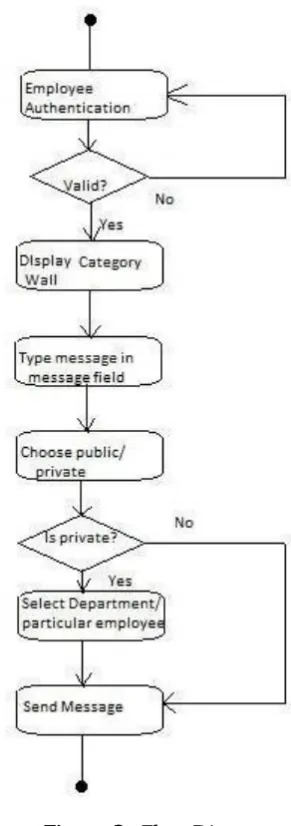
This application consists separate category wall for different departments. For example-Finance, IT, Admin, etc. The employer will have to login and select the category to which he/she wants to send the message. Notification will be shown for successful message delivery. The message can also be marked as public or private. In case of public everyone who logs in will be able to see the message on category wall. User can also search the messages by applying filters.
Category Owner
Category owner is able to see all the messages posted on the category wall and also respond to them. Cate-gory owner can only respond to the public messages posted on the wall and can also apply filters to search the messages.
Admin
Different categories can be Created/Updated/Deleted by the Admin. The admin is able to create the owners of the category who can respond to the messages posted on respective category wall. Admin also has access to all messages from all employees.
File Sending
This application also supports transfer of files with various file formats(eg,.txt, .jpg,.png, etc). The file can either be sent to a specific user or to the entire staff at a time as broadcast.
Figure 3. Flow Diagram
III.
CONCLUSION
I would like to take this opportunity to thank my internal guide Prof. Vaishali Wangikar and Prof.Rajeshwari Gaudar for giving me all the help and guidance I needed. I am really grateful to them for their kind support. Their valuable suggestions were very helpful.
I am also grateful to Prof.Shitalkumar Jain, Head of Computer Engineering Department, College Name for his indispensable support, suggestions.
V.
REFERENCES
[1]. Mohamad Afendee Mohamed, Abdullah
Muhammed and Mustafa Man, A Secure Chat
application based on Peer-to-Peer
Architecture, Journal of Computer Science, 2015.
[2]. Ibrahim Muhammed Abba, Norshakirah Ab.Aziz, Umapathy Eaganathan and Janet Gabriel, Lan Chat Messenger(LCM) Using Java Programming with VoIP, 3rd International Conference on Research and Innovation in Information Systems, 2013(ICRIIS’13).
[3]. Jorge Granjal, Edmundo Monteiro, Jorge S Silva, On the Feasibility of Secure Application-Layer Communications on the Web of Things, LCN 2012, Clearwater, Florida.
[4]. C.Saranya and L.Gomathi, MULTI TASKING SOCKETS IN DATA TRANSMISSION, IJESRT
[5]. MAHA SABRI ALTEMEM, Voice Chat
Application Using Socket Programming, EUROPEAN ACADEMIC RESEARCH Vol. II, 2014
[6]. Salman A. Baset and Henning Schulzrinne, An
[10]. Sheng-Cheng Yeh, Kai-Fu Chan,