The Multilingual Paraphrase Database
Juri Ganitkevitch
1Chris Callison-Burch
21Center for Language and Speech Processing, Johns Hopkins University, Baltimore, MD 2Computer and Information Science Department, University of Pennsylvania, Philadelphia, PA
Abstract
We release a massive expansion of the paraphrase database (PPDB) that now includes a collection of paraphrases in 23 different languages. The resource is derived from large volumes of bilingual parallel data. Our collection is extracted and ranked using state of the art methods. The multilingual PPDB has over a billion paraphrase pairs in total, covering the following languages: Arabic, Bulgarian, Chinese, Czech, Dutch, Estonian, Finnish, French, German, Greek, Hungarian, Italian, Latvian, Lithuanian, Polish, Portugese, Romanian, Russian, Slovak, Slovenian, and Swedish.
Keywords:paraphrasing, multilingual resources, lexical resources
1.
Introduction
Paraphrases are differing ways of expressing the same meaning within a single language (Bhagat and Hovy, 2013; Vila et al., 2014). They have proven useful for a wide va-riety of natural language processing applications. For in-stance, in multi-document summarization, paraphrase de-tection is used to collapse redundancies (Barzilay et al., 1999). Paraphrase generation can be used for query ex-pansion in information retrieval and question answering systems (McKeown, 1979; Ravichandran and Hovy, 2002; Riezler et al., 2007). Paraphrases also allow for more flex-ible matching of system output against human references for tasks like evaluating machine translation or evaluating automatic summarization (Zhou et al., 2006; Madnani et al., 2007; Snover et al., 2010). Paraphrases have been used to perform text normalization on the irregular writing style used on Twitter (Xu et al., 2013; Ling et al., 2013). Fur-thermore, paraphrases are helpful for natural language un-derstanding, including tasks like recognizing textual entail-ment (Bosma and Callison-Burch, 2007; Androutsopoulos and Malakasiotis, 2010) and semantic parsing (Berant and Liang, 2014).
Different algorithms have been developed for extracting paraphrases from different types of data (Madnani and Dorr, 2010). Various types of data have been used, includ-ing regular monolinclud-ingual texts (Lin and Pantel, 2001; Bha-gat and Ravichandran, 2008), comparable corpora (Barzi-lay and Lee, 2003; Dolan et al., 2004; Chen and Dolan, 2011), and bilingual parallel data (Quirk et al., 2004; Ban-nard and Callison-Burch, 2005; Madnani et al., 2007; Gan-itkevitch et al., 2011; GanGan-itkevitch et al., 2013). Several of these research efforts have made paraphrase collections available as a resource, in addition to describing their al-gorithms. Paraphrase resources include the DIRT database which contains 12 million paraphrase rules (Lin and Pantel, 2001), the MSR paraphrase phrase table which has 13 mil-lion rules (Dolan et al., 2004), and the paraphrase database (PPDB) which has 170 million paraphrase rules (Ganitke-vitch et al., 2013). Typically, large paraphrase resources are only available for English. However, the initial version of PPDB was released for English and one other language (Spanish).
There have been several efforts to extract non-English
para-phrases for use in natural language processing applica-tions. For example, paraphrase tables across five differ-ent languages were extracted as a part of METEOR-NEXT, a multilingual extension of the METEOR metric for ma-chine translation evaluation (Denkowski and Lavie, 2010). Similarly, automatically extracted paraphrases in Arabic and Chinese have been used to improve English-Arabic (Denkowski et al., 2010) and Chinese-Japanese (Zhang and Yamamoto, 2002; Zhang and Yamamoto, 2005) ma-chine translation systems. Other individualized efforts have sought to create paraphrase resources for single languages, like Mizukami et al. (2014)’s efforts to create a Japanese version of PPDB. While achieving good results, many of the paraphrase collections used in these efforts have re-mained unavailable to the community.
Here we release a massively expanded version of PPDB that includes collections of paraphrases for 21 additional languages: Arabic, Bulgarian, Chinese, Czech, Dutch, Es-tonian, Finnish, French, German, Greek, Hungarian, Ital-ian, LatvItal-ian, LithuanItal-ian, Polish, Portugese, RomanItal-ian, Russian, Slovak, Slovenian, and Swedish. We extract para-phrases for each of these languages by pivoting through bitexts. Our bitext collection encompasses over 100 mil-lion sentence pairs between English and the foreign lan-guages. The multilingual paraphrase database is freely available fromparaphrase.org. We expect our non-English paraphrases to be useful for a variety of multilin-gual natural language processing applications.
2.
Paraphrase Extraction
We extract paraphrases from bilingual parallel corpora (bi-texts). Although bitexts are more commonly used as train-ing data for statistical machine translation, Bannard and Callison-Burch (2005) showed how they could be lever-aged to find meaning-equivalent phrases in a single lan-guage by “pivoting” over a shared translation in another language. Although Bannard and Callison-Burch extracted equivalent English expressions by pivoting over shared for-eign phrases, it is simple to see how the method can be used to find equivalent expressions in other languages:
[VBZ] ||| arbeitet ||| agiert ||| Abstract=0 Adjacent=0 CharCountDiff=-2 CharLogCR=-0.28768 ContainsX=0 GlueRule=0 Identity=0 Lex(e|f)=5.37270 Lex(f|e)=7.24933 Lexical=1 LogCount=0.69315 Monotonic=1 PhrasePenalty=1 RarityPenalty=0.00248 SourceTerminalsButNoTarget=0 Source-Words=1 TargetTerminalsButNoSource=0 TargetWords=1 UnalignedSource=0 UnalignedTarget=0 WordCountDiff=0 WordLenDiff=-2.00000 WordLogCR=0 p(LHS|e)=2.03377 p(LHS|f)=1.54623 p(e|LHS)=11.70324 p(e|f)=5.90426 p(e|f,LHS)=6.02217 p(f|LHS)=9.26713 p(f|e)=3.95569 p(f|e,LHS)=3.58605
Table 1: An example paraphrase rule for German. The four fields are the left hand size nonterminal, the phrase, the paraphrase and the features associated with the rule.
paraphrase probability. Malakasiotis and Androutsopou-los (2011) re-ranked paraphrases using an maximum en-tropy classifier and a support vector regression ranker to set weights for features associated with a set of paraphrases, optimizing to a development set that was manually labeled with quality scores. Ganitkevitch et al. (2011) used a va-riety of paraphrase features and optimized their weights through minimum error rate training (Och, 2003) on a T2T generation task.
Each of the language-specific paraphrase grammars is a col-lection of paraphrase rules. Formally, these rules comprise a synchronous context free grammar (SCFG). Table 1 gives an example paraphrase rule for German. The entry contains 4 fields separated by|||. The first field is the left-hand side (LHS) nonterminal symbol that dominates the of the SCFG rule. The second field is the original phrase (which can be a mix of words and nonterminal symbols). The third field is the paraphrase. If the paraphrase is a syntactic rule it will have an identical set of nonterminal symbols as the original phrase, but they can appear in different orders. The map-ping between nonterminal symbols is given with indices like [NP,1]and[NP,2]. The fourth field is a collection of features associated with the rule.
The features we estimate for each paraphrase rule are re-lated to features typically used in machine translation sys-tems. As such, we follow traditional SMT notation in des-ignating the input phrase asf and its paraphrase ase. To estimate the count- and probability-based features, we rely on Equation 1. Following the log-linear feature model, the resulting (un-normalized) probablity estimates, likep(e|f), are stored as their negative logarithm−logp(e|f). In de-tail, the 31 features we compute for a PPDB rule are:
• Abstract – a binary feature that indicates whether the rule is composed exclusively of nonterminal symbols.
• Adjacent – a binary feature that indicates whether rule contains adjacent nonterminal symbols.
• CharCountDiff – a feature that calculates the differ-ence in the number of characters between the phrase and the paraphrase. This feature is used for our sen-tence compression experiments (Napoles et al., 2011).
• CharLogCR – the log-compression ratio in characters,
logchars(f2)
chars(f1), another feature used in sentence
com-pression.
• ContainsX – a binary feature that indicates whether the nonterminal symbol X is used in this rule. X is the symbol used in Hiero grammars (Chiang, 2007), and is sometimes used by our syntactic SCFGs when we are unable to assign a linguistically motivated nonter-minal.
• GlueRule – a binary feature that indicates whether this is a glue rule. Glue rules are treated specially by the Joshua decoder (Post et al., 2013). They are used when the decoder cannot produce a complete parse using the other grammar rules.
• Identity – a binary feature that indicates whether the phrase is identical to the paraphrase.
• Lex(e|f) – the “lexical translation” probability of the paraphrase given the original phrase. This feature is estimated as defined by Koehn et al. (2003).
• Lex(f|e) – the lexical translation probability of phrase given the paraphrase.
• Lexical – a binary feature that says whether this is a single word paraphrase.
• LogCount – the log of the frequency estimate for this paraphrase pair.
• Monotonic – a binary feature that indicates whether multiple nonterminal symbols occur in the same order (are monotonic) or if they are re-ordered.
• PhrasePenalty – this feature is used by the decoder to count how many rules it uses in a derivation. Turning helps it to learn to prefer fewer longer phrases, or more shorter phrases. The value of this feature is always 1.
• RarityPenalty – this feature marks rules that have only been seen a handful of times. It is calculated as exp(1−c(e, f)), wherec(e, f)is the estimate of the frequency of this paraphrase pair.
• SourceTerminalsButNoTarget – a binary feature that fires when the phrase contains terminal symbols, but the paraphrase contains no terminal symbols.
• SourceWords – the number of words in the original phrase.
• TargetTerminalsButNoSource – a binary feature that fires when the paraphrase contains terminal symbols but the original phrase only contains nonterminal sym-bols.
• TargetWords – the number of words in the paraphrase.
• UnalignedTarget – a binary feature that fires if there are any words in the paraphrase that are not aligned to any words in the original phrase.
• WordCountDiff – the difference in the number of words in the original phrase and the paraphrase. This feature is used for our sentence compression experi-ments.
• WordLenDiff – the difference in average word length between the original phrase and the paraphrase. This feature is useful for text compression and simplifica-tion experiments.
• WordLogCR – the log-compression ratio in words, es-timated as logwordswords((fe)). This feature is used for our sentence compression experiments.
• p(LHS|e) – the (negative log) probability of the left-hand side nonterminal symbol given the paraphrase.
• p(LHS|f) – the (negative log) probability of the left-hand side nonterminal symbol given the original phrase.
• p(e|LHS) – the (negative log) probability of the para-phrase given the lefthand side nonterminal symbol (this is typically a very low probability).
• p(e|f) – the paraphrase probability of the paraphrase given the original phrase, as defined in Equation 1. This is given as a negative log value.
• p(e|f,LHS) – the (negative log) probability of para-phrase given the the lefthand side nonterminal symbol and the original phrase.
• p(f|LHS) – the (negative log) probability of original phrase given the the lefthand side nonterminal (this is typically a very low probability).
• p(f|e) – the paraphrase probability of the original phrase given the paraphrase, as defined in Equation 1. This is given as a negative log value.
• p(f|e,LHS) – the (negative log) probability of original phrase given the the lefthand side nonterminal symbol and the paraphrase.
To sort each language version of PPDB, we combine a sub-set of the features as follows: SCORE = p(e|f) + p(f|e) + p(e|f,lhs) + p(f|e,lhs) + 100·RarityPenalty + 0.3·p(lhs|e) + 0.3·p(lhs|f). The selection of features and the values for their weights are chosen in an ad hoc fashion, based on our intuitions about which features seem to be useful for sorting higher quality paraphrases from lower quality para-phrases. A more principled approach would be to collect a set of judgments about the quality of a random sample of the paraphrases, and then use logistic regression to fit the weights to the human judgments, for instance, in a similar fashion to (Malakasiotis and Androutsopoulos, 2011). We leave that task to users of our resource. We provide the full feature set so that users can re-sort the resource to fit native-speaker judgments or to fit the needs of a specific NLP task.
1 10 100 1000
Fra Ara Eng Esp Rus Zho
Fin Ita Por Deu Swe Nld
Ell Ces Lit Pol Est Lav
Slk Slv Hun Ron Bul
jp
Figure 3: An overview of paraphrase collection size per language, measured in millions of paraphrase pairs.
4.
Analysis
4.1.
Resource Size
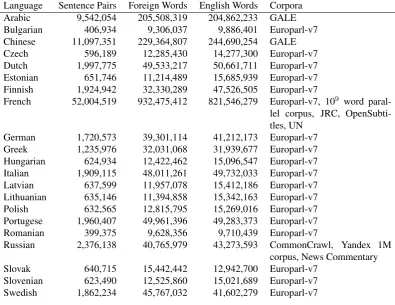
We extract significantly different numbers of paraphrases for each the languages. The number of paraphrases is roughly proportional to the size of the bitext that was used to extract the paraphrases for that language. Figure 3 sorts the languages in order of how many paraphrases we extract for them. Unsurprisingly, we observe a large difference in size between the French, Arabic, and Chinese paraphrase sets, and the others. This is due to the comparatively large bilingual corpora that we used for the three languages, ver-sus the smaller bitexts that we used for the other languages (see Table 2). Table 3 gives a detailed breakdown of the number of each kind of paraphrases (lexical, phrasal, syn-tactic) that we have extracted for each language.
In the future, we hope to incorporate larger parallel cor-pora, taking advantage of improved bitext mining tech-niques (Smith et al., 2013), and we hope to incorporate other pivot languages in addition to English. We expect that these expansions will further improve the coverage and quality of our paraphrase sets for the lower-resource lan-guages.
4.2.
Resource Partitioning
We recognize that our paraphrase collection can feel un-wieldy large, especially for Arabic, French, Chinese, Span-ish, and Russian. We therefore divide the sets into differ-ent sizes. The are named by size: S (small), M (medium), L (large), XL (extra large), XXL (double extra large), and XXXL (Royal with cheese). Each step up in size is de-signed to roughly double the number of paraphrases across each type: lexical, phrasal, and syntactic. The larger sizes subsume the smaller sizes.
Language Sentence Pairs Foreign Words English Words Corpora Arabic 9,542,054 205,508,319 204,862,233 GALE Bulgarian 406,934 9,306,037 9,886,401 Europarl-v7 Chinese 11,097,351 229,364,807 244,690,254 GALE Czech 596,189 12,285,430 14,277,300 Europarl-v7 Dutch 1,997,775 49,533,217 50,661,711 Europarl-v7 Estonian 651,746 11,214,489 15,685,939 Europarl-v7 Finnish 1,924,942 32,330,289 47,526,505 Europarl-v7
French 52,004,519 932,475,412 821,546,279 Europarl-v7, 109 word
paral-lel corpus, JRC, OpenSubti-tles, UN
German 1,720,573 39,301,114 41,212,173 Europarl-v7 Greek 1,235,976 32,031,068 31,939,677 Europarl-v7 Hungarian 624,934 12,422,462 15,096,547 Europarl-v7 Italian 1,909,115 48,011,261 49,732,033 Europarl-v7 Latvian 637,599 11,957,078 15,412,186 Europarl-v7 Lithuanian 635,146 11,394,858 15,342,163 Europarl-v7 Polish 632,565 12,815,795 15,269,016 Europarl-v7 Portugese 1,960,407 49,961,396 49,283,373 Europarl-v7 Romanian 399,375 9,628,356 9,710,439 Europarl-v7
Russian 2,376,138 40,765,979 43,273,593 CommonCrawl, Yandex 1M corpus, News Commentary Slovak 640,715 15,442,442 12,942,700 Europarl-v7
Slovenian 623,490 12,525,860 15,021,689 Europarl-v7 Swedish 1,862,234 45,767,032 41,602,279 Europarl-v7
Table 2: The sizes of the bilingual training data used to extract each language-specific version of PPDB.
Language Code Number of Paraphrases
Lexical Phrasal Syntactic Total Arabic Ara 119.7M 45.1M 20.1M 185.7M Bulgarian Bul 1.3M 1.4M 1.2M 3.9M
Czech Ces 7.3M 2.7M 2.6 12.1M
German Deu 7.9M 15.4M 4.9M 28.3M
Greek Ell 5.4M 9.4M 7.4M 22.3M
Estonian Est 7.9M 1.0M 0.4M 9.2M Finnish Fin 41.4M 4.9M 2.3M 48.6M French Fra 78.8M 254.2M 170.5M 503.5M Hungarian Hun 3.8M 1.3M 0.2M 5.3M Italian Ita 8.2M 17.9M 9.7M 35.8M Lithuanian Lit 8.7M 1.5M 0.8M 11.0M Latvian Lav 5.5M 1.4M 1.0M 7.9M Dutch Nld 6.1M 15.3M 4.5M 25.9M Polish Pol 6.5M 2.2M 1.4M 10.1M Portuguese Por 7.0M 17.0M 9.0M 33.0M Romanian Ron 1.5M 1.8M 1.1M 4.5M
Russian Rus 81M 46M 16M 144.4M
Slovak Slk 4.8M 1.8M 1.7M 8.2M
Slovenian Slv 3.6M 1.6M 1.4M 6.7M Swedish Swe 6.2M 10.3M 10.3M 26.8M Chinese Zho 52.5M 46.0M 8.9M 107.4M
Table 3: An overview over the sizes of the multilingual PPDB. The number of extracted paraphrases varies by language, depending on the amount of data available as well as the languages morphological richness. The language names are coded following ISO 639-2, using the terminology (“T”) code where applicable.
4.3.
Morphological Variants as Paraphrases
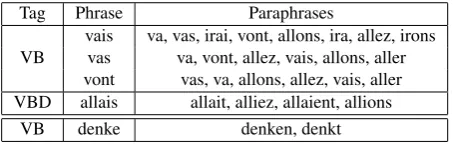
Many of the languages covered by our resource are more morphologically complex than English. Since we are us-ing English pivot phrases and English syntactic labels, the pivoting approach tends to group a variety of
para-enhancements to translation edit rate. Machine Transla-tion, 23(2-3):117–127.
Steinberger, R., Pouliquen, B., Widiger, A., Ignat, C., Er-javec, T., Tufis, D., and Varga, D. (2006). The JRC-Acquis: A multilingual aligned parallel corpus with 20+ languages. InProceedings of LREC, Genoa, Italy. Turney, P. D. and Pantel, P. (2010). From frequency to
meaning: Vector space models of semantics. CoRR, abs/1003.1141.
Vila, M., Mart´ı, M. A., and Rodr´ıguez, H. (2014). Is this a paraphrase? what kind? paraphrase boundaries and ty-pology. Open Journal of Modern Linguistics, 4(01):205. Weese, J., Ganitkevitch, J., Callison-Burch, C., Post, M., and Lopez, A. (2011). Joshua 3.0: Syntax-based ma-chine translation with the Thrax grammar extractor. In
Proceedings of WMT11.
Xu, W., Ritter, A., and Grishman, R. (2013). Gathering and generating paraphrases from twitter with applica-tion to normalizaapplica-tion. InProceedings of the Sixth Work-shop on Building and Using Comparable Corpora, pages 121–128, Sofia, Bulgaria, August. Association for Com-putational Linguistics.
Zhang, Y. and Yamamoto, K. (2002). Paraphrasing of chi-nese utterances. InProceedings of the 19th International Conference on Computational Linguistics - Volume 1, COLING ’02, pages 1–7, Stroudsburg, PA, USA. Asso-ciation for Computational Linguistics.
Zhang, Y. and Yamamoto, K. (2005). Paraphrasing spo-ken chinese using a paraphrase corpus. Nat. Lang. Eng., 11(4):417–434, December.
Zhao, S., Niu, C., Zhou, M., Liu, T., and Li, S. (2008). Combining multiple resources to improve SMT-based paraphrasing model. InProceedings of ACL/HLT. Zhou, L., Lin, C.-Y., Munteanu, D. S., and Hovy, E. (2006).
ParaEval: Using paraphrases to evaluate summaries au-tomatically. InProceedings of HLT/NAACL.