Extrinsic Corpus Evaluation with a Collocation Dictionary Task
Adam Kilgarriff,
1Miloˇs Jakub´ıˇcek,
1,2Vojtˇech Kov´aˇr,
1,2Pavel Rychl´y,
1,2V´ıt Baisa,
1,2Lucia Kocincov´a
21Lexical Computing, Ltd., 71, Freshfield Road, Brighton, UK
2NLP Centre, Faculty of Informatics, Masaryk University, Botanick´a 68a, Brno, Czech Republic [email protected],{jak, xkovar3, pary, xbaisa, xkocinc}@fi.muni.cz
Abstract
The NLP researcher or application-builder often wonders “what corpus should I use, or should I build one of my own? If I build one of my own, how will I know if I have done a good job?” Currently there is very little help available for them. They are in need of a framework for evaluating corpora. We develop such a framework, in relation to corpora which aim for good coverage of ‘general language’. The task we set is automatic creation of a publication-quality collocations dictionary. For a sample of 100 headwords of Czech and 100 of English, we identify a gold standard dataset of (ideally) all the collocations that should appear for these headwords in such a dictionary. The datasets are being made available alongside this paper. We then use them to determine precision and recall for a range of corpora, with a range of parameters.
Keywords:corpus, evaluation, collocation
1.
Cooks and Farmers
Let us talk about food. Cooks prepare the food. It is their skill and ingenuity, their methods and strategies, their in-spiration and imagination, that gives rise to delicacies rare and fine, to tickle the palate and delight the senses. But any cook will say, take care with your ingredients! Make sure the fishes’ eyes sparkle, the tomatoes are plump and firm, the peaches ripe with a rosy hue. No-one can pre-pare a first-rate meal from third-rate ingredients. Be aware of your sources, you want your produce to be from a farmer who cares about quality.
So it is with language technology. Those writing the ap-plications are the cooks, those preparing corpora, the farm-ers. The applications are crucial to the success of the en-terprise. But — and this becomes inescapable as more and more methods are based on learning from data — so too is the quality of the data they are based on.
2.
Introduction
It is twenty years now since the field awoke to the impor-tance of evaluation (Gaizauskas, 1998). This has usually been evaluation of systems, with the playing field leveled by all systems using the same data.
It has also been two decades since the merits of approaches based on data have been explored in earnest. Despite it being the same two decades in each case — and the near-tautology that better input will result in better output — the field still has nothing to say about how to evaluate a corpus. In the 1990s this could be justified by the lack of corpora: when there was only one corpus available, the question ‘how good is it’ was not worth asking. Also the base con-siderations of having data available in a tractable format, with characters correctly encoded and data distinct from metadata, have been priorities, with initiatives such as TEI and many projects described at the LREC conferences fo-cusing on these questions. Corpora have been validated, though not evaluated. But now we are in an age of corpora on demand. The web provides a near boundless supply of
text for a great many languages and text types, so it is easy to make a corpus that may well be good for a particular task. We need methods for evaluating.
In this paper we present a method for evaluating corpora and its implementation for Czech and English.
3.
The Collocation Dictionary Creation Task
A corpus being good is relative to a task: different corpora will be good for different tasks. Many recent initiatives in language technology evaluation pay heed to this base truth with evaluations based on particular use cases.
Still, a well-designed evaluation can be relevant to a broad range of tasks, for two clusters of reasons:
• for most tasks, some criteria hold true
– duplication of content is bad
– junk (including “word salad”, material in a com-puter language, material in the wrong human lan-guage) is bad
– bigger is, all else being equal, better
• many tasks relate to “the language in general”
– NLP tools such as POS-taggers and parsers are often built for “the language in general”
– dictionaries and lexicons are typically for “the language in general”.
Figure 1: Distribution of good collocations in fiftieths, ordered by score.
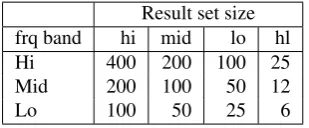
Result set size frq band hi mid lo hl
Hi 400 200 100 25
Mid 200 100 50 12
Lo 100 50 25 6
Table 3: Result set sizes, by frequency band
used to create the candidate set, below. For each corpus, we experimented with the following settings.
• Collocation sorting: by frequency, (fr) or by Dice co-efficient (di).
• How big a result set to examine, for each headword. Clearly, the smaller sets will gain better precision, the bigger sets better recall. We have introduced static constraints, e.g. first 20 or 100 collocates, as well as variable thresholds dependent on the frequency band of the headword, with four possible values, hi, mid, lo, hl, as in Table 3. “-” in the result tables means no restriction, all collocates taken into account.
• the minimum number of hits for a collocation: 3, 5 or 10.
To indicate the parameters for a run, we run these together, e. g., fr/lo/5.
In lexicography recall is a greater challenge than precision. It is not so hard to check data and filter out unwanted items: finding all the instances of interest is much more important. Thus, for the evaluation, we wanted to evaluate both preci-sion and recall, but to give greater weight to recall. To this end we have given scores according to F-5.18 In tables 4 and 5 we present 3 best scores according to precision, re-call and F-5 score. Table 6 contains the best F-5 scores for all English corpora from the testing set.
7.
Discussion
With appropriate settings, we were able to achieve about 90 percent recall (but with very low precisions and high num-bers of extracted collocations) and nearly 60 percent pre-cision (40 for Czech). However, the best prepre-cision results
18F
β = (1 +β2)·(β2precision·precision)+recall·recall , whereβ= 5.
achieve only 11–14 percent recall, so we do not consider them practically usable. The F-5 measure provides a good compromise between these two.
For precision, corpora prepared by careful selection of sources score better, such as the 100 million word BNC or NMCorpus.19 For Czech, the parsed corpora achieved best precision, but the SYN corpus (part of Czech National Corpus, 2.2 billion words) scored well on recall and F-5 measure.
Size matters. Big web corpora are the general winners ac-cording to the F-5 score — namely the 83 billion word en-ClueWeb09, and the enTenTen pair of corpora (3 and 13 billion words), as well as the Czech member of the family, 5 billion word czTenTen. The 2.2 billion word SYN corpus scored also well.
Another important (and surprising) observation is that raw frequency is better than the Dice score for collocation salience estimations — it outperformed the Dice score prac-tically in all important measures.
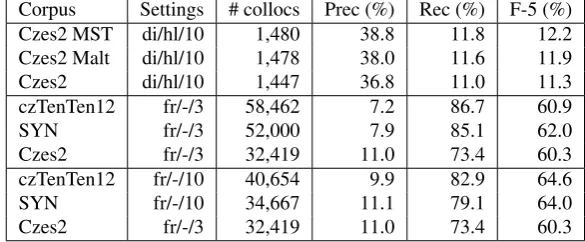
For Czech, parsing slightly helps with precision but has negative impact on recall. According to both recall and F-5, Czes2 processed by the parsers scored worse than the same corpus with the regular expressions grammar. There are only slight differences among the used parsers, as illus-trated by Table 7. It is interesting that the parser scores do not correlate with results of usual parser evaluations, using tree similarities against the Prague Dependency Treebank.
7.1.
Corpora Not Used for Candidate
Generation, and Just-in-Time Evaluation
As OEC was a large, recent, high-quality corpus with a high level of investment, it was initially surprising to see its rather low score. It seemed likely that this was because it had not been used, as a source for generating the colloca-tion candidates.
We explored the hypothesis as follows. For fifty of the En-glish headwords, we identified the twenty highest-scoring collocations found in OEC but which had not occurred with high frequency or salience in the other corpora, so had not
19www.sketchengine.co.uk/documentation/
Corpus Settings # collocs Prec (%) Rec (%) F-5 (%)
BNC fr/hl/10 1,122 58.5 12.3 12.7
Model fr/20/10 969 55.7 10.1 10.5
enTenTen12 fr/hl/10 1,456 52.7 14.4 14.8 enClueWeb09 fr/-/3 89,174 5.4 90.1 56.6 enTenTen12 fr/-/3 66,499 7.2 89.5 62.1 enTenTen08 fr/-/3 52,018 8.9 87.1 65.1 enTenTen12 fr/hi/5 23,113 17.8 77.3 68.5 enTenTen08 fr/hi/3 22,794 18.0 77.1 68.5 enClueWeb09 fr/hi/10 23,651 17.4 77.0 68.0
Table 4: Best results of English evaluation: 3 best according to precision, 3 best according to recall and 3 according to F-5.
Corpus Settings # collocs Prec (%) Rec (%) F-5 (%) Czes2 MST di/hl/10 1,480 38.8 11.8 12.2 Czes2 Malt di/hl/10 1,478 38.0 11.6 11.9
Czes2 di/hl/10 1,447 36.8 11.0 11.3
czTenTen12 fr/-/3 58,462 7.2 86.7 60.9
SYN fr/-/3 52,000 7.9 85.1 62.0
Czes2 fr/-/3 32,419 11.0 73.4 60.3
czTenTen12 fr/-/10 40,654 9.9 82.9 64.6
SYN fr/-/10 34,667 11.1 79.1 64.0
Czes2 fr/-/3 32,419 11.0 73.4 60.3
Table 5: Best results of Czech evaluation: 3 best according to precision, 3 best according to recall and 3 according to F-5.
been in the original candidate set. We then asked the same three judges to judge these items.
Of 984 collocations judged, 187 (19%) were judged good by at least two of the three judges. This ‘overall good’ rate is close to the rate for the original candidate set. The hy-pothesis that OEC scored badly because it was not used as a source for the original candidate list is confirmed. As it stands, the gold standard dataset only serves to evaluate those corpora that have been used to build the candidate set. As explored above, adding to the candidate set by showing the judges more candidates from existing corpora will find few additional collocations. However showing them addi-tional candidates from other corpora will find many. This is in keeping with a common finding in corpora: the more you look, the more you find.20
It suggests an extension to the framework to support evalu-ation of additional corpora: a ‘just-in-time’ method where we identify those candidates that would have been in the collocation set, had the corpus been included originally, and show them to judges. Then we can use the extended gold-standard to compare the new corpus with the original set. Had we included OEC amongst the original corpora (and allowed the candidate set sizes to extend beyond 500, 250, 125), then we would have replaced 3254 items in the can-didate set. For the modest cost of getting additional judge-ment on (in this case) 3254 candidates, we can include an extra corpus in the set to be compared.
20
There is one other explanation to be explored: that judges make their judgements relative to the candidate set they are shown, so will use tighter criteria if shown a better candidate set and more relaxed ones if shown a worse one. We shall be covering this possibility in future work.
8.
Conclusion and Further Work
Corpus evaluation is critical to the progress of the field. Cleverer and cleverer programs operating on the same old flawed data will not get us far, but we will only know it is flawed if we can evaluate it. We have presented an approach to evaluating general-language corpora based around the question “how good is this corpus for creating a publication-quality collocations dictionary?”. For 100 headwords of Czech, and 100 of English, expert judges identified (as far as possible) all the collocations that should go into such a dictionary, and this gold standard set, which has been included with the paper, was then used to evaluate a set of corpora for each language.
Our original, most optimistic hope was that we might gather a complete set of ‘good’ collocations for the headwords. This turned out to be unrealistic because
• if we showed judges more candidates from the same corpora, they found more collocations (though with diminishing returns)
• if we showed judges more candidates from new cor-pora, they found more collocations.
This weakens our claims to establish recall, but still allows us to compare corpora. To compare an additional corpus to the ones used to prepare the candidate set, we send extra collocations to the judges for just-in-time evaluation. Now that we have the framework, we (and, we hope, others) shall use it in a number of ways:
• to set parameters for data cleaning and deduplication, in our corpus-building
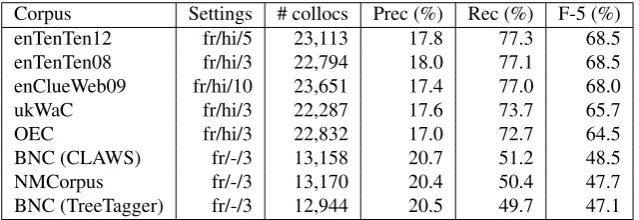
Corpus Settings # collocs Prec (%) Rec (%) F-5 (%) enTenTen12 fr/hi/5 23,113 17.8 77.3 68.5 enTenTen08 fr/hi/3 22,794 18.0 77.1 68.5 enClueWeb09 fr/hi/10 23,651 17.4 77.0 68.0
ukWaC fr/hi/3 22,287 17.6 73.7 65.7
OEC fr/hi/3 22,832 17.0 72.7 64.5
BNC (CLAWS) fr/-/3 13,158 20.7 51.2 48.5
NMCorpus fr/-/3 13,170 20.4 50.4 47.7
BNC (TreeTagger) fr/-/3 12,944 20.5 49.7 47.1
Table 6: Best results for each of the English corpora, according to F-5.
Corpus Settings # collocs PDT score (%) Prec (%) Rec (%) F-5 (%)
Czes2 fr/-/3 32,419 N/A 11.0 73.4 60.3
Czes2 SET fr/-/3 35,729 56.0 9.7 71.2 57.2
Czes2 Synt fr/-/3 18,708 N/A 15.5 59.9 54.0
Czes2 MST fr/-/3 32,581 84.7 10.5 70.5 57.8
Czes2 Malt fr/-/3 32,471 85.8 10.5 70.2 57.6
Table 7: Comparison of Czech parsers using collocation extraction, and using dependency precision against Prague Depen-dency Treebank (PDT). Settings selected according to best F-5 score.
• to compare different processing chains
• to evaluate grammars.
9.
Acknowledgements
This work has been partly supported by the Ministry of Ed-ucation of the Czech Republic within the LINDAT-Clarin project LM2010013 and by the Ministry of the Interior of the Czech Republic within the project VF20102014003.
10.
References
Benson, M., Benson, E., and Ilson, R. (2010). The BBI Combinatory Dictionary of English, 3rd edition. John Benjamins.
Crowther, J., Dignen, S., and Lea, D. (2002). Oxford Col-locations Dictionary for Students of English. Oxford University Press.
Ferraresi, A. and Zanchetta, E. (2008). Introducing and evaluating ukWaC, a very large web-derived cor-pus of English. In Proceedings of the Sixth Interna-tional Conference on Language Resources and Evalua-tion (LREC’08), Marrakech, Morocco. European Lan-guage Resources Association (ELRA).
Gaizauskas, R. (1998). Evaluation in language and speech technology. Journal of Computer Speech and Language, 12(3):249–262.
Hajiˇc, J., Votrubec, J., Krbec, P., Kvˇetoˇn, P., et al. (2007). The best of two worlds: Cooperation of statistical and rule-based taggers for Czech. In Proceedings of the Workshop on Balto-Slavonic Natural Language Process-ing: Information Extraction and Enabling Technologies, pages 67–74. Association for Computational Linguistics. Hajiˇc, J. (2006). Complex corpus annotation: The Prague dependency treebank. Insight into the Slovak and Czech Corpus Linguistics, page 54.
ICNC. (2000–2013). Czech National Corpora – SYN,
SYN2000, SYN2005, SYN2006PUB, SYN2009PUB,
SYN2010. Institute of Czech National Corpus, Faculty of Arts, Charles University, Prague, Czech Republic. Avail-able online atwww.korpus.cz.
Jakub´ıˇcek, M., Kov´aˇr, V., and Hor´ak, A. (2009). Min-ing phrases from syntactic analysis. InLecture Notes in Artificial Intelligence, Proceedings of Text, Speech and Dialogue 2009, pages 124–130, Plzeˇn, Czech Republic. Springer-Verlag.
Jakub´ıˇcek, M. and Kov´aˇr, V. (2010). CzechParl: Corpus of stenographic protocols from Czech parliament.RASLAN 2010 Recent Advances in Slavonic Natural Language Processing, page 41.
Kilgarriff, A., Rychl´y, P., Smrˇz, P., and Tugwell, D. (2004). The Sketch Engine. Information Technology, 105:116. Kilgarriff, A., Kov´aˇr, V., Krek, S., Srdanovi´c, I., and
Tiberius, C. (2010). A quantitative evaluation of word sketches. In Proceedings of the XIV Euralex Interna-tional Congress, Leeuwarden: Fryske Academy.
Kilgarriff, A., Rychl´y, P., Kov´aˇr, V., and Baisa, V. (2012). Finding multiwords of more than two words. In Pro-ceedings of the 15th EURALEX International Congress, pages 693–700.
Kov´aˇr, V., Hor´ak, A., and Jakub´ıˇcek, M. (2011). Syntac-tic analysis using finite patterns: a new parsing system for Czech. Human Language Technology. Challenges for Computer Science and Linguistics, pages 161–171. Krenn, B., Evert, S., et al. (2001). Can we do better than
frequency? A case study on extracting pp-verb colloca-tions. InProceedings of the ACL Workshop on Colloca-tions, pages 39–46.
A data-driven parser-generator for dependency parsing. In Proceedings of the 5th international conference on Language Resources and Evaluation (LREC 2006), vol-ume 6, Genoa, Italy. European Language Resource As-sociation, Paris.
Rundell, M. (2010). Macmillan Collocations Dictionary. Macmillan.
Schmid, H. (1994). Probabilistic part-of-speech tagging using decision trees. In Proceedings of international conference on new methods in language processing, vol-ume 12, pages 44–49. Manchester, UK.
ˇSmerk, P. (2004). Unsupervised Learning of Rules for Morphological Disambiguation. InLecture Notes in Ar-tificial Intelligence 3206, Proceedings of Text, Speech and Dialogue 2004, pages 211–216, Berlin. Springer-Verlag.
ˇSmerk, P. (2008). Towards Czech morphological guesser.