Computational Linguistics and Chinese Language Processing
Vol. 7 , No. 2, August 2002, pp. 37-58
The Association for Computational Linguistics and Chinese Language Processing
A Study on Word Similarity using Context Vector
Models
Keh-Jiann Chen
*, Jia-Ming You
*Abstract
There is a need to measure word similarity when processing natural languages, especially when using generalization, classification, or example -based approaches. Usually, measures of similarity between two words are defined according to the distance between their semantic classes in a semantic taxonomy . The taxonomy approaches are more or less semantic -based that do not consider syntactic similarit ies. However, in real applications, both semantic and syntactic similarities are required and weighted differently. Word similarity based on context vectors is a mixture of syntactic and semantic similarit ies.
In this paper, we propose using only syntactic related co-occurrences as context vectors and adopt information theoretic models to solve the problems of data sparseness and characteristic precision. The probabilistic distribution of co-occurrence context features is derived by parsing the contextual environment of each word , and all the context features are adjusted according to their IDF (inverse document frequency) values. The agglomerative clustering algorithm is applied to group similar words according to their similarity values . It turns out that words with simila r syntactic categories and semantic classes are grouped together.
1. Introduction
It is well known that word -sense is defined by a word ’s co -occurrence context. The context vectors of a word are defined as the probabilistic distributions of its left and right co-occurrence contexts . Conventionally , the similarity between two context vectors is measured based on their cosine distance [Alshawi and Cater, 1994; Grishman and Sterling, 1994; Pereira et al., 1993; Ruge, 1992; Salton, 1989]. However, the conventional measurement
*
Institute of Information Science, Academia Sinica
K. Chen, J. You
suffers from the following drawbacks . First of all, the information in the context vectors is vague. All co -occurrence words are collected without distinguishing whether they are syntactically or semantically related. Second, the coordinates are not pair-wise independent (i.e., the axes are not orthogonal) , and it is hard to apply singular value decomposition to find the orthogonal vectors [Schutze, 1992]. In this paper, we propose to use only syntactic related co-occurrences as context vectors [Dekang Lin, 1998] and adopt information theoretic models to solve the above problems. In our study, the context vectors of a word are defined as the probabilistic distributions of its thematic roles and left/right co -occurrence semantic classes. The context features are derived from a treebank. All context features are weighted according to their TF
×
IDF values (the product of the term frequency and inverse document frequency) [Salton, 1989]. For the context features, the Cilin semantic classes (a Chinese thesaurus) are adopted. The Cilin semantic classes are divided into 4 different levels of granularity. In order to cope with the data sparseness problem, the weighted average of the similarity values at four different levels will be the similarity measure of two words. The weight for each level is equal to the information-content of that level[Shannon, 1948; Manning and Schutze 1999].A agglomerative clustering algorithm is applied to group similar words according to the above defined similarity measure. Obviously, words with similar behavior in the corpus will be grouped together. We have compared the clustering result s to the Cilin classifications. It turns out that words in the same synonym class and with the same syntactic categories have higher similarity values than the words with different syntactic categories.
2. Data Resources
Ideally, to derive context vectors, a large corpus with semantic tags is required. Furthermore, to extract co-occurrence words along with their exact syntactic and semantic relations, the corpus structure has to be annotated. However, such an idea l corpus does not exist. Therefore, in this paper we will adopt the resources that are available and try to derive a useful but imperfect Chinese tree bank. Since the similarity measure based on the vector space model is a rough estimation, minor errors made at the stage of context vector extraction are acceptable.
2.1 Sinica Corpus
The Sinica corpus contains 12,532 documents and nearly 5 million words. Each sentence in the corpus was parsed by a rule parser [Chen, 1996]. The parsed trees were tagged with the structure brackets , syntactic categories and thematic roles of each constituent [Huang et al., 2000] as exemplified below, (Sinica corpus: http://www.sinica.edu.tw/ftms -bin/kiwi.sh):
Original sentence: ‘small’ ‘dog’ ‘dance’
A Study of Word Similarity by Context Vector Models
Although these labels may not be exactly correct, we believe that, even with these minor errors, the majority of word -to-word relations extracted from the trees are correct. However, the semantic label is not provided for each word in the parsed trees. In this paper, we will use Cilin classifications for semantic labeling.
2.2 Cilin- a Chinese Thesaurus
Cilin provides the Mandarin synonym sets in a hierarchical structure [M ei et. al., 1984]. It contains 51,708 Chinese words, and 3918 classes. There are five levels in the Cilin semantic hierarchy, denoted in the format L1-L2-L3-L4-L5. For example, the Cilin class of the word ‘we’ is “A -a-02-2-01”. In level 1, “A”, denotes the semantic class of human; in level 2, “a”, indicates a group of general terms; level 3, “02”, means pronouns in the first person, and in level 4, “2” represents the plural property. In level 5, “01” represents the order rank in the level 4 group. Th is means that “01” in level 5 is the first prototypical concept representation of “A-a -02-2”. In the rest of this paper, only the first four levels will be used. The fifth level is for sense disambiguation only (section 2.3).
2.3 Sense Disambiguation
A polysemous word has more than one Cilin semantic class. In order to tag appropriate Cilin classes, we have designed a simple sense tagging method as follows [Wilks, 1999]. The sense tagging algorithm is based on the facts that the syntactic categories of each word in the tree bank are assigned uniquely , and that each Cilin class has its own major syntactic category. If a word has mult iple Cilin classes, we select the sense class whose major syntactic category is the same as the tagged category of this word. For example , “Jie -Hwa” has two meanings. One is for “project” as a noun and the other is “attempt”, therefore, if “Jie -Hwa” was tagged with a noun category, we will assign the Cilin class whose major category is “project”. Sense ambiguity can be distinguished by measure of syntactic properties for most words. However, there are still cases in which the syntactic category constraints cannot resolve the sense ambiguities . Then, we simply choose the prototypical sense class, i.e, the word that has the highest rank in this sense class with respect to all its sense classes in Cilin.
2.4 The Extraction of Co-occurrence Data
The extracted syntactically related pairs have either a head -modifier relation or head -argument relation. For instance, two syntactically related pairs extracted from the e xample in section 2.1 are:
K. Chen, J. You
(property E-a-03-3 ‘small’), (Head(NP) B-i-07-2 ‘dog’)
The context data of the word1 “dog” consists of its thematic role “agent” and the Cilin class “B-i-07-2” ; the word2 ‘dance’ consists the thematic role “Head(S)” and the Cilin class “H-h -04-2” and so on. The word “small” and “dance” are not syntactically related even though they co-occur. Therefore , they will not be extracted.
3. Context Vector Model
There are three context vectors of a word: role vector, left context vector and right context vector. The role vector is a fixed 48-dimension vector, and each dimension value is equal to the probabilistic distribution of its thematic roles. The left/right context vectors are closer to the probabilistic distributions of its left/right co-occurrence words and their semantic classes. The role vector characterizes a word based more on syntax and less on semantics, but the left/right context vectors are just the opposite. The cosine distance between their context vectors is a measure of the similarity of the two words. We will illustrate the derivations of context vectors and their similarity rating with a simplified example using ( “cat”, “dog”). The role vector of “dog” is {127, 207, 169… , 0}48, which represents the values of “agent”, “goal”, “theme”… and “topic” respectively , generated by Equation (1). The role vector of “cat” is {28, 73, 56… , 0}48, which is also acquired by Equation (1).
Role vector of word W = { V1, V2,… ,V48 }48
Vi = Frequency (Ri)
×
log (1/Pi) (1)Ri: We label thematic roles “agent”, “goal”… and “topic” from R1 to R48 listed in Table2 in the Appendix.
Frequency (Ri): The frequency of Ri played by word W in the corpus.
Pi: = Total frequency of Ri in the corpus / Total frequency of all roles in the corpus. log(1/Pi): The information–context of Ri [Shannon, 1948; Manning and Schutze, 1999]
A Study of Word Similarity by Context Vector Models
word has different information content and two words that have the same co-occurrence semantic classes may not share the same co-occurrence words. In order to resolve the above dilemma, when we compare the similarity between wordX and wordY, 4 levels of left context vectors and right context vectors for wordX and wordY are created1. The weighting of each feature dimension is adjusted using the TF*IDF value if wordX and wordY have shared context words. Equation (2) illustrates the creation of the 4th level left context vector of wordX. The other context vectors for wordX and wordY are created by a similar way.
Left context vector of wordX = {f1, f2,… ,f3918 }L4
Where fi = Sum of
{ TF(wordj)
×
IDF(wordj) if wordX has the same neighbor wordj with wordY TF(wordj) if wordX does not have the s ame neighbor wordj withwordY
} ; for every left co-occurrence wordj with the ith Cilin semantic class. (2) TF(wordj): the frequency of pair ( wordj, Cilin(wordj) ) in wordx’s co-occurrence context.
IDF(wordj): -log(the number of the documents that contains the wordj/total document number
of the corpus)
In Equation (2), we adjust the term weight using TF
×
IDF, which is commonly used in the field of information retrieval [Salton, 1989] to adjust the discrimination power of each feature dimension. We will examine the difference in the adjustment of weights using TF×
IDF and TF in section 4.2. We will next give a simplified example. Assume that the word “dog” has only three left syntactic ally related words: ( “small” Ea033 ) with frequency 30, ( “cute” Ed401 ) with frequency 5 and ( “raise” Ib011 ) with frequency 10; and assume that the word “cat” has only two left syntactic ally related words: ( “black” Ec043 ) and ( “raise” Ib011 ). Assume that we are measuring the similarity between “dog” and “cat”. Then, we can compute the left context data of “dog” as {TF(Aa011), … ,TF(Ea033), … ,TF(Ed041), … ,TF(Ib011)×
IDF( ‘raise’)2, … , TF(La064) }L431
IDF( ’raise’) = 4.188, the IDF values of all words range from 0.19 to 9.12.
2
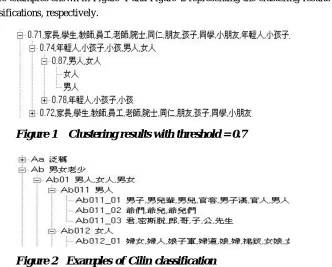
The granularities of the 4 levels of semantic classes are partially shown in Figure2. The four left context vectors and their dimensions are shown below and the right context vectors are similarly derived.
<LeftCilin1>L1 A vector of 12 dimensions from “A” to “L”.
<LeftCilin2>L2 A vector of 94 dimensions from “Aa” to “La”.
<LeftCilin3>L3 A vector of 1428 dimensions from “Aa01” to “La06”.
K. Chen, J. You
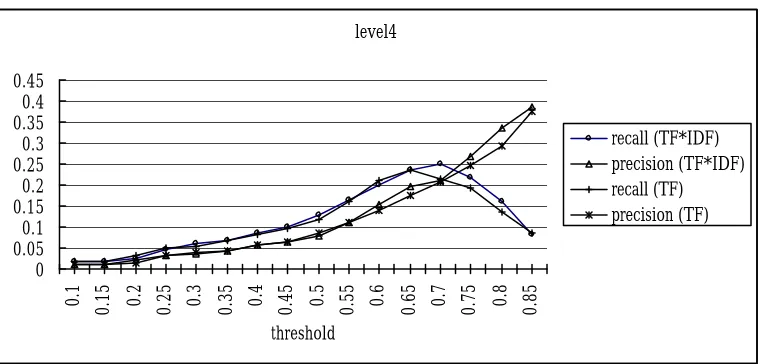
them, 342 classes contained only one testing word, and the classes with multiple testing words contained a total of 658 testing words. With the threshold=0.7, our method clustered 830 words, and only 167 words of them were clustered in the correct Cilin class. Therefore, by Equation (5), recall 4 = 167/658 = 0.25 and with Equation (6) precision 4 = 167/830 = 0.20.
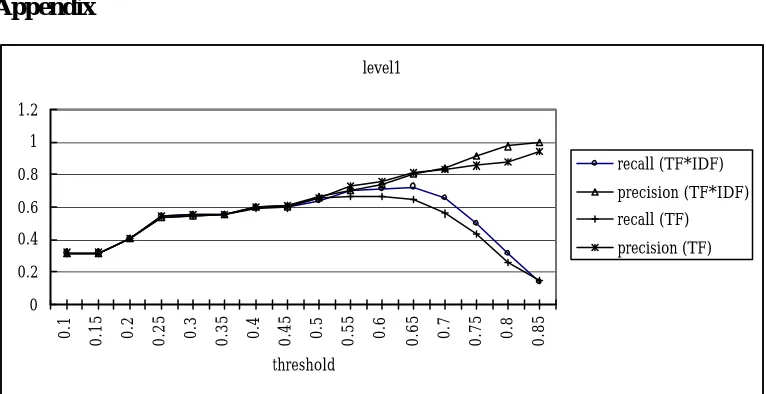
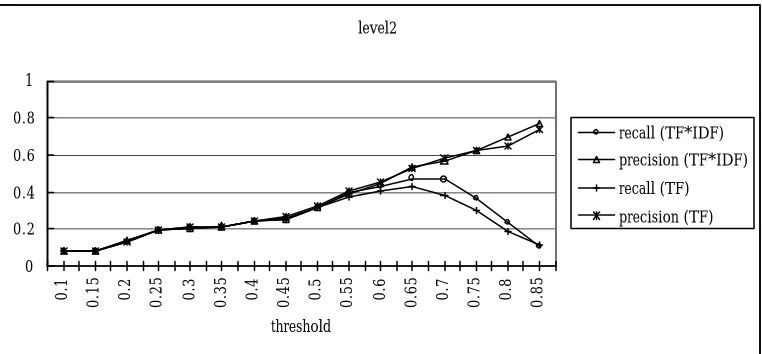
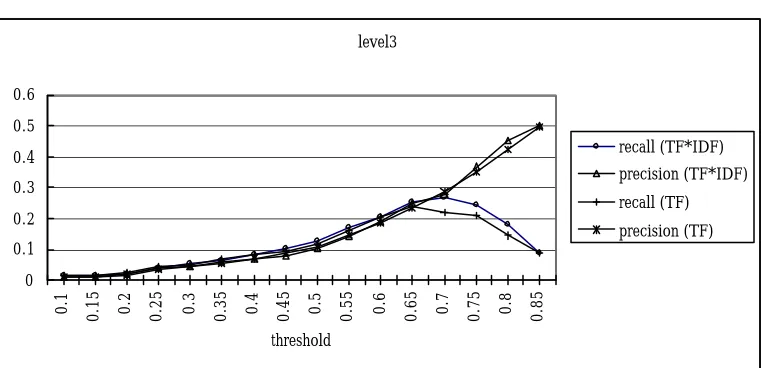
We adopted two methods for measuring similarity; one used Equation TF
×
IDF, and the other used Equation TF. The results are shown in Figure 3 to Figure 6 in the Appendix. We measured the performance by computing the F-score, which is (recall+precision)/2. We discovered that the best F-score of level1 was that 0.7648 located at a threshold equal to 0.65, the best F-score of level2 was that 0.5178 located at a threshold equal to 0.7, the best F-score of level3 was that 0.3165 located at a threshold equal to 0.8, and that the best F-score of level4 was that 0.2476 located at a the threshold equal to 0.8. All were obtained using TF×
IDF stra tegy.Hence, we can see that the TF×
IDF equation achieves better performance than the TF equation does. We list the detaile d F-socre data for various parameters in appendix. Although the clustering results didn’t fit Cilin completely, they are still alike to some degree. From the results, we find that they are similar to syntax taxonomy under a lower threshold and close to semantic taxonomy under higher thresholds.5. Cilin classifications re -examined
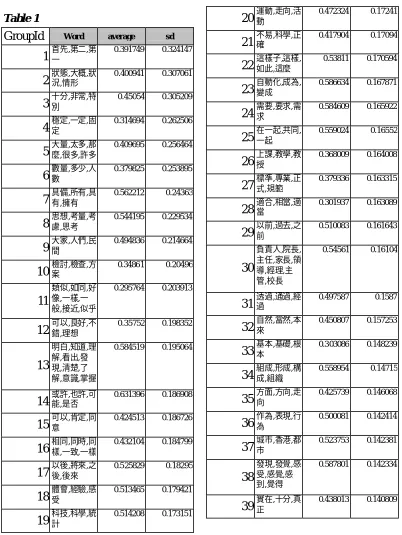
To examine the practicability of our proposed method, we also inspected the similarity values of these 658 testing words which were clustered into 117 4th level Cilin classes. For each semantic class, the average similarity between words in the class and their standard deviation was comp uted. The results are listed in Table1 in the Appendix. We expected that synonyms would have high similarity values, but this was not always the case.
According to the assumption noted above, synonyms might have similar syntactic and semantic contexts in language use. Therefore, the average similarity should be pretty high, and the standard deviation should be quite low. However, some of the results didn’t follow the assumption. We analyze d the data offer explanations in the following.
a) Synonyms with d ifferent POS: Words with the same semantic classification in Cilin could have different parts of speech (POS). (as shown below.)
Word set Average similarity Stand deviation ,
,
0.544195 0.229534
A Study of Word Similarity by Context Vector Models
similarity value was quite low, and the standard deviation was very high. A fter we remo ved the noun from the word -set, we recomputed the values and obtained the table shown below:
Word set Average similarity Stand deviation
, 0.770616 0.0429353
The results conform to our assumption. They also reveal that the context of synonyms may vary from POS to POS.
b) Error in Cilin Classification: The classifications in Cilin could be arbitrary. For example, the three words, “quantity”, “how many” and “the number of people”, were classified in a Cilin group. They might be slightly related, but grouping them together seems inappropriate according to the following table:
Word set Average similarity Stand deviation
, 0.379825 0.253895
c) Different uses: Differences in their usage cause synonyms to behave differently . For example, when we measure d the similarity of “America” to “Japan” and to “China”, the result s we obtained were 0.86 and 0.62,respectively, for each pair. Accroding to human intuition, they simply refer to names of countries and should not have such different similarity values. The reason for these result is that the corpus we adopted is an original Taiwan corpus. As a result , the usage of “China” is different from that of “America” and “Japan”.
d) Polysemy: The word senses that Cil in adopted were not those frequently used in the corpus. See the following table:.
Word set Average similarity Stand deviation
, ,
K. Chen, J. You
e) Words with similar contexts might not be synonyms: A disadvantage does exist when the context vector mode l is used. Words that are similar in terms of their context s might not be similar in meaning. For example, the similarity value of “marry” and “grow” is 0.8139. Although the two words have similar contexts , they are not alike in meaning. Therefore , the vector space model should incorporate the taxonomy approach to solve this phenomenon.
6. Conclusions
In this paper, we have adopted the context vector model to measure word similarity. The following new features have been proposed to enhance the context vector models : a) The weights of features are adjusted by applying TF
×
IDF. b) Feature vectors are smoothed by using Cilin categories to reduce data sparseness. c) Syntactic and semantic similarity is balanced by using related syntactic contexts only.The performance of our method might have been influenced by the small scale of the Chinese corpus and accuracy of the extracted relations. Further more, Cilin was published a long time ago and has not been update recently, which may have influenced our result s. However, our experimental results are encouraging. They supports the theory that using context vectors to measure similarity is feasible and worthy of further research.
References
Alshawi and Carter (1994) “Training and scaling preference functions for disambiguation.” Computational Linguistics,20(4):635-648
Chen, K.J. (1996) “A Model for Robust Chinese Parser”, Computational Linguistics and Chinese Language Processing, Vol. 1, pp.183 -204.
Grishman and Sterling (1994) “Generalizing automatically generated selectional patterns.” In Proceeding of COLING-94, pages 742-747, Kyoto, Japan.
Huang, Chu-ren, F.Y. Chen, Keh-Jiann Chen, Zhao -ming Gao, and Kuang-Yu Chen (2000) ” Sinica Treebank: Desigm Criteria, Annotation Guidelines and On -line Interface”, Proceedings of ACL workshop on Chinese Language Processing, pp.29-37.
Lin, Dekang(1998) “Automatic Retrieval and Clustering of Simila r Words” COLING-ACL98, Montreal, Canada.
Manning, Christopher D. & Hinrich Schutze (1999) Foundations of Statistical Natural Language Processing, the MIT Press, Cambridge, Massachusetts.
Mei, Gia-Chu etc., 1984 .(Cilin - thesaurus of Chinese words). Ho ng Kong, .
A Study of Word Similarity by Context Vector Models
Salton, Gerard (1989) Automatic Text Processing: The Transformation, Analysis, and Retrieval of Information by Computer, Reading, MA: Addison Wesley.
Ruge (1992) “Experiments on linguistically based term associations.” Information Processing & Management, 28(3):317-332
Schutze, Hinrich (1992) “ Context Space”, In Robert Goldman, Peter Norvig, Eugene Charniak, and Bill Gale (eds.), Working Notes of the AAAI Fall Symposium on Probabilistic Approaches to Natural Language, pp. 113-120, Menlo Park, CA. AAAI Press.
Shannon, Claude E. (1948) “A Mathematical Theory of Communication”, Bell System Technical Journal 27: pp. 39-423, 623-656.
K. Chen, J. You
Appendix
Figure 3 Clustering recall and precision at levels one of Cilin’s semantic hierarchy
A Study of Word Similarity by Context Vector Models
Figure 4 Clustering recall and precision at levels two of Cilin’s semantic hierarchy
K. Chen, J. You
Figure 5 Clustering recall and precision at levels three of Cilin’s semantic hierarchy
A Study of Word Similarity by Context Vector Models
Figure 6 Clustering recall and precision at levels four of Cilin’s semantic hierarchy
K. Chen, J. You
Table 1
GroupId
Word average sd1
, , 0.391749 0.3241472
, , ,0.400941 0.307061
3
, , 0.45054 0.3052094
, , 0.314694 0.2625065
, , , , 0.409695 0.2564646
, , 0.379825 0.2538957
, , , 0.562212 0.243638
, , , 0.544195 0.2295349
, , 0.494836 0.21466410
, , 0.34861 0.2049615
, , 0.424513 0.18672616
, , , ,0.432104 0.184799
17
, , ,0.525829 0.18295
18
, , 0.513465 0.17942119
, , 0.514208 0.17315120
, , 0.472324 0.1724121
, , 0.417904 0.1709422
, , ,0.53811 0.170594
23
, , 0.586634 0.16787124
, , 0.584609 0.16592225
, , 0.559024 0.1655226
, , 0.368009 0.16400827
, , ,0.379336 0.163315
28
, , 0.301937 0.16308929
, , 0.510083 0.16164330
32
, , 0.450807 0.15725333
, , 0.303086 0.14823934
, , ,0.558954 0.14715
35
, , 0.425739 0.14606836
, , 0.500081 0.14241437
, , 0.523753 0.14238138
, ,
, ,
,
0.587801 0.142334
A Study of Word Similarity by Context Vector Models
42
, , 0.684297 0.13078543
, , 0.343657 0.12527744
, , 0.607148 0.12404845
, , 0.566784 0.12368746
, , 0.680776 0.12356647
52
, , 0.632536 0.12017653
, , , 0.219618 0.11957754
, , 0.303831 0.1149355
, , 0.482776 0.11203356
57
, , 0.498764 0.10799658
, , 0.425274 0.10762759
, , ,0.677721 0.106543
60
, , 0.480778 0.10046961
, , , ,0.660711 0.100259
62
, , 0.480646 0.099589963
, ,
, ,
0.740326 0.0986638
64
, , 0.317419 0.098477865
, , 0.265376 0.097706866
72
, , 0.698804 0.092632573
, , 0.399523 0.090210474
, , , 0.647893 0.088078375
, , 0.628407 0.085970876
, , , 0.650257 0.0853656
K. Chen, J. You
79
, , 0.749471 0.083402880
, , ,0.752641 0.0789966
81
, , 0.729664 0.078176982
, , ,0.687431 0.0758984
83
, , 0.507651 0.075164684
, ,
, ,
,
0.682376 0.0736292
85
, , 0.592294 0.072439486
, , ,0.750708 0.072335
87
, , 0.71814 0.069160388
, , ,0.772821 0.0680632
89
, , ,0.789036 0.067304
90
, , 0.601009 0.065873991
, , 0.716424 0.065592492
, ,
, ,
0.731575 0.0652677
93
, , 0.717764 0.062185894
, , 0.669031 0.060123395
, , ,0.699484 0.0595996
96
, , ,0.763711 0.0577985
97
, , 0.632963 0.056231698
, , 0.39034 0.055879399
, , 0.712853 0.0544218100
, , ,0.681406 0.0539913
101
, , 0.377922 0.0531331102
, , 0.646048 0.0524472103
, , ,106
, , 0.69697 0.0466416107
, , 0.482305 0.0457521108
, , 0.741531 0.043475109
,, ,0.716108 0.0425544
110
, , ,0.67785 0.0397466
111
, , 0.57837 0.0380475112
, , 0.111716 0.035438113
, , 0.656953 0.0284353114
, , 0.594345 0.0275148115
, , 0.470312 0.0273891116
, , 0.405597 0.023535A Study of Word Similarity by Context Vector Models
Table2