1186
Understanding Neural Machine Translation by Simplification:
The Case of Encoder-free Models
Gongbo Tang1 Rico Sennrich2,3 Joakim Nivre1
1Department of Linguistics and Philology, Uppsala University 2School of Informatics, University of Edinburgh 3Institute of Computational Linguistics, University of Zurich
firstname.lastname@{lingfil.uu.se, ed.ac.uk}
Abstract
In this paper, we try to understand neu-ral machine translation (NMT) via sim-plifying NMT architectures and training free NMT models. In an encoder-free model, the sums of word embeddings and positional embeddings represent the source. The decoder is a standard Trans-former or recurrent neural network that directly attends to embeddings via atten-tion mechanisms. Experimental results show (1) that the attention mechanism in encoder-free models acts as a strong fea-ture extractor, (2) that the word embed-dings in encoder-free models are compet-itive to those in conventional models, (3) that non-contextualized source represen-tations lead to a big performance drop, and (4) that encoder-free models have dif-ferent effects on alignment quality for German→English and Chinese→English.
1 Introduction
Neural machine translation (NMT) (Kalchbrenner and Blunsom, 2013;Sutskever et al., 2014; Bah-danau et al.,2015;Luong et al.,2015) has emerged in the last few years and has achieved new state-of-the-art performance. However, NMT models are black boxes for humans and are hard to interpret. NMT models employ encoder-decoder architec-tures where an encoder encodes source-side sen-tences and an attentional decoder generates target-side sentences based on the outputs of the encoder. In this paper, we attempt to obtain a more inter-pretable NMT model by simplifying the encoder-decoder architecture. We train encoder-free mod-els where the sums of word embeddings and si-nusoid embeddings (Vaswani et al., 2017) repre-sent the source. The decoder is a standard
Trans-former (Vaswani et al., 2017) or recurrent neural network (RNN) that attends to embeddings via at-tention mechanisms.
As motivation for our architecture simplifica-tion, consider the attention mechanism1 ( Bah-danau et al.,2015;Luong et al.,2015), which has been introduced to extract features from the hid-den representations in encoders dynamically. At-tention and alignment were initially used inter-changeably, but it was soon discovered that the attention mechanism can behave very differently from traditional word alignment (seeGhader and Monz,2017;Koehn and Knowles,2017). One rea-son for this discrepancy is that the attention mech-anism operates on representations that potentially includes information from the whole sentence due to the encoder’s recurrent or self-attentional archi-tecture. Intuitively, bypassing these encoder lay-ers and attending word embeddings directly could lead to a more alignment-like, and thus predictable and interpretable behavior of the attention model.
By comparing encoder-free models with con-ventional models, we can better understand the working mechanism of NMT, figure out which components are more crucial, and learn lessons for improvement. Experimental results show that there is a significant gap between the two models. We focus on exploring what leads to the big gap.
As the embeddings in encoder-free Transform-ers (Trans-noEnc) are only influenced by atten-tion mechanisms, without the help of encoders, we hypothesize that the quality of embeddings leads to the gap between Transformers and Trans-noEncmodels. Thus we conduct both qualitative and quantitative evaluations of the embeddings from Transformers andTrans-noEncmodels. We also hypothesize that the attention distribution in Trans-noEncis not spread out enough for
extract-1We refer to the encoder-decoder attention mechanism
ing contextual features. However, we find that word embeddings and attention distributions are not the major reasons causing the distinct gap. We further explore NMT encoders. We find that even NMT models with one layer encoder get signifi-cant improvement compared to encoder-free mod-els which indicates that non-contextualized source representations lead to the evident gap.
In encoder-free models, the attention attends to source embeddings rather than hidden represen-tations fused with the context. We hypothesize that encoder-free models generate better ments than default models. We evaluate the align-ments generated on German→English (DE→EN) and Chinese→English (ZH→EN). We find that encoder-free models improve the alignments for DE→EN but worsen the alignments for ZH→EN.
2 Related Work
2.1 Understanding NMT
The attention mechanism has been introduced as a way to learn an alignment between the source and target text, and improves encoder-decoder models significantly, while also providing a way to inter-pret the inner workings of NMT models. However, Ghader and Monz(2017) andKoehn and Knowles (2017) have shown that the attention mechanism is different from a word alignment. While there are linguistically plausible explanations in some cases – when translating a verb, knowledge about the subject, object etc. may be relevant informa-tion – other cases are harder to explain, such as an off-by-one mismatch between attention and word alignment for some models. We suspect that such a pattern can be learned if relevant information is passed to neighboring representations via recur-rent or self-attentional connections.
Ding et al. (2017) show that only using atten-tion is not sufficient for deep interpretaatten-tion and propose to use layer-wise relevance propagation to better understand NMT.Wang et al.(2018) replace the attention model with an alignment model and a lexical model to make NMT models more inter-pretable. The proposed model is not superior but on a par with the attentional model. They clarify the difference between alignment models and at-tention models by saying that that the alignment model is to identify translation equivalents while the attention model is to predict the next target word.
In this paper, we try to understand NMT by
sim-plifying the model. We explore the importance of different NMT components and what causes the performance gap after model simplification.
2.2 Alignments and Source Embeddings
Nguyen and Chiang (2018) introduce a lexical model to generate a target word directly based on the source words. With the lexical model, NMT models generate better alignments. Kuang et al. (2018) propose three different methods to bridge source and target word embeddings. The bridging methods can significantly improve the translation quality. Moreover, the word alignments generated by the model are improved as well.
Our encoder-free model is a simplification and only attends to the source word embeddings. We aim to interpret NMT models rather than pursuing better performance.
Different from previous work, Zenkel et al. (2019) introduce a separate alignment layer di-rectly optimizing the word alignment. The align-ment layer is an attention network learning to tend to source tokens given a target token. The at-tention network can attend to either the word em-beddings or the hidden representations or both of them. The proposed model significantly improves the alignment quality and performs as well as the aligners based on traditional IBM models.
3 Experiments
In addition to training Transformer and Trans-noEnc models, we also compare Trans-noEnc with NMT models based on RNNs (RNNS2S). We trainRNNS2Smodels without encoders noEnc), without attention mechanisms (RNNS2S-noAtt), and without both encoders and attention mechanisms (RNNS2S-noAtt-noEnc) to explore which component is more important for NMT. We also investigate the importance of positional em-beddings inTrans-noEnc.
3.1 Experimental Settings
of RNNs is 0.2. All the models are trained with a single GPU. During training, each mini-batch con-tains 2,048 tokens. A model checkpoint is saved every 1,000 updates. We useAdam (Kingma and Ba, 2015) as the optimizer. The initial learning rate is set to 0.0001. If the performance on the validation set has not improved for 8 checkpoints, the learning rate is multiplied by 0.7. We set the early stopping patience to 32 checkpoints.
The training data is from the WMT15 shared task (Bojar et al.,2015) on Finnish–English (FI– EN). We choosenewsdev2015as the validation set and usenewstest2015as the test set. All the BLEU (Papineni et al., 2002) scores are measured by SacreBLEU (Post, 2018). There are about 2.1M sentence pairs in the training set after preprocess-ing. We learn a joint BPE model with 32K sub-word units (Sennrich et al.,2016). We employ the models that have the best perplexity on the valida-tion set for the evaluavalida-tion. We set the beam size to 8 during inference.
To test the universality of our findings, we con-duct experiments on DE→EN and ZH→EN as well. For DE→EN, we use the training data from the WMT17 shared task (Bojar et al.,2017). We use newstest2013 as the validation set and new-stest2017 as the test set. We learn a joint BPE model with 32k subword units. For ZH→EN, we choose the CWMT parallel data of the WMT17 shared task for training. We usenewsdev2017 as the validation set andnewstest2017as the test set. We apply Jieba2 to Chinese segmentation. We then learn 60K subword units for Chinese and En-glish separately. There are about 5.9M and 9M sentence pairs in the training set after preprocess-ing in DE→EN and ZH→EN, respectively.
3.2 Results
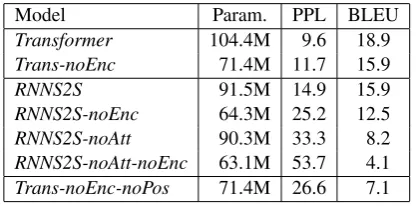
Table 1shows the performance of all the trained models. Encoder-free models (NMT-noEncs) per-form rather poorly compared to conventional NMT models.3 It is interesting thatTrans-noEnc obtains a BLEU score similar to the RNNS2S model. Even though the attention networks only attend to the non-contextualized word embed-dings, Trans-noEnc still performs as well as the RNNS2S by paying attention to the context with
2https://github.com/fxsjy/jieba 3We also trained a
Transformer with less parameters (64.3M). TheTransformerstill achieved a significantly better BLEU score (18.2) thanTrans-noEncwhich means that the number of parameters is not the primary factor in this case.
multiple attention layers. Tang et al.(2018a) find that the superiority of Transformer models is at-tributed to the self-attention network which is a powerful semantic feature extractor. Given our re-sults, we conclude that the attention mechanism is also a strong feature extractor in Trans-noEnc without self-attention in the encoder.
Model Param. PPL BLEU
Transformer 104.4M 9.6 18.9
Trans-noEnc 71.4M 11.7 15.9
RNNS2S 91.5M 14.9 15.9
RNNS2S-noEnc 64.3M 25.2 12.5
RNNS2S-noAtt 90.3M 33.3 8.2
RNNS2S-noAtt-noEnc 63.1M 53.7 4.1
Trans-noEnc-noPos 71.4M 26.6 7.1
Table 1: The performance of NMT models. PPL is the perplexity on the development set. BLEU scores are evaluated on newstest2015. “Param.” denotes the number of parameters.
The attention mechanism improves encoder-decoder architectures significantly. However, there are no empirical results to clarify whether encoders or attention mechanisms are more im-portant for NMT models. We compare RNNS2S-noAtt,RNNS2S-noEnc, andRNNS2S-noAtt-noEnc to explore which component contributes more to NMT models.4 In Table 1, RNNS2S-noEnc per-forms much better thanRNNS2S-noAtt. Moreover, the gap between RNNS2S-noEnc and RNNS2S-noAtt-noEnc is distinctly larger than the gap be-tween RNNS2S-noAtt and RNNS2S-noAtt-noEnc. These results hint that attention mechanisms are more powerful than encoders in NMT.
The positional embedding is also very impor-tant to Transformers which holds the sequential in-formation. We are interested in the extent to which the positional embedding affects the translation performance. We further simplify the model by removing the positional embedding in the source (Trans-noEnc-noPos). Trans-noEnc-noPos has a dramatic drop in BLEU score. It is even worse thanRNNS2S-noAtt. This result indicates that po-sitional information is indeed crucial for Trans-formers.
4Because the encoders and decoders in Transformers are
Word Neighbors
Transformer Trans-noEnc
more less, better, greater, most,further less, greater, better,fewer, most for to, in, on, of,with to, in, of, on,towards
ole (not) olekaan (not the),kykene(unable to), kuulu (part of),pysty(upright),ollut(been)
olekaan, kuulu (part of),ei (no/not),ene(a suffix),liity(sign up) Arvoisa
(honorable)
arvoisa, Arvoisat (honorable),arvoisaa, arvoisan(honorable), hyv¨at (honorable)
arvoisa,arvoisat, hyv¨at, Arvoisat,Hyv¨a(honorable)
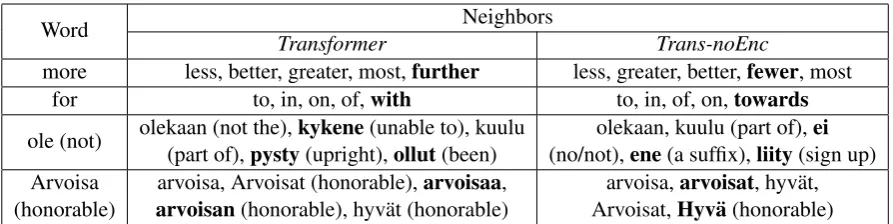
Table 2: Neighbors of the selected word embeddings. Bold words are distinct neighbors.
4 Analysis
Trans-noEncis obviously inferior toTransformer but we are more interested in investigating what causes the performance gap. In this section, we will test our hypotheses on embedding quality and attention distributions.
4.1 Embeddings
Word embeddings are randomly initialized by de-fault and learned during training. As the embed-dings in Trans-noEnc are only updated by atten-tion mechanisms, we hypothesize that embeddings inTrans-noEncare not well learned and therefore affect translation performance. We test our hy-pothesis by (1) evaluating the embeddings in the two models manually and (2) initializing Trans-noEnc with the learned embeddings in Trans-formeras pre-trained embeddings.
Qualitative Evaluation We select the 150 most frequent tokens from the vocabulary and then manually evaluate the quality of embeddings by comparing the 5 nearest neighbors.
The quality of English word embeddings is quite good based on the output of neighbors. Finnish word embeddings are not as good as En-glish word embeddings. Table2exhibits four ex-amples, two English words, “more”, “for” and two Finnish word, “ole” (not), “Arvoisa” (honor-able). The neighbors of “more” in Transformer and Trans-noEnc are all quite related words, in-cluding comparatives and “most” which is the su-perlative of “more”. The words “further” and “fewer” are more different neighbors but both are related to “more”. For the Finnish word “ole” (not), both models have negative words as neigh-bors, but there are different unrelated words as well. We can see that the qualities of neighbors in two embedding matrices are close. We cannot easily distinguish which embedding matrix is
bet-ter based on the neighbors.
Quantitative Evaluation In addition to the qualitative evaluation, we also conduct a quanti-tative evaluation. We first employ the learned em-beddings from Transformer to initialize the em-bedding parameters in Trans-noEnc. The pre-trained embeddings can be either fixed or not fixed during training. Table 3 gives the BLEU scores of these models. The pre-trained embeddings slightly improve the BLEU score.
Embeddings Random Fixed Not-fixed
BLEU 15.9 16.1 16.2
Table 3: BLEU scores ofTrans-noEncs with dif-ferent embedding initialization. “Random” means no pre-trained embeddings. “Fixed” and “Not-fixed” denote using pre-trained embeddings.
The evaluation reveals that the embeddings from Trans-noEnc are competitive to those of Trans-former. Thus, we can rule out differences in em-bedding quality as the main factor for the perfor-mance drop.
4.2 Attention Distribution
The attention networks in Trans-noEnc only at-tend to word embeddings. To better capture the sentence-level context, the attention networks need to distribute more attention to the context. We test our hypothesis that the attention distri-butions in Trans-noEnc are not as distributed as those inTransformer. If the attention distributions inTransformerare more spread out than those in Trans-noEnc, it means that smaller weights are distributed to contextual features byTrans-noEnc.
EAt(yt) =− |x|
X
i=1
We use attention entropy (Equation 1) (Ghader and Monz,2017) to measure the concentration of the attention distribution at timestep t. We then average the attention entropy at all the timesteps as the final attention entropy. xi denotes the ith
source token,ytis the prediction at timestept, and
At(xi, yt) represents the attention distribution at
timestep t. The attention mechanism in Trans-former has multiple layers, and each layer has multiple heads. In each layer, we average the at-tention weights from all the heads.
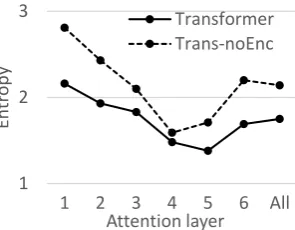
Figure 1 shows the entropy of attention distri-butions in both models. The attention distribu-tions are consistent with the finding inTang et al. (2018b) that the distribution gets concentrated first and then becomes distributed again. Transformer has lower entropy, which potentially is because the contextual information has been encoded in the hidden representations. The attention entropy of Trans-noEnc is clearly higher than that of Trans-former in each attention layer. The attention in Trans-noEnctends to extract features from source tokens more uniformly which indicates that the at-tention mechanism compensates for the fact that embeddings are non-contextualized by distribut-ing attention across more tokens.
1 2 3
1 2 3 4 5 6 All
En
tr
op
y
Attention layer Transformer Trans-noEnc
Figure 1: The attention entropy of each attention layer and the entire attention mechanism.
4.3 Encoders
We have shown that embeddings and attention distributions are not the primary reasons causing the gap between Transformer and Trans-noEnc. Therefore, we move to explore encoders.
Encoders are responsible for providing source hidden representations to the decoder. Encoder-free models have to use word embeddings to rep-resent source tokens without the help of encoders. Thus, the source-side representations probably lead to the performance gap.
We train NMT models with different encoder layers. Table4displays the performance of Trans-former models that have different layers in the en-coder. It is clear that even the model with only a 1-layer encoder outperformsTrans-noEnc (0-layer) by 1.7 BLEU points, which accounts for 56.7% of the performance gap. The results seem to show that source-side hidden representations are crucial in NMT.
Layers Param. PPL BLEU 0 71.4M 11.7 15.9 1 76.9M 10.3 17.6 3 87.9M 9.9 18.4 5 98.9M 9.5 18.6 6 104.4M 9.6 18.9
Table 4: The performance of Transformer models that have different layers in the encoder, including the perplexity (PPL) on the development set and the BLEU scores onnewstest2015.
It has been shown that encoders could extract syn-tactic and semantic features in NMT (Belinkov et al.,2017a,b;Poliak et al.,2018). In the mean-time, contextual information is encoded in hidden representations as well. Hence we conclude that the quality of source representations is the main factor causing the big gap between Transformer andTrans-noEnc.
In Table 5, our additional experiments on DE→EN and ZH→EN confirm that models with contextualized representations are much better. Transformer models always outperform Trans-noEncmodels substantially.
Lan. Trans-noEnc Transformer Impr.
DE→EN 29.5 32.6 10.5%
ZH→EN 18.5 20.9 13.0%
Table 5: The improvement (Impr.) of employ-ing encoders in Trans-noEncs on DE→EN and ZH→EN.
5 Alignment
has been provided by RWTH,5and consists of 508 DE→EN sentence pairs. The other one is fromLiu and Sun (2015) and contains 900 ZH→EN sen-tence pairs. We apply alignment error rate (AER) (Och and Ney,2003) as the evaluation metric.
Following Luong et al. (2015); Kuang et al. (2018), we also force the models to produce the reference target words during inference to get the alignment between input sentences and their ref-erence outputs. We merge the subwords after translation following the method in Koehn and Knowles(2017).6 We sum the attention weights in all attention heads in each attention layer.7 Given a target token, the source token with the highest attention weight is viewed as the alignment of the current target token (Luong et al., 2015). How-ever, a source token maybe aligned to multiple tar-get tokens and vice versa. Therefore, we also align a source token to the target token that has the high-est attention weight given the source token. Exper-imental results show that the bidirectional method achieves higher alignment quality.
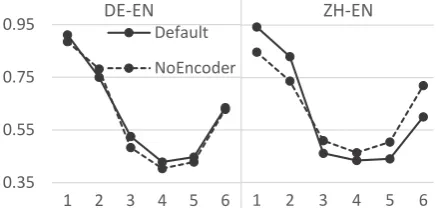
Figure 2 displays the evaluation results. The alignment in the fourth attention layer achieves the best performance. Therefore, we only compare the alignments in the fourth layer. In DE→EN, the encoder-free model has a lower AER score (0.41) than the default model (0.43) which accords with our hypothesis. However, in ZH→EN, the align-ment quality of the encoder-free model (0.46) is worse than that of the default model (0.43). The effect on alignment quality is not clear-cut for encoder-free models given limited language pairs.
1 2 3 4 5 6
ZH-EN
0.35 0.55 0.75 0.95
1 2 3 4 5 6
DE-EN
Default
NoEncoder
Figure 2: The AER scores of alignments in differ-ent attdiffer-ention layers on DE→EN and ZH→EN.
5
https://www-i6.informatik. rwth-aachen.de/goldAlignment/
6(1) If an input word is split into subwords, we sum their
attention weights. (2) If a target word is split into subwords, we average their attention weights.
7FollowingTang et al.(2018b), we tried maximizing the
attention weights as well but got worse alignment quality.
6 Conclusion
To better understand NMT, we simplify the at-tentional encoder-decoder architecture by training encoder-free NMT models in this paper. The non-contextualized source representations in encoder-free models cause a big performance drop, but the word embeddings in encoder-free models are shown competitive to those in default models. Also, we find that the attention component in encoder-free models is a powerful feature extrac-tor, and can partially compensate for the lack of contextualized encoder representations.
Regarding the interpretability of attention, our results do not show that the attention mech-anism in encoder-free models is consistently more alignment-like: only attending to source embeddings improves the alignment quality on DE→EN but makes the alignment quality worse on ZH→EN.
Acknowledgments
We thank all reviewers for their valuable and insightful comments. Gongbo Tang is mainly funded by the Chinese Scholarship Council (grant number201607110016).
References
Dzmitry Bahdanau, Kyunghyun Cho, and Yoshua Ben-gio. 2015. Neural machine translation by jointly learning to align and translate. In Proceedings of the 3rd International Conference on Learn-ing Representations. San Diego, California, USA. https://arxiv.org/abs/1409.0473.
Yonatan Belinkov, Nadir Durrani, Fahim Dalvi, Has-san Sajjad, and James Glass. 2017a. What do neu-ral machine translation models learn about morphol-ogy? In Proceedings of the 55th Annual Meet-ing of the Association for Computational LMeet-inguistics (Volume 1: Long Papers). Association for Computa-tional Linguistics, Vancouver, Canada, pages 861– 872. http://aclweb.org/anthology/P17-1080.
Yonatan Belinkov, Llu´ıs M`arquez, Hassan Sajjad, Nadir Durrani, Fahim Dalvi, and James Glass. 2017b. Evaluating layers of representation in neural machine translation on part-of-speech and semantic tagging tasks. InProceedings of the Eighth Interna-tional Joint Conference on Natural Language Pro-cessing (Volume 1: Long Papers). Asian Federation of Natural Language Processing, Taipei, Taiwan, pages 1–10. http://www.aclweb.org/anthology/I17-1001.
Var-(Short Papers). Association for Computational Lin-guistics, New Orleans, Louisiana, USA, pages 513– 523. https://doi.org/10.18653/v1/N18-2082.
Matt Post. 2018. A call for clarity in reporting BLEU scores. InProceedings of the Third Conference on Machine Translation: Research Papers. Association for Computational Linguistics, Belgium, Brussels, pages 186–191. http://aclweb.org/anthology/W18-6319.
Rico Sennrich, Barry Haddow, and Alexandra Birch. 2016.Neural machine translation of rare words with subword units. InProceedings of the 54th Annual Meeting of the Association for Computational Lin-guistics (Volume 1: Long Papers). Association for Computational Linguistics, Berlin, Germany, pages 1715–1725. http://www.aclweb.org/anthology/P16-1162.
Ilya Sutskever, Oriol Vinyals, and Quoc V Le. 2014. Sequence to sequence learning with neural net-works. InProceedings of the Neural Information Processing Systems 2014. Montr´eal, Canada, pages 3104–3112. https://papers.nips.cc/paper/5346- sequence-to-sequence-learning-with-neural-networks.pdf.
Gongbo Tang, Mathias M¨uller, Annette Rios, and Rico Sennrich. 2018a. Why self-attention? a targeted evaluation of neural machine translation architectures. In Proceedings of the 2018 Con-ference on Empirical Methods in Natural Lan-guage Processing. Association for Computational Linguistics, Brussels, Belgium, pages 4263–4272. http://aclweb.org/anthology/D18-1458.
Gongbo Tang, Rico Sennrich, and Joakim Nivre. 2018b. An analysis of attention mechanisms: The case of word sense disambiguation in neu-ral machine translation. In Proceedings of the Third Conference on Machine Translation: Research Papers. Association for Computational Linguistics, Belgium, Brussels, pages 26–35. http://aclweb.org/anthology/W18-6304.
Ashish Vaswani, Noam Shazeer, Niki Parmar, Jakob Uszkoreit, Llion Jones, Aidan N Gomez, Ł ukasz Kaiser, and Illia Polosukhin. 2017. Attention is all you need. In Advances in Neural Informa-tion Processing Systems 30, Curran Associates, Inc., pages 6000–6010. http://papers.nips.cc/paper/7181-attention-is-all-you-need.pdf.
Weiyue Wang, Derui Zhu, Tamer Alkhouli, Zixuan Gan, and Hermann Ney. 2018. Neural hidden markov model for machine translation. In Pro-ceedings of the 56th Annual Meeting of the As-sociation for Computational Linguistics (Volume 2: Short Papers). Association for Computational Linguistics, Melbourne, Australia, pages 377–382. https://www.aclweb.org/anthology/P18-2060.
Thomas Zenkel, Joern Wuebker, and John DeN-ero. 2019. Adding interpretable attention
to neural translation models improves word alignment. arXiv preprint arXiv:1901.11359