534
Using Syntax to Resolve NPE in English
Payal Khullar Allen Antony Manish Shrivastava Language Technologies Research Centre
International Institute of Information Technology, Hyderabad Gachibowli, Hyderabad, Telangana-500032
{payal.khullar@research., allen.antony@research., m.shrivastava@}iiit.ac.in
Abstract
This paper describes a novel, syntax-based system for automatic detection and resolu-tion of Noun Phrase Ellipsis (NPE) in En-glish. The system takes in free input English text, detects the site of nominal elision, and if present, selects potential antecedent candi-dates. The rules are built using the syntactic information on ellipsis and its antecedent dis-cussed in previous theoretical linguistics lit-erature on NPE. Additionally, we prepare a curated dataset of 337 sentences from well-known, reliable sources, containing positive and negative samples of NPE. We split this dataset into two parts, and use one part to re-fine our rules and the other to test the perfor-mance of our final system. We get an F1-score of 76.47% for detection and 70.27% for NPE resolution on the testset. To the best of our knowledge, ours is the first system that de-tects and resolves NPE in English. The curated dataset used for this task, albeit small, covers a wide variety of NPE cases and will be made public for future work.
1 Introduction
Nominal Ellipsis or Noun Phrase Ellipsis (NPE, henceforth) is a type of ellipsis in linguists wherein the sub-parts of a nominal projection are elided, with the remaining projection pronounced in the overt syntax. For example in the sentence presented in (1), the noun chairsis elided at the position marked by [e].
1. There are threechairsin the living room and two [e] in the hall.
The full meaning of such a sentence can only be understood when we reconstruct the meaning of the elided part from the antecedent, which can be present in the linguistic context as in (1) or has to be retrieved from real world knowledge as in (2), whereMary’sactually meansMary’s place.
2. We are all partying at Mary’s [e].
All world languages use some or the other mecha-nism to elide redundant information and, hence, ellipses is fairly pervasive in natural language, more so in conversational settings (Langacker,
1999). While human interlocutors effectively re-solve and disambiguate any elided information in a sentence based on context and cognitive com-monsense extension (Chen,2016), the realization of the complexity of processing of ellipsis be-comes evident when it poses a serious challenge for computational systems involved in natural lan-guage understanding.
The approaches that handle ellipsis in both the-oretical linguistics and NLP are largely classified as syntactic, semantic and pragmatic (Merchant,
2010). For the current paper, we present a system that automatically detects and resolves NPE in En-glish using a syntax-driven approach.
2 Previous Work
The syntax and semantics of the ellipsis phe-nomenon has been thoroughly studied in theoret-ical linguistics (Halliday and Hasan, 1976; Dal-rymple et al.,1991;Lobeck,1995;Lappin,1996;
Hardt,1999;Johnson,2001;Merchant,2004; Fra-zier, 2008; Chung et al., 2010; Merchant, 2010;
of VPE using machine learning (Nielsen, 2003) and parsed text (Nielsen, 2004), using linguistic principles (McShane and Babkin,2016), with sen-tence trimming methods (McShane et al., 2015), reconstruction of sentences with gapping using improved parsing techniques that encode elided material dependencies (Schuster et al.,2018), etc. There are no known systems that handle NPE detection and resolution in English. However, on a related linguistic phenomenon called one-anaphora or one-substitution, in which the elided noun is replaced by an overt pro-form, there is a thorough data-driven investigation (Gardiner,
2003) and machine-learning methods that use heuristics proposed in this study (Ng et al.,2005). Another phenomenon similar to NPE is zero-anaphora, which has been thoroughly studied in some pro drop languages such as Chinese (Yeh and Chen,2019a,b) and Japanese (Iida et al.,2007;
Asao et al., 2018; Chen, 2016). Zero-anaphora does not occur in English, although there is some evidence of the phenomenon being used to achieve certain interactional functions in ordinary conver-sational settings by English speakers (Oh,2005). There are also proposed heuristics for determining antecedents of pronominal words (Lappin and Le-ass,1994;Kennedy and Boguraev,1996). In the
present paper, we do not deal with one-anaphora, zero anaphora or pronominals, and restrict our fo-cus to NPE.
3 Task Description
Resolution of ellipsis comprises two tasks - detec-tion of the elided material and antecedent selec-tion. In some cases, reference resolution might also be necessary (Liu et al.,2016;Nielsen,2003). For example, in (3), the common sense interpreta-tion is that Sam loves his girlfriend. But it could also lead to a sloppy reading where it means Sam loves John’s girlfriend.
3. Johnloves his girlfriend. Sam does [e] too.
Note that (3) presents an example of VPE as the verb along with its predicate are elided. In this paper, we focus only on the first two tasks, i.e. de-tection of NPE and antecedent selection.
4 Dataset Preparation
There are no dedicated linguistic resources or datasets for the analysis of NPE in English. How-ever, there are many well-known corpora that con-tain annotated instances of NPE. One such re-source is the Universal Dependency (UD)
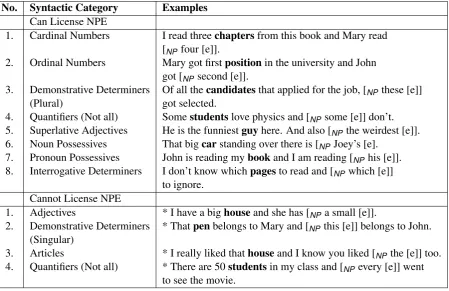
tree-No. Syntactic Category Examples Can License NPE
1. Cardinal Numbers I read threechaptersfrom this book and Mary read [NPfour [e]].
2. Ordinal Numbers Mary got firstpositionin the university and John got [NPsecond [e]].
3. Demonstrative Determiners Of all thecandidatesthat applied for the job, [NPthese [e]]
(Plural) got selected.
4. Quantifiers (Not all) Somestudentslove physics and [NPsome [e]] don’t.
5. Superlative Adjectives He is the funniestguyhere. And also [NPthe weirdest [e]].
6. Noun Possessives That bigcarstanding over there is [NPJoey’s [e].
7. Pronoun Possessives John is reading mybookand I am reading [NPhis [e]].
8. Interrogative Determiners I don’t know whichpagesto read and [NPwhich [e]]
to ignore. Cannot License NPE
1. Adjectives * I have a bighouseand she has [NPa small [e]].
2. Demonstrative Determiners * Thatpenbelongs to Mary and [NPthis [e]] belongs to John.
(Singular)
3. Articles * I really liked thathouseand I know you liked [NPthe [e]] too.
4. Quantifiers (Not all) * There are 50studentsin my class and [NPevery [e]] went
to see the movie.
bank (Silveira et al., 2014) for English that con-tains example sentences for different types of el-lipsis such as VPE, NPE, etc. The UD tree-bank marks NPE by raising the dependents of the elided noun to the position of head in cases where the dependents are overtly marked. Through a simple search for noun dependents that are given the status of noun heads, we get a to-tal of 146 cases of NPE in 120 sentences from the UD treebank. There is another compara-tively small corpus called the ParCorFull: a Par-allel Corpus Annotated with Full Coreference (Lapshinova-Koltunski et al., 2018) that is dedi-cated to anaphora. This corpus targets anaphora, but deals partly with NPE cases as well, mark-ing them with a nom-ellipsis tag. A simple search for this tag gives us 5 sentences containing 5 NPE cases. We also pick a total of 80 sentences contain-ing 83 cases of NPE from lcontain-inguistic textbooks on ellipsis (Lobeck,1995;Saito et al.,2008;Menzel,
2017;Kim et al.,2019;Corver and van Koppen,
2011) to cover even the infrequently occurring cases. Finally, we randomly pick 132 sentences that do not contain NPE from UD treebank, Par-COrFull and the same linguistic textbooks. Some of these negative samples of NPE contain sen-tences with ellipsis other than NPE, such as VPE.
In total, we curate a small dataset of 337 sen-tences, of which 205 sentences have 234 instances of NPE (some sentences contain more than one in-stance of NPE) and the remaining 132 sentences without NPE. This dataset, albeit small, covers a wide variety of the cases of NPE discussed in the ellipsis literature and will be useful for future work. Since the focus of this paper is on present-ing a system for detection and resolution of ellip-sis, we do not undertake the formidable task of preparation of annotation guidelines and perform-ing annotation to prepare a Gold dataset in this pa-per. However, this could be an important future work considering the limited available resources for the analysis of NPE.
To fine tune our rules, we only need positive samples of NPE. However, for testing, it is im-portant to use both positive and negative samples. We split our dataset into two parts. For fine tun-ing the rules, we randomly pick 140 out of the 205 positive sentences (roughly 70%), containing a to-tal of 158 NPE instances. The remaining 65 sen-tences (roughly 30%) contain 76 NPE instances and are included in the testset along with the 132
sentences without NPE. Hence, our testset has 76 positive and 132 negative samples.
5 System Overview
Our system is divided into two parts. An input sentence is fed into the NPE detection system that decides whether an NPE is present or not. If an NPE is detected, it sends the sentence to the Res-olution system where a potential antecedent is se-lected. The output of the complete system is ei-ther a decision that ei-there is no ellipsis present in the sentence or an ellipsis site marked along with its antecedent.
5.1 NPE Detection
For the task of NPE detection, we exploit a very useful syntactic feature, which is the presence of overt remnants of the noun phrase at the ellipsis site. In case of NPE in English, these trigger words are often determiners and modifiers of the elided noun. These are also known as licensors of ellip-sis. In the examples presented in (1) and (2), the li-censors of elided noun are the cardinal numbertwo and possessive proper noun Mary’s respectively. We use these remnants or noun modifiers present at the ellipsis site as cues to locate the elided noun. An interesting feature about these license of NPE in English is that they can only belong to cer-tain syntactic categories. These include cardinal and ordinal numbers, plural demonstrative deter-miners, possessives, adjectives, quantifiers, and a certain types of determiners. Table1provides ex-amples from each of these categories, along with examples of syntactic categories that cannot li-cense NPEs in English. Hence, the idea is to use the syntactic environment of the nominal ellipsis site to perform detection. Linguistically, our ap-proach is similar to detection of VPE by using auxiliary and modal verbs as cues (McShane and Babkin,2016), as VPE in English are licensed by auxiliary and modal verbs.
5.1.1 Look for Pre-Modifiers and Determiners
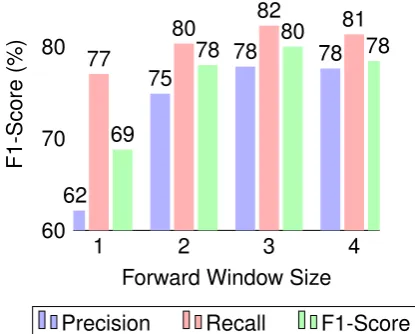
Figure 1: F1-score corresponding to different win-dow sizes for searching nouns.
1 2 3 4
60 70 80
62
75
78 78
77
80 82 81
69
78 80 78
Forward Window Size
F1-Score
(%)
Precision Recall F1-Score
NPE. If the system detects POS tags correspond-ing to any such category, it proceeds to the second step.
5.1.2 Filter Using Syntactic Features
In this step, the system decides if the selected noun modifier is a licensor of an elided noun or not. This decision is taken using the following syntac-tic features:
(a) Search for Noun Heads
This simple feature looks for a noun word after the selected noun modifier. We check nouns in a forward search window of 3 words. This window is forward because in English noun heads follow their depen-dents. If there is no noun present in the next 3 words, the system marks the modifier in question as a licensor. The optimum size of the window as 3 is obtained after experimen-tation with different window sizes on the 100 sentences from the curated dataset. Figure1
presents the results of experiments done with different forward window sizes searching for noun heads after noun dependents.
(b) Check for Noun Modifiers as Verbal Argu-ments
The feature looks for verbs with the selected noun modifiers as the main argument. This is because, many times, spaCy raises a noun modifier to the position of a head in the ab-sence of its noun head, which confirms the presence of an elided noun.
(c) Check for Punctuation
We first check for a simple feature that checks for noun modifiers close to punctua-tion marks. Since a punctuapunctua-tion can indicate a sentential or phrasal break, this could indi-cate the absence of a noun head for the given noun modifier in the sentence or noun phrase respectively.
(d) Check for Prepositions
We check if the selected noun modifier is immediately followed by a preposition as that would indicate the beginning of a new (prepositional) phrase and imply that the noun modifier in the given noun phrase does not have a noun head overtly present.
(e) Check for Verbs and Auxiliaries
We also check if the selected noun modifier is immediately followed by a verb or auxil-iary verb as that would indicate the end of the given noun phrase immediately after the noun modifier.
5.2 NPE Resolution
Ellipses can be resolved textually when their an-tecedents are present in the same text as in (1). Such cases of ellipsis are calledendophoric. How-ever, not all ellipses can be recovered or inferred from a co-text. It is also possible that the an-tecedent of a given ellipsis is present outside the given text. For example, consider a speaker point-ing towards pencils in a shop and utterpoint-ing a sen-tence such as (4).
4. Give me three [e].
Using visual context, the shopkeeper can easily resolve the ellipsis in this sentence as three pen-cils. Such cases of ellipses are calledexophoricor situational as they need situational context to re-solve. Since we are only limited to text processing at this stage in the current paper, we only focus on resolving NPE that have textual antecedents.
5.2.1 Ellipsis-Antecedent Environment
It is shown that clauses that are linked by an ellipsis-antecedent relation often have similar syn-tactic structure and priming effects (Xiang et al.,
reference phenomenon (Hobbs and Kehler,1997). This becomes our motivation to resolve NPE.
(a) Match POS tags of the Licensor with other Noun Modifiers
The syntactic environment of the an NPE comprises the remnants left in the noun phrase. One simple way to see structural par-allelism between the syntactic environment of antecedent and that of ellipsis to locate antecedents is through matching the syntac-tic category information. From the detec-tion task, we already have the POS tag in-formation of the licensor of the NPE. In the first step of antecedent selection, the system checks for other noun phrases in the sentence that contain the modifiers with the same POS tag as that of the licensor of the NPE.
(b) Select Antecedent
If a POS tag matching the licensor of the NPE (detected in the NPE detection task) is found in the sentence, the system outputs the noun that the modifier with the same tag modifies as the antecedent of the NPE. If there are more than one such modifiers found, the system selects the one nearest to the NPE as distance generally has a role to play in anaphora and coreference resolution tasks (Lappin,1996).
6 Results
Simply looking for nouns in the context of the noun modifiers gives a poor F1-score of 64.20%. Addition of only the feature that checks for noun modifiers raised as verbal arguments results into an increased in F1-score by 10.25%. Addition of only the punctuation feature after auxiliary and modal verbs resulted into an increase in accuracy by 3% for VPE detection task (Nielsen, 2004). However, in our task, this resulted into a drop in accuracy by 0.05%. Hence, we excluded this feature from the final system. Addition of only the feature that checks for prepositions immedi-ately following the noun modifier results into an
increase in F1-score by 13.73%. Finally, addition of only the feature that checks for verbs and aux-iliaries that immediately follow the noun modifier gives an increase in F1-score by 11.46%. These features are independent of each other and do not follow any hierarchy.
The final system together with only the signif-icantly important features is tested on the testset containing 76 positive and 132 negative samples of NPE. The detection system is able to correctly de-tect 65 instances of NPE out of 76. It also rightly predicts 113 out of 132 negative samples as not containing any NPE. It fails to detect 11 positive cases and falsely detects 29 others. This gives us a final precision of 69.15%, a recall of 85.53% and an F1-score 76.47%. Out of the 65 NPE cases detected by the system, 41 have a textual an-tecedent and the remaining 24 are exophoric and need extra-linguistic context to resolve. Our sys-tem is able to select a potential antecedent for 37 of these from the text, of which 32 are correct pre-dictions. The system fails to select any antecedent for the 9 cases. This gives us a final precision of 78.79%, a recall of 63.41% and an F1-score 70.27%. See table2for precision, recall and F1-score values for the NPE detection and resolution tasks on the testset.
One of the main reasons of the low accuracy of our system is wrong POS tags generated for sen-tences with missing or incomplete information as in the case of ellipses (Menzel,2017). Secondly, although, licensors of NPE and modifiers of the antecedent indeed show similarity in terms of syn-tactic category information, this might not always be the case.
5. The books were new, and all six [e] were on syntax.
For example in (5), the NPE licensor is a cardi-nal number, but antecedentbookshas the definitive article in its Noun Phrase.
7 Conclusion & Future Work
This paper described a syntax-based system for automatic detection of NPE in English. The
sys-Task Positive Samples Negative Samples Precision Recall F1-Score
Detection 76 132 69.15% 85.53% 76.47%
Resolution 65 29 78.79% 63.41% 70.27%
tem takes in free English text and exploits syntac-tic constraints on the licensors of NPE to mark the site of ellipsis and syntactic parallelism between antecedent-ellipsis syntactic environments to se-lect potential antecedents. Evaluated on a testset containing both positive and negative NPE sam-ples, the system achieves an F1-score of 76.47% on the detection task and 70.27% on the resolu-tion task. Although these numbers are not high, they can be useful as baselines for future work in this direction. NLP research on ellipsis and NPE in particular suffers from a scarcity of re-sources. While a rule-based system such as ours does not need sizable data for training, with more language resources available in future, machine learning methods can also be used.
References
Yoshihiko Asao, Ryu Iida, and Kentaro Torisawa. 2018. Annotating zero anaphora for question an-swering. InLREC.
Johan Bos and Jennifer Spenader. 2011. An annotated corpus for the analysis of vp ellipsis. Language Re-sources and Evaluation, 45(4):463494.
Wei Chen. 2016. The motivation of ellipsis. The-ory and Practice in Language Studies, 6(11):2134– 2139.
Sandra Chung, William Ladusaw, and James Mc-Closkey. 2010. Sluicing (:) between structure and inference. In Representing language: Essays in honor of Judith Aissen.
Norbert Corver and Marjo van Koppen. 2011. Np-ellipsis with adjectival remnants: A micro-comparative perspective. Natural Language and Linguistic Theory, 29.
Jeroen van Craenenbroeck and Jason Merchant. 2013. Ellipsis phenomena. InThe Cambridge Handbook of Generative Syntax, pages 701–745. Cambridge University Press.
Mary Dalrymple, Stuart M. Shieber, and Fernando C. N. Pereira. 1991. Ellipsis and higher-order unifi-cation. Linguistics and Philosophy, 14(4):399–452.
Lyn Frazier. 2008. Processing ellipsis: A processing solution to the undergeneration problem? In Pro-ceedings of the 26th West Coast Conference on For-mal Linguistics.
Mary Gardiner. 2003. Identifying and resolving one-anaphora. Department of Computing, Division of ICS, Macquarie University.
Tilbe Goksun, Tom W. Roeper, Kathy Hirsh-Pasek, and Roberta Michnick Golinkoff. 2010. From noun-phrase ellipsis to verbnoun-phrase ellipsis: The acquisi-tion path from context to abstract reconstrucacquisi-tion.
Christine Gunther. 2011. Noun ellipsis in english: ad-jectival modifiers and the role of context.The struc-ture of the noun phrase in English: synchronic and diachronic explorations, 15(2):279–301.
Michael Alexander Kirkwood Halliday and Ruqaiya Hasan. 1976. Cohesion in english. page 76.
Daniel Hardt. 1997. An empirical approach to vp ellip-sis.Computational Linguistics, 23(4):525541.
Daniel Hardt. 1999. Dynamic interpretation of verb phrase ellipsis. Linguistics and Philosophy, 22(2):187–221.
Jerry R. Hobbs and Andrew Kehler. 1997. A theory of parallelism and the case of vp ellipsis. In Pro-ceedings of the 35th Annual Meeting of the Associa-tion for ComputaAssocia-tional Linguistics and Eighth Con-ference of the European Chapter of the Association for Computational Linguistics, ACL ’98/EACL ’98, pages 394–401, Stroudsburg, PA, USA. Association for Computational Linguistics.
Matthew Honnibal and Mark Johnson. 2015. An im-proved non-monotonic transition system for depen-dency parsing. In Proceedings of the 2015 Con-ference on Empirical Methods in Natural Language Processing, pages 1373–1378, Lisbon, Portugal. As-sociation for Computational Linguistics.
Nina Hyams, Victoria Mateu, and Lauren Winans. 2017. Ellipsis meets wh-movement: sluicing in early grammar.
Ryu Iida, Kentaro Inui, and Yuji Matsumoto. 2007. Zero-anaphora resolution by learning rich syntactic pattern features. ACM Trans. Asian Lang. Inf. Pro-cess., 6.
Kyle Johnson. 2001.What vp ellipsis can do, and what it cant, but not why. pages 439–479.
Christopher Kennedy and Branimir Boguraev. 1996. Anaphora for everyone: pronominal anaphora res-olution without a parser. InIn Proceedings of COL-ING, page 113118.
Nayoun Kim, Laurel Brehm, and Masaya Yoshida. 2019. The online processing of noun phrase ellipsis and mechanisms of antecedent retrieval. Language, Cognition and Neuroscience, 34(2):190–213.
Ronald W Langacker. 1999. Grammar and Concep-tualization (Cognitive Linguistics Research), vol-ume 14. Mouton de Gruyter, New York.
Shalom Lappin and Herbert Leass. 1994. A syntacti-cally based algorithm for pronominal anaphora res-olution. Computational Linguistics, 20:535561.
Ekaterina Lapshinova-Koltunski, Christian Hardmeier, and Pauline Krielke. 2018. Parcorfull: a parallel corpus annotated with full coreference. In Proceed-ings of the Eleventh International Conference on Language Resources and Evaluation, LREC 2018, Miyazaki, Japan, May 7-12, 2018.
Charlotte Lindenbergh, Angeliek van Hout, and Bart Hollebrandse. 2015. Extending ellipsis research: The acquisition of sluicing in dutch. BUCLD 39 On-line Proceedings Supplement, 39.
Zhengzhong Liu, Edgar Gonzalez, and Dan Gillick. 2016. Verb phrase ellipsis detection using automati-cally parsed text. pages 32–40.
Anne Lobeck. 1995.Functional Heads, Licensing, and Identification. Oxford University Press.
Marjorie McShane and Petr Babkin. 2016. Detection and resolution of verb phrase ellipsis. Linguistic Is-sues in Language Technology, 13(1).
Marjorie McShane, Sergei Nirenburg, and Petr Babkin. 2015. Sentence trimming in service of verb phrase ellipsis resolution. InEAPCogSci.
Katrin Menzel. 2017. Understanding English-German contrasts: a corpus-based comparative analysis of ellipses as cohesive devices. Ph.D. thesis, Universi-tat des Saar- landes, Saarbrucken.
Jason Merchant. 2004. Fragments and ellipsis. Lin-guistics and Philosophy, 27(6):661–738.
Jason Merchant. 2010. Three Kinds of Ellipsis: Syn-tactic, Semantic, Pragmatic?
Hwee Tou Ng, Yu Zhou, Robert Dale, and Mary Gar-diner. 2005. A machine learning approach to iden-tification and resolution of one-anaphora. pages 1105–1110.
Leif Arda Nielsen. 2003. Using machine learning tech-niques for vpe detection.
Leif Arda Nielsen. 2004.Verb phrase ellipsis detection using automatically parsed text.
Sun-Young Oh. 2005. English zero anaphora as an in-teractional resource. Research on Language and So-cial Interaction, 38(3):267–302.
Dongwoo Park. 2017. When does ellipsis occur, and what is elided? PhD dissertation, University of Maryland.
Alain Rouveret. 2012.Vp ellipsis, phases and the syn-tax of morphology. Natural Language & Linguistic Theory, 30(3):897963.
Mamoru Saito, Jonah Lin, and Keiko Murasugi. 2008. Nominal-ellipsis and the structure of noun phrases in chinese and japanese.
Sebastian Schuster, Joakim Nivre, and Christopher D. Manning. 2018. Sentences with gapping: Parsing and reconstructing elided predicates.ArXiv e-prints.
Natalia Silveira, Timothy Dozat, Marie-Catherine de Marneffe, Samuel Bowman, Miriam Connor, John Bauer, and Christopher D. Manning. 2014. A gold standard dependency corpus for English. In
Proceedings of the Ninth International Conference on Language Resources and Evaluation (LREC-2014).
Frank Wijnen, Tom W. Roeper, and Hiske van der Meulen. 2003. Discourse binding: Does it begin with nominal ellipsis?
Ming Xiang, Julian Grove, and Jason Merchant. 2014. Ellipsis sites induce structural priming effects.
Ching-Long Yeh and Yi-Chun Chen. 2019a. Using zero anaphora resolution to improve text categoriza-tion.