568
A Qualitative Evaluation Framework for Paraphrase Identification
Venelin Kovatchev1,3, M. Ant`onia Mart´ı1,3, Maria Salam´o2,3, Javier Beltran1,3 1Facultat de Filolog´ıa, Universitat de Barcelona
2Facultat de Matem`atiques i Inform`atica, Universitat de Barcelona 3Universitat de Barcelona Institute of Complex Systems
Gran V´ıa de les Corts Catalanes, 585, 08007 Barcelona, Spain {vkovatchev, amarti, maria.salamo, javier.beltran}@ub.edu
Abstract
In this paper, we present a new approach for the evaluation, error analysis, and interpre-tation of supervised and unsupervised Para-phrase Identification (PI) systems. Our evalu-ation framework makes use of a PI corpus an-notated with linguistic phenomena to provide a better understanding and interpretation of the performance of various PI systems. Our ap-proach allows for a qualitative evaluation and comparison of the PI models using human in-terpretable categories. It does not require mod-ification of the training objective of the sys-tems and does not place additional burden on the developers. We replicate several popular supervised and unsupervised PI systems. Us-ing our evaluation framework we show that: 1) Each system performs differently with re-spect to a set of linguistic phenomena and makes qualitatively different kinds of errors; 2) Some linguistic phenomena are more chal-lenging than others across all systems.
1 Introduction
In this paper we propose a new approach to eval-uation, error analysis and interpretation in the task of Paraphrase Identification (PI). Typically, PI is defined as comparing two texts of arbitrary size in order to determine whether they have approx-imately the same meaning (Dolan et al., 2004). The two texts in 1a and 1b are considered para-phrases, while the two texts at 2a and 2b are non-paraphrases.1 In 1a and 1b there is a change in the wording (“magistrate” - “judge”) and the syntac-tic structure (“was ordered” - “ordered”) but the meaning of the sentences is unchanged. In 2a and 2b there are significant differences in the quanti-ties (“5%” - “4.7%”and“$27.45” - “$27.54”).
1a A federal magistrate in Fort Lauderdale or-dered him held without bail.
1Examples are from the MRPC corpus (Dolan et al.,2004)
1b He was ordered held without bail Wednesday by a federal judge in Fort Lauderdale, Fla.
2a Microsoft fell 5 percentbefore the open to
$27.45from Thursday’s close of $28.91.
2b Shares in Microsoft slipped 4.7 percent in after-hours trade to $27.54 from a Nasdaq close of $28.91.
The task of PI can be framed as a binary clas-sification problem. The performance of the differ-ent PI systems is reported using the Accuracy and F1 score measures. However this form of evalua-tion does not facilitate the interpretaevalua-tion and error analysis of the participating systems. Given the Deep Learning nature of most of the state-of-the-art systems and the complexity of the PI task, we argue that better means for evaluation, interpreta-tion, and error analysis are needed. We propose a new evaluation methodology to address this gap in the field. We demonstrate our methodology on the ETPC corpus (Kovatchev et al.,2018a) - a re-cently published corpus, annotated with detailed linguistic phenomena involved in paraphrasing.
We replicate several popular state-of-the-art Supervised and Unsupervised PI Systems and demonstrate the advantages of our evaluation methodology by analyzing and comparing their performance. We show that while the systems ob-tain similar quantitative results (Accuracy and F1), they perform differently with respect to a set of hu-man interpretable linguistic categories and make qualitatively different kinds of errors. We also show that some of the categories are more chal-lenging than others across all evaluated systems.
2 Related Work
et al.,2012;Ji and Eisenstein,2013) to end-to-end Deep Learning models (He et al., 2015;He and Lin,2016;Wang et al.,2016;Lan and Xu,2018a;
Kiros et al., 2015;Conneau et al., 2017). The PI systems are typically divided in two groups: Su-pervised PI systems and UnsuSu-pervised PI systems. “Supervised PI systems” (He et al., 2015; He and Lin, 2016; Wang et al., 2016; Lan and Xu,
2018a) are explicitly trained for the PI task on a PI corpora. “Unsupervised PI systems” in the PI field is a term used for systems that use a general purpose sentence representations such asMikolov et al.(2013);Pennington et al.(2014);Kiros et al.
(2015);Conneau et al.(2017). To predict the para-phrasing relation, they can compare the sentence representations of the candidate paraphrases di-rectly (ex.: cosine of the angle), and use a PI cor-pus to learn a threshold. Alternatively they can use the representations as features in a classifier.
The complexity of paraphrasing has been em-phasized by many researchers (Bhagat and Hovy,
2013; Vila et al., 2014; Benikova and Zesch,
2017). Similar observations have been made for Textual Entailment (Sammons et al.,2010;Cabrio and Magnini,2014). Gold et al.(2019) study the interactions between paraphrasing and entailment. Despite the complexity of the phenomena, the popular PI corpora (Dolan et al., 2004; Ganitke-vitch et al.,2013;Iyer et al.,2017;Lan et al.,2017) are annotated in a binary manner. In part it is due to lack of annotation tools capable of fine-grained annotation of relations. WARP-Text (Kovatchev et al.,2018b) fills this gap in the NLP toolbox.
The simplified corpus format poses a problem with respect to the quality of the PI task and the ways it can be evaluated. The vast majority of the state-of-the-art systems in PI provide no or very little error analysis. This makes it difficult to in-terpret the actual capabilities of a system and its applicability to other corpora and tasks.
Some researchers have approached the problem of non-interpretability by evaluating the same ar-chitecture on multiple datasets and multiple tasks.
Lan and Xu (2018b) apply this approach to Su-pervised PI systems, while Aldarmaki and Diab
(2018) use it for evaluating Unsupervised PI sys-tems and general sentence representation models.
Linzen et al.(2016) demonstrate how by modi-fying the task definition and the evaluation the ca-pabilities of a Deep Learning system can be de-termined implicitly. The main advantage of such
an approach is that it only requires modification and additional annotation of the corpus. It does not place any additional burden on the developers of the systems and can be applied to multiple sys-tems without additional cost.
We follow a similar line of research and propose a new evaluation that uses ETPC (Kovatchev et al.,
2018a): a PI corpus with a multi-layer annotation of various linguistic phenomena. Our methodol-ogy uses the corpus annotation to provide much more feedback to the competing systems and to evaluate and compare them qualitatively.
3 Qualitative Evaluation Framework
3.1 The ETPC Corpus
ETPC (Kovatchev et al.,2018a) is a re-annotated version of the MRPC corpus. It contains 5,801 text pairs. Each text pair in ETPC has two separate lay-ers of annotation. The first layer contains the tradi-tional binary label (paraphrase or non-paraphrase) of every text pair. The second layer contains the annotation of 27 “atomic”linguistic phenomena involved in paraphrasing, according to the authors of the corpus. All phenomena are linguistically motivated and humanly interpretable.
3a A federalmagistratein Fort Lauderdale ordered him held without bail.
3b He was ordered held without bail Wednesday by a federaljudgein Fort Lauderdale, Fla.
We illustrate the annotation with examples 3a and 3b. At the binary level, this pair is annotated as “paraphrases”. At the “atomic” level, ETPC con-tains the annotation of multiple phenomena, such as the “same polarity substitution (habitual)” of “magistrate” and “judge” (marked bold) or the
“diathesis alternation” of “...ordered him held”
and“he was ordered by...”(marked underline). For the full set of phenomena, the linguistic rea-soning behind them, their frequency in the cor-pus, real examples from the pairs, and the anno-tation guidelines, please refer toKovatchev et al.
(2018a).
3.2 Evaluation Methodology
annota-[S4]A replication of the pairwise word interac-tion modeling with deep neural network system by
He and Lin(2016)
[S5]A character level neural network model by
Lan and Xu(2018a)
TheUnsupervised PI systemsinclude:
[S6] A binary Bag-of-Word sentence represen-tation (baseline)
[S7] Average over sentence of pre-trained Word2Vec word embeddings (Mikolov et al.,
2013)
[S8]Average over sentence of pre-trained Glove word embeddings (Pennington et al.,2014)
[S9] InferSent sentence embeddings (Conneau et al.,2017)
[S10] Skip-Thought sentence embeddings (Kiros et al.,2015)
In the unsupervised setup we first represent each of the two sentences under the corresponding model. Then we obtain a feature vector by con-catenating the absolute distance and the element-wise multiplication of the two representations. The feature vector is then fed into a logistic regres-sion classifier to predict the textual relation. This setup has been used in multiple PI papers, more re-cently byAldarmaki and Diab (2018). While the vector representations of BERT are unsupervised, they are fine-tuned on the dataset. Therefore we put them in a separate category (System #11).
5 Results
5.1 Overall Performance
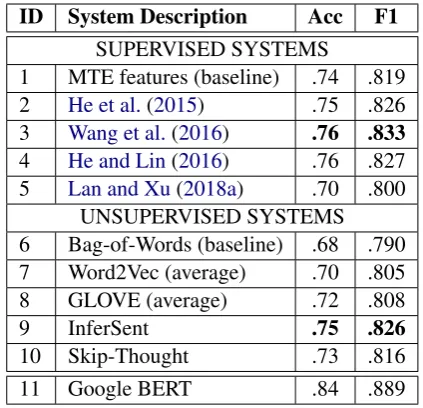
Table 1 shows the “overall performance” of the systems on the 1725 text pairs in the test set. Looking at the table, we can observe several reg-ularities. First, the deep systems outperform the baselines. Second, the baselines that we choose are competitive and obtain high results. Since both baselines make their predictions based on lexical similarity and overlap, we can conclude that the dataset is biased towards those phenomena. Third, the supervised systems generally outperform the unsupervised ones, but without running a full grid-search the difference is relatively small. And fi-nally, we can identify the best performing systems:
S3(Wang et al.,2016) for the supervised andS9
(Conneau et al.,2017) for the unsupervised. BERT largely outperforms all other systems.
The “overall performance” provides a good overview of the task and allows for a quantitative
ID System Description Acc F1
SUPERVISED SYSTEMS
1 MTE features (baseline) .74 .819
2 He et al.(2015) .75 .826
3 Wang et al.(2016) .76 .833
4 He and Lin(2016) .76 .827
5 Lan and Xu(2018a) .70 .800
UNSUPERVISED SYSTEMS 6 Bag-of-Words (baseline) .68 .790 7 Word2Vec (average) .70 .805 8 GLOVE (average) .72 .808 9 InferSent .75 .826
10 Skip-Thought .73 .816 11 Google BERT .84 .889
Table 1: Overall Performance of the Evaluated Systems
comparison of the different systems. However, it also has several limitations.
It does not provide much insight into the work-ings of the systems and does not facilitate error analysis. In order to study and improve the per-formance of a system, a developer has to look at every correct and incorrect predictions and search for custom defined patterns. The“overall perfor-mance”is also not very informative for a compar-ison between the systems. For exampleS3(Wang et al.,2016) andS4(He and Lin,2016) obtain the same Accuracy score and only differ by 0.06 F1 score. With only looking at the quantitative eval-uation it is unclear which of these systems would generalize better on a new dataset.
5.2 Full Performance Profile
Table 2 shows the full “performance profile” of
S3 (Wang et al., 2016), the supervised system that performed best in terms of “overall perfor-mance”. Table2shows a large variation of the per-formance ofS3on the different phenomena. The accuracy ranges from .33 to 1.0. We also report the statistical significance of the difference between the correct and incorrect predictions for each phe-nomena and the correct and incorrect predictions for the full test set, using the Mann–Whitney U-test3(Mann and Whitney,1947).
Ten of the phenomena show significant differ-ence from the overall performance atp<0.1. Note
3The Mann–Whitney U-test is a non-parametric
OVERALL PERFORMANCE
Overall Accuracy .76
Overall F1 .833
PHENOMENA PERFORMANCE
Phenomenon Acc p
Morphology-based changes
Inflectional changes .79 .21
Modal verb changes .90 .01
Derivational changes .72 .22 Lexicon-based changes
Spelling changes .88 .01
Same polarity sub. (habitual) .78 .18 Same polarity sub. (contextual) .75 .37 Same polarity sub. (named ent.) .73 .14 Change of format .75 .44
Lexico-syntactic based changes Opp. polarity sub. (habitual) 1.0 na Opp. polarity sub. (context.) .68 .14 Synthetic/analytic substitution .77 .39
Converse substitution .92 .07
Syntax-based changes
Diathesis alternation .83 .12 Negation switching .33 na
Ellipsis .64 .07
Coordination changes .77 .47
Subordination and nesting .86 .01
Discourse-based changes
Punctuation changes .87 .01
Direct/indirect style .76 .5
Syntax/discourse structure .83 .05
Other changes
Addition/Deletion .70 .05
Change of order .81 .04
Contains negation .78 .32 Semantic (General Inferences) .80 .21
Extremes
Identity .77 .29
Non-Paraphrase .81 .04
Entailment .76 .5
Table 2: Performance profile ofWang et al.(2016)
that eight of them are also significant atp<0.05. The statistical significance of “Opposite polarity substitution (habitual)”, and “Negation Switch-ing” cannot be verified due to the relatively low frequency of the phenomena in the test set.
The demonstrated variance in phenomena per-formance and its statistical significance address
RQ 1: we show that the performance of a PI sys-tem on each candidate-paraphrase pair depends on the different phenomena involved in that pair or at least there is a strong observable relation between the performance and the phenomena.
The individual “performance profile”also ad-dresses RQ 2. The profile is humanly inter-pretable, and we can clearly see how the system performs on various sub-tasks at different linguis-tic levels. The qualitative evaluation shows thatS3
performs better when it has to deal with: 1) surface phenomena such as“spelling changes”, “punctu-ation changes”, and “change of order”; 2) dic-tionary related phenomena such as“opposite po-larity substitution (habitual)”, “converse substi-tution”, and“modal verb changes”. S3performs worse when facing phenomena such as“negation switching”, “ellipsis”, “opposite polarity substi-tution (contextual)”, and“addition/deletion”.
5.3 Comparing Performance Profiles
Table3shows the full performance profiles of all systems. The systems are identified by their IDs, as shown in Table 1. In addition to providing a better error analysis for every individual system, the “performance profiles” of the different sys-tems can be used to compare them qualitatively. This comparison is much more informative than the “overall performance” comparison shown in Table1. Using the“performance profile”, we can quickly compare the strong and weak sides of the different systems.
When looking at the“overall performance”, we already pointed out that S3 (Wang et al., 2016) andS4 (He and Lin, 2016) have almost identical quantitative results: 0.76 accuracy, 0.833 F1 for
S3against 0.76 accuracy, 0.827 F1 forS4. How-ever, when we compare their “phenomena per-formance”it is evident that, while these systems make approximately the same number of correct and incorrect predictions, the actual predictions and errors can vary.
Looking at the accuracy, we can see that S3
performs better on phenomena such as “Con-verse substitution”, “Diathesis alternation”, and
“Non-Paraphrase”, while S4 performs better on
“Change of format”,“Opposite polarity substitu-tion (contextual)”, and“Ellipsis”.
PHENOMENON PARAPHRASE IDENTIFICATION SYSTEMS
SUPERVISED UNSUPERVISED
S1 S2 S3 S4 S5 S6 S7 S8 S9 S10 S11 OVERALL ACC. .74 .75 .76 .76 .70 .68 .70 .72 .75 .73 .84 Inflectional .77 .76 .79 .79 .75 .79 .75 .76 .78 .80 .84 Modal verb .84 .89 .90 .89 .91 .92 .89 .84 .81 .89 .92 Derivational .80 .83 .72 .73 .84 .80 .88 .86 .80 .77 .87 Spelling .85 .83 .88 .90 .89 .85 .89 .88 .85 .89 .94 Same pol. sub. (hab.) .74 .77 .78 .76 .76 .76 .76 .75 .76 .76 .85 Same pol. sub. (con.) .74 .74 .75 .74 .70 .71 .71 .71 .73 .73 .81 Same pol. sub. (NE) .74 .72 .73 .75 .64 .67 .65 .70 .73 .66 .80 Change of format .80 .79 .75 .84 .85 .82 .81 .80 .80 .71 .91 Opp. pol. sub. (hab.) 1.0 1.0 1.0 .50 1.0 1.0 1.0 1.0 1.0 1.0 1.0 Opp. pol. sub. (con.) .77 .84 .68 .84 .52 .84 .61 .77 .65 .52 .71 Synthetic/analytic sub. .73 .73 .77 .77 .74 .70 .72 .71 .73 .74 .83 Converse substitution .93 .93 .92 .86 .93 .86 .79 .79 .93 .79 .86 Diathesis alternation .77 .85 .83 .77 .83 .89 .85 .83 .84 .81 .85 Negation switching 1.0 .67 .33 .33 .33 .67 .33 .67 .33 .67 .33 Ellipsis .77 .71 .64 .74 .80 .65 .81 .74 .61 .71 .81 Coordination .92 .92 .77 .92 .77 .92 .85 .85 .92 .92 .92 Subord. & nesting .83 .84 .86 .84 .81 .81 .85 .86 .80 .85 .93 Punctuation .88 .90 .87 .87 .86 .87 .89 .89 .89 .88 .93 Direct/indirect style .84 .84 .76 .80 .76 .80 .80 .84 .80 .80 .92 Syntax/disc. struct. .80 .83 .83 .81 .78 .81 .80 .80 .76 .78 .82 Addition/Deletion .69 .68 .70 .72 .67 .64 .65 .66 .70 .67 .82 Change of order .82 .83 .81 .81 .77 .82 .82 .82 .83 .84 .89 Contains negation .78 .74 .78 .79 .78 .72 .74 .78 .75 .76 .85 Semantic (Inferences) .80 .89 .80 .81 .88 .90 .90 .92 .76 .79 .90 Identity .74 .75 .77 .77 .73 .72 .73 .73 .76 .74 .85 Non-Paraphrase .76 .77 .81 .75 .71 .55 .67 .68 .77 .79 .88 Entailment .80 .80 .76 .76 .88 .80 .84 .88 .92 .88 .76
Table 3: Performance profiles of all systems
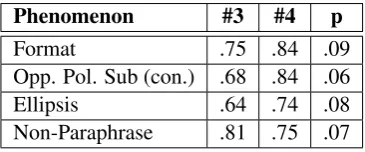
the errors of the two systems for each phenomena. Table4shows some of the more interesting results. Four of the phenomena with largest difference in accuracy show significant difference withp<0.1. These differences in performance are substantial, considering that the two systems have nearly iden-tical quantitative performance.
Phenomenon #3 #4 p
Format .75 .84 .09 Opp. Pol. Sub (con.) .68 .84 .06 Ellipsis .64 .74 .08 Non-Paraphrase .81 .75 .07
Table 4: Difference in phenomena performance be-tween S3 (Wang et al.,2016) and S4 (He and Lin,2016)
Phenomenon #3 #5 p
Derivational .72 .84 .03 Same Pol. Sub (con.) .75 .70 .02 Same Pol. Sub (NE) .73 .64 .01 Format .75 .85 .03 Opp. Pol. Sub (con.) .68 .52 .10 Ellipsis .64 .80 .10 Addition/Deletion .70 .67 .02 Identity .77 .73 .01 Non-Paraphrase .81 .71 .01 Entailment .76 .88 .08
Table 5: Difference in phenomena performance: S3 (Wang et al.,2016) and S5 (Lan and Xu,2018a)
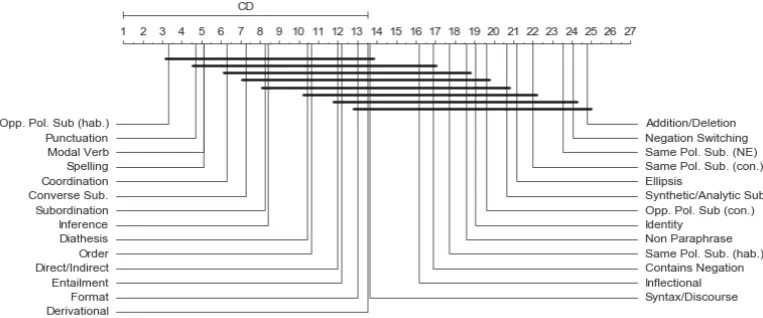
Figure 1: Critical Difference diagram of the average ranks by phenomena
a larger quantitative difference. Table 5 shows the comparison betweenS3andS5(Lan and Xu,
2018a). Ten of the phenomena show significant difference with p <0.1 and seven with p <0.05. These results answer our RQ 3: we show that there are significant differences between the “per-formance profiles”of the different systems.
5.4 Comparing Performance by Phenomena
The“phenomena performance” of the individual systems clearly differ among them, but they also show noticeable tendencies. Looking at the per-formance by phenomena, it is evident that certain phenomena consistently obtain lower than aver-age accuracy across multiple systems while other phenomena consistently obtain higher than aver-age accuracy.
In order to quantify these observations and to confirm that there is a statistical significance we performed Friedman-Nemenyi test (Demˇsar,
2006). For each system, we ranked the perfor-mance by phenomena from 1 to 27, accounting for ties. We calculated the significance of the dif-ference in ranking between the phenomena using the Friedman test (Friedman, 1940) and obtained a Chi-Square value of 198, which rejects the null hypothesis withp <0.01. Once we had checked for the non-randomness of our results, we com-puted the Nemenyi test (Nemenyi, 1963) to find out which phenomena were significantly different. In our case, we compute the two-tailed Nemenyi test for k = 27 phenomena and N = 11 systems. The Critical Difference (CD) for these values is 12.5 atp<0.05.
Figure 1 shows the Nemenyi test with the CD
value. Each phenomenon is plotted with its av-erage rank across the 11 evaluated systems. The horizontal lines connect phenomena which rank is within CD of each other. Phenomena which are not connected by a horizontal line have signifi-cantly different ranking. We can observe that each phenomenon is significantly different from at least half of the other phenomena.
We can observe that some phenomena, such as “opposite polarity substitution (habitual)”, “punctuation changes”, “spelling”, “modal verb changes”, and “coordination changes” are sta-tistically much easier according to our eval-uation, as they are consistently among the best performing phenomena across all systems. Other phenomena, such as“negation switching”, “addition/deletion”, “same polarity substitution (named entity)”, “opposite polarity substitution (contextual)”,and“ellipsis”are statistically much harder, as they are consistently among the worst performing phenomena across all systems. With the exception of “negation switching” and “op-posite polarity substitution (habitual)”, these phe-nomena occur in the corpus with sufficient fre-quency. These results answer our RQ 4: we show that there are phenomena which are easier or harder for the majority of the evaluated systems.
6 Discussion
In Section 3.2 we described our evaluation methodology and posed four research questions. The experiments that we performed and the anal-ysis of the results answered all four of them. We briefly discuss the implications of the findings.
perfor-mance of a system can differ significantly based on the phenomena involved in each candidate-paraphrase pair. By addressingRQ 4, we showed that some phenomena are consistently easier or harder across the majority of the systems. These findings empirically prove the complexity of para-phrasing and the task of PI. The results justify the distinction between the qualitatively different lin-guistic phenomena involved in paraphrasing and demonstrate that framing PI as a binary classifica-tion problem is an oversimplificaclassifica-tion.
By addressingRQ 2, we showed that each sys-tem has strong and weak sides, which can be iden-tified and interpreted via its “performance pro-file”. This information can be very valuable when analyzing the errors made by the system or when reusing it on another task. Given the Deep archi-tecture of the systems, such a detailed interpreta-tion is hard to obtain via other means and metrics. By addressing RQ 3, we showed that two sys-tems can differ significantly in their performance on candidate-paraphrase pairs involving particu-lar phenomenon. These differences can be seen even in systems that have almost identical quan-titative (Acc and F1) performance on the full test set. These findings justify the need for a qualita-tive evaluation framework for PI. The traditional binary evaluation metrics do not account for the difference in phenomena performance. They do not provide enough information for the analysis or for the comparison of different PI systems. Our proposed framework shows promising results.
Our findings demonstrate the limitations of the traditional PI task definition and datasets and the way PI systems are typically interpreted and eval-uated. We show the advantages of a qualitative evaluation framework and emphasize the need to further research and improve the PI task. The
“performance profile”also enables the direct em-pirical comparison of related phenomena such as “same polarity substitution (habitual)” and
“(contextual)”or“contains negation”and “nega-tion switching”. These comparisons, however, fall outside of the scope of this paper.
Our evaluation framework is not specific to the ETPC corpus or the typology behind it. The framework can be applied to other corpora and tasks, provided they have a similar format. While ETPC is the largest corpus annotated with para-phrase types to date, it has its limitations as some interesting paraphrase types (ex.: “negation
switching”) do not appear with a sufficient fre-quency. We release the code for the creation and analysis of the“performance profile”4.
7 Conclusions and Future Work
We present a new methodology for evaluation, interpretation, and comparison of different Para-phrase Identification systems. The methodology only requires at evaluation time a corpus annotated with detailed semantic relations. The training cor-pus does not need any additional annotation. The evaluation also does not require any additional ef-fort from the systems’ developers. Our methodol-ogy has clear advantages over using simple quan-titative measures (Accuracy and F1 Score): 1) It allows for a better interpretation and error analysis on the individual systems; 2) It allows for a better qualitative comparison between the different sys-tems; and 3) It identifies phenomena which are easy/hard to solve for multiple systems and may require further research.
We demonstrate the methodology by evaluating and comparing several of the state-of-the-art sys-tems in PI. The results show that there is a statisti-cally significant relationship between the phenom-ena involved in each candidate-paraphrase pair and the performance of the different systems. We show the strong and weak sides of each system using human-interpretable categories and we also identify phenomena which are statistically easier or harder across all systems.
As a future work, we intend to study phenomena that are hard for the majority of the systems and proposing ways to improve the performance on those phenomena. We also plan to apply the evalu-ation methodology to more tasks and systems that require a detailed semantic evaluation, and further test it with transfer learning experiments.
Acknowledgements
We would like to thank Darina Gold, Tobias Hors-mann, Michael Wojatzki, and Torsten Zesch for their support and suggestions, and the anonymous reviewers for their feedback and comments.
This work has been funded by Spanish Min-istery of Science, Innovation, and Universities Project PGC2018-096212-B-C33, by the CLiC re-search group (2017 SGR 341), and by the APIF grant of the first author.
Nitin Madnani, Joel Tetreault, and Martin Chodorow. 2012. Re-examining machine translation metrics for paraphrase identification. InProceedings of the 2012 Conference of the North American Chapter of the Association for Computational Linguistics: Human Language Technologies, NAACL HLT ’12, pages 182–190, Stroudsburg, PA, USA. Association for Computational Linguistics.
H. B. Mann and D. R. Whitney. 1947. On a test of whether one of two random variables is stochas-tically larger than the other. Ann. Math. Statist., 18(1):50–60.
Tomas Mikolov, Ilya Sutskever, Kai Chen, Greg Cor-rado, and Jeffrey Dean. 2013. Distributed represen-tations of words and phrases and their composition-ality. InProceedings of the 26th International Conference on Neural Information Processing Systems -Volume 2, NIPS’13, pages 3111–3119, USA. Curran Associates Inc.
P.B. Nemenyi. 1963. Distribution-free Multiple Com-parisons. Ph.D. thesis, Princeton University.
Jeffrey Pennington, Richard Socher, and Christo-pher D. Manning. 2014. Glove: Global vectors for word representation. InIn EMNLP.
Mark Sammons, V. G. Vinod Vydiswaran, and Dan Roth. 2010. ”ask not what textual entailment can do for you...”. In ACL 2010, Proceedings of the 48th Annual Meeting of the Association for Com-putational Linguistics, July 11-16, 2010, Uppsala, Sweden, pages 1199–1208.
M. Vila, M. A. Mart´ı, and H. Rodr´ıguez. 2014. ”is this a paraphrase? what kind? paraphrase boundaries and typology. ”. pages 205–218.