Proceedings of Recent Advances in Natural Language Processing, pages 111–120,
An Evolutionary Algorithm for Automatic Summarization
Aur´elien Bossard* and Christophe Rodrigues** *LIASD - EA 4383, Universit´e Paris 8, Saint-Denis, France
**L´eonard de Vinci Pˆole Universitaire, Research Center, Paris La D´efense, France
Abstract
This paper proposes a novel method to select sentences for automatic summa-rization based on an evolutionary algo-rithm. The algorithm explores candidate summaries space following an objective function computed over ngrams probabil-ity distributions of the candidate summary and the source documents. This method does not consider a summary as a stack of independent sentences but as a whole text, and makes use of advances in un-supervised summarization evaluation. We compare this sentence extraction method to one of the best existing methods which is based on integer linear programming, and show its efficiency on three different acknowledged corpora.
1 Introduction
Automatic summarization systems are essential components of information systems. Indeed, in-crease of numerical information sources can have a negative effect on online content reading and as-similation. Summarizing such content can allow users to better apprehend it. Automatic summa-rization has therefore become one of the first re-search in natural language processing field (Luhn, 1958) and still remains a widely spread topic.
In order to validate the benefits obtained from new methods or parametrization, the automatic summarization field needs robust evaluation meth-ods. Evaluating automatic summaries, just like evaluating automatic translation, is a complex task. Until early 2000s, only two types of ap-proach existed: entirely manual evaluation with a reading grid and semi-automatic evaluations that compare automatic summaries with human written references. Since, entirely automatic approaches
that allow for evaluating a summary without a human reference (writing it is the most time-consuming task in evaluation) emerged and have recently achieved good performances, using prob-abilistic models (Louis and Nenkova, 2009; Sag-gion et al.,2010).
Probabilistic models for automatic summariza-tion evaluasummariza-tion are natural: a summary and its source have to share the same distribution of con-cepts. As they have proven performant for evalu-ation, using them to guide automatic summariza-tion process seems obvious, although it has to our knowledge not been already tested. As opposed to the most part of automatic summarization methods that use encoded metrics, we here propose to con-sider automatic summarization as the maximiza-tion of a natural score: the divergence between the concepts distribution in the source and the con-cepts distribution of a candidate summary.
So we view automatic summarization as choos-ing the best summary among a very large set of candidate summaries upon a metric that is com-puted on the whole candidate summary. This leads us to the use of an evolutionary algorithm in order to naturally select the best summaries.
While other recent papers (Li et al., 2013; Nishikawa et al.,2014;Peyrard and Eckle-Kohler, 2016) integrate sophisticated and task-specific preprocessings and postprocessings, and handle semantics using complex representations, this pa-per proposes a new generic and directly usable sentence extraction method for automatic sum-marization. This method explores the candidate summaries space using an evolutionary algorithm. This algorithm aims at finding an approximate so-lution of the maximization of an objective func-tion computed over a candidate summary. We first present iterative methods and exploratory analy-sis methods for automatic summarization. We then expose our sentence extraction method and
the evaluation protocol: it is compared to one of the best methods in the automatic summarization field. Finally, we discuss our results.
2 Related Work
Iterative Selection Automatic summarization systems generally combine a centrality score for text portions and an extraction method for these portions. The first automatic summarization sys-tems (Luhn,1958;Edmundson,1969) simply ex-tracted most central portions. MMR method ( Car-bonell and Goldstein, 1998) allows for iterative text portions extraction given a centrality score and a redundancy score. CSIS-based method (Radev, 2000) removes from a list of text por-tions sorted by centrality every one that shares too much information with a higher ranked. These methods share a major drawback: generated sum-maries depend mostly on the first selected text portion. Therefore, they are exposed to omitting summaries made of average ranked sentences that reflect correctly the overall content of the source documents when combined together.
Optimization Other methods emerged recently to overcome this problem. They consist in expling the space of all candidate summaries in or-der to find the one that maximizes an objective function. This problem is exponential in input sentences as there are Cn
m candidate summaries
composed ofnsentences for a corpus of m sen-tences. For example, choosing 10sentences over 200leads to1025possible solutions. Adding con-straints on text portions selection and using ILP1 help delimiting the problem and finding (not al-ways) an exact solution (McDonald,2007;Gillick and Favre, 2009b). The search space is lim-ited by constraints on text portions length and by constraints that avoid including text portions that do not provide additional information. Whereas Gillick and Favre(2009b) select summaries based on the maximization of bigram occurrences, Li et al. (2013) try to maximize the similarity be-tween summaries and sources bigram frequencies. These methods have proven to be very efficient. However, the use of an ILP solver enforces to modelize the problem as a linear functions, so does not allow for complex functions that could bet-ter take into account the structure of the automatic summarization problem.
1Integer Linear Programming
Liu et al. (2006); Nandhini and Balasundaram (2013); Shigematsu and Kobayashi (2014) pro-pose to look for an approximate solution using a genetic algorithm. As opposed to ILP extrac-tion methods, these methods are free of any con-straints on the objective function. However, these methods keep on considering a summary as a set of independent portions of text, and do not take advantage of the new structure of the prob-lem that we propose: a summary is not consid-ered as a whole. Considering a summary as a whole allows for a better space exploration and more complex objective functions. Alfonseca and Rodr´ıguez(2003) use a ”standard GA” without de-scribing it and several fitness scores, whose main metric is cosine-tfidf similarity between sources and candidate summaries. However, this similar-ity has obtained poor results when used as an au-tomatic evaluation metric (Nenkova et al.,2007). So this metric should not be used as fitness score for automatic summarization. As opposed to Al-fonseca and Rodr´ıguez(2003), we define a new, non-standard, and fully replicable evolutionary al-gorithm combined with an extension of an agreed-upon automatic evaluation metric.
Supervised Learning (Litvak et al., 2010; Bossard and Rodrigues, 2011) use genetic algo-rithms for supervised learning of parameters in order to tune automatic summarization systems. Nishikawa et al.(2014);Takamura and Okumura (2010);Sipos et al.(2012) perform structured out-put learning to maximize ROUGE scores. These approaches suffer from the complexity of machine learning model. Moreover, it requires learning data and is very task-specific. Recently, Peyrard and Eckle-Kohler (2016) proposed to use an ap-proximation of ROUGE-N score combined to an ILP solver. The approximation of ROUGE-N score is performed with supervised learning. The results obtained outperform state-of-the art meth-ods on DUC 2002 and 2003 corpora.
optimiza-tion algorithm. So evoluoptimiza-tionary algorithms seem appropriate. In the meantime, the scoring func-tions we use allow to benefit more of evolutionary algorithms.
3 Our Method
Louis and Nenkova(2009) have proposed an en-tirely unsupervised function for automatic sum-mary evaluation. The evaluation method has proved efficient as it strongly correlates to Pyra-mid score, a semi-automatic score used in TAC evaluation campaigns to assess automatic sum-maries informational quality (Nenkova et al., 2007). Saggion et al. (2010) confirmed the rel-evance of the approach. The method is entirely unsupervised, so it does not need any human ref-erence. This makes it perfectly fit to be used as an objective function in a guided space exploring algorithm.
Our objective function computes the probabil-ity distribution of tokens in the source documents with the probability distribution of tokens in the summaries. Tokens can be words, ngrams or even semantic concepts. The objective function is based on (Louis and Nenkova, 2009) that handles auto-matic evaluation using Jensen-Shannon(JS) diver-gence.
The JS divergence can be considered as a symmetric version of Kullback-Leibler divergence (KL). KL divergence is defined as the average number of bits wasted by coding samples belong-ing to P usbelong-ing another distribution Q, an approxi-mate of P (Louis and Nenkova,2009). In our case, the two distributions are those for words (or con-cepts) in the input and the summary.
Given two distributions P and Q, here is the definition of JS divergence:
JS(P||Q) = 12[KL(P||A) +KL(Q||A)] with : A = P+2Q the mean distribution ofP and Q;KL(P||A)the Kullback-Leibler divergence:
KL(P||Q) =X w
pP(w)log2ppP(w) Q(w)
Louis and Nenkova(2009) use a simple weighted Laplace smoothing over probabilities.
p(w) = N+Cδ(×w1)+.5×|δV|
with : C(w) the number of occurrences ofw;N the overall number of tokens; V the vocabulary, andδ= 0.0005.
3.1 Unigram Distribution Objective Function This objective function (Uniprob) fits the exact au-tomatic evaluation function described above and in (Louis and Nenkova,2009).
3.2 Bigram Simple Sum Objective Function Bigram simple sum objective function (Bisimple) consists in summing all bigram weights in a can-didate summary. Cancan-didate summaries get a high score if they are composed of the most frequent bigrams in the source documents.
3.3 Bigram Cosine Objective Function Bigram cosine objective function (Bicos) consists in a cosine similarity between source and can-didate summaries bigram vector. This objective function is used in (Alfonseca and Rodr´ıguez, 2003).
3.4 Bigram Distribution Objective Function Lin (2004) has shown that ROUGE semi-automatic evaluation metrics are more correlated to manual evaluation when using bigrams rather than unigrams when it comes to compare sum-maries and references of a standard length: 50 words and more. Therefore, we make the assump-tion that a probabilistic model based on bigrams outcomes one based on unigrams for our objec-tive function. Moreover, we smooth probabili-ties using Dirichlet smoothing (MacKay and Peto, 1994), that adds to every count of a token in a summary its probability in the source documents. Dirichlet smoothing is more faithful to the data (Zhai and Lafferty,2004) than Laplacian smooth-ing while remainsmooth-ing simple to compute. With Dirichlet smoothing, the probability of a tokent in a summarySis computed this way:
pdir(t|S) = CS(t)+NµpS+MLµ(t|D)
with:Dthe source documents;CS(t)the number
of occurrences oftinS;pML(t|D)the maximum
likelihood of t in D; NS the number of tokens
inS; and µ a constant parameter called pseudo-frequency.
Candidate summaries are subsets of source doc-uments, so smoothing is only applied to sum-maries.
redundant, the summaries that are rated high on this objective function would also be redundant. 3.5 Evolutionary Algorithm
We here describe the evolutionary algorithm we developed and use for maximization of our objec-tive function. This evolutionary algorithm differs from traditional genetic algorithms as described below, to better handle automatic summarization problem. In fact, automatic summarization tasks often bound the summaries length in words, not in number of sentences. So the number of sentences extracted in a summary depends on both maxi-mum summary length and each sentence length. That is why we cannot use a standard problem model in which every candidate summary would be an individual withngenes,nbeing the number of sentences to extract. Having a specific repre-sentation of the individuals leads to defining new operators on these individuals. So the mutation and hybridization mutators differ from what we are used to because of the structure of our prob-lem.
Individuals Definition Each individual (= a candidate summary) is defined by a set of chro-mosomes (= sentences). A chromosome codes for a sentence. The number of chromosomes in the set of an individual is variable, while there is an upper threshold for the sum over the length of all chromosomes in words. This requires some adap-tations to the classic mutation and hybridization operators, that we define below.
Algorithm Sequence At generation 0, a starting population is created randomly. It containsN in-dividuals, whereN =Np+Nm+Nh, whereNp, NmandNhare the parameters of the evolutionary
algorithm for the next generations. For each of the next generations:
• Npis the number of parents;
• Nmis the number of mutated individuals;
• Nhis the number of hybridated individuals.
ThenNpparents are selected to generate by
mu-tation and by hybridation Nm andNh additional
individuals. The parents and the individuals they generated constitute a new generation. Ng
gener-ations are iteratively created this way. At the end, the individual that maximizes the objective func-tion is selected.
Starting Population Selection N individuals are randomly generated. A new sentence is ran-domly added to an individual until the length con-straint is reached:
∃s∈S\Is.t.X
si∈I
length(si)+length(s)< maxLength,
withIan individual andSthe sentences in source documents.
Parents Selection Parents selection can be per-formed through different methods. These meth-ods favor space exploration or exploitation by se-lecting the best individuals. We chose a selection method that is a compromise between exploration and exploitation : tournament selection. Np
tour-naments composed of N
Np individuals – withNthe total population size – are randomly created. The best individual in each tournament is selected as a parent for the next generation.
Mutation Operator We cannot use classic mu-tation operators: changing one gene for another. Selecting a too long sentence would violate the summary length constraint while selecting a too short sentence would let the new candidate sum-mary to be evaluated against other summaries that are longer. Our mutation operator is defined as follows : a chromosome (sentence) is randomly deleted from an individual. The individual is then randomly filled with new chromosomes until the length constraint is no longer satisfiable.
Hybridization Operator The chromosomes of two individuals (here, parents) are put together in a single set. A new individual is then cre-ated with chromosomes randomly selected from this set. Once no more chromosome matches the length constraint, the individual is randomly filled with chromosomes from the source documents. This operation does not guarantee that chromo-somes from both individuals will be selected, so it is completely different from traditional hybridiza-tion operators. Proceeding this way is however mandatory in order to create individuals that will satisfy the summary length constraint.
4 Experiment
We compare our summarization method to three
baselines on TAC 2008, TAC 2009 evaluation campaigns corpora2. We also use the French
cor-2The corpora are available on request athttp://www.
pus RPM23 evaluation that share a similar struc-ture with the TAC 2008 and 2009 corpora.
4.1 Corpora
TAC 2008, 2009 and RPM2 are composed of two distinct parts: the first one is dedicated to stan-dard multi-document summarization. The second is dedicated to update summarization: the goal is to summarize information in the update set, as-suming that the user has already read the infor-mation in the standard set. The following TAC campaigns concern guided summarization: writ-ing summaries for a given topic where the topic falls into a predefined category, including ”Acci-dents and Natural Disasters”, ”Attacks”, ”Health and Safety”, ”Endangered Resources”, and ”Tri-als and Investigations”. The goal is to encourage a deeper linguistic analysis, and summarization sys-tems must take into account each task specificity in order to produce coherent summaries. So, post 2009 TAC campaigns are out of this article scope. TAC 2009 standard summarization corpus is composed of 44 sets of 10 documents each: english-written news articles. The task consists in generating a 100 words summary for every docu-ment set. Average docudocu-ment length is 6330 words.
4.2 Our System
Document Preprocessing The documents are first cleaned: all tags and meta-information are re-moved.
Tokenization and Sentence Splitting We first use the default tokenizer of the POS-tagging tool tree-tagger4 (Schmid, 1994). Tree-tagger is also used for POS-tagging (not used in the English sys-tem) and sentence splitting.
Stemming Words are stemmed via the Porter stemmer for TAC 2008 and 2009 corpora. For RPM2, we implemented the French snowball stemmer5.
Bigrams Filtering Bigrams composed of two stopwords are pruned. A stoplist composed of the 200 more frequent English words is used for this
3The corpus is available on request at http://
lia.univ-avignon.fr/fileadmin/documents/ rpm2/
4Treetagger: http://www.cis.uni-muenchen.
de/˜schmid/tools/TreeTagger/
5Snowball: http://snowball.tartarus.org/
algorithms/french/stemmer.html
purpose. For the French corpus, a word is consid-ered as a stopword if it is tagged as either a deter-miner or a preposition.
Sentence Selection Sentence selection is per-formed by the evolutionary algorithm described in Section3.5using the three objective functions de-scribed in Sections3.4,3.1and3.2.
Evolutionary Algorithm Parameters We em-pirically tuned the number of generations using TAC 2009 test dataset in order to increase the probability that the algorithm converges. TAC 2009 test dataset and evaluation datasets are strictly disjoint. Here are the parameters of the evolutionary algorithm: Np = Nh = Nm = 160
andNg=160.
First Sentences Salience TAC 2009 corpus is a news corpus composed for the most part of news wires and articles. First sentences are of-ten considered as more salient than the other ones. (Gillick et al., 2009a) upweight by a factor 2 the concepts that appear in the first sentence of a docu-ment and thus reach a 16% gain in automatic eval-uation metrics on TAC 2009 corpus. Our systems also upweight by a factor 2 the bigrams in the first sentences. We test its effect in Section5.
4.3 Baselines
We implemented two baselines:
• lexmmr: common scoring method LexRank (Erkan and Radev,2004), followed by MMR (Carbonell and Goldstein, 1998) to perform redundancy removal;
• ILP: the sentence selection method of (Gillick et al.,2009a) described in Section2.
These two systems have the same preprocess-ing, tokenizpreprocess-ing, stemmpreprocess-ing, filterpreprocess-ing, and first sen-tence bigrams weighting as ours, so they can be compared efficiently.
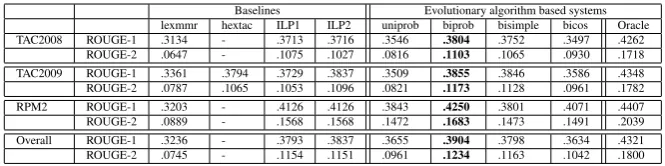
Baselines Evolutionary algorithm based systems lexmmr hextac ILP1 ILP2 uniprob biprob bisimple bicos Oracle TAC2008 ROUGE-1 .3134 - .3713 .3716 .3546 .3804 .3752 .3497 .4262
ROUGE-2 .0647 - .1075 .1027 .0816 .1103 .1065 .0930 .1718 TAC2009 ROUGE-1 .3361 .3794 .3729 .3837 .3509 .3855 .3846 .3586 .4348 ROUGE-2 .0787 .1065 .1053 .1096 .0821 .1173 .1128 .0961 .1782 RPM2 ROUGE-1 .3203 - .4126 .4126 .3843 .4250 .3801 .4071 .4407 ROUGE-2 .0889 - .1568 .1568 .1472 .1683 .1473 .1491 .2039 Overall ROUGE-1 .3236 - .3793 .3837 .3655 .3904 .3798 .3634 .4321 ROUGE-2 .0745 - .1154 .1151 .0961 .1234 .1163 .1042 .1800
Table 1: Average results of all systems on TAC 2008, 2009 and RPM2
same solver as ICSI system (glpk) but preprocess-ings are limited to the strict minimum: the same as our system, described in 4.2. This way it can be efficiently compared to our evolutionary based sentence extraction method. As in (Gillick et al., 2009a), sentences of less than 10 words and bi-grams that do not appear more than twice are not taken into account; in ILP2, we add the last rule in ICSI summarization system: sentences that do not share at least one word in common with the query are pruned. This way, we can compare more effi-ciently ILP baselines to our system that does not take query into account. The only difference be-tween ICSI summarization system and ILP2 lies in processings that are not related to the sentence selection module.
The last baseline (hextac) is TAC 2009 third
baseline: human generated extractive summaries (Genest et al.,2009). This baseline stands for de-termining the best summary we can achieve using purely extractive methods. Therefore, comparing its results to a pure extractive summarizer is in-formative. However, as the goal of this system is to produce good summaries for a human judge, its automatic scores could be lower than manual ones. In fact, human extractors can emphasize linguistic quality and global coherence rather than pure in-formation extraction.
4.4 Oracle Experiments
We want to estimate the upper bound that a system based on our evolutionary algorithm and a proba-bilistic model can achieve. For this purpose, we define a new objective function. The objective function described above compares distributions between candidate summaries and source docu-ments. If we suppose that manual summaries are available (which is the case in ROUGE evaluation campaigns), then we can directly compute distri-butions between candidate summaries and manual ones. So doing, we obtain an evolutionary ap-proach guided by an Oracle. Given the small size of manual summaries used as source documents,
we don’t use any smoothing at all.
This oracle is a good way to fit to the manual summaries. However, it is not optimal in all cases. The manual summaries are indeed small and are not necessarily composed of bigrams also present in source documents. This can cause the distribu-tion divergences to be less precise.
5 Results
We here use the same ROUGE parameters as for TAC evaluation campaings6.
5.1 General Results
Table 1 presents the results obtained by all the systems and baselines described in Section4.2on three corpora : TAC 2008, TAC 2009 and RPM2. The best system, whatever the evaluation metric, isbiprob, that uses our evolutionary algorithm and JS divergence between bigrams distributions on source documents and candidate summaries as ob-jective function. It outperforms ILP1 and ILP2
baselines. ILP1andILP2baselines have the same ROUGE scores on RPM2 corpus, as RPM2 is not query-oriented. One can notice thatbiproband hu-man baseline hextac are really close in terms of ROUGE scores.
Biprob system as well as ILP baselines out-perform the human generated hextac baseline. It means that both systems succeed in extract-ing as many salient information as a human. However,hextacsummaries outperform automatic summaries in terms of linguistic quality: coher-ence, ordering...
5.2 Impact of First Sentence Bigrams Upweight
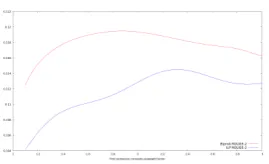
All of the three corpora are only composed of newswire articles and share the same information structure. The central information is located in the first sentences. Figure 1 shows biprob and
ILPbaseline ROUGE-2 scores when the upweight
Figure 1:Biprobsystem andILP1baseline results depending on first sentences concepts upweight value
Figure 2: ROUGE-2 scores on all topics depend-ing on topic size in bigrams
factor of first sentence bigrams varies on our three corpora. Increasing first sentences concepts weight improves ROUGE-2 scores of both ILP baseline andbiprobon the overall score over the three corpora. The maximum is reached around the factor 2, as assumed byGillick et al.(2009a). Our experiment confirms that weighting up first sentence concepts with a factor 2 is efficient on newswire articles corpora.
5.3 Impact of Input Size
Figure2presents ROUGE-2 scores of ILP1 base-line and Biprob depending on the number of bi-grams in the source documents for all corpora. The x error bar shows the number of topics that are concerned by a point. One can see that the two systems are really close for small topics. How-ever, for topics with a larger number of bigrams, Biprob tends to outperform ILP1 (except for num-ber of bigrams intervals with a small numnum-ber of examples).
5.4 Impact of Bigram Filtering
Taking into account only the bigrams that appear more than twice for ILP baselines increases re-sults (as also noticed in (Gillick et al., 2009a)), so we tested a probability distribution that keeps
only these bigrams. The results are not as good as when computing probability distribution over all bigrams. This can be linked to the fact that our method performs better when the number of bi-grams as input is high.
5.5 Convergence on TAC 2009 Data
Figure3shows the average fitness score (= bigram distribution objective function) of each generation for every topic of TAC 2008, TAC 2009 and RPM2 corpora for 12 different runs of the evolutionary algorithm. We can see that the scores seem to con-verge quite fast on average, before the 50th gener-ation.
Figure 3: Average fitness scores of all topics in TAC 2008, 2009 and RPM2 corpora depending on the generation.
The Figure3presents the fitness average scores on all evaluation topics. Convergence speed de-pend on several factors: data dispersal, explo-ration space size... Figure 4 shows the conver-gence speed for the most populated topic of our three corpora: the D0918 topic from TAC 2009. It prints the average score, and the score standard de-viation for D0918 topic on 12 different runs. This can give us an idea of the algorithm convergence in the worst case, speaking of exploration space size.
Figure 4: Average scores and standard deviation of scores for D0918 topic depending on the gener-ation.
that match the 100 words length limit, and the evolutionary algorithm has always reached con-vergence after exploring 70400 different candidate summaries.
5.6 Oracle Results
One can see in table1that, as expected, our Ora-cle performs more than 50% better than every of our systems. This means that there are summaries composed of sentences in the source documents that are closer to the reference summaries than those chosen by our objective functions. The 50% difference in ROUGE-2 scores shows that there is room for improvement.
6 Discussion
In this article, we proposed a sentence extraction method for automatic summarization that allows for good summaries on our three evaluation cor-pora. Our method outperforms a state-of-the-art sentence extraction method based on an ILP model by more than6.4% on the combined score of our three evaluation corpora.
We show that Jensen-Shannon divergence out-performs cosine similarity as objective function in our evolutionary algorithm. This confirms the conclusions of (Louis and Nenkova,2009) on the evaluation of metrics for automatic summary eval-uation.
Thanks to the use of an evolutionary algorithm rather than an ILP-based method, the score com-putation and constraints are totally free and not limited by ILP modelization constraints. How-ever, the objective functions described here do not handle redundancy. A candidate summary will be well scored if its probability distribution sticks to the one of the source documents. So, if the source documents display high redundancy on a given in-formation, our method could generate redundant summaries. However, other objective functions that handle redundancy can be implemented as well as constraints on candidate summaries gener-ation. Our system does not try to improve linguis-tic quality: sentences arlinguis-ticulation is not managed. Methods such as lexical chains (Barzilay and El-hadad,1999) could be implemented to the objec-tive function or used as post-treatment.
The method proposed in the article uses an evo-lutionary algorithm and objective functions that imply heavy computation. Several solutions can be brought to this problem: using GPU
architec-ture for faster computation of distribution diver-gences as the evolutionary algorithm can be easily parallelized, or finding a linear approximation of the divergence distribution function so it can be used inside an ILP solver.
At last, an evolutionary algorithm needs a fine parameters tuning: population size, mutants and cross over percentage. Although we parameter-ized the algorithm so it finds a good solution for every topic of our three corpora, their influence on the algorithm convergence should be further stud-ied using different data sets.
Extractive automatic summaries can outperform (in terms of ROUGE scores) human extractive summaries. It brings us to the upper limit that one can achieve with purely extractive methods, and to question the methods to consider from now on: sentence compression, generative paradigms for specialized summaries, or sentence rephrasing to achieve a better textual cohesion.
7 Conclusion
For automatic summarization, finding a summary (as good as possible) without an Oracle or any ref-erence summary is an unsupervised task. In this paper, we show that automatic summarization can be achieved using recent advances in automatic summarization evaluation. In particular, we ex-plore automatic summarization under the hypoth-esis that source documents and summaries have to share the same bigram distribution.
We present a sentence extraction evolutionary algorithm for automatic summarization capable of improving summary generation after generation based only on distribution computation. We show that this extraction algorithm achieves good results compared to state-of-the-art method on three cor-pora. However, the system can be improved in several ways: the objective function can be im-proved to better evaluate candidate summaries or be approximated to be used in a faster algorithm. If ROUGE-2 scores used in this paper are heavily correlated to human metrics, the evaluation needs to be pushed further using fully manual metrics such as Pyramid.
References
Helmut Schmid. 1994. Probabilistic part-of-speech tagging using decision trees. InProceedings of the International Conference on New Methods in Lan-guage Processing. Manchester, UK.
Haruka Shigematsu and Ichiro Kobayashi. 2014. Topic-based multi-document summarization using differential evolution for combinatorial optimization of sentences .
Ruben Sipos, Pannaga Shivaswamy, and Thorsten Joachims. 2012. Large-margin learning of
sub-modular summarization models. In Proceedings
of the 13th Conference of the European Chapter of the Association for Computational Linguis-tics. Association for Computational Linguistics, Stroudsburg, PA, USA, EACL ’12, pages 224–233.
http://dl.acm.org/citation.cfm?id=2380816.2380846. Hiroya Takamura and Manabu Okumura. 2010.
Learn-ing to generate summary as structured output. In Jimmy Huang, Nick Koudas, Gareth J. F. Jones, Xin-dong Wu, Kevyn Collins-Thompson, and Aijun An, editors,CIKM. ACM, pages 1437–1440.
Chengxiang Zhai and John Lafferty. 2004. A study of smoothing methods for language models applied to information retrieval. ACM Trans. Inf. Syst.