CSEIT184648 | Published – 08 May 2018 | May-June 2018 [ (4 ) 6 : 250-254 ]
National Conference on Engineering Innovations and Solutions (NCEIS – 2018)
International Journal of Scientific Research in Computer Science, Engineering and Information Technology
© 2018 IJSRCSEIT | Volume 4 | Issue 6 | ISSN : 2456-3307
250
Virtual Eye Glasses Try-On System
Prof. Prasanna. G. Patil, Srinidhi K.V, Ayushi Jain, Kavyashree M. S, Sripriya R. R Computer Science and Engineering, MIT Mysore-VTU Belagavi, Karnataka, India
ABSTRACT
This paper presents a virtual eyeglasses try-on system. With this system, users can virtually try on glasses to see how a particular glass style looks and fits their face via a live video approach, before they purchase it. Also, the system recommends flattering style of eye glasses based on the user’s face shape. This really saves a lot of time for the selection of eyeglasses in the store When the user starts the system, initially face detection will be done by using the Viola and Jones algorithm. Further, eye detection is done again by using Viola and Jones algorithm. After this, face shape estimation is performed where the system recommends the user, the best pair of glasses which suites the user’s face based on his/her face shape. The user can then try on the glasses virtually by using live video approach. Keywords: Live video approach, Viola and Jones algorithm.
I.
INTRODUCTION
Old traditional method of going to eyeglasses store and trying on multiple glasses is usually a hectic task. According to global eyesight, around 6 out of 10 people in the developed world are those wear eye-glasses. As mentioned earlier, the old method of trying out different glasses in a store is certainly a hectic task as it is time consuming.
In this paper, the proposed system of virtual eyeglasses try on creates a product in which the users could come in with nothing but their face and can get information and an idea about what type of glasses will flatter their face the most which will reduce time required during selection of eyeglasses. This system collects data about the facial geometry of the user, and uses that information to recommend them a flattering style of glasses which suites their face the best. The user is then able to try on different pairs of those glasses to see which type of glasses exactly suites them the best, through a live camera interface. The best-suited glasses can then be purchased online.
The virtual try-on glasses proposed in this paper poses certain advantages over physical try-on of eyeglasses in some cases. To select an eyeglass model that looks good and perfect on the customer’s face, is usually time consuming. Also, the virtual try-on system encourages online shopping which enjoys greater popularity these days. In this system, the user can try the various eyeglasses recommended by the system through a live video approach. The eyeglass that is selected is then perfectly positioned on the customer’s face. With the possible recommendations from the system, the virtual try-on system can be used to narrow down the selection to a few designs and sizes efficiently and interactively.
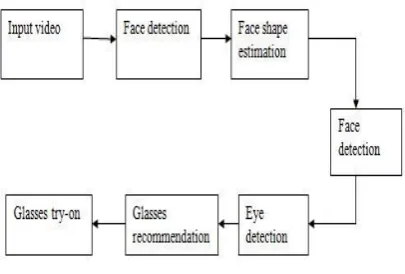
Fig 1: Proposed system overview
II.
METHODS AND MATERIAL
A. Viola and Jones algorithm:
In this paper, we use Viola and Jones algorithm for face and eye detection.
Fig 2: Face detection using Viola and Jones algorithm
The algorithm comprises of four stages
1. Haar features selection 2. Creating integral image 3. Adaboost training algorithm 4. Cascade classifiers
Haar features selection:
Haar like features are digital image features, which is used in object detection. It considers adjacent rectangular regions, which is at a particular location
in a detection window that adds up the pixel intensities in each and every region and then calculates the difference between these sums.
Creating integral image:
In a haar feature the black region is replaced by +1 and white region is replaced by -1. It is found that it is time consuming to add up all the black region pixels and white region pixels at every step to solve this problem Viola and Jones algorithm is used which solves this problem by an integral image. This algorithm introduces the concept of integral image, which finds the sum of all the pixels under a rectangle with just four corner values instead of summing up all the values. To generate an integral image, the value at pixel (x, y) in this integral image is the sum of pixels above and to the left of the pixel (x, y).
Adaboost training algorithm:
It is a machine-learning algorithm, which is used for finding only the best features among all the identified features. Once these features are found, a weighted combination of all these features are used in evaluating and deciding if any given window has a face or not. Only if they can at least perform better than random guessing, each of the selected feature is considered to be included. These features are also called as weak classifiers. A strong classifier is constructed by Adaboost as a linear combination of this weak classifier. Adaboost constructs a strong classifier as linear combination of these weak classifier. The classifier, which is only slightly correlated with the true classification, is defined to be a weak learner. In contrast, a strong learner is a classifier that is well correlated with the true classification. Weak classifier would at least perform better than random guessing.
Cascade classifier:
all best features are not good to evaluate on each window, because this would lead to a high computational cost. Therefore, a cascade classifier
which is composed of stages, in which each stage will contain the strong classifier. The job at each stage is to determine whether the given sub window is definitely a face or not. The given sub window should be immediately discarded if it is not a face when it fails in any of the stage. Adaboost decides which classifiers or features to use at each stage.
Face shape estimation:
Face shape estimation deals with estimating face shape of the user and frame suggestion is provided according to the face shape of the user. In order to estimate the face shape we have made use of distance formula. Distance formula is a numerical measurement of how far apart objects are. In most of the cases distance from a to b is interchangeable with distance from b to a.
Various formulae have been used to estimate different face shape of the user.
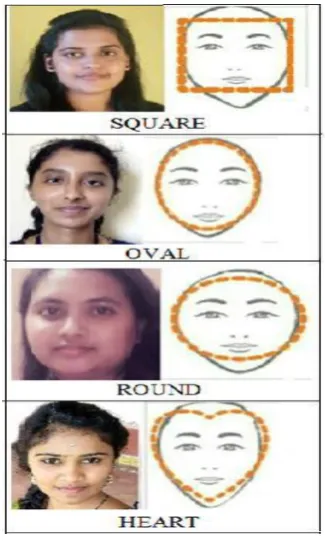
similar width in appearance. If width of the forehead and the jaw are equal to one then it is considered as square face. The system determines the oval face shape if the face length is longer than the cheekbone
width as well as forehead width larger than jaw line. It likely that both chin and jaw line aren’t pronounces and have a slight roundness to them. If the face length and face width are greater than or equal 1.55 then, it is considered as oval face. And if the forehead is wider and chin is narrower then it is determined as heart shaped face. If the forehead width and the jaw width is greater than 1.24 then, it is considered as heart face.
Forehead width is determined by: Forehead width = √(fx − bx)2+(fy − by)2
Jaw width is determined by: Jaw width = √(ex − cx)2+(ey − xy)2
Face length is determined by: Face length = √(ax − dx)2+(ay − dy)2
Face width is determined by:
Face width = (forehead width+ jaw width)/2.0
Fig 3: Various face types
the face is very equal in regards to length and width. The forehead and jaw lines of a square face have a.
Live video:
The major work that needs to be done by the admin is to perform this operation as a live video by placing the eyeglasses on the eye of an individual. Live video is a process where frames are taken one after the other to make it into a continuous video. Every frame is overlayed with the eyeglasses on the region of eye detected.
Try on glasses
Eyeglasses try on is a process where the form is loaded with the eyeglasses images. Face detection with eye detection takes place where the eye region detected is overlayed with the png image of glasses thus justifying as virtual try on.
III.
RESULTS AND DISCUSSION
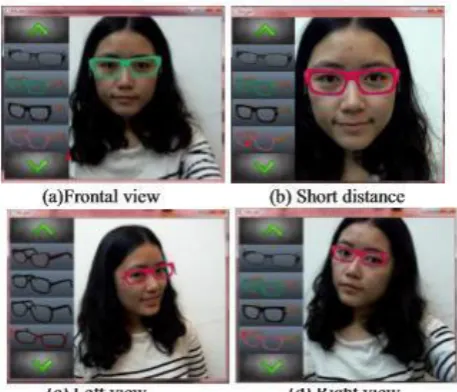
Accurate, precise and interactive virtual environment is created in virtual eyeglasses application. The application is highly accurate with low cost and simple, this makes the application available to every individual . The most important problems that are addressed in the project are shape estimation based on points and stabilization of eyeglasses on individuals face in live video. The goal was to build live 2D eyeglasses with face shape estimation and was successful. The major drawback in the project is that the temples of the eyeglasses i.e. the piece of the frame that extends over the ear cannot be placed as it is done in 2D. To design the virtual eye glasses try-on system, we have made use of OpenCV. The figure below shows various examples of the results which are obtained using our system.
Fig 5: Results of virtual eye glasses try-on system
As we can see from the previous figure, the first case (a) frontal view in a normal face to camera
distance,
(b)frontal view in a short face to camera distance, (c) the view when the user rotates her head to left,
and
(d)the view that the user rotates her head to right. We see that, even when the user moves close or far from the camera or rotates his/her head, the eyeglass images still fit face well.
Table 1. Overview Of The System Sr. no Parameters Proposed Application
1 Applicable areas
3 Platform status Platform dependent
makes
it accessible only to a particular
system.
IV.
CONCLUSION
This system overcomes the few drawbacks of the pre-existing methods of trying the eye glasses online by using the live video approach. Unlike in the pre-existing systems we use live video approach and not pre-recorded videos or just uploaded videos/photos. Hence, this makes our system more realistic and user friendly. Also, the system recommends various flattering eye glasses based on the shape of the user’s face which makes it easy for the user to select the best suited eye glass. This in turn saves the user time.
V.
REFERENCES
[1] Almir Kimura, Jr. Ruan Belem, “A faster face detection method combining Bayesian and Haar Cascade classifiers”, 2015.
[2] K.G Jamkhande, M.J Pandhre, “Human face detection by using depth information”, 2014. [3] Sharanya R Benedict, J Satheesh Kumar,
“Geometric shaped facial feature extraction using face recognition”, 2016.