National Conference on Engineering Innovations and Solutions (NCEIS – 2018)
International Journal of Scientific Research in Computer Science, Engineering and Information Technology
© 2018 IJSRCSEIT | Volume 4 | Issue 6 | ISSN : 2456-3307
Decision Making for Heart Disease Detection Using Hybrid
Neural Network-Particle Swarm Optimization Algorithm
Ranjitha P*1, Vanishri Arun2
*1Software Engineering, J S S Science and Technology University 2Assistant Professor, J S S Science and Technology University
ABSTRACT
Cardiovascular disease is one of the most rampant causes of death around the world and was deemed as a major illness in Middle and Old ages. Coronary artery disease, in particular, is a widespread cardiovascular malady entailing high mortality rates. Angiography is, more often than not, regarded as the best method for the diagnosis of coronary artery disease; on the other hand, it is associated with high costs and major side effects. Much research has, therefore, been conducted using machine learning (genetic algorithm) and data mining to seek alternative modalities. Accordingly, we herein propose a highly accurate hybrid method for the diagnosis of coronary artery disease. As a matter of fact, the proposed method is able to increase the performance of neural network through enhancing its initial weights using Particle Swarm optimization Algorithm (PSO) that suggests better weights for neural network. Making use of such methodology, we can improve accuracy, sensitivity and specificity rates on Z-Alizadeh Sani dataset.
Keywords: Artificial Neural Network, Particle swarm optimizer, Coronary Artery disease, Evolutionary algorithm.
I.
INTRODUCTION
Cardiovascular disease (CVD) is a class of diseases
that involve the heart or blood vessels.
Cardiovascular disease includes coronary artery diseases (CAD) such as angina and myocardial infarction (commonly known as a heart attack). Other CVDs include stroke, heart failure, hypertensive heart disease, rheumatic heart disease, cardiomyopathy, heart arrhythmia, congenital heart disease, valvular heart disease, carditis, aortic
aneurysms, peripheral artery disease,
thromboembolic disease, and venous thrombosis.
The heart is a muscle that acts like a pump to move blood throughout the body. To function properly, the heart must receive oxygen. Oxygen is supplied to
course of a person‟s lifetime many influences can cause one or more of your coronary arteries to become narrowed or blocked.
The present study, given the risks of invasive diagnostic procedure such as angiography and auspicious experiences in the field of data mining, attempts were made to propose a model for identifying coronary arteries disease. The suggested detection model, based on artificial neural networks and Particle swarm optimizer algorithms, can detect coronary artery disease based on clinical data without the need for invasive diagnostic methods. Although ANNs are powerful, designing a proper network can be a very tough task and the more complex a desired dynamics are, the more difficult the design of the network becomes. Many researchers have sought to automate ANN design process by using computer programs. They have used algorithms that explore various combinations of network parameters (size, topology, connection weights, etc.) and the most suitable networks.
II.
RELATED WORKEvolutionary algorithms (EAs) are optimization and search methods, based on Darwinian evolution. EAs are especially useful for Finding global optima of functions which have many locally optimal solutions, because in comparison with traditional gradient-based search methods, EAs have more chances to escape from local optima. EAs are independent of gradient signals and are thus suitable for handling problems where such information is not available. EAs have been frequently used to carry out various tasks regarding 1[1].
Distribution of age and sex was different in the two groups. Subjects with disease had a mean age of 53.3 years and 84% were males, whereas those without disease had a mean age of 49.1 years and 51% were males. Because of these differences and the subsequent
determination that the risk associated with cigarette smoking and serum cholesterol level differed with both age and sex, discriminant analyses were performed in nine age-sex subgroups[2].
Heart disease is the leading cause of death in the world over the past 10 years. Researches have been using several data mining techniques in the diagnosis of heart disease. Most of these systems have successfully employed Machine learning methods such as Naïve Bayes and Support Vector Machines for the classification purpose[3].
Predicting heart disease use inputs from complex tests conducted in labs. Developing a system which will predict heart based on the risk factors[4]. Artificial Bee Colony (ABC) Optimization for the Prediction of Coronary Heart Disease. This probabilistic algorithm has performed better to produce the best accuracy rate. The intelligent behaviour algorithm can be recommended for solving highly complicated optimization problems[5].
III.
METHODOLOGYFeature type Feature name
Thyroid Diseases CHF
DLP(Dyslipidemia)
Symptoms and
examination
BP
PR(Pulse rate) Edema
Weak peripheral pulse Lung rales
Systolic murmur Diastolic murmur Typical Chest pain Dyspnea
Function class Atypical
Nonanginal chest pain Exertional chest pain Low th Ang
ECG Rhythm
Q wave St elevation St depression T inversion LVH
Poor R-Wave
Progression
Laboratory and echo Fbs, Cr, TG, LDL, HDL, BUN, ESR, HB, K, NA, WBC, Lymph, Neut, PLT, EF, Region with RWMA,VHD.
A. Architecture
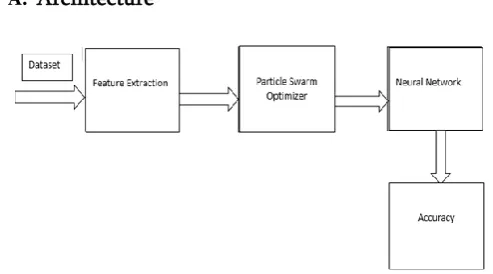
Figure 1. Block Diagram
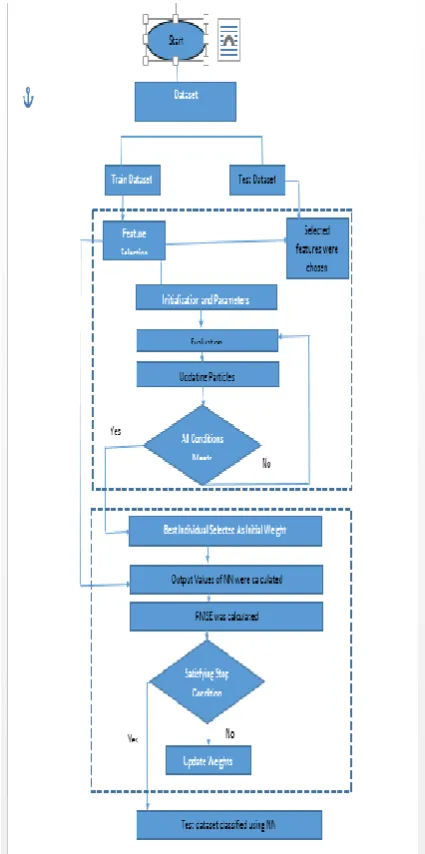
Z-Alizadeh Sani dataset is considered for the work. Where the dataset contains information on 303 patients, 216 of whom suffered from CAD. Fifty-four features were collected for each patient. Firstly dataset is send for pre-processing where noise and missing data or record are removed. For feature selection, weight by SVM and principal component analysis (PCA) were used. In weight by SVM, attribute weights are the coefficients of the normal vector of a linear SVM .PCA converts a set of correlated variables into a smaller number of uncorrelated variables employing an orthogonal transformation. Later the selected feature are passed for the particle swarm optimization algorithm for the generation of global best weight. Where global weight are given as input for neural network for training and testing.
B. Workflow
in approaching the optima. PSO consists of a swarm of particles where each particle has its own position and velocity. Each particle is initialized randomly at the beginning of the algorithm and the heuristics update the position and velocity in the latter stages of algorithm.
The pseudo code of PSO for global minimization problems is as follows:
Let P = fp1; p2; p3; : : :png be set of particles where each pi is of d dimensions;
pid = fpi1; pi2; : : : ; pidg. Each particle has its own
Figure 2. Workflow
individual velocities vi i.e., V = fv1;v2;v3; : : : vng. Start
Initialize positions and velocities randomly of permissible range for each particle.
While convergence criteria is not met DO
For each particle
Calculate the fitness value
If the fitness value of the particle is less than pibest (old) then
Update pibest to present value End if
End
Update gbest with the particle that provides best fitness value of all the particles in
the swarm For each particle For each dimension
vid = w _ vid(old) +c1*rand*(pibestd
_pid)+c2*rand*(gibestd _pid) // update particles velocity
pid = pid (old)+vid // updating particles position end for
end for END
IV. RESULT DISCUSSION
A. Preprocessing and Feature extraction
Figure 3. PCA Feature Extraction
Figure 4. Selected features
B. Traning and testing phase
Artificial neural network (ANN) serves the objective providing a model which has the ability to relate very complex input and output datasets. This ANN model works extremely well for very complex data sets which are normally very difficult to predict using mathematical modelling (equations). The ANN is a network of neuron connected among themselves through weights and biase. Once the structure of the ANN is formed then the next task is to train the network.
Training of the networks means finding the optimum values of various weights and biases of the network. Normally, various types of techniques are used to find the suitable values of weights and biases of the ANN.
I this work, optimum training of the network have been obtained through particle swarm optimization (PSO).
The following seven steps have been used to train ANN using PSO.
Step 1) Collect dataset.
Step 2) Create input data and output data from the dataset.
Step 3) PSO algorithm parameters gets initialized. Step 4) Weights gets generated.
Step 5) Training using PSO and neural network . Step 6) Check the Network
Step 7) Testing
Figure 5. Result of traning phase
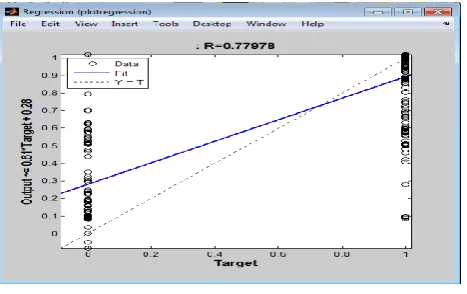
The trained ANN is 'net_f'. Once the training is completed the regression plot will be displayed. Figure 6 shows the regression plot of the trained ANN (net_f). From this figure, it is observed that regression coefficient R is 0.77978.
Figure 6. Regression Plot
IV.
CONCLUSIONnetwork as concerns CAD detection. Specifically, using this method, CAD can be detected without angiography which can help eliminate high costs and major side effects. Meanwhile, other versions of neural networks can be tested and compared. Parameters like learning rate, and momentum factor can also be optimized for this work. Finally, new data with some other features must be checked by this algorithm.
V.
REFERENCES1. G. Parthiban, S.K.Srivatsa,” Applying Machine Learning Methods in Diagnosing Heart Disease for Diabetic Patients”, International Journal of Applied Information Systems (IJAIS) Volume 3– No.7, August 2012 – www.ijais.org.
2. V.Arun ,”Disease classification and prediction using principal component Analysis and
Ensemble classification framework”,
International journal of control Theory and Application, Vol 10 ,2017,ISSN:0974-5572. 3. Sowmya N. and Dr. R .Vijayabhanu ,” Artificial
Bee Colony (ABC) Optimization for the
Prediction of Coronary Heart Disease”,
International Journal of Trend in Research and Development, Volume 2(5), ISSN 2394-9333 www.ijtrd.com
4. Jamal Salahaldeen Majeed Alneamy and Rahma Abdulwahid Hameed Alnaish ” Heart Disease Diagnosis Utilizing Hybrid Fuzzy Wavelet Neural Network and Teaching Learning Based Optimization Algorithm”, Hindawi Publishing Corporation Advances in Artificial Neural Systems Volume 2014, Article ID 796323
5. Sowmya N. and Dr. R .Vijayabhanu.” Intelligent Heart Diseases Prediction System Using A New Hybrid Metaheuristic Algorithm”, International Journal of Engineering Research & Technology (IJERT) Vol. 1 Issue 8, October - 2012 ISSN: 2278-018
6. Murat Koklu and Yavuz Unal, “Analysis of a Population of Diabetic Patients Databases with Classifiers” , International Science Index,
Biomedical and Biological Engineering Vol:7, No:8, 2013 waset.org/Publication/16219
7. Prof(Dr.) Nirali Nanavati ,Aashna Agarwal,” Association rule mining using hybrid GA-PSO for multi-objective optimization”, 978-1-5090-0612-0/16/ ©2016 IEEE .
8. Majid Ghonji Feshki, Omid Sojoodi Shijani,” Improving the Heart Disease Diagnosis by Evolutionary Algorithm of PSO and Feed Forward Neural Network”, 978-1-5090-2169-7 ©2016 IEEE.