© 2019 IJSRCSEIT | Volume 4 | Issue 7 | ISSN : 2456-3307
Challenges in Implementing NGN
Pavithra D. R.Assistant Professor, BMS College for Women, Bangalore University, Bangalore, Karnataka, India
ABSTRACT
The telecommunication industry started to focus on a "next generation" of network that would replace the current telephone network . The technological advancements in telecommunications is leading towards the trend of unification of networks and services and Next Generation Networks are rapidly growing and developing globally. NGN being an IP based network enables customers to receive voice, data and video over the same network. NGN offers reduced network and operational complexity resulting in better and reliable service. It offers unrestricted access by users to different service providers also supporting generalized mobility. In the course of transition from the legacy PSTN to an IP based NGN there are many issues which need to be addressed. In this paper some of them is been defined.
Keywords : Next Generation Network (NGN), Dynamic Topology, Heterogeneity, Soft switch, Wavelength Division Multiplexing
I. INTRODUCTION
Communications technologies are evolving fast, demand for more and newer services anywhere and at any time. The drivers for this trend come from the economy, military defense,health and education fields, and match the request for more efficiency, and more comfortable and safe daily life. As a rule, new technologies are put into use as soon as they are available.
Communication networks have become a key economic and social infrastructure in world economies. The network infrastructure supports all economic sectors, and is therefore crucial to the national and international exchange of goods and services.
II. OVERVIEW OF NGN
In this section, we present the definition of Next Generation Network (NGN) along with its architecture and principles.
2.1 Definition of NGN
Fig. 1 shows typical NGN components
The connection between the service network and the core network can be implemented via gateways. The core network in NGN represents the transportation backbone in traditional networks, which is concerned with the transfer of information between peer entities. Besides the transfer of packets, control and management functions are also implemented in the core network. The access network in NGN is derived from the existing access technologies. To accommodate various access media, the access network is separated from the core network of NGN, which serves as an intermediate between user equipments and core network
2.2 NGN Functional Architecture
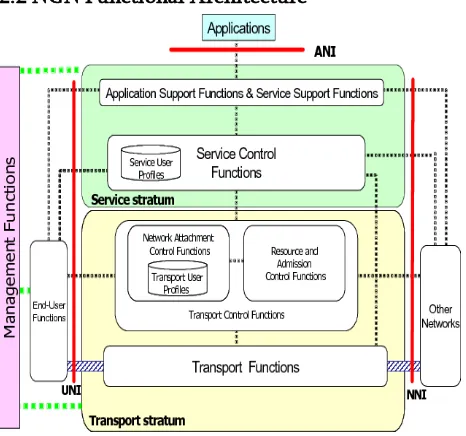
Fig. 2 shows an overview of the NGN functional architecture.
The NGN architecture needs to offer the configuration flexibility to support multiple access technologies. It also needs to support a distributed and open control mechanism, which provides a separated service provisioning from transport network operation and speeds up the provision of diversified NGN services The NGN functions are divided into service and transport strata.The service stratum functions provide session-based and non-session-based services, including subscribe/notify for presence information and a messaging method for instant message exchange .End-user functions are connected to the NGN by user-to network interface (UNI), while other networks are interconnected through the network-to-network interface (NNI). The application-to-network-to-network interface (ANI) provides a channel for interactions and exchanges between applications and NGN elements.
2.3 Core NGN Technologies Required
.Now NGN is not only a concept on the paper; its commercial implementations are already realized on a large scale. Appropriate technologies are significant for the accomplishment of the functions and abilities promised by NGN. In fact, any technologies which satisfy the NGN requirements could label themselves as NGN; some industry-wide accepted and practice-proved core NGN technologies are listed below:
Soft-switch: NGN provides PSTN/ISDN emulation and simulation services, which are used to enable end-users to use their legacy terminals with NGN continuously and have similar experience to the legacy system in an NGN environment.
networks with basic traffic engineering ability such as CoS (Class of Service) and packet priority.
Core Transport Technology: IP over ASON over OTN: Wavelength Division Multiplexing (WDM) technology is widely used in the telecommunication backbone/core transport networks to provide solid transport services due to its tremendous line rates. Furthermore, IP is the virtually dominant network protocol now in the world to carry a variety of services and applications. Therefore, IP, ASON and OTN compose the best technical solution for an NGN transport network at the present time.
Moreover, a full NGN deployment requires telecommunication networks has been impressive. The shift from simple voice communication to rich content interactions (video and image) over the Internet, even in terms of the simple voice communication, voice carried by packets over mobile networks and the Internet has seen a dramatic increase while the voice traffic over conventional PSTN has dropped in recent years.
As stated the deployment of NGN is mainly driven by the desires of cost reduction and product differentiation from network companies (network carriers and service providers); however those network companies have a huge investment in the existing network infrastructure, and therefore a balance point between retaining current value and investing for the future must be taken into account.
On the other hand, from a users’ point of view, the services of current networks have done quite well in teams of service quality, fulfilling the demands of enabling people to communicate geographically.
However, from a network carriers’ point of view, the
existing network architecture has some significant drawbacks, it is too complicated and uneconomical to handle the possible traffic explosion in the future on a large scale and therefore it cannot meet the constantly increasing demands of the market. A new network infrastructure is required to handle the increasing data traffic in a cost-effective way and NGN was conceived due to this purpose.
III.Challenges in Future
Although NGN will derive greatly from the current telecommunications networks and IP-based infrastructure, its control and management architecture is likely to be radically different from both, and will be anchored on a clean separation between a QoS-enabled transport/network domain and an object-oriented service/application domain, with a distributed processing environment . The pressure arising from deregulation, competition and rapid technology development together with the fresh vision of NGN would generate significant challenges in terms of operation, administration and maintenance of networks and services.
Generation with the basic understanding of the concepts mentioned above, the challenges faced by next can be investigated.
A. Energy Efficiency, Maintaining Friendly Outlook.
keeping the service running at an economical rate.One network requirements. On the other hand, if the load on the network is very less, then only certain parts of the network are active and the others are in stand-by mode, which saves energy.
B. Dynamic Topology
In NGN, it is reasonable to expect that devices,especially high-end routers and switches, will become increasingly programmable, and that it will become possible to execute more control software directly on the devices . As a result, network topology of common networks of NGN can change occasionally. In addition, the collaboration between disparate network domains or between different service providers will increase to a great extent. Dynamic configuration and topology of NGN will challenge the traditional configuration management approaches,which are often inefficient and involve too many human efforts. In NGN, a quick-response and network-wide configuration capability is required to manage the changing network topology which may be composed of thousands of distributed nodes.
C. Heterogeneity
The NGN will not only contain the legacy
components from traditional PSTN, but also some
“brand new” components from the development of
up-to-date technologies, e.g. Multi-protocol Label Switching (MPLS). Meanwhile, the flexibility based on trust negotiation among disparate domains is required in the pervasive computing environments of NGN. The interoperability among heterogeneous entities will become critical important for NGN. For these reasons, different vendors’ platforms /
technologies have to be “converged” and managed on
a common platform in order to support and improve
NGN services. Both CMIP and SNMP can be the candidates for the next-generation network management protocols. Limited by the multi-vendor capability and other weaknesses of current approaches how to deal with heterogeneous resources in a cost-effective manner thus becomes the big challenge for NGN.
D. Multiple Services (Traffic Considerations)
The NGN is packet-based, and responsible for carrying multiple services over the single IP-based transport network, ranging from traditional telephony voice to data, video and multimedia applications.
E. Security Issues
The next-generation-networks will be using a lot moresoftware (like SDN) than previous generations. This opens it up to a lot of security concerns. Whenever there is software involved, there are also security concerns. Security risks may arise as a result of a voluntary attack or software bug that occurs naturally.Jamming and spoofing are examples of voluntary attack on software and hardware.
F. Quality of Service (QoS) Challenge
QoS is extremely important for the next-generation of Internet applications such as VoIP, video-on-demand and several other consumer services. Some older networking
technologies such as Ethernet were not designed or meant to support prioritized traffic which offer guaranteed performance levels. This makes it extremely difficult to implement QoS across the current infrastructure of the internet.
sequence numbers of data packets can be used to reconstitute a message signal even if individual data packets have different transition delays.
G.Reliability
As a network grows, there are more and more aspects that come into the picture. A large network will have thousands of software/hardware components, even if one of these components fail, there may be a drop in quality of service or a total disruption in service. This is obviously unacceptable. For example, a small network, say, servicing about a 100 people can be regularly checked and maintained to ensure100% uptime Therefore, with growing networks, reliability is going to be a big issue. But this can be addressed with the use In the SDN, a controller has the overview of the entire network and hence can find and correct faults in a short period of time.Best-effort approach in the current Internet, the NGN is optimized for differentiated services where QoS and reliability of services will be engineered and guaranteed. Accordingly, the traffic management capability for differentiated NGN services and traffic has to be provided so as to monitor and control any concerned service. In the traditional TMN framework,traffic management has not been addressed clearly since all network connections are at fixed rate. In NGN, the fine-grained controlling and monitoring of traffic pattern will become an important consideration for NGN service providers and network operators. H. Standardization
For any service provider or network operator in NGN, the biggest motivation for adopting new operations support system (OSS) is to maximize Return On Investment (ROI). Besides taking advantage of new technologies coping with issues such as multiple services, other industry trends have to be considered, such as the trend towards commercial off-the-shelf (COTS) components and systems promising seamless integration (plug-and-play). Most important of all, the fundamental management architecture for NGN shall be considered. In the TMN architecture of the ITU-T,
no further decomposition of the proposed layers into specific functions is proposed.
Although ITU-T’s NGN Management Focus Group is
emerging for necessary management standards, standardization in the area of network management for NGN is still fragmented at many different standards bodies.
IV.CONCLUSION
In conclusion, in the current telecommunication market, a new phenomenon can be observed: an ongoing rapid shift from traditional voice traffic to IP traffic, and a move from service-specific networks towards a common network infrastructure where all services are supported. Following the trends above, NGN is envisioned as a network infrastructure designed to cover the shortcomings of current networks. variety of challenges in NGN make current management approaches not applicable in the future. Some foreseeable challenges have been discussed in this paper, combined with the characteristics and services of NGN. Furthermore, promising evolutionary and revolutionary approaches were presented to illuminate emerging technical trends in the network management development of NGN.
V. REFERENCES
[1]. IEEE Network, New Books & Multimedia Column, November 2002)December 2, 2008, [2]. ICT papers from
http://www.newport-networks.com/cust-docs/89-ECH.pdf
[3]. Nightingale, S., Montgomery, D., Frankel, S., & Carson, M. (2007). A Profile for IPv6 in the U.S. Government. Retrieved December 2, 2008, from http://www.antd.nist.gov/usgv6-v1-draft.pdf [4]. Olszewski, C., Labourdette, J., Huang, F.,
2008, from http://www- ee.ccny.cuny.edu/www/web/ellinas/network-migration_NFOEC2003.pdf
[5]. Ponterotto J. G., (2005). Qualitative Research in Counselling Psychology: A Primer on Research Paradigms and Philosophy of Science. Journal of Counselling Psychology, 52(2), 126-136. [6]. Pullar, T. (2007). Telecom's NGN will make old
phones obsolete. Retrieved 2 December, 2008 from: http://www.stuff.co.nz/4178345a28.html
Cite this article as :