© 2018 IJSRCSEIT | Volume 3 | Issue 3 | ISSN : 2456-3307
Identity Based Encryption with Data Self Destruction in
Revocable Cloud Environment
Kalyani Jaltare1, Asavari Bhusari1, Samiksha Dangre1, Shivali Hedau1, Shruti Waghmare1, Prof. D. B.
Khadse2
1BE Students, Department of Computer science and Engineering Priyadarshini Bhagwati College of
Engineering, Nagpur, Maharashtra, India
2Assistant Professor, Department of Computer science and Engineering Priyadarshini Bhagwati College of
Engineering, Nagpur, Maharashtra, India
ABSTRACT
Concerning securing information, scattered limit is quickly changing into the system for decision. Scattered cut-off is rapidly changing into the framework for choice. Securing data remotely instead of locally boasts a collection of inclinations for both home and expert customers. Appropriated bind assigns "the most extraordinary of information online in the cloud", regardless, the left on putting away behind isn't totally trusted. Regardless of whether the instructive getting together away on cloud are or not changes into a massive worry of the customers moreover discover the chance to control changes into a troublesome business, especially when we share information on cloud servers. To manage this issue outsourcing Revocable IBE gets ready for skilled key period and key maintaining technique is accessible. Other than to revive the limit of cloud server to past what numerous would consider conceivable new secure information self-destructing structure in scattered figuring is utilized. In this framework, each figure contains (encoded report) is named with a period break. In the event that the qualities related with the figure content fulfill the keys discover the chance to structure and both the time minute is in the permitted time between times then the figure substance is decoded. After a client demonstrated end time the information at cloud server will be safely self-destructed. Keywords: Cloud Computing, Self-Destruction, Identity Based Encryption (IBE), Revocation, Outsourcing.
I.
INTRODUCTION
cloud Computing proposes the usage of enrolling assets, those being re-endeavoring or adjust that trouble a re-bit machine and are passed on to the end customer as a relationship over a structure, with the most comprehensively watched case being the web. Scattered most distant point is getting acclamation and centrality quickly. To share information safely the Identity-based encryption structure or utilization of mix of Identity's is utilized [2]. The identity based encryption (IBE) is a principal grungy of ID-based cryptography. Considering all that it is a sort of open key encryption in which people when all is said in
private key. Any social gathering can choose an open key fundamentally vague to the identity ID by join the expert open key with the character respect given the ace open key. To get a managing private key, the get-together got a handle on to utilize the character ID relates the PKG, which utilizes the pro private key to make the private key for identity ID. Precisely when a client leaves the party or bear on genuinely, this client must be denied from the social event for security reasons. Thusly, this denied client ought to never again can get to and change shared information. For this revocable Identity Based Encryption framework is presented by A. Boldyreva, V. Goyal, and V. Kumar [3], yet it as a shortcoming of estimation overhead at single point i.e. official or principal individual from the relationship, to beat the weight an outsourcing considering nearby IBE renouncement is showed up. Structure propose a procedure to offload all the key time related structures amidst key-issuing and key-restore, leaving just a tireless number of direct exercises for PKG and qualified clients for perform locally. Other than another diagram safe key issuing strategy is proposed which uses a mutt private key for every client, in which an AND portal is merged into key period design, to be specific the identity part and the time section.
In like way to deal with overhaul the passed on storage room a guaranteed information self-destructing structure in appropriated arranging is proposed. In this structure, while private key is related with a period minute each ciphertext is named with a period between values. On the off chance that both the time minute is in the permitted time amongst time and the characters related with the ciphertext fulfill the keys find the opportunity to structure then the ciphertext can be unscrambled. All around, the proprietor has the great position to admit that specific flimsy data is true blue for an obliged time explore i.e. self-destructed after total of time break set by the proprietor, or ought not to be unconfined before an asking for time.
II.
LITERATURE SURVEY
In this paper [4] the author proposes an absolutely utilitarian character based encryption plot (IBE). Expecting an assortment of the computational Diffie Hellman issue the structure has picked ciphertext security in the subjective prophet show. The structure depends upon bilinear maps between social events. The Weil blending on elliptic turns is an example of such a guide.
In this paper [3] the Identity-based encryption is proposed, as IBE murders the essential for a Public Key Infrastructure (PKI), it is an enabling separating other option to open key encryption. Any setting, PKI-or identity based, must give a way to deal with deny clients from the framework. Able denial is a general considered burden in the standard PKI setting.
However in the setting of IBE, there has been little work on center the disavowal parts. While scrambling, the most even disapproved obviously of activity require the senders to in like way utilize periods and by accomplishing the trusted ace every last one of the recipients to resuscitate their private keys dependably. In any case, this game-plan does not scale well the work on key updates changes into a bottleneck, as the measure of customer's enlargements. We propose an IBE plot that plainly advances key-animate adequacy for the place stock in social event, while remaining talented for the clients.
more, 0 are each extraordinary as assessed by the "set cover" allocate. A Fuzzy IBE plan can be connected with attract encryption using biometric duties as characters; the mess up insurance property of a Fuzzy IBE configuration is absolutely what takes into cooling check the usage of biometric identities, which unavoidably will have some irritation each time they are investigated. Besides, we show that Fuzzy-IBE can be used for a kind of utilization that we term "quality based encryption".
In this paper [6] the creator keeps an eye on the issue of using untrusted (potentially poisonous) cryptographic partners. A formal security definition to securely outsourcing figurings from a computationally obliged contraption to an untrusted frill is proposed. In this model, the will sorted out condition outlines the thing for the partner, however then does not have encourage correspondence with it once the contraption starts relying on it. Not with standing security, it in like way gives a structure to evaluating the adequacy additionally; check utmost of an outsourcing use. It also show two sensible outsource secure courses of action. Specifically, it show to securely outsource evaluated exponentiation, which demonstrates the computational bottleneck in most open key cryptography on computationally confined contraptions. Without outsourcing, a contraption would require O (n) specific developments to finish specific exponentiation shape bit sorts. The store decays to O (log2 n) for any exponentiation-based strategy where the honest to goodness contraption may use two untrusted exponentiation programs; they highlight the Cramer-Shoup cryptosystem and Schnor stamps as tests. With a pleasing considered security, we fulfill a near weight diminishment for another CCA2-secure encryption compose using rise untrusted Cramer-Shoup encryption program.
In this paper [7] the producer demonstrated that the Trait based encryption (ABE) is a promising cryptographic contraption for ne-grained get the
chance to control. Coincidentally, the computational taken at online encryption by and large makes with them any-sided nature of get the chance to methodology in existing ABE composes, which changes into a bottleneck persuading its application. In this paper, a novel perspective of outsourcing encryption of ABE to cloud affiliation provider to quiet neighborhood count trouble is proposed. It uses an improved movement with MapReduce cloud which is secure under the vulnerability that the pro concentration point and in addition no short of what one of the slave centers is prompt. In the wake of outsourcing, the computational apportioned basic mischief at customer side in the midst of encryption is lessened to darken four exponentiations, which is driving forward. Another inspiration driving inclination of the proposed movement is that the customer can assign encryption for any approach.
In this paper [8] the producer proposed ABE design, the Attribute based encryption (ABE) is a promising cryptographic rough, which has been generally connected with configuration fine-grained get the chance to control structure beginning late. Regardless, ABE is being reproached for its high game plan over-head as the computational cost makes with the multifaceted idea of the get to equation. Since they have obliged getting ready assets this deterrent winds up being more true blue for versatile de-obscenities.
In this paper [9] the producer proposed the virtuoso to kind of forward security for Cryptographic estimations was displayed. Perplex keys are restored at normal time ranges; contact of the mystery key sorting out to a given time does not enable a challenger to "break" the game plan for any earlier day and age in a forward-secure course of action. Diverse enhancements of forward-secure pushed stamp outlines, key-trade customs, and symmetric-key plans are known. The basic building achieves security close picked plaintext strikes under the decisional bilinear Diffie-Hellman supposition in the standard model. This framework is useful, and with the aggregate number of times all parameters make at generally logarithmically.
III.
IMPLEMENTATION
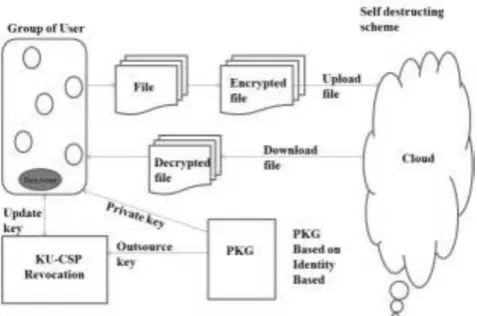
A. System Overview1) The client registers himself at server and after that login with true blue username and secret word into framework. After login, client ask for keys to KU-CSP [1]. The client/proprietor scramble the records utilizing the keys and traded these reports at cloud server for particular time interim and wind up being free from the weight. Precisely when any client leave the social event ,the rundown of outstanding client is send to CSP, where the KU-CSP make the new key or resuscitate the keys to keep up the security of the structure and send the new keys to the key asked for client. At cloud server if the predefined time for the file is end then the record is destructed/erase from the server and it is never again open for clients. This develops the storage space at cloud server. In past work the structure stores the information at cloud server and the client itself has kill the informational index away at cloud in the event that he never again required the information, it fabricates overhead of client and additionally utilizes more space at cloud server, to beat the downside of past framework, the structure virtuoso positions information self-hurting game plan, In this client trade the information at cloud server for particular time length (for example,(15/1/2018-2/3/2018,).at cloud server information is honest to
goodness for just a lone year i.e. from begin date to end date controlled by client after satisfaction of day and age information is self-destructed from the cloud and it liberates the space at cloud server.
Figure 1. System Architecture
B. Self-Destructing Scheme
tree where the time snapshot of each leaf in the customers key should have a place with the in the planning trademark in the ciphertext.
C. Algorithm
1) Setup ( ): PKG run the setup algorithm. It picks a random generator g 2R G as well as a random integer x 2R Zq and sets g1 = gx. Then, A random Element PKG picked by g2 2R G and two hash functions H1; H2: f0; 1g! GT. Finally, output the public key PK= (g; g1; g2; H1; H2) and the master key MK = x.
2) KeyGen (MK, ID, RL, TL, and PK): PKG firstly checks whether there quest identity ID exists in RL, for each user's private key request on identity ID, if so the key generation algorithm is terminated. Next, PKG randomly selects X1 2R Zq and sets x2 = x x1. It randomly selects, and computes. Then, PKG reads the current time period Ti from TL. Accordingly, it randomly selects Ti 2R Zq and computes, where and finally, output SKID = (IK [ID]; TK [ID] Ti) and OKId = x2.
3) Encrypt (M, ID, Ti+, and PK): Assume a user needs to encrypt a message M under identity ID and time Ti period. He/She chooses a random value s 2R Zq and computes, C0 = Me (g1; g2) s; C1 = gs; EID = (H1 (ID)) s and Finally, publish the ciphertext as CT = (C0; C1; EID; ETi).
4) Decrypt (CT; SKID; PK): Assume that the ciphertext CT is encrypted under ID and Ti, and the user has a private key SKID = (IK[ID]; TK[ID]Ti), where IK[ID] = (d0; d1) and TK[ID]Ti = (dTi0; dTi1).
5) Revoke(RL; TL; {IDi1; Idi2; ::::Idik}) : If users with identities in the set {IDi1; Idi2; ::::Idik} are to be revoked at time period Ti, PKG updates the revocation list as RL0 = RL{IDi1; Idi2; ::::Idik} as well as the time list. Through connecting the recently created time period Ti+1 onto original list TL. Finally send a copy for the updated revocation list as well as the new time period Ti+1 to KUCSP.
6) Key Update (RL; ID; Ti+1; OKID): Upon receiving a key update request on ID , KU-CSP firstly checks whether ID exists in the revocation list RL , if so KU-CSP returns and key-update is terminated. Other-wise, KU-CSP gets the corresponding entry (ID; OKID = x2) in the user list UL. Then, it randomly selects Ti+1 2R Zq.
Data self-destruction after end: Previously the current time instant tx lags behind after the threshold value (expiration time) of the valid time interval tR; x, the user cannot obtain the true private key SK. Therefore, the ciphertext CT is not capable to be decrypted in polynomial time, ease the self-destructions of the shared data after end.
IV.
EXPERIMENTAL RESULT
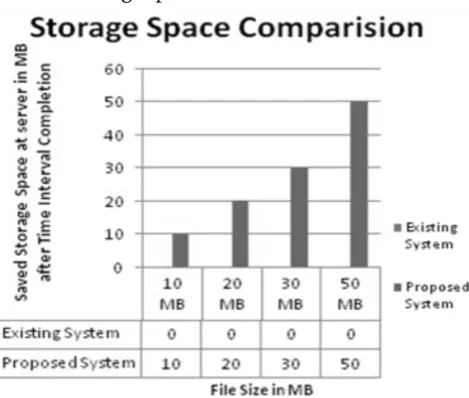
The graph shows the storage space comparison between existing system and proposed system, the existing system is unable to delete file from cloud server as proposed system is able to delete the file from cloud server after specific time interval allocated to that file, which increases the storage space at cloud server. The x-axis shows the various files size uploaded at cloud server while y-axis shows the saved storage space in MB.
V.
CONCLUSIONS
Various Problems have showed up with the advantageous contrast in flexible cloud affiliations. A champion among the most titanic issues is the best way to deal with oversee safely erase the outsourced edifying rundown away in the cloud isolates. Keeping in mind the end goal to deal with the issues by executing versatile fine-grained find the opportunity to control amidst the ensuring time explore and time-controllable self-pummeling after close to the customary and outsourced information in spilled setting up, this paper proposed an information self-destructing structure which can achieve the time picked ciphertext. Furthermore a revocable outsourcing considering nearby IBE contemplates beat issue of character revocation. There is No guaranteed channel or client check is required amidst key-resuscitate among client and KU-CSP, in addition with the assistance of KU-CSP, the structure has bundles, for example, excited believability for the two tallies at PKG and private key size at client.
VI.
REFERENCES
[1]. Jin Li, Jingwei Li, Xiaofeng Chen, Chunfu Jia, and Wenjing Lou, "Identity-Based Encryption with Outsourced Revocation in Cloud Computing", in IEEE transactions on computers, vol. 64, no. 2, february 2015.
[2]. W. Aiello, S. Lodha, and R. Ostrovsky, "Fast digital identity revocation," In Advances in Cryptology CRYPTO98). New York, NY, USA:Springer, 1998, pp. 137-152.
[3]. A. Boldyreva, V. Goyal, and V. Kumar, "Identity-based encryption with efficient revocation," in Proc. 15thACMConf. Comput. Commun.Security (CCS08), 2008, pp. 417-426. [4]. D. Boneh and M. Franklin, "Identity-based
encryp-tion from the Weilpairing," in Advances in Cryptology CRYPTO „01), J. Kilian, Ed.Berlin, Germany: Springer, 2001, vol. 2139, pp. 213-229.
[5]. A. Sahai and B. Waters, "Fuzzy identity-based encryption,"in Advances in Cryptology (EUROCRYPT‟05), R. Cramer, Ed. Berlin, Germany: Springer, 2005, vol. 3494, pp. 557-557.
[6]. J. Li, C. Jia, J. Li, and X. Chen, "Outsourcing encryp-tion of attribute based encryption with
mapreduce," in Information and
Communications Security. Berlin, Heidel-berg:Springer, 2012, vol. 7618, pp. 191-201. [7]. B. Zhang, J. Wang, K. Ren, and C. Wang,
"Privacy-assured Trans. Emerging Topics Comput., vol. 1, no. 1, p. 166-177, Jul. Dec. 2013 outsourcing of image reconstruction service in cloud," IEEE.
[8]. J. Li, X. Chen, J. Li, C. Jia, J. Ma, and W. Lou, "Fine-grained access control system based on outsourced attribute-based encryption," in Proc. 18th Eur. Symp. Res. Comput. Secu-rity (ESORICS), 2013,pp. 592-609.
[9]. R. Canetti, S. Halevi, and J. Katz, "A forward-secure publickey Encryption scheme," in Advances in Cryptology (EUROCRYPT'03), E. Biham, Ed. Berlin, Germany: Springer, 2003, vol. 2656,pp. 646-646.
[10]. P. Mell and T. Grance, "The NIST Definition of Cloud Computing," Nat. Inst. Stand. Technol., Tech. Rep. SP 800- 145, 2011.
[11]. C. Wang, K. Ren, and J. Wang, "Secure and practical outsourcing of linear programming in cloud computing," in Proc. IEEE Int. Conf. Comput. Commun. (INFOCOM), 2011, pp. 820–828.
[12]. M. Green, S. Hohenberger, and B. Waters, "Outsourcing the decryption of ABE ciphertexts," in Proc. 20th USENIX Conf. Security (SEC‟11), 2011, pp. 34–34.
[14]. C. Gentry, "Practical identity-based encryption without random oracles," in Advances in Cryptology (EUROCRYPT‟06), S. Vaudenay, Ed. Berlin, Germany: Springer, 2006, vol. 4004, pp. 445–464.
[15]. C. Gentry, C. Peikert, and V. Vaikuntanathan, "Trapdoors for hard lattices and new cryptographic constructions," in Proc. 40th
Annu. ACM Symp. Theory Comput.
(STOC‟08), 2008, pp. 197–206.
[16]. S. Agrawal, D. Boneh, and X. Boyen, "Efficient lattice (h)ibe in the standard model," in Advances in Cryptology (EUROCRYPT‟10), H. Gilbert, Ed. Berlin, Germany: Springer, 2010, vol. 6110, pp. 553–572.
[17]. D. Cash, D. Hofheinz, E. Kiltz, and C. Peikert, "Bonsai trees, or how to delegate a lattice basis," in Advances in Cryptology (EUROCRYPT‟10), H. Gilbert, Ed. Berlin, Germany: Springer, 2010,vol. 6110, pp. 523– 552
[18]. Y. Hanaoka, G. Hanaoka, J. Shikata, and H. Imai, "Identity-based hierarchical strongly key-insulated encryption and its application," in Advances in Cryptology (ASIACRYPT‟05), B. Roy, Ed. Berlin, Germany: Springer, 2005, vol. 3788, pp. 495–514.
[19]. D. Boneh, X. Ding, G. Tsudik, and C. Wong, "A method for fast revocation of public key certificates and security capabilities," in Proc. 10th USENIX Security Symp., 2001, pp. 297– 308.
[20]. B. Libert and J.-J. Quisquater, "Efficient revocation and threshold pairing based cryptosystems," in Proc. 22nd Annu. Symp. Principles Distrib. Comput., 2003, pp. 163–171.
[21]. H. Lin, Z. Cao, Y. Fang, M. Zhou, and H. Zhu,