CSEIT1831188 | Received : 16 Feb 2018 | Accepted : 28 Feb 2018 | January-February-2018 [(3) 2 : 118-123 ]
International Journal of Scientific Research in Computer Science, Engineering and Information Technology © 2018 IJSRCSEIT | Volume 3 | Issue 2 | ISSN : 2456-3307
118
A Study of Different Steganalysis Methods
Arohi Patel
*, Milin Patel
Computer Engineering Department, Sardar Patel Institute of Technology, Vasad, Gujarat, India
ABSTRACT
Steganography and steganalysis got a lot of consideration from media and law requirement. Steganography is specialty of mystery correspondence and steganalysis is the craft of identifying shrouded messages installed in computerized media. Steganalysis originates from steganography. In this paper we are thinking about the strategies for steganalysis that are helpful for the concealing the information. This audit paper gives some thought regarding the steganalysis and its strategies. I---n this paper, we examined the techniques and classifier of the steganalysis. Discrete cosine transformation and discrete wavelet transformation and discrete Fourier transformation are the principle change systems. In addition, we concentrating on DCT and DWT mix change. WE contemplated Support vector machine and artificial neural system as classifier.
Keywords: Steganalysis, Feature Extraction, DCT, DWT, DFT, SVM, ANN
I. INTRODUCTION
The word steganography is comes from the Greek words “steganos” (covered) and “grapy” (writing). The intention of steganography is to secure the transmission of data. Steganalysis gives a platform to detecting the hidden data in the watermark image. This paper provides you too many methods, which are useful for the steganalysis. In steganalysis, technique there is a two type spatial domain and transfer domain. Feature extraction and classification are the main part of the steganalysis. Steganalysis distributed in statistical and dynamic. In statistical side, there is only Least Significant Bit method. In dynamic side there is discrete wavelet transformation (DCT) and discrete wavelet transformation (DWT). In this review paper there is also providing information related to attackers. There is two types of attacks in steganalysis active and passive. There are two types of steganalysis, which is statistical and dynamic. Dynamic steganalysis also known as blind steganalysis / universal steganalysis.
II. METHODS AND MATERIAL
A. Steganalysis Method:
Steganalysis has two main type of techniques: Statistical analysis and dynamic analysis.
For detection of the hidden message is present or not, steganalysis methods are divided as follows, Statistical steganalysis and Feature based steganalysis
In spatial domain information inserting in pixels is done straightforwardly where, in transform domain space pictures are first changed over to DCT (Discrete cosine transformation ), DFT (Discrete Fourier transformation) or DWT (Discrete Fourier transformation ) area and afterward the message is implanted inside the picture. Preferred standpoint of this transformation over spatial technique is that it is more secure against measurable assaults.
spatial domain steganalysis and transform domain steganalysis.
Spatial domain, one or more than two of pixels is considered and the difference between them is calculated. The pair may be any two neighbouring pixels. They could be selected within a block otherwise across the two blocks.
In transform domain, frequency counts of coefficients are measured first, and then histogram is plots. With the help of Histogram, the cover and stego images can be differentiated. However, this method is not gives the information about the embedding algorithms. To solve the problem, we may choose feature-based steganalysis.
Feature based steganalysis: In features of this image will be extracted for choosing & holding relevant information. The extracted features are used to detect hidden message in an image. Also, use them to train classifiers. This research focuses on feature-based steganalysis.
Feature extraction and classification are the two main steps of any image steganalysis algorithm. Properties of features used for any image steganalysis algorithm are given as below:
• Features should be sensitive to data hiding method.
• Features should be different form the original image and stego image. Larger feature difference means better feature selection.
• Features should be sensitive to all data hiding methods.
B. Discrete Cosine Transformation:
In DCT, first step is to divide the image into blocks of size 8X8 & then DCT transform is applied, using JPEG standard quantization table, then we get quantized coefficients
To make the experiments fair, only the steganalysis algorithms, which extract the features directly from the DCT domain, are considered. An extension of DCT domain features can simply be optimize by adding the features derived from the spatial domain.
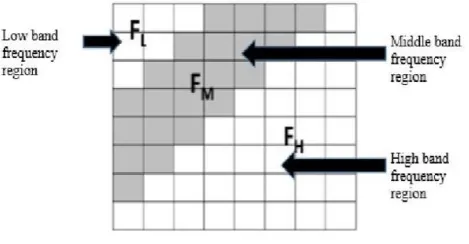
Decomposition of a 2-D DCT to two 1-D DCTs. To perform the JPEG coding, an image (in color or grey scales) is first sub divided into blocks of 8x8 pixels. The DCT is the performed on each block. This generates 64 coefficients, which are then quantized to reduce their magnitude. The coefficients are then reordered into a 1- D array in a zigzag manner before further entropy encoding.
Figure 1. Discrete Cosine Transformation Discrete cosine transform returns the unitary discrete cosine transform of x
N is the length of x, and x and y are the same size. If x is a matrix, dct transforms its columns. Disadvantages of DCT.
• Spatial correlation of the pixels inside the single 2-D block is considered and the correlation from the pixels of the neighboring blocks is neglected. • Impossible to completely decor relate the blocks
at their boundaries using DCT
reconstructed images or video frames.
• Poor identification of which data is relevant to human perception less compression ratio.
C. Discrete Wavelet Transformation:
In DWT After applying Discrete wavelet transform on image we get 4 different sub bands (1)LL, (2)HL, (3)LH, (4) HH, where LL sub band is low frequency component contain maximum information and other three sub bands (HL,LH,HH) are high frequency component contain less information..
In DWT the four blocks are further divided and make other four block which is first level transformation where LL1 sub band is low frequency component containing maximum information also known as approximation Volume 1 | Issue 1 | July-August 2016 | www.ijsrcseit.com 2 coefficient and other three sub bands (HL1,LH1,HH1) are high frequency component containing least information also known as detailed coefficients.
Figure 2. Multi-scale decomposing of an image using DWT
DWT based image steganalysis methods to demonstrate the effects of various aspects image steganalysis algorithms. Features are extracted from
the wavelet-transformed domain. Image is
decomposed into wavelet sub-bands (Horizontal, Vertical, Diagonal, Low pass) using Discrete Wavelet Transform (DWT).Then statistical features are extracted from those wavelet sub-bands i.e. moments
of wavelet sub-bands, moments of probability density function (PDF), moments of characteristic function (CF). Mostly first four moments i.e. Mean, Variance, Skewness and Kurtosis are used as features. Here, PDF is the Histogram
An image and CF is the DFT (Discrete Fourier Transform) of Histogram. General expression to find nth moment is given as follows.
The variance, skewness and kurtosis calculated by outlined formulas.
D. Discrete Fourier transformation:
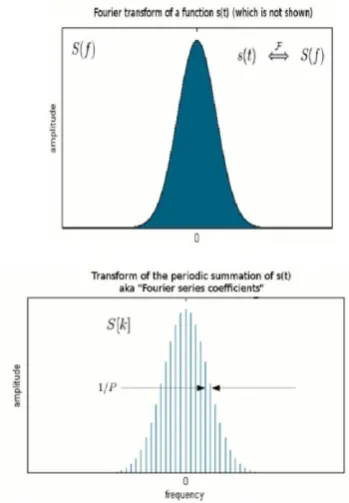
The discrete Fourier transformation (DFT) coverts a in to infinite sequence of equal samples of a function in to a same length sequence of equally spaced samples of the discrete Time Fourier Transform.
If the original sequence spans all the non-zero values, its DTFT is continuous or periodic, and the DFT provides discrete samples of one cycleThe Fourier transform is symmetric, since the original Cauchy function is symmetric.
The Fourier transform of a function f(x) is defined as Moreover, the inverse Fourier transform as
This formula is for the Fourier transform of f with respect to x as a function of w.
Below table give, the information related to comparative analysis of the methods and techniques, which are used in steganalysis. In which we show that Firstly applying DCT on any system and application then applying DWT.
Table 1. Comparative analysis
III. CLASSIFIER
In my research, we comparing the DCT with DWT and in my survey I work with DWT with DFT. But, DFT takes time for classifies the image with the artificial neural network.
Artificial Neural Network:
An artificial neural network, also called simply a “neural network (NN)”. It is defined as similarly to biological neuron system, which is store data of artificial neurons. The classification process has training and testing phase.
The reason for selecting DFT, DCT and DWT is that most data hiding method operate in these domains. However, there is a problem which is "It's difficult to find those features" so as a solution a neural network is selected to process this problem.
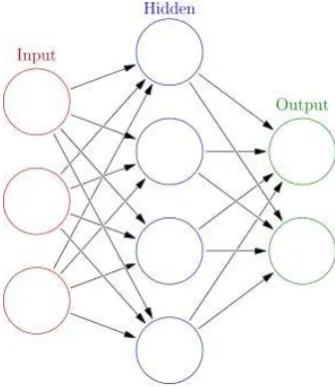
Figure 4. Artificial Neural Network
The simple basic neural network there is three different layers: the input layer, the hidden layer and the output layer, which is shown in above figure. In this ANN the layers are fully connected. Each node in one layer is connected with every other node in the following layer.
Support Vector Machine:
Support vector machine is the supervised learning models that analyse data used for classification and regression analysis. In the training phase, it is trained for the recognize and assign class labels. In addition to performing linear classification.
Figure 5. SVM classifier
Above figure is illustrates that Support Vector Machine Classifier classify the two classes. In which the H1 does not separates the classes. H2 separates the classes but only with a small margin. Moreover, the H3 separates H1 and H2 with the maximum margin. From figure, we can also say that it is a graph of a straight line.
Advantages of SVM:
• Accuracy is high
• It works well on smaller cleaner datasets
• It is more efficient because it uses a subset of training points.
IV.RELATED WORK
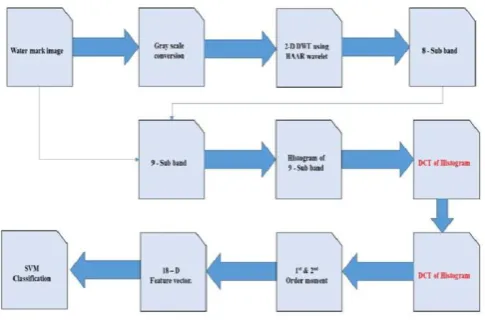
In the figure, we see that the existing system, first of all in system they takes a watermark image. Watermark image was converting in to coloured image so they converting this image in to grey scale image.
Now applying the wavelet transformation on that grey image and gat 8 sub plots of that grey scale image. Now the original image and 8 sub plot of the Grey scale image on which DWT applied getting total 9 sub band including grey image itself. Now we plot the histogram of that image and gated out which place the data is hidden high. Appling DWT on the
HL band in this band the amount of data hiding is high.
After getting histogram of DWT, we applying the DFT for finding its series transformation. For getting DFT histogram we applying 1st and 2nd order of moment. Moreover, getting 18 –D feature vectors. We applying 2 level and three orientation (horizontal, vertical, and diagonal) and gated 8 sub ban bands and image itself so get 9 sub band applying 2 level so we get 9 in to 2 sub band total 18-D feature vector with support of SVM classification.
Figure 6. Working with DCT and DWT
V. CONCLUSION
In this research, I studied the techniques of the steganography and steganalysis. From that I concluded that now a days the LSB method is not working because it is easy to found out data. Comparative DCT and DWT are very use full and is taught for the criminal activities so data can not be easily found out. So now a days only this methods are used in various places. Two classifier SVM and ANN are also used with the DCT and DWT methods.
VI.REFERENCES
and Computer Technology (ICAECCT) Rajarshi Shahu College of Engineering, Pune India. Dec 2-3, 2016
[2]. Changxin Liu, Chunjuan Ouyang “Image
Steganalysis Based on Spatial Domain and
DWT Domain Features” 2010 IEEE
Department of Computer Science Jinggangshan
University Ji’an, Jiangxi, China
{jalcx,oycj001}@163.com
[3]. Anupama K. Ingale “Universal Steganalysis using DWT and Entropy Features” Information Technology Department Rajarambapu Institute of Technology Sangli, India
[4]. Jingxin Hong*, Jun Hu, Hengwei Zhang, “A
Study on Pre-processing Method for
Steganalysis Feature Extraction”, 2016 IEEE. [5]. Sunaina Verma “Steganalysis using Difference
Image Histogram”, IEEE 2016 P.G. Dept. of Computer Science B.B.K.D.A.V. College, Amritsar-143001 (Pb) India
[6]. Marcelinus Henry Menori, Rinaldi Munir, ” Blind Steganalysis for Digital Images using Support Vector Machine Method”, 2016 International Symposium on Electronics and Smart Devices (ISESD) November 29-30, 2016. [7]. Yun Q. Shi, Guorong Xuan, “Steganalysis Based
on Moments of Characteristic Functions Using
Wavelet Decomposition,
Prediction-ErrorImage, and Neural Network”, 2005 IEEE.8].Swaroop Kumar Pedda Reddy B.E
Bangalore University, INDIA, 2001,”
Steganalysis Techniques: A Comparative
Study”, Pedda Reddy, Swaroop Kumar, "Steganalysis Techniques: A comparative Study" (2007). University of New Orleans Theses and Dissertations. Paper 562.
[8]. Mr. Falesh M. Shelke1, Miss. Ashwini A. Dongre2, Mr Pravin D. Soni3, “Comparison of different techniques for Steganography in images”, International Journal of Application or Innovation in Engineering & Management (IJAIEM)
[9]. Aron Chandrababu, “Using an Artificial Neural Network to Detect the Presence of Image
Steganography”, International Journal of Application or Innovation in Engineering & Management (IJAIEM)