A voting scheme to detect semantic underspecification
Héctor Martínez Alonso, Bolette Sandford Pedersen, Núria Bel
University of Copenhagen, Universitat Pompeu Fabra Copenhagen (Denmark), Barcelona (Spain)
Abstract
The following work describes a voting system to automatically classify the sense selection of the complex types Location/Organization and Container/Content, which depend on regular polysemy, as described by the Generative Lexicon (Pustejovsky, 1995) . This kind of sense alternations very often presents semantic underspecificacion between its two possible selected senses. This kind of underspecifi-cation is not traditionally contemplated in word sense disambiguation systems, as disambiguation systems are still coping with the need of a representation and recognition of underspecification (Pustejovsky, 2009) The data are characterized by the morphosyntactic and lexical enviroment of the headwords and provided as input for a classifier. The baseline decision tree classifier is compared against an eight-member voting scheme obtained from variants of the training data generated by modifications on the class representation and from two different classification algorithms, namely decision trees and k-nearest neighbors. The voting system improves the accuracy for the non-underspecified senses, but the underspecified sense remains difficult to identify.
Keywords:voting system, regular polysemy, semantic underspecification
1.
Introduction
Semantic underspecification has been object of interest in the last years, from the Generative Lexicon (GL) framework for lexical semantics (Pustejovsky 1995) to GL-compliant lexicon and ontology building (Lenci et al, 2000; Buitelaar 1998), as well as other GL-based sense-disambiguation works, such as Rumshisky et al (2007). Disambiguation systems, however, are still coping with the need of a representation and recognition of underspecification (Pustejovsky, 2009).
The cause for a lexical sense to be underspecified is very often regular polysemy. Regular polysemy is the phenomenon whereby a word that belongs to a semantic type can act as a member of another semantic type without incurring in metaphor, as this change of type is the result of metonymy (Apresjan 1974, Pustejovsky 1995).
In spite of the GL’s computational aim, implementations that examine the actual computational feasibility of the GL are few. Moreover there is no overt attempt to identify the possible three behaviors of a dot type, as the dot predication has not been computationally tackled, given the lack of strategies to capture meaning underspecification. The goal of the experiment is to use classification to identify the cases of dot predications in two datasets which correspond to two different dot types: Location/Organization and Container/Content.
2.
Regular polysemy
Very often a word that belongs to a semantic type, like Location, can behave as a member of another semantic type, like Organization, as shown by the following exam-ples from the American National Corpus or ANC (Ide and Macleod, 2001):
a) Manuel died in exile in 1932 in England.
b) England was being kept busy with other concerns
c) England was, after all, an important wine market
In case a), Englandrefers to the English territory (Loca-tion), whereas in b) it refers to England as a political entity (Organization). The third case refers to both the English ter-ritory and the English people. The ability of certain words to switch between semantic types in a predictable manner is named by different authors as logical, complementary, sys-tematic or regular polysemy.
Apresjan (1974) offers the following definition: "For any word that has a meaning of type ’A’, is true that it can be used in a meaning of type ’B’ as well [...] Regular poly-semy is triggered by metonymy, whereas irregular polypoly-semy is triggered by other metaphorical processes."
Pustejovsky (1995) provides a different wording:"I will de-fine logical polysemy as a complementary ambiguity where there is no change of lexical category, and the multiple senses of the word have overlapping, dependent or shared meanings."
Pustejovsky’s definition focuses on the relations between the senses (and the possibility of overlap between them) in the cases of regular polysemy, whereas Apresjan fo-cuses on the fact that the alternation of senses is caused by metonymy. From these two definitions we understand regular polysemy as a phenomenon whereby a word that belongs to a semantic type can act as a member of another semantic type without incurring in metaphor, as this change of type is the result of metonymy. Some well-known exam-ples are:
d) Container for content:He drank a whole glass.
e) Location for organization: France elects a new presi-dent.
f) Property for subject of property: The authorities ar-rived quickly.
The last value, which is the artificial class NO, was discarded, and then the highest of the other three which are actual classes was used for classification. Here the assigned sense is ORG, which corresponds to the value of 1.77, which is larger than the 0.88 for LOC and the 1.32 for DOT.
7.
Evaluation
We evaluated the system on 10-fold cross-validation over a random 2/3 vs. 1/3 data split. The two systems are compared in the next table, which shows the class-wise f-measure for baseline (BL) and voting (VT) systems for Lo-cation and Organization (LOC,ORG), Container and Con-tent (CTAIN,CTENT), and their respective dot predica-tions. The voting scheme improved averaged accuracy:
LOC ORG DOT CTAIN CTENT DOT
BL 0.78 0.36 0.48 0.78 0.25 0.32
VT 0.81 0.43 0.31 0.80 0.16 0.32
Table 1: F-measures for each system and class
a) from 64% to 69% in the Location/Organization dataset over a MFS (Most Frequent Sense) baseline of 56%
b) from 62% to 66% in the Container/Content dataset over a MFS baseline of 62%
The improvement on performance is significant in both cases (paired t-test gives a p-value <0.001 for both datasets). However, the system does not show overall im-provement on the detection of the DOT sense, but rather, it biases the output towards the fundamental sense, which is also the majority class for both datasets, as can be seen from the descent of f-score on classification of metonymi-cal senses, while the f-score for the main sense (LOC or CTAIN) becomes higher with the voting system. This be-havior indicates that the system is overfit for the majority class.
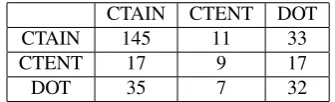
The next tables show the compared confusion matrices from the baseline system and the voting system on the right, for the two datasets, in one of the ten experiment runs:
LOC ORG DOT
LOC 248 45 35
ORG 64 73 32
DOT 34 30 43
Table 2: Baseline system on Location/Organization
LOC ORG DOT
LOC 319 29 16
ORG 69 71 29
DOT 39 21 47
Table 3: Voting system on Location/Organization
CTAIN CTENT DOT
CTAIN 145 11 33
CTENT 17 9 17
DOT 35 7 32
Table 4: Baseline system on Container/Content
CTAIN CTENT DOT
CTAIN 177 2 19
CTENT 23 7 13
DOT 53 2 19
Table 5: Voting system on Container/Content
Performance on the Container/Content dataset is lower, be-cause the patterns that pinpoint the senses are less clear-cut than in the LOC/ORG/DOT case. Locations, for example, are very often introduced by prepositions likein, and orga-nizations tend to prefer the subject position or the agentive role, which makes them either be the first token of the sen-tence or the nominal head of a PP introduced by emphby. The top features for CTAIN and CTENT are the presence of the prepositionof after the headword ("a water bottle" vs. "a bottle of water") and the headword being in plural.
8.
Conclusions and further work
Dot predications still remain difficult to classify with the current data, features and algorithms. The results suggest that is it required that we measure the ITA (inter-encoder agreement) for this phenomenon, which is very likely to be lower than the expected value of 0.88 provided by Mar-ket and Nissim (2007) on their metonymy-resolution work. Measuring agreement also will provide the upper bound for the classification of the datasets. The only available base-line now is MFS basebase-line.We also want to measure how the annotation by group of annotators relates to expert-generated data. Ideally, a lower agreement on binary decisions ("Is this a location or an or-ganization?") would hint a DOT sense, as a low ITA can pinpoint semantic underspecification when informants dis-agree, which can happen in complex contexts, and well as in sparse ones.
International Conference on Generative Approaches to the Lexicon.
A. Rumshisky, VA Grinberg, and J. Pustejovsky. 2007. Detecting selectional behavior of complex types in text. In Fourth International Workshop on Generative Ap-proaches to the Lexicon, Paris, France. Citeseer. N. Tomuro. 2001. Tree-cut and a lexicon based on
system-atic polysemy. InProceedings of the second meeting of the North American Chapter of the Association for Com-putational Linguistics on Language technologies, pages 1–8. Association for Computational Linguistics. P. Vossen, W. Peters, and J. Gonzalo. 1999. Towards a
universal index of meaning. Proceedings of SIGLEX99: Standardizing Lexical Resources.