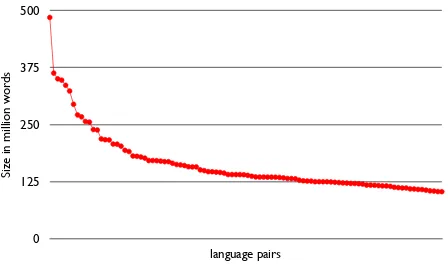
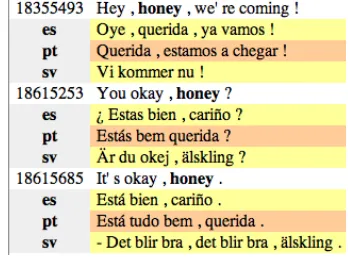
Figure 2: Searching for parallel data. The example shows a query for Bulgarian - Finnish parallel data. Data resources can immediately be downloaded from the listed results of the query by clicking on the links of the corresponding data formats (XCES/XML, Moses, TMX).
berto Sim˜oes (http://alfarrabio.di.uminho.pt/∼albie/). It contains over 30 million parallel translation units in 19 European languages.
MBS: This corpus is a collection of translated newspaper texts from the “Moniteur Belge/Belgisch Staatsblad” compiled by Tom Vanallemeersch (Vanallemeersch, 2010). It contains French and Dutch texts of over 10 million parallel units.
OpenSubtitles2011: This is a major extension of the old subtitle corpus and constitutes now the biggest paral-lel corpus in OPUS. It contains data from over 50 lan-guages with altogether over 8 billion words.
TEP: This is another subtitle corpus for Persian and En-glish compiled by (Pilevar et al., 2011). This corpus is cleaned and pre-processed with special care for the Persian part and contains about 1.2 million parallel sentences.
WikiSource: This collection is the result of a pilot study of extracting parallel resources from the public do-main content collected at WikiSource. Currently, it only contains a Swedish and an English translation of the Bible.
TheOpenSubtitles2011corpus deserves some special atten-tion. Unique for this collection is not only its size but also its contents. Subtitles cover various genres and time periods and combine features from spoken language corpora and narrative texts including many dialogs, idiomatic expres-sions, dialectal expressions and slang. It, therefore, repre-sents a quite exceptional resource especially considering its size and language variety. The collection comes from a free on-line resource of user uploads (www.opensubtitles.org). Due to its open nature, some special treatment was required when compiling the corpus. First of all, the original col-lection contains many duplicates, i.e., subtitle variants of the same movies. Furthermore, it contains a lot of noise in terms of corrupted files and incorrectly tagged files (wrong language, wrong encoding, wrong movie, etc).
Fortunately, the source is sorted by movie and release year which simplifies the matching of subtitles substan-tially. However, TV series with many episodes are usu-ally tagged with the same identifier and, therefore, are not
easily matched with their translations into other languages. Fortunately, we could rely on very fast time-based sentence alignment (Tiedemann, 2007), which enabled us to perform a brute-force search for matching movies among all com-binations of subtitles tagged with the same movie ID. For selecting the most appropriate match, we defined the fol-lowing criteria:
• All subtitles are aligned to one and only one transla-tion in another language.
• At least 50% of the time specified in subtitle time frames has to overlap.
• The best candidate is the subtitle pair with the largest time overlap.
• The ratio between non-empty alignments and empty alignments has to be larger than two.
fre-Figure 3: Querying an annotated parallel corpus using a corpus-specific search interface (Europarl). The example is taken from the following query:"as" [tnt="JJ.*"] "as" <chunk type="NP"> []+ </chunk>(the word “as” followed by an adjective based on TnT-tagger labels, followed by “as” and followed by an NP found by the English chunker).
for some languages. For example, it is possible to illus-trate the bracketing structure produced by shallow parsing for English in the Europarl data. Available annotation can be queried using the flexible CQP query language of the Corpus Workbench by all concordance tools in OPUS (see figure 3).
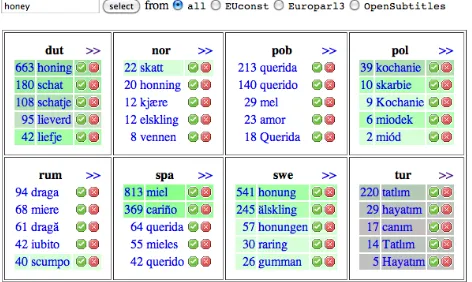
Figure 5: A word alignment database with feedback func-tion. The colors correspond to the proportion between ac-ceptance and rejection of the proposed translation (green = mostly correct, red = mostly incorrect, gray = undecided). Word translations are linked to the concordance tool to ob-tain real-world examples from OPUS corpora.
Finally, there is also a database of word alignments ex-tracted from a subset of the OPUS corpora. This database represents a rough multilingual dictionary with links to real-world examples. The database entries can be judged by users and can easily be explored through interlinked terms. Figure 5 shows a screenshot of the on-line interface.
6.
Conclusion and Future Work
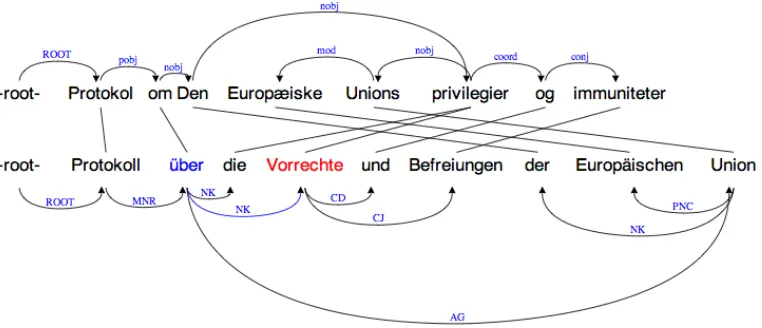
In summary, OPUS presents a unique collection of paral-lel resources and tools for processing them. A large num-ber of new sources have been added recently and we plan to further extend the corpus in the future. We started al-ready to word-align larger portions of our collection and the results will be available to the public from our website. Furthermore, we plan to add more linguistic annotation. In
particular, we like to add dependency information for sev-eral corpora. A prototype for the visualization of machine-annotated parallel treebanks is shown in figure 6. Such an interface could also be used to verify and correct parse trees to improve the annotation and possibly to create extended training data.
Another idea is to open the collection to user contributions using automatic upload facilities. Pre-processing and align-ment tools could then be run off-line supporting users with-out technical experience to built new parallel resources on their own. Our idea is to even support the creation of pri-vate data collections but the main motivation is to enable external users to contribute to our free collection of parallel corpora.
7.
References
P. Denis and B. Sagot. 2009. Coupling an annotated cor-pus and a morphosyntactic lexicon for state-of-the-art pos tagging with less human effort. InProceedings of PACLIC 2009, Hong Kong, China.
Stefan Evert and Andrew Hardie. 2011. Twenty-first cen-tury corpus workbench: Updating a query architecture for the new millennium. Presentation at Corpus Linguis-tics 2011, University of Birmingham, UK.
Jes´us Gim´enez and Llu´ıs M`arquez. 2004. Svmtool: A gen-eral pos tagger generator based on support vector ma-chines. InProceedings of the 4th LREC.
P´eter Hal´acsy, Andr´as Kornai, and Csaba Oravecz. 2007. Poster paper: Hunpos – an open source trigram tagger. In Proceedings of the 45th Annual Meeting of the As-sociation for Computational Linguistics Companion Vol-ume Proceedings of the Demo and Poster Sessions, pages 209–212, Prague, Czech Republic, June. Association for Computational Linguistics.
Figure 6: Visualization of aligned parallel dependency trees. A prototypical interface with editing possibilities (tree struc-ture and word alignment).
Figure 7: A monolingual concordance tool displaying keywords in context.
the Demo and Poster Sessions, pages 177–180, Prague, Czech Republic, June. Association for Computational Linguistics.
Joakim Nivre, Johan Hall, Jens Nilsson, Atanas Chanev, G¨ulsen Eryigit, Sandra K¨ubler, Svetoslav Marinov, and Erwin Marsi. 2007. MaltParser: A language-independent system for data-driven dependency parsing. Natural Language Engineering, 13(2):95–135.
Franz Josef Och and Hermann Ney. 2003. A system-atic comparison of various statistical alignment models. Computational Linguistics, 29(1):19–51.
Mohammad Taher Pilevar, Heshaam Faili, and Ab-dol Hamid Pilevar. 2011. Tep: Tehran english-persian parallel corpus. InCICLing (2), pages 68–79.
Jan Pomik´alek and V´ıt Suchomel. 2011. chared – a character encoding detection tool. available from http://code.google.com/p/chared/. website accessed 13 October 2011.
Helmut Schmid. 1994. Probabilistic part-of-speech tag-ging using decision trees. In Proceedings of Interna-tional Conference on New Methods in Language Pro-cessing, pages 44–49, Manchester, UK, September. http://www.ims.uni-stuttgart.de/˜schmid/.
J¨org Tiedemann. 2007. Improved sentence alignment for movie subtitles. In Proceedings of the Conference on Recent Advances in Natural Language Processing (RANLP’07), Borovets, Bulgaria.
J¨org Tiedemann. 2008. Synchronizing translated movie subtitles. In Proceedings of the 6th International Conference on Language Resources and Evaluation (LREC’2008), Marrakesh, Marocco.
J¨org Tiedemann. 2009. News from opus - a collection of multilingual parallel corpora with tools and inter-faces. In N. Nicolov, K. Bontcheva, G. Angelova, and R. Mitkov, editors, Recent Advances in Natural Lan-guage Processing, volume V, pages 237–248. John Ben-jamins, Amsterdam/Philadelphia, Borovets, Bulgaria. Gertjan van Noord. 2010. TextCat - an
imple-mentation of a text categorization algorithm.
http://www.let.rug.nl/∼vannoord/TextCat/.
Tom Vanallemeersch. 2010. Belgisch staatsblad corpus: Retrieving french-dutch sentences from official docu-ments. InProceedings of LREC 7, pages 3413 – 3416, Malta.