Figure 2: Morphological analysis in the database with a text and segment id, the output string of the analysis (ana), the duration time of the analysis (time), the analysis tool (sys), the creation date (crdate) and the creation date of the last analysis conducted in the same configuration (lastana).
Figure 3: Dependency tree produced by the syntactic component of the B3-tool.
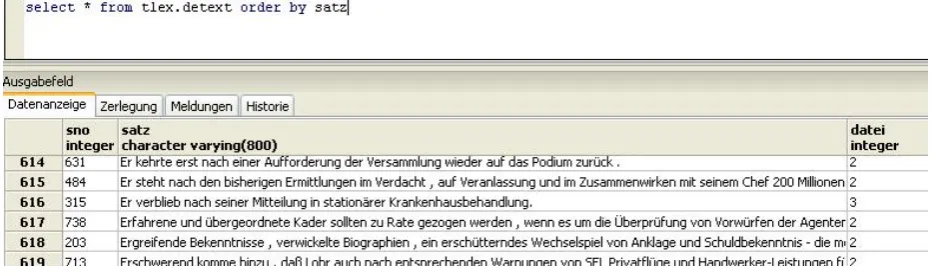
Applied to sentence 315 of file 3 (“datei”, see Figure 1) with stipulations as in (3) we obtain a new database entry as reproduced in Figure 26.
(3) dbanalyze(sent(3,315),de,morph,[],[]).
5.3. Creating further steps directly or indirectly
If we need syntactic analyses we may get them directly by a corresponding command as in (4) or indirectly as in (5) via applying the analysis tool to the existing morphological information as given in Figure 2, thus making use of verti-cal relations (cf. Section 2.) and of the pipeline architecture of the analysis system.
(4) dbanalyze(sent(3,315),de,syn,[],[]).
6For space reasons only the first part of each entry is shown in
the ’zoom’ bubble.
(5) dbanalyze(
analysis(3,315,morph),de,syn,[],[] ).
Figure 3 shows the result of applying a syntactic analysis step to the morphological description represented in Fig-ure 2. The content of the analysis column of the corre-sponding entry can be represented by the analysis tool as in the ’zoom’ bubble.
5.4. Indicating readings by pronoun resolution
Data and Language Metadata, pages 65–75. Springer, Heidelberg.
Boris Haselbach, Wolfgang Seeker, and Kerstin Eckart. submitted. German nach particle verbs in semantic the-ory and corpus data.
Sebastian Hoffmann and Stefan Evert. 2006. BNCweb (CQP-edition): The marriage of two corpus tools. In S. Braun et al., editor,Corpus Technology and Language Pedagogy: New Resources, New Tools, New Methods, volume 3 of English Corpus Linguistics, pages 177 – 195. Peter Lang, Frankfurt am Main.
Nancy Ide and Keith Suderman. 2007. GrAF: A graph-based format for linguistic annotations. InProceedings of the Linguistic Annotation Workshop, 1-8.
Ellen F. Prince. 1992. The ZPG Letter: Subjects, Definite-ness and Information Status. In W. C. Mann and S. A. Thompson, editors,Discourse Description: Diverse Lin-guistic Analyses of a Fund-Raising Text, pages 295–325. Benjamins, Amsterdam.
Arndt Riester, David Lorenz, and Nina Seemann. 2010. A Recursive Annotation Scheme for Referential Informa-tion Status. InProceedings of the Seventh LREC, pages 717–722, Valletta, Malta.