NOMOS: A Semantic Web Software Framework for Annotation of Multimodal
Corpora
John Niekrasz
∗, Alexander Gruenstein
†∗Center for the Study of Language and Information
Stanford University
†Spoken Language Systems
Computer Science and Artificial Intelligence Laboratory Massachusetts Institute of Technology
Abstract
We present NOMOS, an open-source software framework for annotation, processing, and analysis of multimodal corpora. NOMOS is designed for use by annotators, corpus developers, and corpus consumers, emphasizing configurability for a variety of specific annotation tasks. Its features include synchronized multi-channel audio and video playback, compatibility with several corpora, platform indepen-dence, and mixed display of temporal, non-temporal, and relational information. We describe NOMOS from two perspectives. First, we present its software architecture, highlighting its principal difference from comparable systems: its use of an OWL-based semantic an-notation back-end which provides automatic inference capabilities and a well-defined method for layering datasets. Second, we describe how the system is used. For corpus development and annotation we present a typical use scenario involving the creation of a schema and specialization of the user interface. For processing and analysis we describe the GUI- and Java-based methods available, including a GUI for query construction and execution, and an automatically generated schema-conforming Java API for processing of annotations. Additionally, we present some specific annotation and research tasks for which NOMOS has been specialized and used, including topic segmentation and decision-point annotation of meetings.
1.
Introduction
Progress in the field of human language technology has brought about a great increase in the complexity and depth to which multimodal language resources are being anno-tated and used by humans and machines. An excellent ex-ample of this is the research being done as part of the Eu-ropean Augmented Multi-party Interaction (AMI) project1. One major aim of this project is to enhance the value of multimodal recordings by providing tools for their dissem-ination, summarization and browsing. In order to accom-plish this goal, a large corpus of multi-party meetings is being collected and annotated for an extensive range of inter-connected properties, including dialogue acts, emo-tion, head and hand gestures, speech transcripemo-tion, topics, named entities, and many others (McCowan et al., 2005). Of course, this kind of endeavor has not been exclusive to AMI. The multi-party meeting domain has become a major focus in the fields of speech recognition and automatic un-derstanding of natural communication, and the AMI Meet-ing Corpus is one of many meetMeet-ing corpora which have been collected and annotated in this manner (Janin et al., 2003; Garofolo et al., 2004; Burger et al., 2002). Producing rich, multi-tiered annotations of multimodal spoken lan-guage resources such as these is difficult for many reasons: distribution of the data and annotation work is difficult, the annotation tasks require a tight integration between signal and symbol, and the design of annotation tools appropriate for specific tasks is non-trivial.
1
http://www.amiproject.org
In our own research as part of the DARPA Cognitive Assistant that Learns and Organizes (CALO) project2 (see (Niekrasz et al., 2005) for background information), we too have been confronted with similar problems to those faced by the AMI project and have designed an annotation and processing framework to address them. The CALO project has essentially two scenarios in which producing multi-tiered annotations are an important problem: 1) dur-ing system development and research, and 2) in the deploy-able CALO assistant. In the development scenario, meet-ings are recorded at several different sites, distributed, and processed by both humans and machines. For example, the recorded audio is processed at one site by a speech-to-text system to produce transcriptions which are then delivered to a site which parses this text which in turn provides in-put to a decision detection algorithm. The recordings may also be manually transcribed or annotated by humans at any step in the process. Currently, manual annotations are be-ing done for features like topics, action items, and physical gestures, and they are being used for training the algorithms which detect these phenomena automatically. In the de-ployable CALO assistant scenario, meetings are recorded by the system, automatically analyzed, and summarized for actual users who then use this information as part of their daily work and provide feedback to the system by means of their interaction with the system. In this latter scenario, ex-tracted information resides centrally in a shared ontology-based knowledge base that uses an ontology of multimodal discourse (Niekrasz and Purver, 2006) and is the focal point
2
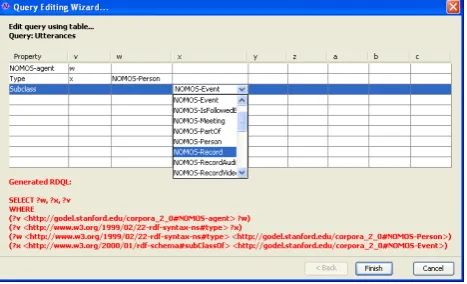
exam-Figure 1: The NOMOS interface for editing queries.
Figure 2: The NOMOS interface for editing perspectives.
extract the desired information from the annotations and may be created using a graphical query-construction in-terface included in the NOMOS application (see Fig. 1), or using the SPARQL6 query language. Perspectives then
configure the manner in which the query results are dis-played by assigning them to interface plugins, as seen in Fig. 2, which shows the NOMOS perspective-editing inter-face. We present examples of the user interface plugins, queries, and perspectives in Section 4..
3.4. Performing Annotations
The manner in which annotations are performed will be highly dependent on the specific user interface that has been designed for the task. However, NOMOS does provide a shared interface for common or generic interactions. For example, media playback control employs a shared user interface in which actions may be performed using menu items, a toolbar, or keystrokes, depending on the user’s preference. The NOMOS API also provides several com-mon actions which may be used when designing the anno-tation interface, including generic property editing for indi-vidual objects, drag-and-drop creation of relations between objects, and various mechanisms for modifying the tempo-ral properties of event objects.
3.5. Querying and Processing
For consumers of annotations, the most common interest is for statistical processing, and NOMOS provides two meth-ods for this. In the first, the user selects a query to run and a set of models on which to run it. The query is then
6
http://www.w3.org/TR/rdf-sparql-query/
automatically executed iteratively on each model, produc-ing flat tab-separated files containproduc-ing the results. This tech-nique facilitates processing by other programs or by statis-tical analysis applications. The other technique available for processing annotations is the use ofprocessor plugins. Processor plugins perform an operation that is essentially the inverse of importer plugins: they read NOMOS annota-tions and produce some output. As with importer plugins, processor plugins may be run directly from the NOMOS interface or executed as standalone Java processes which use the OPI Java API to access the annotation data. This technique circumvents the need to translate annotations and allows the consumer to generate output of any kind using Java. For example, Java algorithms are able to add a layer of annotations automatically using this method, without the need for intermediate translation steps.
4.
Example Applications
Following the typical use scenario described above, the NOMOS framework has been employed effectively for a number of tasks as part of the CALO project and others. For example, NOMOS specializations have been designed for the annotation of topic segments, decision points, and ac-tion items in meetings (Gruenstein et al., 2005). These spe-cific annotations have been done in accordance with a rich ontology of multimodal discourse (Niekrasz and Purver, 2006) which we have employed as part of the CALO sys-tem ontology. This has facilitated the use of our NOMOS-annotated data in research toward the deployable CALO system. The following sections describe how the NOMOS framework has been specialized for these specific tasks and briefly describes the datasets which have been produced.
4.1. Topic Segmentation and Decision-points
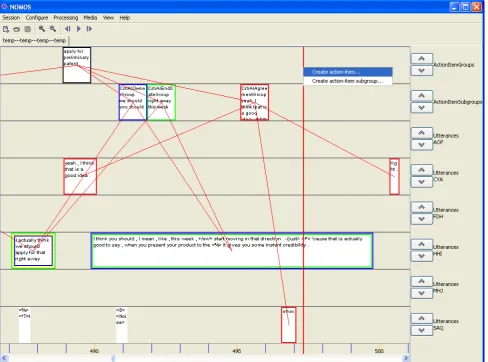
In Figure 3, a screenshot of a NOMOS implementation for the segmentation of meetings by topic and marking of decision-relevant utterances is shown. In the implemen-tation, a track plugin has been used to show the coarse segmentation of the discourse and provide a specific set of mouse actions which allows the annotator to manipu-late those segments and their names. Additionally, the im-plementation uses a label plugin to specialize the manner in which utterances are displayed such that they are col-ored based on their association to an identified action item. These action items are also shown as a tree structure in a panel plugin on the left side of the window. Using this tool, 56 meetings from the ICSI and ISL meeting corpora were annotated, and the annotations have been made pub-licly available (see (Gruenstein et al., 2005) for full details on the design of the tool and the resulting dataset).
4.2. Action Items
Figure 3: A topic segmentation and action-item annotation tool built with NOMOS.