Extraction tools for collocations and their morphosyntactic specificities
Julia Ritz , Ulrich Heid
Institut für Linguistik Universität Potsdam
Postfach 601553 14415 Potsdam
Germany
Institut für Maschinelle Sprachverarbeitung (IMS) Universität Stuttgart
Azenbergstr. 12 70174 Stuttgart
Germany
Abstract
We describe tools for the extraction of collocations not only in the form of word combinations, but also of data about the morphosyntactic properties of collocation candidates. Such data are needed for a detailed lexical description of collocations, and to support both their recognition in text and the generation of collocationally acceptable text. We describe the tool architecture, report on a case study based on noun+verb collocations, and we give a first rough evaluation of the data quality produced.
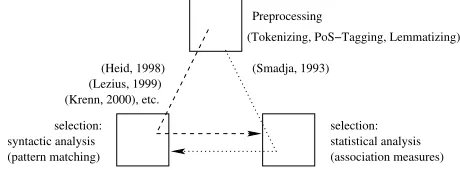
(Krenn, 2000), etc. (Lezius, 1999)
selection: statistical analysis (association measures) (pattern matching)
syntactic analysis selection:
(Heid, 1998) (Smadja, 1993)
(Tokenizing, PoS−Tagging, Lemmatizing) Preprocessing
Figure 1: Collocation extraction approaches
1. The Problem
In much of the more recent work on the extraction of collo-cation candidates from text corpora, an architecture is used that relies on a sequence of steps (see figure 1). Typically, first corpora are preprocessed by means of tokenizing, part-of-speech (=PoS) tagging and lemmatization. As a sec-ond step, pattern-based extraction routines are used, which provide syntactically homogeneous sets of candidate word pairs (in a given grammatical relation: ’relational cooccur-rences’ (Evert, 2005)), for example pairs of nouns and at-tributive adjectives preceding them. Since obviously not all pairs are collocational, statistical filtering by means of association measures (such as, for example, the log likeli-hood ratio test (Dunning, 1993)) is used as a third step, to identify pairs with a statistically significant cooccurrence frequency, and to order them according to the strength of their association. This architecture was used, among many others, by (Heid, 1998; Lezius, 1999; Krenn, 2000), etc. It differs from Smadja’s (1993) approach: he first determines significant word pairs and then uses their occurrence within a syntactic relation as a filtering criterion.
Either approach will provide pairs of lemmas or pairs of word forms that show sufficient evidence of (relational)
cooccurrence. But both can not account for effects of id-iomatization, nor for differences in readings of any of the two elements of a collocation. It has often been noticed that many collocations have strong preferences to appear in certain morphosyntactic forms rather than others. Exam-ples are preferences with respect to number (see example 11) or determination (see example 2). There are also
com-bined preferences (for more than one dimension) and there are collocations which show up in two (or more) different morphosyntactic forms (see example 3), but not in all theo-retically possible forms.
(1) in Schwierigkeiten stecken ’to be in trouble’
(2) zur Diskussion stehen ’to be under consideration’ (3) im Dienst des X stehen
bei X in Diensten stehen ’to be in X’s service’
These restrictions on morphosyntactic variability have been interpreted as signs of idiomatization ((Helbig, 1984): ’lexikalisierte Funktionsverbgefüge’) or of opacity (Tutin, 2004). Some such restrictions are also valid for idioms. Moreover, if an extraction tool just provides lemma pairs like Hoffnung + machen, this result may in fact be due to the presence of several different collocations in the cor-pus data, some of which can be distinguished in terms of
1Abbreviations used in examples and tables:
f n v poss pl, null sg, null def indef quant
214 Stimme abgeben 179 (84%) 20 (9%) - 7 (3%) 4 (2%) 3 (1%)
212 Veto einlegen 147 (69%) n.r. 11 (5%) - 25 (12%) 29 (16%)
174 Zustimmung geben 147 (84%) n.r. 6 (3%) 10 (6%) 3 (2%) 6 (4%)
123 Amt niederlegen 109 (89%) 1 (1%) - 10 (8%) -
-93 Amt aufgeben 73 (78%) 3 (3%) - 15 (14%) -
-147 Hut nehmen 113 (77%) - - 34 (23%) -
-163 Einfluß haben - n.r. 63 (39%) 1 (1%) 9 (6%) 84 (52%)
40 Auskunft erteilen - 7 (18%) 11 (28%) - 1 (3%) 21 (53%)
29 Schwierigkeit machen - 10 (34%) - - 1 (3%) 18 (62%)
Table 7: Distribution of determiners
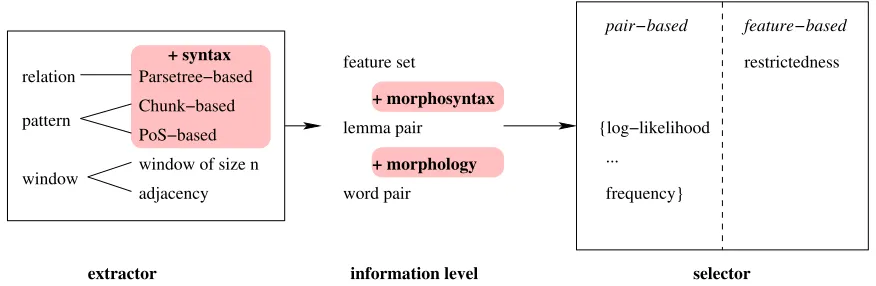
selector
word pair
+ syntax feature set
+ morphosyntax
relation
lemma pair
+ morphology
pair−based
restrictedness feature−based
information level extractor
...
{log−likelihood
frequency} window
adjacency window of size n PoS−based Chunk−based Parsetree−based
pattern
Figure 2: Methods of collocation extraction and selection
4. Conclusions: Towards large-scale
extraction of detailed multiword data
On the assumption that restrictions in the morphosyntac-tic behaviour of multiword sequences and in lexical combi-natorics can be correlated with idiomacity (in the sense of partial compositionality or non-compositionality), the tools may be used to identify multiword items that show idiom-atization effects. As the distinction between, e.g., support verb constructions, other verb+object collocations and VP idioms can not be drawn on the basis of morphosyntactic data, our tools are obviously only meant to provide data for more detailed (manual) linguistic analysis. However, large-scale descriptive work on a broad basis of data is only possible, if the collection and structuring of sample data is automated.
By combining pattern-based search and the extraction of linguistic features, we are able to provide lexeme cooc-currence data and context parameters in one go. Figure 2 schematically compares different approaches to the extrac-tion and selecextrac-tion of collocaextrac-tion candidates. From window-based to pattern-window-based to relation-window-based extraction, an in-creasing amount of lingistic knowledge is needed. Typi-cally, this knowledge is permanently annotated in the cor-pus, and a variety of tools can benefit from the available an-notations. With the addition of morphological knowledge, the abstraction step from word pairs to lemma pairs be-comes feasible; and the addition of morphosyntactic knowl-edge, as underlying the work presented here, opens up the possibility to describe the extracted data in terms of restrict-edness.
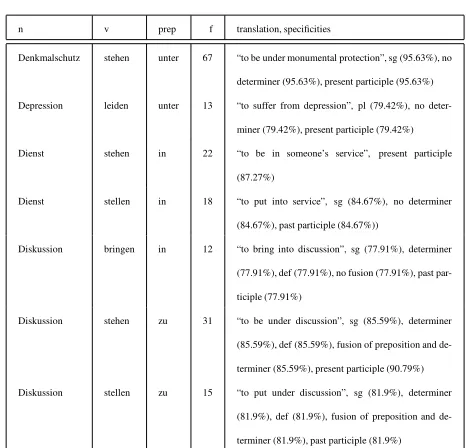
This latter type of description is possible on the basis of chunked corpora (as in our case) or of parsed corpora. Some of our results clearly show the lack of information about grammatical relations, since N637'89 +V collocations (e.g. Abkommen + in Kraft treten) are contained in ta-ble 3, next to N: 8)9 +V collocations. At the expense of recall, we can restrict the search in our database of inter-mediate results to cases with a clearly marked accusative, in which case the false positives disappear (along with all those N: 8)9 +V collocations whose nouns have no unam-biguous accusative form). Overall, the use of chunked cor-pora provides a major information gain over PoS-pattern-based or window-PoS-pattern-based approaches. Yet, frequency- or significance-based selectors can still be combined with the tools presented here. One integration possibility is to iden-tify collocation candidates by means of association, and re-trieve the morphosyntactic preferences of each collocation in a second step.
Furthermore, a number of features have been extracted but not yet analyzed in detail with respect to their relevance for collocation and idiom extraction. These include negation, tense preferences, embedding underlassenand other modal verbs, modification of the noun (by means of adjectives), or modification of the verb (by means of adverbs). It would also be interesting to identify cases where adjective and adverb seem both possible (brieflich;"<>= /brieflichen;"<@? Kontakt halten,’stay in contact by mail’).
5. References
Oliver Christ. 1994. A modular and flexible archi-tecture for an integrated corpus query system. In Proceedings of COMPLEX’94: 3rd conference on Computational Lexicography and Text Research, pages 23–32, Budapest. http://www.ims.uni-stuttgart.de/projekte/CorpusWorkbench/. Ted E. Dunning. 1993. Accurate Methods for the
Statis-tics of Surprise and Coincidence. Computational Lin-guistics, 19(1):61–74.
Stefan Evert. 2005. The Statistics of Word Cooccurrences - Word Pairs and Collocations. Ph.D. thesis, Institut für Maschinelle Sprachverarbeitung (IMS), Universität Stuttgart.
Ulrich Heid. 1998. Towards a corpus-based dictionary of German noun-verb collocations. InProceedings of the EURALEX International Congress 1998, pages 301 – 312, Liège.
Gerhard Helbig. 1984. Studien zur deutschen Syntax. Leipzig: VEB Verlag Enzyklopädie.
Hannah Kermes. 2003. Off-line (and On-line) Text Anal-ysis for Computational Lexicography. Ph.D. thesis, In-stitut für Maschinelle Sprachverarbeitung, Universität Stuttgart.
Brigitte Krenn. 2000. Collocation Mining: Exploiting Cor-pora for Collocation Identification and Representation. InProceedings of KONVENS 2000, pages 209 – 214, Il-menau, Deutschland.
Wolfgang Lezius. 1999. Automatische Extrahierung id-iomatischer Bigramme aus Textkorpora. In R. Rapp, ed-itor,Tagungsband des Linguistischen Kolloquiums 1999, Germersheim, Germany.
Julia Ritz. 2006. Collocation Extraction: Needs, Feeds and Results of an Extraction System for German. EACL 2006 Workshop ’Multi-word-expressions in a multilin-gual context’, April 6th, 2006. To appear.
Frank Smadja. 1993. Retrieving Collocations from Text: Xtract.Computational Linguistics, 19:143–177. Agnès Tutin. 2004. Pour une modélisation dynamique des
collocations dans les textes. In Geoffrey Williams and Sandra Vessier, editors,Proceedings of the Eleventh EU-RALEX International Congress, Lorient, France. Angelika Wöllstein-Leisten, Axel Heilmann, Peter Stepan,
and Sten Vikner. 1997.Deutsche Satzstruktur. Stauffen-burg Verlag, Tübingen, Germany.