Word Knowledge Acquisition for Computational Lexicon Construction
Thatsanee Charoenporn†,††, Canasai Kruengkrai†, Thanaruk Theeramunkong††,
Virach Sornlertlamvanich†, and Hitoshi Isahara†††
†Thai Computational Linguistics Laboratory, Thailand
††Sirindhorn International Institute of Technology (SIIT), Thammasat University, Thailand †††National Institute of Information and Communications Technology, Japan {thatsanee, canasai, virach}@tcllab.org, [email protected], [email protected]
Abstract
The growing of multilingual information processing technology has created the need of linguistic resources, especially lexical database. Many attempts were put to alter the traditional dictionary to computational dictionary, or widely named as computational lexicon. TCL’s Computational Lexicon (TCLLEX) is a recent development of a large-scale Thai Lexicon, which aims to serve as a fundamental linguistic resource for natural language processing research. We design either terminology or ontology for structuring the lexicon based on the idea of computability and reusability.
1.
2.
Introduction
Researchers in the area of computational linguistics and natural language processing have been interested in the problem of acquiring large semantic knowledge for natural language understanding systems. The availability of lexical databases or machine-readable of several languages, such as English WordNet (Miller et al, 1993), English FrameNet (Baker et al, 1998), and Japanese EDR Dictionary (EDR, 1990), and Chinese HowNet (Dong, online) appears to be useful for many different research areas, including word sense disambiguation, machine translation, information retrieval, etc. More recently, the reemergence of ontology researches in both theories and applications has activated researchers to reuse and extend these linguistic resources in many other domains. Among few Thai machine-readable dictionaries, Multilingual Machine Translation: MMT (CICC, 1995) and LEXiTRON (Lexitron, online) are dominant. MMT dictionary is a dictionary designed and developed for using in analysis and generation modules in the multilingual machine translation system. The dictionary then contains as much detailed information as needed for concept disambiguation and word selection. LEXiTRON dictionary is designed and developed for human use. It is extracted from the MMT dictionary to add more human friendly information, as well as to reduce the unnecessary information. Part-of-speech categories are simplified. Due to these different purposes, one may contain information not existing in the other. Moreover, currently these machine-readable dictionaries cope with only limited semantic aspects of word entries. To implement in more practical applications, a more expressive dictionary with various types of information is required.
In this paper, we propose an approach to construct a content-rich computational lexicon by reusing information from the two existing dictionaries, i.e., the MMT dictionary and LEXiTRON, and then enriching the result with additional semantic information extracted from texts on the web. Toward this end, we design the specification of the lexicon and propose a method to acquire semantic information in automatic and semi-automatic ways rather than by only manual annotation. A number of practical approaches are applied for such tasks. As a by-product, we
obtain a methodology of word sense representation, in contrast to the descriptive manner in general lexicons.
This paper is organized as follows. Section 2 describes the existing Thai dictionaries and reference thesaurus, MMT dictionary and LEXiTRON. The structure of our lexicon and its construction is proposed in Section 3. The method to acquire constraints from corpora is illustrated in section 4. In section 5, experimental results are reported together with some discussion. Finally, section 6 gives a conclusion and some future works.
Thai Dictionaries and Thesaurus
Two large-scale dictionaries, namely Multilingual Machine Translation (MMT) Dictionary for language processing and LEXiTRON for human use were developed and publicized. The MMT dictionary contains 68,860 entries with 53,759 unique words while LEXiTRON covers 40,844 entries with 35,192 unique words. The MMT dictionary was originally constructed by National Electronics and Computer Technology Center (NECTEC), for the Multilingual Machine Translation project, which is a six-year (1987-1992) cooperative project between groups of research institutes from five countries, i.e. China, Indonesia, Japan, Malaysia, and Thailand, organized by the Center of the International Cooperation for Computerization (CICC) in Japan.The MMT dictionary consists of three levels of linguistic information; morphological, syntactic and semantic information. It was created based on some linguistic theories, such as phrase structure grammar, case grammar and dependency grammar.
3.
TCLLEX’s Structure and
its Construction
The syntactic information contains information of the entry’s syntactic structure, i.e. grammatical categories (CAT) and subcategories (SUBCAT). In case of a verb, its verb pattern is also included. In TCLLEX, there are 11 categories with 44 subcategories defined. Each category is divided into subcategories according its sub characteristic,
such as its occurring position, composition, and reference. For example, the category ‘determiner’ is divided into 9 subcategories by its occurring position, such as after noun, after noun and classifier, between noun and classifier, etc. There are totally 11 verb patterns, classified according to the position of the obligatory arguments and its contextual environment.
Eventhough the MMT dictionary and LEXiTRON are very useful for the Thai language processing, pros and cons of both depend on purpose of the design. Some problems occur when we consider combining these two dictionaries.
- Information in these two dictionaries is individually defined for different purpose. Consistency of the information in word entry is crucial.
- The semantic information that is useful for word sense disambiguation (i.e. semantic constraint) is not explicitly defined in both of these two dictionaries, for example, the possible semantic class of the agent (AGT) or the object (OBJ) of the verb ‘pay’.
TCL’s Computational Lexicon (TCLLEX) adopts the semantic constraints to generate a word frame. Word arguments and semantic groups are defined to indicate the meaning that can be differentiated from others. Based on the designed framework, the word entries are selected from LEXiTRON. The corresponding word information especially the syntax-semantic mapping and AKO are extracted from the MMT dictionary. As a result, 68,860 word entries of 13,781 verbs, 35,688 nouns are extracted and redefined in TCL lexicon.
Since the MMT dictionary includes much more information than LEXiTRON, the word entries taken from LEXiTRON are revised using information from the MMT dictionary. Some information comes from LEXiTRON. For instance, the synonym of LEXiTRON is selected for Equal in TCLLEX, such as “ใหเงิน” ,“จายเงิน”, the synonyms of “จาย” (to pay). On the other hand, arguments in the MMT dictionary are relied for the selection of semantic constraints. Among 35,192 word entries in LEXiTRON and 53,759 word entries in MMT dictionary, there are 22,173 word entries co-existing in both dictionaries. The information from both dictionaries is selected to compose TCLLEX. The ones that exist in either dictionary will be added. As a result, the union set of both dictionaries will be generated as the TCLLEX. Moreover, TCLLEX relies on the word entries, part-of-speech category and synonym from LEXiTRON while it relies on part-of-speech sub-category, syntax-semantic mapping from the MMT dictionary. TCLLEX is then generated to cover both word syntax and semantic.
The TCLLEX’s structure consists of four types of information, including general, morphological, syntactic, and semantic information. The general information of an entry conveys its Thai entry, corresponding English word, entry definition, and example sentence. The morphological information indicates the type of word composition (TYPE), which is of two types: single word and compound word. A single word is a lexical unit that cannot be divided into smaller units, such as โทรศัพท (telephone). In contrast, a compound word is a combination of more than one single word. For example, the word โทรศัพทมือถือ (mobile phone) consists of two lexical units: โทรศัพท (telephone), and มือถือ (mobile).
The semantic information provides a set of logical and semantic constraints, which is useful for discriminating word senses. The logical constraints can be attached to a word of any category type. They illustrate the logical relationship among word senses in the lexicon. The semantic constraints are attached to a verb or an adjective. They represent the relationship among thematic roles in a verb or adjective pattern.
There are five types of logical constraints proposed in the work. They are ISA (a-kind-of), EQU (synonym), NEQ (antonym), POF (meronym), and WOF (holonym). The ISA constraint indicates a-kind-of relation of words in the semantic hierarchy which is currently composed of 189 conceptual classes. There are 16 kinds of semantic constraints or case relations, constructed by analyzing a set of Thai sentences by Thai linguists. They are Agent, Object, Patient, Experiencer, Result, Goal, Location, Commutative, Measure, Complement, Cause, Time, Source, Instrument, Manner, and Beneficiary. Syntax-semantic mapping information (MAPS) is a key for extracting the constraint arguments. BIC and Agglomerative Merging algorithms are finally used to provide the candidates of classes for each constraint.
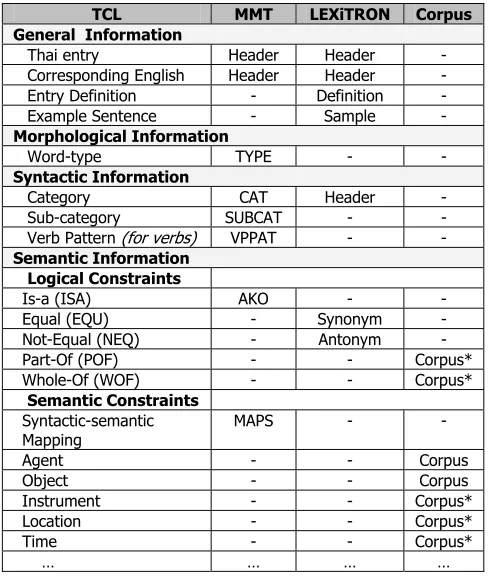
TCL MMT LEXiTRON Corpus
General Information
Thai entry Header Header -
Corresponding English Header Header -
Entry Definition - Definition -
Example Sentence - Sample -
Morphological Information
Word-type TYPE - -
Syntactic Information
Category CAT Header -
Sub-category SUBCAT - -
Verb Pattern (for verbs) VPPAT - -
Semantic Information Logical Constraints
Is-a (ISA) AKO - -
Equal (EQU) - Synonym -
Not-Equal (NEQ) - Antonym -
Part-Of (POF) - - Corpus*
Whole-Of (WOF) - - Corpus*
Semantic Constraints Syntactic-semantic
Mapping MAPS - -
Agent - - Corpus
Object - - Corpus
Instrument - - Corpus*
Location - - Corpus*
Time - - Corpus*
… … … …
Table 1: The list of TCLLEX entries and their sources
These processes are implemented by MERGECLASSES and
AGGLOMERATIVEMERGING algorithms shown in Figure 1. The algorithm iterates until it cannot find leaf nodes to merge or there remains one class.
ANIMAL
BIRD INSECT
bird 4
crow 2
eagle 2
swallow 0
bee 2
bug 0
insect 0 ParentBIC > ChildrenBIC (-18.58) (-19.56) NewGlobalBIC > OldGlobalBIC (-28.20) (-29.17)
(a)
ANIMAL
BIRD INSECT
bee 2
bug 0
insect 0 ParentBIC > ChildrenBIC (-7.81) (-7.97) NewGlobalBIC > OldGlobalBIC (-28.05) (-28.20)
(b)
ANIMAL
BIRD INSECT NewGlobalBIC < OldGlobalBIC (-28.07) (-28.05)
(c)
ANIMAL
BIRD INSECT
(d)
Algorithm 1: MERGECLASSES({ci}ki=1)
begin
c’ ←∅ ;
for i from i = 1, . . . , kdo
c’ ← c’∪ ci;
endFor
if BIC(c’) > BIC({ci}ki=1) then
return c’;
else return ∅;
endif
Algorithm 2: AGGLOMERATIVEMERGING
input: Semantic hierarchy Γ containing a set of initial leaf nodes ci, where i = 1, …, m.
output: Generalized Γ with leaf nodes forming the optimal noun classes.
begin repeat
Find remaining nodes to merge, {ci}ki=1;
if k = 0 then
break;
endif
c’ = MERGECLASSES({ci}ki=1);
if c’≠∅ ; then
Ψ = Γ \ {ci}ki=1∪c’;
if BIC(Ψ) > BIC(Γ)then
Re-distribute P(n) for n∈ c’
according to Equation 3; DELETE(Γ, {ci}ki=1);
APPEND(Γ, c’);
m = m − k + 1;
endif
endif Figure 2: An Example of Agglomerative Merging until m < 1;
end
5.
5.1.
Experimental Methodology
Figure 1: MERGECLASSES andAGGLOMERATIVEMERGING Algorithms
Data Collection Figure 2 illustrates an example of how the algorithm
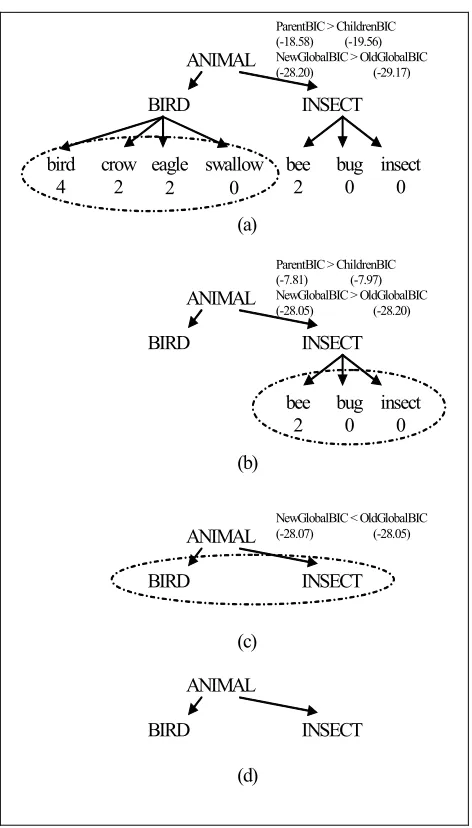
works, (originally, Li and Abe, 1998). Given the verb fly with the syntactic relationship subject, the co-occurring nouns are: crow (2), eagle (2), bird (4), and bee (2), where numbers in the parentheses indicate the co-occurring frequency of nouns. Let us focus on Figure 2a, which is the initial semantic hierarchy of the data. The algorithm starts by finding possible leaf nodes to merge. Since the local BIC score increases, it further measures the global BIC score by comparing the overall structure. The global BIC score also increases, it decides to merge the children nodes into the parent node. Figure 2b performs the same process. In Figure 2c, since the local BIC score decreases, it is not necessary to measure the global BIC score. Finally, we obtain the generalized semantic hierarchy in Figure 2d, whose remaining leaf nodes are considered to be selectional preferences (Kruengkrai, 2004).
As mentioned earlier, we view the Web as large and free corpora. Below we describe how to retrieve examples for selectional preference generalization through search engines. Common search engines usually return results, including a number of relevant links and their short descriptions. Since our objective is to extract the co-occurrence tuples, what we anticipate from the search engines is that, given a verb as a query, the returned short descriptions may contain the verb and its context. We refer to these short descriptions as snippets.
We implemented a simple web robot that sends the target verb to the search engines, and retrieves all the search results kept into a repository. Two major Thai search engines were used, including www.sansarn.com and www.siamguru.com. Then, we parsed HTML documents in the repository to extract only snippets. We obtained about 800-1000 snippets for each verb query. Each snippet contains 100-150 words on average.
Direct Object of ซื้อ ‘buy’ ABSTRACT_THING
ARTIFACT GRAIN
0.40 0.27 0.03
ธุรกิจ ‘business’
ของที่ระลึก ‘souvenir’
ขาว ‘rice’ Direct Object of จาย ‘pay’ IMMATERIAL_THING
SOCIAL_AB_THING RESULT_OF_ACT
0.31 0.22 0.01
คาเชา ‘rental fee’
คา ‘fee’
ดอกเบี้ย ‘interest’
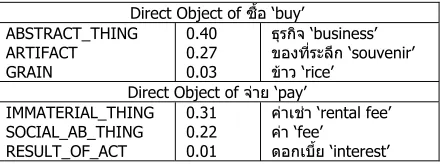
Table 4 Generalization results with verb-direct object relationship
From these tables, it is noted that the result matches well with human intuition. For example, the subject of the verb ตรวจ ‘check’ falls into the class PEOPLE, which its children classes are PERSON and ORGANIZATION. The class ANIMAL_PART can be discovered to be the object of this verb. The computational time is very short, which is less than one second running on a personal computer with Pentium processor 2GHz and memory 512 KB. In addition, we observe that the noun sense ambiguity can lead to irrelevant results in some cases. For example, the noun โรงพยาบาล ‘hospital’ has two senses, which are categorized into two classes: CONSTRUCTION and ORGANIZATION.However, the class CONSTRUCTION is unlikely to be the subject of the verb ตรวจ ‘check’. Since the tree cut model just deals with this problem by equally dividing the frequency of a noun among all the classes containing that noun, more sophisticated approach is needed for further improvement.
6.
7.
8.
Conclusion and Future Work
In this paper, we have described the ongoing work on developing the TCL's computational lexicon (TCLLEX). We redefine the structured form of the semantic information by using the logical and semantic constraints. Our specification attempts to cover all possible semantic representation based on the concept of the simplicity and re-usability. The acquisition schemes of the semantic information are given.
In future work, we plan to explore approaches to extract other logical and semantic constraints. Additionally, we further study how the computational operations among word senses can be performed by using TCLLEX.
Acknowledgements
This study is supported by Thailand Graduate Institute of Science and Technology (TGIST) of National Science and Technology Development Agency (NSTDA) under the grant number TGIST-TG-B-11-44-13-418D. The authors would like to thank the anonymous reviewers for giving a lot of useful comments.
References
Baker , Collin F., Fillmore, Charles J., and Lowe, John B. (1998). The Berkeley FrameNet Project, In Proceedings of the COLING-ACL. Montreal, Canada,
Center of the International Cooperation for Computerization (CICC) (1995). Thai Basic Dictionary: Technical Report. Tokyo, Japan.
Chickering, D.M., and Heckerman, D. (1997). Efficient approximations for the marginal likelihood of Bayesian networks with hidden variables. Machine Learning, 29, pp.181-212.
Dong, Zhendong, and Dong, Qiang. Hownet [online]. Available at http://www.keenage.com/zhiwang/e_zhiw-ang.html.
Dunning, T. (1994). Accurate methods for the statistics of surprise and coincidence. Computational Linguistics, 19(1), pp. 61-74.
EDR (1990). EDR Electronic Dictionary Technical Guide. Japan Electronic Dictionary Research Institute, Ltd., Japan.
Kruengkrai, C., Charoenporn, T., Sornlertlamvanich, V., Isahara,H. (2004). Acquiring selectional preferences in a thai lexical database. In Proceedings of the 1st Joint Conference on Natural Language Processing (IJCNLP-04), China.
Lexitron, Available at http://lexitron.nectec.or.th
Li, H., and Abe, N. (1998). Generalizing case frames using a thesaurus and the MDL principle. Computational Linguistics, 24(2), pp. 217—244.
Miller, G. A., Beckwith, R., Fellbaum, C., Gross, D. and Miller, K. (1993). Introduction to WordNet: An on-line lexical database. CSL Report 43.