Automatic paraphrasing based on parallel corpus for normalization
Mitsuo Shimohata
∗and Eiichiro Sumita
∗∗ATR Spoken Language Translation Research Laboratories
2-2 Hikaridai Seika-cho Soraku-gun Kyoto 619-0288 Japan
{mitsuo.shimohata eiichiro.sumita}@atr.co.jp
Abstract
There are various ways to express the same meaning in natural language. This diversity causes difficulty in many fields of natural language processing. It can be reduced by normalization of synonymous expressions, which is done by replacing various synonymous expressions with a standard one. In this paper, we propose a method for extracting paraphrases from a parallel corpus automatically and utilizing them for normalization. First, synonymous sentences are grouped by the equivalence of translation. Then, synonymous expressions are extracted by the differences between synonymous sentences. Synonymous expressions contain not only interchangeable words but also surrounding words in order to consider contextual condition. Our method has two advantages: 1) only a parallel corpus is required, and 2) various types of paraphrases can be acquired.
1.
Introduction
Natural languages are so expressive that there are var-ious ways to represent the same meaning. This rich ex-pressiveness is extremely useful in human communication. We can convey various additional intentions or nuances by choosing a particular expression.
However, such diversity causes difficulty in natural lan-guage processing. If a certain meaning can be expressed in various ways, we have to comprehend this variation to fully grasp this meaning. If we want to retrieve the infor-mation of “pamphlet,” we have to also search through the information of synonymous words such as “brochure” and “booklet.”
“Normalization” is an operation that replaces synony-mous expressions with one standard expression. It equal-izes the words having basically the same meaning and re-duces the variation of synonymous expressions. Although this operation sometimes eliminates nuances and minor in-formation, it is still very useful in many fields.
In this paper, we describe a method of automatic para-phrasing of synonymous expressions for normalization. First, synonymous sentences are grouped by the equiva-lence of their translations. Then synonymous expressions are acquired from the differences between synonymous sentences. The extraction and filtering of synonymous ex-pressions is built on DP-matching (Cormen et al., 2001). Standard expressions are determined by their frequencies in the corpus. Our method has two advantages: (1) The only required resource is a tagged parallel corpus1, and no
other knowledge or resource, such as sentence structure, a dictionary, or a thesaurus, are used; (2) Various types of paraphrases, such as content words, functional words, and synonyms, can be acquired.
2.
Related Works
Paraphrasing is useful for many applications, such as text generation, multi-document summarization, and in-formation retrieval. Automatic acquisition of paraphrases
1A tagged corpus is one in which morphological analysis has
been done.
from a corpus is a major approach to the collection of para-phrases. Synonymous multi-word terms can be identified by morphological and syntactic differences (Jacquemin et al., 1997). However, this requires rich linguistic knowl-edge, and the types of applicable terms are limited.
Various types of paraphrases could be acquired in (Barzilay and McKeown, 2001). Their method is based on the iteration of two processes: extraction of contexts and extraction of interchangeable words. Extracted paraphrases do not include contextual information. They reported that the precision of paraphrases is deeply influenced by con-text. An evaluation of paraphrases showed that those ob-tained when taking context into account have a much higher precision than when context is not considered.
Automatic word clustering involves extraction of lexi-cal paraphrases (Langkilde and Knight, 1998), (Lin, 1998), (Frakes and Baeza-Yates, 1992). The types of applicable words, however, are limited to content words, and clustered words are not always interchangeable, such as “dog” and “cat.”
The major difference between our method and the above works is our emphasis on applying contextual information. The equivalence of synonymous words is often influenced by the context. The expressions used in our method include the words surrounding synonymous words, which are used as contextual information.
3.
Normalization
The operation of “normalization” means that synony-mous expressions are replaced with one standard expres-sion. Which expression is most suitable as the standard ex-pression? We use the most frequent expression in the cor-pus as the standard expression. The operation that replaces the minor expressions with the major expression can delete the minor expressions from the corpus, and it simplifies the corpus. We call this operation normalization in this paper.
May I take photos?
Can I take pictures?
May I take some photos?
Can I take a photo?
Is it OK to take pictures? (1)
(2)
(3)
(4)
(5)
SS Group Selected SS Pairs
(1) May I take photos?
(1) May I take photos?
(1) May I take photos?
(2) Can I take pictures?
(2) Can I take pictures?
(3) May I take some photos?
(4) Can I take a photo?
(4) Can I take a photo?
=
=
=
=
"syashin wo tottemo iidesuka" TL
PL
Figure 1: Extraction of SS Pairs
causes little problem, while the inverse replacement some-times causes a problem, such as (D→C).
(A) May I take a photo?
(B) May I take a picture?
(C) He drew the photo yesterday. (D) He drew the picture yesterday.
4.
Extraction of Synonymous Expressions
The paraphrasing rules described in this paper consist of several synonymous expressions. The most frequent ex-pression is marked as the “major exex-pression,” and other expressions are marked as the “minor expressions.” Para-phrasing is done by replacing the various minor expres-sions with the major expression. (Extracted paraphrases are shown in figure 3.) The aim and idea of synonymous ex-pressions are described in section 4.1., and normalization is explained in section 3..
4.1. Basic Idea of Synonymous Expression
The aim of our paraphrasing method is to capture lexi-cal synonymy rather than syntactic. Detection of syntactic synonymy is very difficult since it requires rich informa-tion, such as sentence structure and morphological equiva-lences. We derive lexically synonymous expressions from the differences between sentences that are almost the same. We assume that “almost the same sentences” have lexical differences but no syntactical difference.
The interchangeability of synonymous expressions fre-quently depends on the context. The words “call” and “phone” are synonymous in the context of telephoning but not synonymous in other contexts. The auxiliary verbs “would” and “could” are interchangeable if they are used in euphemistic request sentences like “(could|would) you pass me the salt?” but not synonymous in other sentences. Therefore, it is necessary to take contextual information into account in determining whether expressions are syn-onymous. We use the words surrounding synonymous words as contextual information. We use “synonymous ex-pression” (SE) to designate not only synonymous words but also the surrounding words hereafter.
The determination of “almost the same sentences” and the extraction of SE are built on DP-matching. Both mini-mum edit distance and edit operations (insertion, deletion, substitution) can be computed by DP-matching. Based on the edit operations, the types of SE pairs can be classified into two: substitution and insertion/deletion. Both expres-sions in substitution pairs have variant words, while one of the expressions in the insertion/deletion pair does not have variant words. We exclude the insertion/deletion pairs for two reasons based on the preliminary experiment: (1) Interjections such as “thank you” and “please” are domi-nant. These can be easily handled by using dictionaries. (2) Many other words concern context, such as “my,” “to-day’s,” and “this.” It may be safe to preserve them to avoid the confusion of different contexts.
In our method algorithm, sentences are regarded as mere word sequences, and no linguistic information is used for filtering. Therefore, this algorithm can be applied to the tagged text of any language, and the types of paraphrases that can be acquired are not restricted.
4.2. Method
The procedure of generating paraphrasing rules is de-scribed below in order of process.
4.2.1. SS Group
“Synonymous sentences” (SS) are defined as sentences that have the same translations in the parallel corpus. The left part of figure 1 shows an example of an SS group. Here, all of the English sentences have the same Japanese trans-lation of “syashin wo tottemo iidesuka.” In other words, this Japanese sentence forms an SS group that includes five sentences.
4.2.2. Extraction of SE Pairs
#
Can take pictures %May I
take
#
I photos %#
Can I#
May Itake pictures % take photos % SS Pair
SE Pair
Figure 2: Extraction of SE Pairs
shown in the right side of figure 1 are selected since both sentences in each pair have less than two variant words.
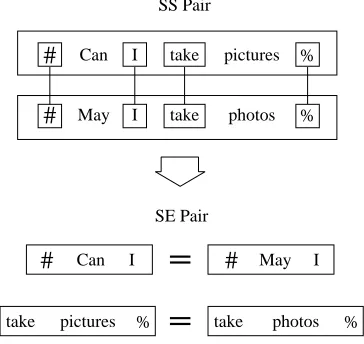
Next, SE pairs consisting of variant words and sur-rounding common words are extracted. The SE pairs that have no variant words in either expression are excluded. Figure 2 shows an example of SE extraction from DP-matched sentence pairs. Common words are bound by lines, and the symbols “#” and “%” are special marks indi-cating head-of-sentence and end-of-sentence, respectively. Two SE pairs can be acquired from this sentence pair.
Some SE pairs can be extracted from different sentence pairs in the same group. Each SE pair from a single group is equally counted as one regardless of its frequency. For example, the SE pair “# Can I = # May I” is counted as one, as with other pairs, although it can be extracted from the two combinations (1)-(2) and (1)-(4).
4.2.3. Filtering
Collected SE pairs are filtered by two criteria: fre-quency and co-occurrence ratio, which is the ratio of the co-occurrence of a minor expression with the major expres-sion to all instances of that minor expresexpres-sion in the corpus. The former involves the case where the synonymy of the pair is valid, and the latter involves the case where the syn-onymy is invalid. A threshold was set up heuristically, and it is commonly used for English and Japanese. At this stage, the frequency of each expression in the corpus is counted.
Frequency
SE pairs whose frequency is less than three are excluded. The remaining SE pairs must appear in more than three dif-ferent SS groups.
Co-occurrence Ratio
This filtering criterion removes the SE pairs containing mi-nor expression that have a relatively small co-occurrence with the major expression. These pairs show synonymy that is valid only under a few limited conditions. SE pairs with a co-occurrence ratio of less than 5% are removed. We do not put such a constraint on the major expression. This enables acquisition of pairs having not only equivalent but also inclusion relations.
Table 1: Statistics of the Corpus
Training Evaluation
Sentence
(token) 162,319 10,150
Sentence 97,092 (E) 8,671 (E) (type) 102,406 (J) 8,922 (J)
Average 5.8 (E) 5.8 (E) Length 6.9 (J) 6.8 (J)
4.2.4. Synonymous Expression Clusters
SE pairs are clustered by a transitive relation. If A = B and B = C, then A, B, C form the SE cluster. Within the SE cluster, the most frequent expression in the corpus is marked as the major expression.
4.3. Examples of Generated Rules
Examples of extracted paraphrasing rules are shown in figure 3. We refer to the language to be paraphrased as “PL” and to the translation language as “TL.” Rules tagged E* are examples of Eng-Jpn2rules, and those tagged J* are examples of Jpn-Eng. The major expression in each rule is located at the top.
Rules E1 and J2 describe the exchange of auxiliary verbs. These expressions have basically the same mean-ing if the nuance is ignored. Rules E5 and E6 describe the equivalence of abbreviations. Rule J1 describes the differ-ence in character types. All expressions in J1 mean “a cold” in English and are pronounced “kaze.” This rule says that “kaze” can be written in kanji, katakana, and hiragana3.
5.
Experiment
5.1. Data
We use a bilingual corpus of travel conversation, which has Japanese sentences and corresponding translations in English (Sumita, 2001). Since the translations were made sentence-by-sentence, this corpus was sentence-aligned from its origin. Morphological analysis was carried out with our morphological analysis tools. The corpus was di-vided into training data and evaluation data by extracting evaluation data randomly from the entire set of data. The statistics of each type of data is shown in table 1.
Sentences consisting of fewer than three words were skipped in our experimental data, since the meaning of short sentences can be widely different by context. For ex-ample, “Ticket please” can have the meanings of “I want to buy a ticket” or “Please show your ticket.” These short sentences comprise 11% of the English data and 7% of the Japanese data.
2
We represent combination of PL and TL as “PL-TL.” For ex-ample, “Eng-Jpn” means that English is the PL and Japanese is the TL.
3
E1 # Could you
# Would you
# Can you
# Will you
E2 # Nice to
# Glad to
# Pleased to
# Happy to
E3 a guarantee %
a warranty %
E4 the toilet %
the bathroom % the lavatory % the restrooms %
E5 what ’s wrong
what is wrong
E6 I ’m a
I am a
E7 a bad cough
a terrible cough
E8 anything cheaper %
anything less expensive %
# Iw<Y $r
J1 # $+$< $r
# %+%< $r
$$$$ $G$9 $+
J2 $$$$ $N$G$9 $+
$$$$ $G$7$g$& $+
$$$$ $N$G$7$g$& $+
# %H%$%l $O
J3 # $*<j@v$$ $O
# 2=>Q<< $O
$N NA6b $G$9
J4 $N CMCJ $G$9
$N 6b3[ $G$9
Figure 3: Examples of Rules
Table 2: Numbers of Rules
PL – TL Rules Exp. E/R
Eng– Jpn 264 583 2.21 Jpn –Eng 423 945 2.23
5.2. Number of Rules
From our trilingual corpus, six combinations of PL and TL can be selected. The numbers of extracted rules, in-cluded expressions (Exp.) and inin-cluded expressions per rule (E/R) by the combination of PL and TL are shown in table 2.
Table 3: Ratios of POS Types
Eng-Jpn Jpn-Eng
Noun 26 23
Pronoun 20 2
Verb 25 28
Adjective 5 5
Be-Verb 14
-Preposition 5
-Determinative 11
-Auxiliary Verb 11 21
Particle - 36
5.3. Types of Rules
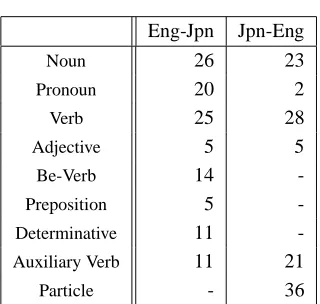
Various types of paraphrasing rules can be acquired by our method. The ratios of main POSs to total rules are shown in table 3.
Interestingly, the ratios of content words, such as nouns, verbs, and adjectives, are almost the same independent of PL and TL. On the other hand, functional words, such as pronouns and auxiliary verbs, show obvious differences by PL and TL. For example, many more rules concerning pro-nouns are generated in using English as PL than in using Japanese as PL.
5.4. Criteria for Evaluation of Paraphrasing
The correctness of paraphrasing was manually evalu-ated by natives of PL. Paraphrased sentences were eval-uated for classification into one of four classes: “Same,” “Different” (Dif.), “Semantical Error” (Sem.), and “Syntac-tical Error” (Syn.). A description of each evaluation class is given below.
Same Paraphrased sentences are natural and represent
ba-sically the same meaning as the original.
Dif. Paraphrased sentences are natural but represent
differ-ent meanings.
Sem. Paraphrased sentences are syntactically proper but
semantically improper. No comparison with the origi-nal sentence is considered.
ex) “What time does this train land?”
Syn. Paraphrased sentences are syntactically improper.
ex) “Are you have a ticket?”
“Same” is the only evaluation class that satisfies correct paraphrasing, and other evaluations are judged as incorrect paraphrasing. Details of the criteria used in the case of En-glish are given below. The criteria for Japanese follow these guidelines.
Table 4: Result of Applied Ratio and Precision
PL – TL Total AR Same Dif. Sem. Syn.
Eng–Jpn 7,564 17.1 83.1 4.2 2.1 10.4
Jpn –Eng 8,092 13.9 93.5 1.2 4.9 0.4
same meaning as the original sentence “When does it start?”, although the available context of the para-phrased sentence is narrower.
2. The degree of politeness is excluded from the ba-sic meaning. The differences among “Would you,” “Could you,” and “Won’t you” do not affect the ba-sic meaning.
3. Differences in the pronouns used do not affect the ba-sic meaning. The interchange of “this,” “that,” and “it” does not affect the basic meaning. However, the exchange of personal and non-personal pronouns is judged as semantically improper. The paraphrased sentence “It wants to buy a ticket” is semantically im-proper.
5.5. Applied Ratio and Precision of Paraphrasing
We evaluated the precision of two types of paraphrasing rules, Eng-Jpn and Jpn-Eng. The results of applied ratio (AR) and precision are shown in table 4.
There were many syntactical errors in English para-phrasing but relatively few in Japanese parapara-phrasing. This difference was due to the respective strengths of the syntac-tical constraints in English and Japanese. Since the area of each paraphrasing rule is partial, syntactical discrepancies between paraphrased and other parts can be caused. Exam-ples of rules that often cause syntactical errors are shown below.
“Where are you” = “Where do you” “Where are the ” = “Where is the”
6.
Conclusions
In this paper, we described a method for acquiring para-phrasing rules from a parallel corpus. These rules normal-ize the expressions of the corpus by replacing synonymous expressions with a major expression. Extraction and filter-ing of expressions are based on DP-matchfilter-ing, so no other resources are required, and a wide range of paraphrases can be acquired. The effectiveness of our method was demon-strated by an experiment using English and Japanese as paraphrased languages.
We have two plans for the future. One is to improve the method by adjusting the length of the surrounding con-text. Longer context would constrain the application and improve precision. Shorter context would extend the ap-plied ratio. Proper adjustment of the context length could improve both applied ratio and precision. The other plan is to apply our method to other NLP fields, such as example-based machine translation, statistical machine translation,
and information retrieval. Our paraphrasing method could have a great effect in these fields.
7.
Acknowledgment
The research reported here was supported in part by a contract with the Telecommunications Advancement Or-ganization of Japan entitled, “A study of speech dialogue translation technology based on a large corpus”.
8.
References
R. Barzilay and K. R. McKeown. 2001. Extracting para-phrases from a parallel corpus. In Proc. of the 39th An-nual Meeting of the Association for Computational Lin-guistics, pages 50–57.
T. H. Cormen, C. E. Leiserson, R. L. Rivest, and C. Stein. 2001. Introduction to Algorithms. MIT Press.
W. B. Frakes and R. Baeza-Yates, editors, 1992. Infor-mation Retrieval Data Structures & Algorithms, chapter Thesaurus Construction, pages 161–218. Prentice Hall. C. Jacquemin, J. Klavans, and E. Tzoukermann. 1997.
Ex-pansion of multi-word terms for indexing and retrieval using morphology and syntax. In Proc. of the 35th An-nual Meeting of the Association for Computational Lin-guistics.
I. Langkilde and K. Knight. 1998. Generation that exploits corpus-based statistical knowledge. In COLING-ACL, pages 704–710.
D. Lin. 1998. Automatic retrieval and clustering of similar words. In COLING-ACL, pages 768–774.