Getting Deeper Semantics than Berkeley FrameNet with MSFA
Kow KURODA
∗, Masao UTIYAMA
∗, Hitoshi ISAHARA
∗∗National Institute of Information and Communications Technology (NICT), Japan
3-5 Hikaridai, Sorakugun, Kyoto, 619–0289, Japan
{kuroda, mutiyama, isahara}@nict.go.jp
Abstract
This paper illustrates relevant details of an on-going semantic-role annotation work based on a framework called MULTI
-LAYERED/DIMENSIONALSEMANTICFRAMEANALYSIS(MSFA for short) (Kuroda and Isahara, 2005b), which is inspired by, if not derived from, Frame Semantics/Berkeley FrameNet approach to semantic annotation (Lowe et al., 1997; Johnson and Fillmore, 2000).
1.
Introduction
§1.1. presents the current status of our work, presenting our
framework called MSFA.§1.2. explains our motivations.
Main features of MSFA are presented in §2.1. Relevant
details of the proposed annotation scheme under MSFA are
presented in§2.3. with some explanations.
1.1. Current status
In (Kuroda and Isahara, 2005b), we defined a frame-work for fine-grained semantic analysis/annotation called MULTI-LAYERED/DIMENSIONAL SEMANTIC FRAME
ANALYSIS (MSFA for short), and produced a small collection of semantic analyses/annotations for Japanese texts taken from Kyodai Corpus (KC) (Kurohashi and Nagao, 2003). This was just a first attempt to provide an evaluation version released for free, expecting feedback
from users.1More annotation work will follow.2
The target sentences of the official release were three Japanese newspaper articles, comprising 63 sentences in to-tal, selected from the KC. The English translation of the KC was completed now at NICT, and the Chinese translation is underway. We hoped that our semantic role annotation could be used on a multi-lingual basis if a similar kind of semantic annotation was added to other language’s part.
The number of the frames we identified through this an-notaion/analysis work comes around 700 in terms of type. Note that, as we will see later, the semantic analysis of a sentence and the identification of frames needed for it are performed at the same time, in a cycle. This distinguishes our work from semantic annotation projects like SALSA Project (Erk et al., 2003), which crucially depend on the pre-existing (and yet completed) BFN database of frames.
In MSFA, we annotate the texts for semantic roles dif-ferentiated from semantic types, an important distinction proposed by (Kuroda and Isahara, 2005a) based on in-sights from Frame Semantics (Fillmore, 1985; Fillmore and
Atkins, 1994).3 While semantic types can be equated with
1Data access is restricted, however. Users need an account.
2Besides this “official” result, some additional
se-mantic analyses/annotations are being done on a volun-teer basis in the form of open development available at
http://www.kotonoba.net/˜mutiyama/cgi-bin/ hiki/hiki.cgi?FrontPage.
3Roughly, the proposed distinction of semantic roles from
se-mantic types corresponds to the distinction of “relational”
cate-natural kinds by and large and encoded in a thesaurus ef-fectively, semantic roles can’t: they are situation-specific
concepts highly dependent on culture, seeming to be more
responsible for text understanding than semantic types.
1.2. Motivations: Dealing with “deeper” semantics
Semantic annotation has become a trend: it is being prac-ticed in a variety of forms. To name just a few frameworks, we have Berkeley FrameNet (BFN, henceforth) (Baker et al., 1998; Fillmore et al., 2003), PropBank (Kingsbury et al., 2002) and SemCor. For comparison of some of the ma-jor frameworks, see (Ellsworth et al., 2004).
When it comes to the task of specifying “deeper” se-mantics useful to text understanding at realistic levels, BFN looks most appealing because it tries, or at least promises, to provide more specific semantic information than you can get through specification of argument structures of predi-cates (this is what PropBank aims for) and more interesting information than you can get through WordNet-based word sense disambiguation (this is what SemCor aimed for).
By realistic, we mean it is capable of specifying seman-tic intuitions that reflect actual mental processing in human brain. Shallow semantic analysis like word sense disam-biguations at the level of SemCor is useful, but we still need more to get into realistic text understanding, and without semantic specifications at some reasonably deep levels, un-derstanding of texts at some psychologically realistic levels would be just a fancy, for the reasons specified below.
1.2.1. Need for finer-grained specifications: A case study of a Japanese verb osou
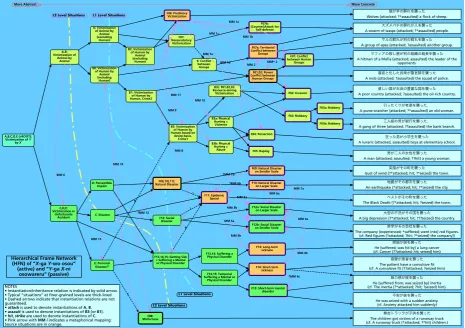
(Nakamoto et al., 2005) conducted psychological exper-iments based on a detailed corpus-based analysis of the Japanese verb osou. They analyzed carefully all uses of “X -ga Y -wo osou” (active) and “Y --ga X -ni osowareru” (pas-sive form) collected from a Japanese-English alignment
data (Utiyama and Isahara, 2003).4 giving the network
analysis specified in Figure 1. The experiments showed that ordinary Japanese were able to easily differentiate at least 15 situations (F01–F15) specified at very concrete levels in
gories from “object/entity” categories made by Genter and her colleagues (Gentner, 2005; Gentner and Kurtz, 2005; Asmuth and Gentner, 2005). Also, Gentner’s “relational schema” category seems to correspond to “(semantic) frame” in the BFN sense, and “(idealized) situation” in our sense.
English verbs that translate OSOU (TOTAL)112 L0 = SubL1 Level L1 Semantic Classes at
Level 1 L2
Semantic Classes at
Level 2 L3 Semantic Classesat Level 3 attack[+human(s)]: rob 4 7 10
Resource-threatenig situations 51
Intended
Harm-causation[+animate] 90 Cause oriented attack[+human(s)]: rob: break into 2
attack[+human(s)]: rob: make off with MONEY 1 attack[+human(s)]: rob: hold up 1 3 attack[+human(s)]: rob: threaten 2
attack[+human(s)] 23 23 42 threatening by Life-human attack[+human(s)]: kill 1 1
attack[+human(s)]: assault 9 10 attack[+human(s)]: assault: raid 1 attack[+human(s)]: assault: shoot 3 5 attack[+human(s)]: assault: shoot, wound 1 attack[+human(s)]: assault: shoot; rob 1 attack[+human(s)]: assault: stab 3 3 attack[-human(s),+animal(s)] 7 8 9
Life-threatening by
nonhuman attack[-human(s),+animal(s)]: kill 1
attack[-human(s),?animal]: assault[+metaphoric?]:
turn on 1 1
hit,strike: hit 3 8 18 disastersNatural 39 causation[-animate]Disasters = Harm-hit,strike: rock 1
hit,strike: strike 2 hit,strike: pound 2 hit,strike: destroy: wreak on 1 2 hit,strike: destroy: ravage 1 hit,strike: roar through 1 2 hit,strike: sweep through 1 hit,strike: wrought devastation 1 6 hit,strike: IMPLICIT in: earthquake 2 hit,strike: IMPLICIT in: in PLACE 2 hit,strike: there is 1 hit,strike[+metaphoric, +human(s)?]: occur[=attack] 1 2 21
Social disasters[+met
aphoric] hit,strike[+metaphoric]: hurt 1
hit,strike[+metaphoric?]: hit 2 9 hit,strike[+metaphoric]: hit 5 hit,strike[+metaphoric]: paralyze 1 hit,strike[+metaphoric]: IMPLICIT in: shocks from 1 hit,strike[+metaphoric]: overtake 1 4 hit,strike[+metaphoric]: take a toll 1 hit,strike[+metaphoric]: besiege 1 hit,strike[+metaphoric]: engulf 1 hit,strike[+metaphoric]: occur 2 4 hit,strike[+metaphoric]: fall on 1 hit,strike[+metaphoric]: IMPLICIT in: in PLACE 1 hit,strike[+metaphoric]: IMPLICIT in: problems 1 2 hit,strike[+metaphoric]: IMPLICIT in: turmoil 1
suffer 3 5 10 Sufferings 10 Sufferings = Harm-experience 10 Effect oriented suffer: IMPLICIT in: victim 1
suffer: be injured 1 suffer: feel pain 1 3 suffer: bring sorrow to people 1 suffer: feel anxiety 1 suffer: seized with 1 4 suffer: suddenly begin a SYMPTOM 1 suffer: experience attack[-human(s), +metaphoric] 2
Figure 2: English verbs that appear in the translations of the osou-sentences in Japanese-English Alignment Data (JEAD) (Utiyama and Isahara, 2003)
otoko-wo osotta (‘A gust of wind gust hit the man’) sounds
fine. All of this suggests that taifuu is understood as a rela-tively large-scale disaster that happens to a relarela-tively large group of people, whereas toppuu is understood as a rela-tively small-scale disaster that happens to an individual.
The same is true ofCause harmandAttackbut we
omit details here for the sake of space.
1.2.2. Need for more effective identification procedure
Based on the observation above, we can state the prob-lem we are facing as follows: if BFN promises to provide “deeper” semantics, how deep should it be? More plainly, are BFN frames “deep enough”? For this matter, our
an-swer is negative, becauseCause impact,Cause harm,
andAttack, provided by BFN, are not detailed enough to
specify selectional properties we need to describe to reflect human semantic intuitions. But how is this case, after all?
We believe that the frame identification procedure
adopted by BFN now is not adequate for the purpose of serious, exhaustive semantic annotation/analysis of an unselected text, no matter how reasonable it may look for
the purpose of building a relatively wide-coverage database in a short time. More specifically, we believe that the ade-quate levels of granularity need to be “discovered” through inductive exploration into real texts, unlike BFN’s top-down quick “scans” for frames.
There are more “general” problems that are not particu-larly applicable to BFN, however. Most seriously, no
eval-uation measures are defined to tell whether a given se-mantic description is “deep enough” and without such
measures, any promise of providing deeper semantics is likely to be ineffective. This means that we definitely need to define a measure for the goodness of frame identifica-tion procedure, which provides a “testbed” for evaluating semantic analyses in terms of frames.
There are certain possible choices. At one extreme,
one can define as many frames as people can recognize as “different situations”, based on the selectional proper-ties for frame-governing verbs. In the case of Japanese verb osou, (Nakamoto et al., 2005) showed, as mentioned earlier, that ordinary Japanese were able to easily differ-entiate at least 15 situations specified at the most con-crete levels (F01–F15) in Figure 1, depending on the
na-ture of theAssailant(the Agent-class role ofAttack),
Impactor(the Agent-class role ofCause impact) and
Harm causer (the Agent-class role of Cause harm),
especially in terms of their purposes. If their claim is ad-equate, it is implied that HFNA in Figure 1 is not “too de-tailed.” If you want to claim it is, you need justify it on empirical basis, because your claim argues against an em-pirical result from psychological experiments.
It is possible to say that BFN is more interested in es-tablishing the syntax-semantics interface rather than doing deep enough semantic analysis alone. It sounds like a good excuse, but we are also afraid if it is not “too much for one, not enough for the other.”
An important finding by (Nakamoto et al., 2005) is that for osou-sentences, the semantic classes of subjects
co-vary with those of objects. For example, as F06:
Predactory Victimization in Figure 1 specifies,
ahPREDATORi {attacks; ?*assaults; *hits}ahPREYi. This is why The wolf attacked the (school of) sheep con-trasts to ?*The wolf attacked the (school of) sardins, and
The tuna attacked the (school of) sardins contrasts to ?*The tuna attacked the (school of) sheep. This piece of deeper
semantics, or knowledge of what animal serves as food for what animal, enables us to make such judgments.
Arguably, the semantic co-variation (under
co-selection) among arguments (and adjuncts, too) for a
given verb can be used as a good test for differentiation among finer-grained frames/situations, serving as a useful distinctive feature applicable to semantic classification
of many other verbs. Later research confirmed this.
This means that we can use it as a guideline for frame identification/differentiation. Unfortunately, however, this crucial feature of semantic co-variation is largely ignored, if not totally unrecognized, in BFN now, even though it plays a crucial role in identifying frames/situations.
More importantly, if semantic co-variation accounts for selectional properties of predicates, they ought to be spec-ified somewhere, and we believe their specifications need to be done in terms of frames/situations; or where else? —
Do you want it to appear in the entries for WOLF,SHEEP,
TUNA, andSARDIN, risking the notorious frame problem?
1.3. Why MSFA?
expressive-ness, you usually need to sacrifice its standardization level. Obviously, BFN sets higher priority on the standardization measure, but this is not the only way to go. In a sense, our semantic annotation/analysis was done as an experiment to see what would happen if expressiveness is more important. This is why we did what we did.
2.
Details of MSFA-based Annotation
In this section, we specify relevant details of the MSFA-based semantic annotation/analysis to clarify what makes it different from BFN-based one.
2.1. Features of MSFA
MSFA-based annotation has the following features:
(1) It is not presumptive, in that there are no presupposed frames before doing annotation/analysis, except when the results of a previous analysis are reused. More specifically, frame identification in MSFA is
necessi-tated by semantic analysis/annotation itself.
(2) This means that the analysis/annotation needs to be
greedy, in that as many frames as you need can be
identified and added to the analysis, as long as they found necessary for providing deep enough seman-tic analysis/annotation of a text. Sufficiency is de-termined by successful specification of semantic co-variations among arguments and adjuncts.
(2) It does not assume (at least currently) established def-initions for any frames: they are always open to major modifications, and the annotation task is designed so to make it easy to manage.
(3) It is exploratory, in that it aims to “discover” frames in a bottom-up, inductive fashion, through the process of “exhaustive” semantic analysis of a text itself.
(4) It is meant to be exhaustive, in that every word and multi-word unit are identified as a frame-evoking el-ement: no exception. This means that you are not allowed to ignore certain elements as “uninteresting for our purposes.” Rather, you are required to seri-ously work with capturing the frame-evocation effects by each word within a sentence in a running text.
(5) In this sense, it is unbiased, in that identification of frames is not motivated by any specific applications like Machine Translation, QA, Information Retrieval.
(6) Also, it provides semantic analyses/annotations
inde-pendent from syntactic parses, in that it only
as-sumes tokenization, or “shallow parses” in some lim-ited cases only for the sake of simplication. Unlike many other frameworks, it tries to “unground” seman-tic specifications against syntacseman-tic ones. For one, spec-ification of valence-patterns is out of our focus, be-cause it is very likely that other databases will provide such information independently.
(7) This makes annotation flexible, in that you are always allowed to add or remove frames. If semantic analy-sis/annotation depended on certain syntactic parses, it would be a disaster to do such an “editorial” job.
(8) It is meant to be open, in that annotation work can be done in the form of open-development. The annota-tion scheme was so defined that annotators are only required to have a good command of Microsoft Excel,
dispensing with special house tools for annotation.7
The policy in (2) guarantees that MSFA’s aim to provide “unrestricted” and “unbiased” description. It means that it does not avoid the analysis of such “troublesome” cases as metaphors, metonymies, idioms, and other figurative uses of language. Analysis of them can, and it turned out to, be pains-taking, but it’s worth doing it. We will be discussing
some relevant details in§2.3.3.
2.2. Remarks
One of the anonymous reviewers said that our first at-tempt, semantic annotations for only 63 sentences, was just anecdotal. We don’t deny it, but we’ve just started. Please be patient and hold your judgment until you see coming releases. Any great developments started small.
For this, it should be noted that MSFA is designed for an open, distributed development, and researchers are always welcome to participate. It doesn’t depend on any house softwares: annotators just need to work on Excel spread-sheets. This, we hope, would “compensate” our small start.
2.3. How Annotation/Analysis Goes in MSFA 2.3.1. Sample MSFAs
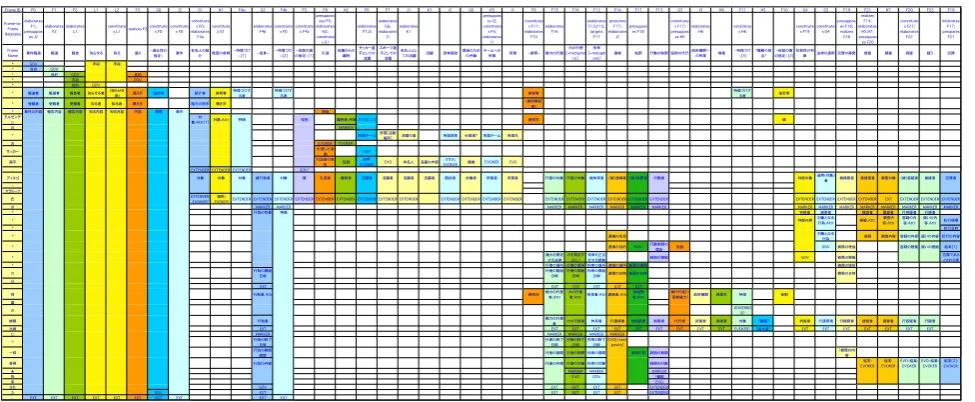
For illustration, a sample MSFA of (9), which is S-ID:
950107210-002of the KC, is given in Table 3.
(9)
(10) On January 6, Diego Maradona, a renowned former soccer
player of Argentina, was temporarily taken into custody by the local prosecutor’s office in his country.
As mentioned earlier, MSFA was inspired by the Frame
Semantics/BFN approach. Details of MSFA, however,
were specified independently of BFN, for reasons specified above. Their main differences are the following:
(11) a. BFN provides standardized frames in the form of
a database, whereas MSFA provides an annota-tion database using frames discovered in a run-ning text in an unselective way.
b. Frames identified using MSFA are more detailed and specific, having more effectiveness than BFN frames in terms of granularity.
This naturally has led to the difference in descriptive den-sity between two frameworks. On average, a sentence has 20+ frames attached to it in the MSFA, drastically more dense if compared to 2 or 3 frames per sentence in the BFN
annotation publicized at their Web site.8
Despite this, it should be noted that MSFA-based and BFN-based annotations are expected to be compatible, be-cause MSFA should give us a superset of BFN frames.
7Of course, the quality control of the annotation work is done
by a “committee,” managed independently using a Wiki site.
8But BFN is not (yet) a project of semantic annotation per se.
“figurative uses” of words including metaphor
and/or idioms.10e.g.,hShootingitargetsh
Refut-ingiin sentences like He shot down the
counter-arguments from his opponents.
Some of the relations, such as Presumption, Realization,
Transfer do not seem to be defined in BFN.11
2.3.3. Encoding “figurative” senses
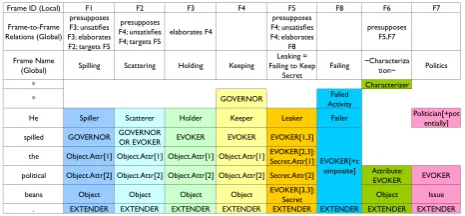
Real texts contain a lot of problematic cases in which words have “nonliteral” meanings, to which the BFN frame def-initions are not easily applicable. Representative, if not all, cases are metaphoric expressions and idiomatic ex-pressions. They pose a serious challenge to semantic an-notation/analysis, because, as mentioned above, success-ful analysis of a metaphorical expression requires clari-fication of “(conceptual) metaphorical mapping” (Lakoff and Johnson, 1999), and idioms have, for whatever rea-son, noncompositional, “superlexical” meanings encoded in a distributed fashion. BFN does not explicitly specify how to encode such effects. This is one of the major rea-sons we defined MSFA independently of BFN. Take He
spilled the political beans for example, where political
in-terrupts spill(ed) the beans. This is an example of discon-tinuous frame-evocation. The multilayered, redundancy-tolerant design allows us to analyze this idiom with the
Target/Transfer relation, as in Figure 5. hPROCECUTOR:
X itakehCRIMINAL: Yi into custody, appearing in (9)
in the passive form Y was (temporarily) taken into custody
and targetinghArrest(ing)i(=h i) (viahImprisoningi
(=h i) realizeshArrest(ing)i), is analyzed in this way.
Frame ID (Local) F1 F2 F3 F4 F5 F8 F6 F7 Frame-to-Frame
Relations (Global) presupposes F3; unsatifies F3; elaborates F2; targets F5
presupposes F4; unsatisfies F4; targets F5 elaborates F4
presupposes F4; unsatisfies F4; elaborates F8
presupposes F5,F7
Frame Name
(Global) Spilling Scattering Holding Keeping Leaking = Failing to Keep
Secret
Failing ~Characterization~ Politics
* Characterizer
* GOVERNOR ActivityFailed
He Spiller Scatterer Holder Keeper Leaker Failer Politician[+potentially] spilled GOVERNOR GOVERNOROR EVOKER EVOKER EVOKER EVOKER[1,3]
the Object.Attr[1] Object.Attr[1] Object.Attr[1] Object.Attr[1]EVOKER[2,3]:Secret.Attr[1]
political Object.Attr[2] Object.Attr[2] Object.Attr[2] Object.Attr[2] Secret.Attr[2] Attribute:EVOKER EVOKER beans Object Object Object Object EVOKER[3,3]:Secret Object Issue
. EXTENDER EXTENDER EXTENDER EXTENDER EXTENDER EXTENDER EXTENDER EXTENDER EVOKER[+c
omposite]
Figure 5: MSFA of He spilled the political beans.
3.
References
J. A. Asmuth and D. Gentner. 2005. Context sensitivity of rela-tional nouns. In Proceedings of the 27th Annual Meeting of the Cognitive Science Society, pages 163–168.
C. F. Baker, C. J. Fillmore, and J. B. Lowe. 1998. The Berke-ley FrameNet project. In COLING-ACL 98, Montreal, Canada, pages 86–90. Association for the Computational Linguistics. A. Burchardt, K. Erk, A. Frank, A. Kowalski, S. Pad´o, and
M. Pinkal. 2006. Consistency and coverage: Challenges
10We came to know that a similar solution was adopted in
SALSA framework (Burchardt et al., 2006).
11It’s not easy to establish correspondence between our
defini-tions and the ones given in BFN, because the proper semantics of certain frame-to-frame relations are unclear, need to be refined from the ontological perspective.
for exhaustive semantic annotation. Presented at Worshop on Corpus-based Approaches to Noncompositional Phenomena, DGfS-06 (Bielefeld), Feb 24, 2006.
M. Ellsworth, K. Erk, P. Kingsbury, and S. Pad´o. 2004. Prop-Bank, SALSA, and FrameNet: How design determines prod-uct. In Proc. of the LREC 2004 Workshop on Building Lexical Resources from Semantically Annotated Corpora, Lisbon. K. Erk, A. Kowalski, S. Pad´o, and M. Pinkal. 2003. Towards a
resource for lexical semantics: A large German corpus with extensive semantic annotation. In Proceedings of the ACL-03. C. Fillmore and B. T. S. Atkins. 1994. Starting where the
dic-tionaries stop: The challenge for computational lexicography. In B. T. S. Atkins and A. Zampoli, editors, Compuational Ap-proaches to the Lexicon, pages 349–393. Clarendon Press. C. Fillmore, C. Johnson, and M. Petruck. 2003. Background to
FrameNet. International J. of Lexicography, 16(3): 235–250. C. Fillmore. 1985. Frames and the semantics of understanding.
Quaderni di Semantica, 6(2):222–254.
D. Gentner and K. J. Kurtz. 2005. Relational categories. In W. K. Ahn, R. L. Goldstone, B. C. Love, A. B. Markman, and P. W. Wolff, editors, Categorization Inside and Outside the Labora-tory, pages 151–175. APA.
D. Gentner. 2005. The development of relational category knowl-edge. In L. Gershkoff-Stow and D. H. Rakison, editors, Build-ing Object Categories in Developmental Time, pages 245–275. Hillsdale, NJ: Lawrence Earlbaum.
C. Johnson and C. Fillmore. 2000. The FrameNet tagset for frame-semantic and syntactic coding of predicate-argument structure. In Proceedings of the 1st Meeting of the North Amer-ican Chapter of the Association for Computational Linguistics (ANLP-NAACL 2000), pages 56–62.
T. Kanamaru, M. Murata, K. Kuroda, and H. Isahara. 2005. Ob-taining Japanese lexical units for semantic frames from Berke-ley FrameNet using a bilingual corpus. In Proceedings of the
6thInternational Workshop on Linguistically Interpreted
Cor-pora (LINC-05), pages 11–20.
P. Kingsbury, M. Palmer, and M. Marcus. 2002. Adding semantic annotation to the Penn TreeBank. In Proceedings of the Human Language Technology Conference.
K. Kuroda and H. Isahara. 2005a. Towards a new classification of (word) concepts by distinguishing role names and object names. Technical Report of IEICE, 105 (204): 47–54.
K. Kuroda and H. Isahara. 2005b. Proposing the MUL
-TILAYERED SEMANTIC FRAME ANALYSIS OF TEXT. In The 3rd International Conference on Generative Ap-proaches to the Lexicon. [Revised version is available as:
http://clsl.hi.h.kyoto-u.ac.jp/˜kkuroda/ papers/msfa-gal05-rev1.pdf].
S. Kurohashi and M. Nagao. 2003. Building a Japanese parsed corpus: While improving the parsing system. In A. Abeill´e, editor, TreeBanks: Building and Using Parsed Corpora, pages 249–260. Kluwer Academic, Dordrecht/Boston/London. G. Lakoff and M. Johnson. 1999. The Philosophy in the Flesh.
Basic Books.
J. B. Lowe, C. F. Baker, and C. J. Fillmore. 1997. A frame-semantic approach to frame-semantic annotation. In Proceedings of the SIGLEX Workshop on Tagging Text with Lexical Semantics K. Nakamoto, K. Kuroda, and H. Nozawa. 2005. Proposing the feature rating task as a(nother) powerful method to explore sen-tence meanings. Japanese J. of Cognitive Psychology, 3 (1): 65–81. (written in Japanese).