Holy Moses! Leveraging Existing Tools and Resources for Entity Translation
Jean Tavernier
1, Rosa Cowan
1, Michelle Vanni
2 1CACI International Inc., 2US Army Research Laboratory 4831 Walden Lane, Lanham, MD 22207, USA E-mail: {jtavernier,rcowan}@caci.com, [email protected]
Abstract
Recently, there has been an emphasis on creating shared resources for natural language processing applications. This has resulted in the development of high-quality tools and data, which can then be leveraged by the research community as components for novel systems. In this paper, we reuse an open source machine translation framework to create an Arabic-to-English entity translation system. The system first translates known entity mentions using a standard phrase-based statistical machine translation framework, which is then reused to perform name transliteration on unknown mentions. In order to transliterate names more accurately, we introduce an algorithm to augment a names database with name origin and frequency information from existing data resources. Origin information is used to learn name origin classifiers and origin-specific transliteration models, while frequency information is used to select amongst n-best transliteration candidates. This work demonstrates the feasibility and benefit of adapting such data resources and shows how off-the-shelf tools and data resources can be repurposed to rapidly create a system outside their original domain.
1.
Introduction
The entity translation problem has received increasing attention recently. In early 2007, the U.S. National Institute of Standards and Technology (NIST) added an entity translation (ET) pilot evaluation to its Automatic Content Extraction (ACE) evaluations (NIST, 2007b), in order to evaluate systems for cross-language information extraction. By accurately translating entity mentions, a number of applications benefit, including machine translation (MT) and information retrieval (Hassan, Fahmy & Hassan, 2007).
Entity translation (ET) systems translate or transliterate source language entity mentions into a target language. Typically, this is done in situations where the source and target language do not share a common script. The ET problem is non-trivial for a number of reasons. First, new names are continuously being introduced (Al-Onaizan & Knight, 2002), making complete coverage by a MT system impossible. Second, there may be multiple ways of rendering a source language name into a target name, as is the case with the name إ, which can be represented as Ismail or Ismael in English. Likewise, the same target language name can be represented by multiple source language renderings, as is the case with Jean, which can be written ن or ن in Arabic.
Most approaches to ET have used a statistical translation model to generate name transliterations, but these either use a custom translation formalism (Al-Onaizan & Knight, 2002; Jiang et al, 2007) or they leverage tools which are not publicly available (Ji et al, 2007). To deal with insufficient transliteration accuracy, previous approaches have leveraged online resources to generate additional translation candidates. Al-Onaizan and Knight (2002) and Hassan et al (2007) did this by searching for comparable corpora and then attempting to discover an appropriate alignment with the source entity. (Jiang et al, 2007) attempts to discover content where both the source and target entity exist on the same page while (Huang 2005)
showed that classifying names by their likely origins and then generating the transliteration from an origin-specific model significantly improves transliteration accuracy. Our approach makes use of similar techniques, but leverages existing tools and resources. This allows us to build a simple but competitive system in a short amount of time. We use an open source MT tool to learn phrase-based statistical MT (SMT) models to translate known entity mentions. We then reuse the same tool to learn character transliteration models to translate unknown mentions. Rather than looking to the web for additional translation candidates, we select amongst n-best variants by using freely available name frequency resources.
The remainder of the paper details this system and describes its performance characteristics: In section 2, we briefly give an overview of the system, followed by a section detailing the resources and tools used to build it. Section 4 outlines the runtime system. We describe an evaluation of our system in Section 5, followed by a discussion of the results.
2.
Entity Translation System Overview
name transliteration is built, again using Moses. To provide more precise translations, origin information is used to build name-origin classifiers and origin-specific name transliteration models. Both the generic and origin-specific transliteration models produce multiple English translation variants for a given Arabic name, which are re-ranked using monolingual frequency information for English names.
3.
System components
This section describes the development of three primary components of our system: a phrase-based statistical machine translation model, a names database and name transliteration models.
3.1 Statistical Machine Translation
We trained a phrase-based SMT engine to translate known words and phrases using the training tools available with Moses (Koehn et al, 2007). Moses is trained using sentence aligned parallel text. One of the first steps in the training process is an alignment of words and phrases in parallel text, performed by GIZA++ (Och & Ney, 2003). The output of the training phase results in a four-part model, including a phrase translation table, an English language model, a reordering model to constrain distortion, and a word penalty to control the length of the translation.
3.2 Building a Names Database
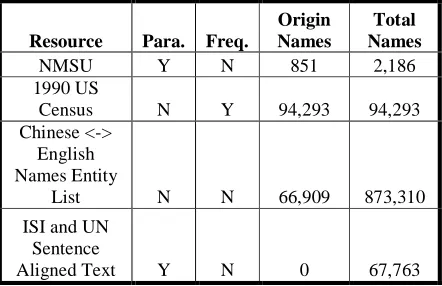
The names database is used at training time and run time. At training time, it's used to provide training data for name transliteration training and at run time, it's used to compare an “n-best” list of name transliterations and select the most likely candidate. Because of this dual role, both bilingual and monolingual data resources are added to the names database. Table 1 provides a partial listing of data resources used to build the names database, where “Para.” indicates that the resource has parallel Arabic-English entries, “Freq.” means the resource contains frequency information and “Origin Names” gives a count of names with implicit or explicit origin labels for the names. Entries from the ISI and UN resources are added by performing named entity extraction using BBN Identifinder, a commercial NEE
Resource Para. Freq.
Origin Names
Total Names
NMSU Y N 851 2,186
1990 US
Census N Y 94,293 94,293 Chinese <->
English Names Entity
List N N 66,909 873,310
ISI and UN Sentence
Aligned Text Y N 0 67,763
Table 1 - Summary of names database data resources.
tool. This tool extracts named entities from the UN and ISI corpora, then entities are aligned using a custom alignment procedure.
For cases in which a name entry consists of multiple parts, GIZA++ is used to intra-align name parts. This alignment is carried out on the name parts stemmed to six characters, in order to reduce data sparseness. Following alignment, database entries are created for each of the aligned name parts with each of the new entries inheriting the origin information of the parent entry. For example, if the following names were collected from bilingual and monolingual sources:
Arabic English Origin و ن John Ugabe Kenya نو ن John Weatherington UK
Jaoxping John Lin China
The following entries would be created in the database: Arabic English Origin
ن John Kenya,UK,China
و Ugabe Kenya
نو Weatherington UK
Following the intra-name alignment process, database entries with identical English and Arabic name parts are de-duplicated, retaining origin and identity information from the de-duplicated entries. Entries with identical Arabic strings but different English forms are retained, since they reflect the fact that there may be multiple ways of representing a single Arabic form in English. Likewise, entries with identical English string but different Arabic forms are retained.
The development of multiple origin-specific name transliteration models requires additional steps. First, data sources of name origin information must be identified. Sources of name origin information need not be Arabic-English bilingual; as long as the resource provides explicit or implicit origin information, and either Arabic or English name renderings, the source can provide origin information. Table 1 provides a listing of sources used that contain name origin information. Note that the 1990 US Census Corpus is monolingual and the Chinese <-> English Name Entity Lists v 1.0 database does not contain Arabic name renderings, but we can re-use the origin information by matching on the English names available in both sets of resources. Names from the former are given a default label of 'USA'. Roughly 65K names in the Chinese-English resource contain explicit labels; in addition to those, names in the “Chinese Who's Who” list are given a default label of 'China'. A labeling algorithm applies the labels from the annotated monolingual names by exact string match of name parts; that is, if a name part from the origin-annotated monolingual name list matches a name part in the bilingual corpus, the origin labels from the monolingual name are applied to the entire bilingual name entry.
(NIST, 2007a).
6.
Results
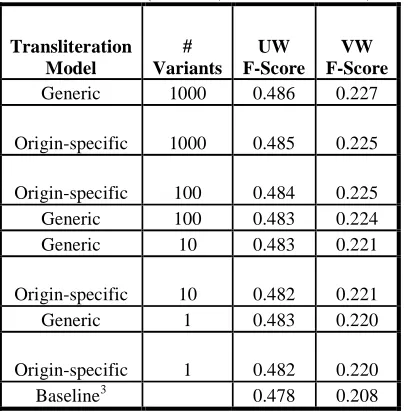
Table 2 shows unweighted (UW) and value-based (VB) F-scores for a number of system variants. Note that all of the system variants that incorporate name transliteration improve on the baseline, verifying our first hypothesis. The improvement over the baseline is statistically significant (p-value is 0.0158 for the two top performing systems), which was determined using Fisher's randomization test (Smucker, Allan & Carterette, 2007).
Transliteration Model
# Variants
UW F-Score
VW F-Score Generic 1000 0.486 0.227
Origin-specific 1000 0.485 0.225
Origin-specific 100 0.484 0.225 Generic 100 0.483 0.224 Generic 10 0.483 0.221
Origin-specific 10 0.482 0.221 Generic 1 0.483 0.220
Origin-specific 1 0.482 0.220 Baseline3 0.478 0.208 Table 2 - System variants evaluated with NIST ACE
ET Diagnostic test data, sorted by Value-weighted
F-Score
Our second hypothesis, that utilizing origin information improves name translation, cannot be verified. While origin-specific model performance is comparable to the generic model, and slightly better in the n=100 case, they do not generally outperform the generic name transliteration models. The reason may be that the origin-specific character models are smaller than the generic model and do not produce as diverse a set of name variants (in particular, when n is large). Another possible cause is that the smaller size of the origin-specific models means that their performance can be disproportionately influenced by noise introduced during names database construction.
Note that in all cases, increasing the number of candidate variants (and letting the frequency information select amongst them) improves results, verifying our third hypothesis. An order of magnitude increase in the number of generated variants seems to result in a linear accuracy improvement, suggesting there is a logarithmic relationship between the number of variants and accuracy. However, because of the limited nature of our frequency information (a list of personal names occurring in the United States), we would expect accuracy improvements
3 The Baseline system uses phrase-based SMT without generic or origin-specific name transliteration.
Entity Type Baseline
Origins (n=1000)
Generic (n=1000) Facility 12 13.4 14.1
GPE 41.6 42.8 42.7 Location 14.1 14.1 13.9 Organization 13.3 15.6 15.4 Person 13.1 15.1 15.6 Vehicle 6.7 9.4 9.4 Weapon 10.8 11.8 11.7
Total 20.8 22.5 22.7
Table 3 - Value-weighted scores for the two best
performing systems, and the baseline system, by entity
type (with best scores in bold)
to stop as more-and-more unlikely variants are generated, some of which may be popular but incorrect.
We also wanted to investigate the efficacy of utilizing transliteration models trained only on person names to correctly translate other types of entities. Table 3 shows the entity type specific performance (using the value-weighted metric) of the two best performing systems, versus the baseline system. Both origin-specific and generic transliteration models improve translation accuracy 10% or more for Facility, Organization, Person and Vehicle entity types, demonstrating that transliteration models built from personal name translations generalize well to other entity types. The effect for GPE, Location and Weapon types either does not exist or is dampened. One likely reason for this is that the primary data source for our MT system (United Nations documents) mentions these types of entities frequently, making it difficult for the transliteration models to improve upon the baseline accuracy. In addition, the nature of the GPE (e.g., nation names) and Location (e.g., mountain names) types is such that new names are introduced less frequently than other types, making a sufficiently trained MT system suitable for name translation.
7.
Conclusion
This paper demonstrates how open source tools and available data resources can be repurposed to rapidly produce an ET system. We utilized GIZA++, an open-source alignment tool, to construct a names database from various existing name resources and Moses, an open-source SMT framework, to train both phrase-based SMT and name transliteration models. The resulting ET system demonstrated its utility by significantly improving name translation accuracy over the baseline SMT system. In addition, we showed how a names database containing frequency information from freely available monolingual resources aids in discriminating amongst n-best variants.
8.
Acknowledgements
Thanks to Dr. Kristen Summers for reviewing this paper and for contributing to earlier drafts of this paper, and to Leila Saidi for reviewing and correcting name database entries used in this work. Thanks also to the anonymous reviewers for their helpful suggestions.
Army contract #DAAD19-03-C-0059. The opinions, interpretations, conclusions and recommendations are those of the authors and are not necessarily endorsed by the U.S.G.
9.
References
Al-Onaizan, Y., Knight K. (2002). Translating Named Entities Using Monolingual and Bilingual Resources. In Proceedings of the 40th Annual Meeting of the
Association for Computational Linguistics. Morristown,
NJ: Association for Computational Linguistics, pp. 400--408.
Hassan, A., Fahmy H., Hassan, H. (2007). Improving Named Entity Translation by Exploiting Comparable and Parallel Corpora. In Proceedings of the 2007
Workshop on Acquisition and Management of Multilingual Lexicons. Borovetz, Bulgaria: pp. 2--7.
Huang, F. (2005). Cluster-Specific Named Entity Transliteration. In Proceedings of the Conference on
Human Language Technology and Empirical Methods in Natural Language Processing. Morristown, NJ:
Association for Computational Linguistics, pp. 435--442.
Ji, H., Blume M., Freitag, D., Grishman, R., Khadivi, S., Zens, R. (2007). NYU-Fair Isaac-RWTH Chinese to English Entity Translation 07 System. In Proceedings
of ACE ET 2007 PI/Evaluation Workshop. Washington,
USA.
Jiang, L., Zhou, M., Chien, L., Niu, C. (2007). Named Entity Translation with Web Mining and Transliteration. In Proceedings of the Twentieth International Joint
Conference on Artificial Intelligence. Menlo Park, CA:
International Joint Conferences on Artificial Intelligence and AAAI Press, pp. 1629--1634.
Koehn, P., Hoang H., Birch, A., Callison-Burch, C., Federico, M., Bertoldi, N., Cowan, B., Shen, W., Moran, C., Zens, R., Dyer, C., Bojar, O., Constantin, A., Herbst, E. (2007). Moses: Open Source Toolkit for Statistical Machine Translation. In Proceedings of the 45th
Annual Meeting of the Association for Computational Linguistics Companion Volume Proceedings of the Demo and Poster Sessions. Morristown, NJ:
Association for Computational Linguistics, pp. 177--180.
NIST (2007). The ACE 2007 Evaluation Plan. http://www.nist.gov/speech/tests/ace/ace07/doc/ace07-evalplan.v1.3a.pdf.
NIST (2007). The Evaluation Plan for the ACE 2007 Pilot Evaluation of Entity Translation. http://www.nist.gov/speech/tests/ace/ace07/doc/ET07-evalplan-v1.8.pdf.
Och, F. J., Ney, H. (2003). A Systematic Comparison of Various Statistical Alignment Models. Computational
Linguistics, 29(1), pp. 19--51.
Och, F.J. (2003), Minimum Error Rate Training in Statistical Machine Translation. In Proceedings of the
41st Annual Meeting of the Association for
Computational Linguistics, Morristown, NJ:
Association for Computational Linguistics, pp. 160--167.
Smucker, M.D., Allan, J., Carterette, B. (2007). A comparison of statistical significance tests for information retrieval evaluation. In Proceedings of the
Sixteenth ACM Conference on Conference on
information and Knowledge Management. New York,
NY: ACM Press, pp. 623--632.
Stolcke, A. (2002). SRILM -- an extensible language modeling toolkit. In Proceedings of the International
Conference on Spoken Language Processing. Denver,